How Good a Judge Are You?

How Good a Judge Are You?

Ram was at home one day when he heard activity outside and realised that new neighbours were moving in.

A family had arrived with a moving truck: a middle-aged couple and their two teenage children. They seemed cheerful, friendly and easy-going. Ram stepped outside, exchanged greetings with them and watched them carry boxes into the house.

A little later, the new neighbour came over and introduced himself as Gaurav. He said that the family had just moved from another city, and that once they had settled in properly, he would come over again so that the two of them could sit together and chat over a cup of tea.

The first impression could hardly have been better. Ram went back inside thinking he had been fortunate to get such warm, decent and friendly neighbours.

The next day, Ram went to a nearby hair salon. As usually happens in such places, he and the hairstylist began chatting about local matters, and Ram mentioned that a new family had moved into the house next to his.

Ram talking with the hairstylist after mentioning his new neighbour Gaurav.

‘They seem like really nice people,’ he said. ‘Very friendly.’

The hairstylist asked who they were, and Ram gave him the name.

The hairstylist suddenly looked interested. ‘Do you mean the tall fellow with the beard and moustache? A little plump, not much hair on his head?’

‘Yes.’

‘And he said he came from another city?’

‘Yes.’

‘Two teenage children?’

‘Yes.’

The hairstylist lowered his voice. ‘Do you know who that man is? In the city he came from, he is known as a con man. He has cheated a lot of people.’

That was the whole of it. No evidence, no document, no police report, no second source. Just a short conversation in a hair salon.

Yet something had already happened. Gaurav had changed, not in reality, but in Ram’s mind.

When Ram got home later, he saw Gaurav outside near his car. Gaurav smiled and greeted him, and Ram barely responded. The friendliness of the previous day had given way to suspicion. The man he had thought pleasant and trustworthy now looked dangerous and dishonest.

A few days later, the truth emerged. The hairstylist had confused Gaurav with somebody else. Gaurav was not the person he had been talking about at all.

Now Ram felt terrible. He was ashamed of having treated an innocent man coldly and wondered how he could possibly explain his behaviour.

But the most important part of this story is not the hairstylist’s mistake. It is what happened inside the listener.

Nothing about Gaurav had changed. His face, his voice, his family and his conduct were exactly as they had been the day before. Only one new piece of information had entered Ram’s mind, and that single piece of information completely altered his judgement of the man.

This is how easily our minds work. We perceive something, we interpret it, and we form a conclusion. Our judgement depends first on what reaches us through the senses, but what often affects us most strongly is what we hear from another person. Someone tells us something about somebody, and from that moment we no longer see that person in the same way. The troubling part is that we rarely stop to ask whether the information is accurate, complete, relevant or even about the right person.

Emotion then enters the picture. Fear, anger, loyalty, resentment, sympathy, suspicion or excitement can cloud the intellect. Once emotion takes control, judgement becomes far less reliable, and decisions made in that state may later become a source of regret.

This is why I have started a new interactive Tavamithram series called What’s Your Verdict?

You will be given a situation and asked to judge it based on the information available to you at that moment. Then more information will appear. You may discover that something important was missing, or that your first judgement still stands, or that the new details change everything. Then you will be asked again: do you stand by your verdict, or would you change it?

The purpose is not to trick you. It is to let you observe something that normally happens too quickly for us to notice: the formation of judgement itself. How quickly do you reach a conclusion? What information do you trust? What assumptions do you make? How much does emotion influence your decision, and how willing are you to revise your view when new facts appear?

And perhaps the most important question of all: how often in real life have we judged a person without knowing the whole story?

The first case opens on 22 September 2026 at 02:00 GMT.

Read carefully. Decide honestly. Then wait for the rest of the story.

Practical Bhagavad Gita for Modern Life

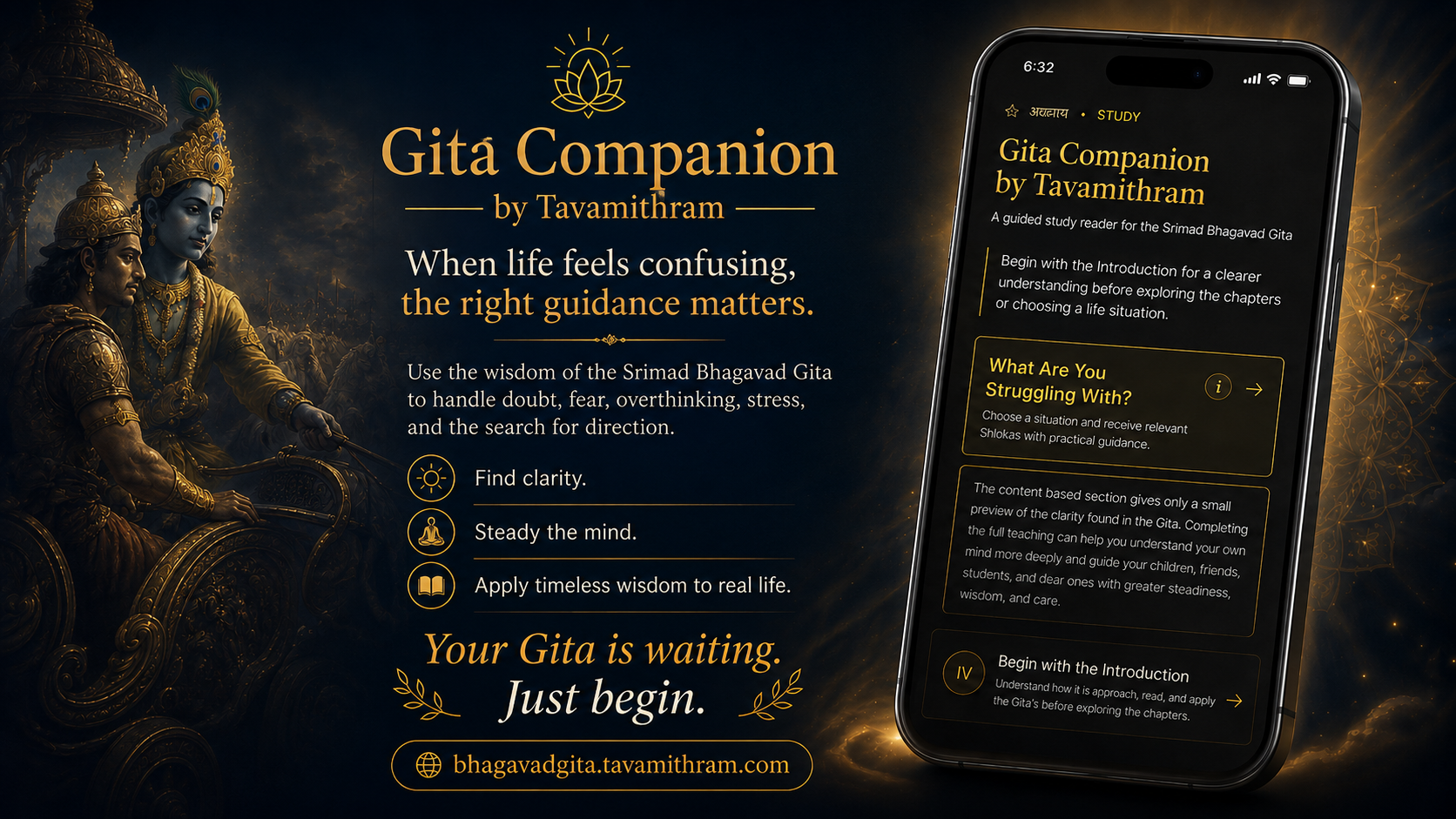
Bhagavad Gita Companion: Ancient Wisdom for the Problems You Face Today. Learn to apply the knowledge of the Gita to Real Life.


Bhagavad Gita Companion by Tavamithram web app

When you are facing a serious problem, whom would you rather speak to? Someone as confused, stressed and disturbed as you are, or someone with a calmer mind who can look at your situation from a little distance, see what you may not be seeing, and help you think it through rationally?

Every one of us meets situations in which the mind becomes disturbed. There are choices to make, relationships to handle, losses to accept, fears to overcome, anger to control, and moments when we simply do not know what to do. This is ordinary and human.

The Srimad Bhagavad Gita can itself be read as an externalisation of that inner turmoil. Arjuna’s crisis becomes the setting in which questions about action, judgement, responsibility, fear, attachment and life itself are examined.

The One-of-a-kind Bhagavad Gita Companion by Tavamithram puts that examination within immediate reach.

Rather than expecting you to know in advance which chapter or shloka to look for, it lets you begin with what you are actually facing: anger, fear, relationships, confusion, loss and grief, attachment, uncertainty, difficult decisions, inner conflict, and other concerns that arise in life. Seventeen of them are covered, each taking you through the problem, the principles involved, and the teachings of the Srimad Bhagavad Gita that bear on it.

The purpose is not to hand you another quotation. It is to help you think clearly at the moment your thinking is under most pressure.

Distress often makes people confide in whoever is nearby, and they later regret what they revealed. The Gita Companion by Tavamithram offers a private space instead: somewhere to examine the situation, understand yourself better, and gradually absorb what is needed to think for yourself. A firm grasp of the Srimad Bhagavad Gita enables a person to be guided by their own intellect rather than led about by uncontrolled senses, emotions and impulses, or left permanently dependent on the counsel of others.

Many years of study, analysis and painstaking work lie behind this web app, all of it directed at one purpose: making the philosophy of the Srimad Bhagavad Gita understandable, accessible and applicable to daily life.

The concern-based section is only one part of it. The Companion also carries all 18 chapters and 701 shlokas in the original Sanskrit, with romanisation, English translation and audio recitation.

You do not need to wait until you are old before you ‘study’ the Srimad Bhagavad Gita and someday learn to use it. Use it while you are living your life, when you are confused, when emotions are interfering with your judgement, when a difficult decision is in front of you, and when life tests you.

As the knowledge becomes internalised, you increasingly learn to recognise the relevant principles yourself when situations arise. The Gita Companion by Tavamithram thus helps you develop the clarity and intellectual independence to rely less on others for counsel and increasingly on your own informed and disciplined intellect.

You should not merely own a copy of the Srimad Bhagavad Gita. You should carry its knowledge with you.

Your Gita is waiting.
Just begin.

Self-Enquiry in Advaita Vedanta: What Remains?

Sometimes you identify with your body and say, โ€˜I look good,โ€™ โ€˜I am fat,โ€™ โ€˜I am getting old,โ€™ โ€˜I am sick.โ€™ Other times, you identify with your mind and say, โ€˜I am excited,โ€™ โ€˜I am depressed,โ€™ โ€˜I am angry.โ€™ When life is going well, you say you have a great life, and when you feel low, you say your life is terrible.

Your body changes. Your mind changes. Your story changes.

What are you, then, when everything you call yourself keeps changing?

Give me less than ten minutes.


1: You Are Not the Body

The body is known.

You see it and feel it; you watch it change. It was small once. It is different now. One day it will be frail and unrecognisable. It has never stopped changing since the moment it appeared.

Now, here is the question: can the known be the knower? Obviously not.

You have a body. But you are not the body.


2: You Are Not the Mind

Thoughts appear and disappear. Anger arrives and leaves. Fear comes and goes. Even the silence between thoughts comes and goes.

So, if everything in the mind is passing through, what are you? You are the one in whom all of it is happening. The knower of the mind cannot be the mind. You are not the thought. You are not the thinker. You are what remains when the noise stops.


3: You Are Not Your Story

Your name was given to you by others. Your past is memory. Your identity is a collection of recorded experiences that the mind calls โ€œmine.โ€

Stop at that word. Mine.

You say โ€œmy childhood,โ€ โ€œmy pain,โ€ โ€œmy reputation,โ€ โ€œmy achievement,โ€ and even โ€œmy lifeโ€! If it is โ€œmy,โ€ it is not the final โ€œI.โ€ The story is known. You are not the story.


4: What Remains?

When the body is set aside as known, when the mind is set aside as known, when the story is set aside as known, what is left?

Awareness. Not a theory, not a religious claim, not something you need to practise into existence. It is the simple, undeniable fact of knowing. Before thought, it is there. During thought, it is there. After thought fades, it is still there.

You do not create it. You have simply been overlooking it.

That is what you are.


5: Why Suffering Begins

Now look at this carefully.

The body changes, and fear begins. The mind changes, and confusion begins. Peopleโ€™s opinions shift, and insecurity begins. Circumstances move, and anxiety begins.

Why? Because you placed yourself inside what was changing. You took the known to be the knower. You took the passing story to be the real โ€œI.โ€

That single error is the entire root of human suffering. Not sin. Not karma. Not fate. One misidentification. That is bondage.


6: Do Not Turn This Into Another Idea

At this point, the mind may try to grab the teaching and convert it into a new identity.

โ€œI am awareness.โ€ โ€œI know Vedanta.โ€ โ€œI understand Brahman.โ€ โ€œI am beyond the body and mind.โ€

Careful.

That may only be the ego wearing new clothes.

Vedanta is not a sentence to repeat. It is not a badge. It is not a spiritual status.

The question is not whether you can say โ€œI am awareness.โ€ The question is whether you still collapse when the body is criticised, the mind is disturbed, the story is threatened, or your image is insulted.

That is where the enquiry becomes real.


7: What Vedanta Actually Does

Vedanta does not hand you a new belief to replace the old one.

It removes error.

You already are the awareness because of which the body, the mind, the thought, the memory, and the entire world are known. Vedanta does not manufacture this truth. It exposes the confusion that has been covering it.

It does not say, โ€œBecome something else.โ€ It says, โ€œSee clearly what you have been mistaking yourself for.โ€ Nothing is added. Everything false is removed.


8: What Brahman Actually Means

Brahman is not a bearded โ€˜godโ€™ above the clouds. Not a cosmic authority watching from a throne.

Brahman is the reality because of which anything is known at all. The body appears in it. The mind moves in it. The world arises in it. Even this moment of reading or listening is happening because of it.

Not an object to be reached. Not a reward to be earned. It is the ground that is already here, making all experience possible.


9: What Liberation Actually Means

Liberation is not escape to another world. It is not joining an ashram, acquiring a title, or becoming someone others regard as spiritually elevated.

Liberation is the collapse of the central error.

The body continues to act. The mind continues to think. Life continues with all its weight and texture. But the root mistake is gone: the belief that โ€œI am this body-mind storyโ€ is gone.

Once that error is genuinely seen, and not merely understood as an interesting idea, life stops being driven by fear, vanity, and borrowed identity.


10: Final Strike

Do not believe me.

See it.

Everything you have ever called โ€œIโ€ has been known. The body, known. The mind, known. The story, known. The fear, the desire, and the confusion, all known.

You are the knower. You have never been the known.

That is Vedanta.


No costume. No institution. No borrowed holiness. No performance.

If the false โ€œIโ€ survives this enquiry untouched, nothing has happened. Sorry. But if the false โ€œIโ€ collapses, Vedanta has done its work.

Costume cannot replace clarity. Institution cannot replace enquiry. And no teacher has done the job if the false โ€œIโ€ walks out intact.

The special clothes were never the point. The real โ€œIโ€ was always the point.

The โ€˜Iโ€™ you have been protecting all your life was never you.

What you truly are has never been born, has never suffered, and has never needed saving.

READ THIS ARTICLE ON SUBSTACK

Continue the enquiry into the โ€œIโ€

If this question has become real for you, continue with Modern Rishi. It is built around the same enquiry into identity, the mind, the Self, conditioning, ego, responsibility and living with clarity.

Do This AT LEAST ONCE in Your Lifetime – Only 3 Hours!

No Mantras, No Prayers, No Fasting – Just 3 Hours to Smash Illusion and Gain the Supreme Truth!

I am not saying this. KRISHNA SAYS IT IN THE SRIMAD BHAGAVAD GITA.

All worries, fears, stress, anger, envy, and every negative force that can block, weaken, or destroy your chance of living a truly beautiful and fulfilling life will be crushed to smithereens and pulverised to dust.

With soothing sound, captivating visuals, and clear English text to follow along.

Please let me be honest, my dear brothers and sisters, I find it utterly saddening that so many people have been convinced that the Srimad Bhagavad Gita is โ€œtoo difficult to comprehendโ€ and that without a โ€œgood guruโ€ they can never learn it.

In Shloka SBG 9:02, Bhagavan Krishna clearly says that this knowledge is not only VERY EASY, but also it is also VERY EASY TO PRACTISE and it is EVERLASTING. All it takes is the small effort of sitting down and reading a simple translation of the 700 Shlokas. In fact, I must have read this supreme scripture over a thousand times, and I never tire of it. The same applies to every genuine seeker. You cannot read it once and expect to fully grasp it. But at the very least, read it, listen to it, or go through it ONCE BEFORE YOU DIE!

As part of my SBG for ALL Mission, here is my humble offering: a three-hour guided study of this life-changing scripture, a true gift to humanity.

Experience this once, and the weight of your illusions will collapse into nothing.

Please, take this opportunity. Whatever you think it is worth, COMPLETE IT. Do it at least for your brotherโ€™s sake. You can thank me later ๐Ÿ™‚

JAI SHRI KRISHNA.

LOOK UP, AND WAKE UP

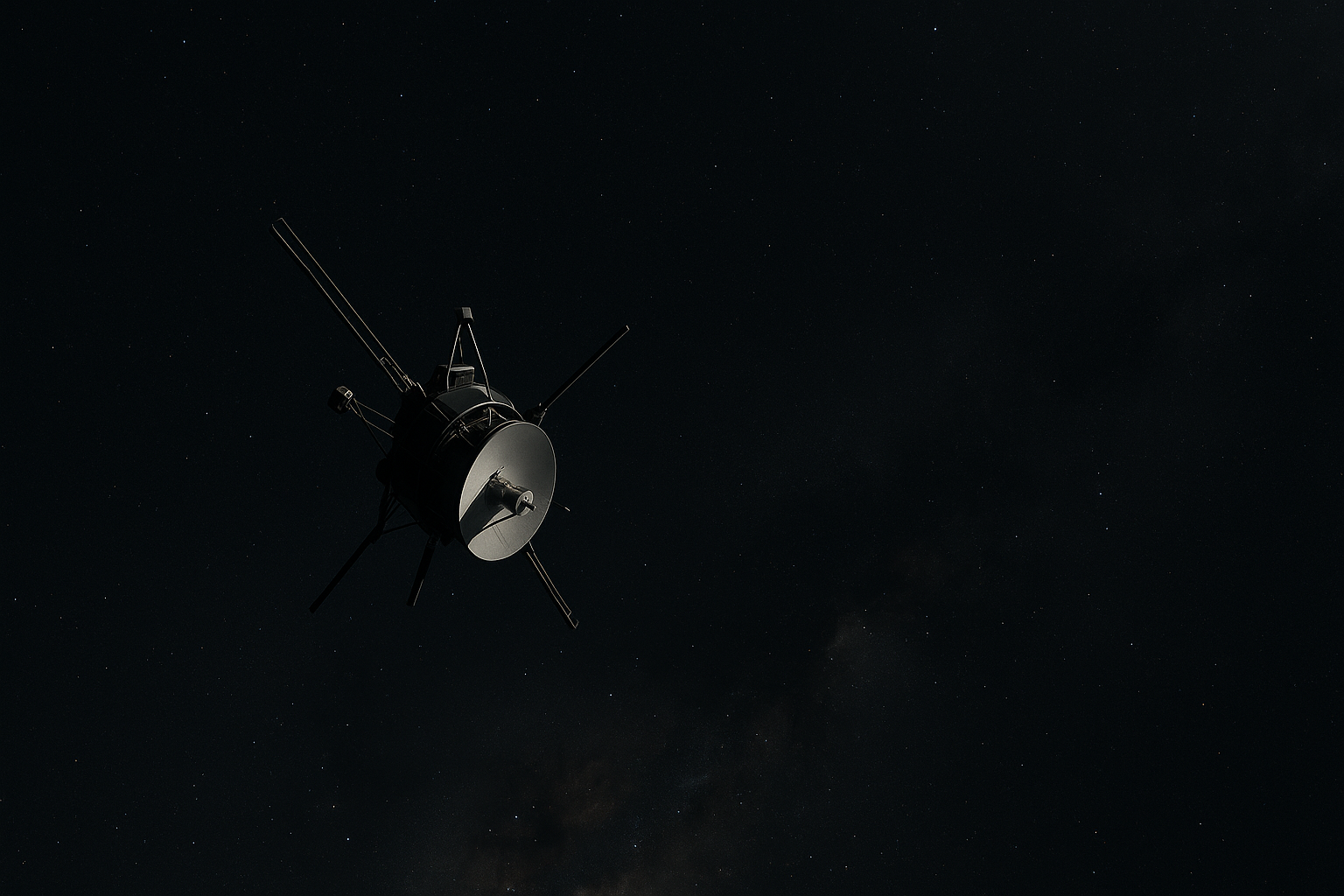
Voyager 1 has been flying non-stop for nearly 48 years since 1977. It has already travelled over 24 billion kilometres and is still not even one light-day away from Earth.
Let that sink in. Just one day of light-speed travel, and we havenโ€™t reached it yet.

And here we areโ€ฆ
On this tiny, fragile speck called Earth, floating in infinite space,
Wasting our precious moment of life with ego, pride, inferiority, religious superiority, hatred, and greed.

All our religious places, ideologies, nations, and flags – they vanish into nothingness when seen from just a few kilometres above Earth, let alone from Voyagerโ€™s view.

The spacecraft carries a golden record of music and greetings from humanity, in case it ever meets another intelligent being.
Imagine if it did. What would we say we stood for?

Itโ€™s time we grow up, let go of imaginary divisions, ridiculous beliefs, and cults, and embrace the sheer miracle of being alive at all. Because in the grand movie of the universe, we’re not even a pixel on the screen.

Stuck? Escape Regret. Get the Life You Deserve

Break Free from Emotional Baggage with This Transformative Two-Word Mantra

Are you tired of being stuck in repetitive emotional patterns, haunted by your past, and overwhelmed by regret? This powerful new video dives into a life-changing concept that blends spiritual clarity, emotional resilience, and mental discipline through the use of two deceptively simple yet profound mantras: โ€œSo what?โ€ and โ€œWhat next?โ€.

Rooted in Vedanta, and enriched by a personal journey of spiritual transformation, this message is a wake-up call for those ready to reclaim their power. Whether you’re on the path of self-inquiry, seeking personal development, or aiming to cultivate a growth mindset, this video offers direct and practical tools to help you move forward.

Let go of self-pity, stop dwelling on the past, and embrace conscious living. The time to transform your inner world is now.

Timeless Vedanta – Don’t Believe. KNOW!

Introducing โ€œTimeless Vedantaโ€ – A Channel Dedicated to Non-Dual Wisdom

The Timeless Vedanta Channel on YouTube

Dear Readers,

“It brings me immense joy to announce the launch of my new YouTube channel, Timeless Vedanta – a space dedicated solely to sharing the pure essence of Advaita Vedanta in a clear, rational, and practical manner.

“In today’s world, which is saturated with noise, confusion, and often superficial spirituality, there is a deep hunger among thoughtful seekers – especially young minds – for clarity and truth. Timeless Vedanta is a space to gain such understanding

“This channel is not about religion, dogma, or blind belief. It is about direct exploration, deep inquiry, and the timeless truth of non-duality – the understanding that your innermost Self is not separate from the reality that pervades all existence.

What You Can Expect:

  • Thought-provoking explorations of the Srimad Bhagavad Gita, Upanishads, and Brahma Sutras
  • Connections between Vedantic thought and Western philosophies, including Spinozism and Stoicism
  • Simple, logical explanations of profound topics such as consciousness, existence, and the nature of reality
  • A firm rejection of superstition, ritualism, and unnecessary complexity
  • Content that encourages critical thinking, self-reflection, and most importantly, direct understanding

Why โ€œTimeless Vedantaโ€?

Because truth does not age. It is not bound by culture, belief, or time. The teachings of Vedanta, when stripped of layers of tradition and theological interpretation, reveal a science of consciousness that is as relevant today as it was thousands of years ago.

This channel is open to people of all cultural and religious backgrounds who have an open mind and a sincere desire to seek clarity.

This channel is an invitation to rediscover that wisdom, to see clearly, and to live freely.


๐Ÿ“Œ Subscribe to Timeless Vedanta today
๐Ÿ”” Turn on notifications so you never miss an update
๐Ÿ’ฌ Join the conversation, share your thoughts, and grow with a community of sincere seekers

Born by Chance, Fooled by Belief

READ AND WATCH THE VIDEO ON SUBSTACK.

JOIN MY SUBSTACK – IT IS FREE.

Unravelling the Illusion of Fate in a Stochastic Universe

Many people believe thereโ€™s a โ€˜grand planโ€™ behind everythingโ€”a higher power or force shaping events through fate, destiny, or divine will. This belief often leads us to surrender a significant portion of our mental capacity and autonomy to things we cannot fully prove: unseen beings, sacred books, religious intermediaries, and abstract concepts. But what if this comforting story is merely a creation we’ve been telling ourselves for centuries? Even more troubling is that such beliefs breed a sense of entitlement, creating divisions among individuals, fostering inequality, envy, jealousy, and belligerenceโ€”forces that ultimately damage lives, relationships, and our natural world.

In this short presentation, I confront the illusion of fate head-on. Let us examine the stochastic nature of existenceโ€”not through superstition or sentiment, but through reason, science, and Vedanta. From the genetic lottery you were born into, to the subtle conditioning shaped by environment and epigenetics, youโ€™ll see how much of your life has just happened. No blueprint. No cosmic purpose. No invisible puppeteer.

Let us question why religions and mythologies have always tried to impose order upon chaos, and why fatalism is just another form of resignation. I present Karma not as divine justice, but simply as cause and effect. Actions and consequences, not punishments and rewards.

And yet, this isnโ€™t a descent into nihilism. Far from it.

To embrace randomness is to reject the passive comfort of fate and to step into clarity. Life doesnโ€™t need a script to have meaning. Meaning arises not from predestination, but from conscious living in an unpredictable world.

This presentation is for the quietly curious, the disillusioned believer, the sceptic, the philosopherโ€”and anyone ready to ask: What if chance isnโ€™t your enemy, but your liberation?

Haven’t you completed the Srimad Bhagavad Gita yet? Here is your solution:

The Complete Srimad Bhagavad Gita – Explained Simply | No Confusion, Only Clarity!

Nirvana Shatakam: The Bold Truth That Shatters Every Illusion You Hold Dear

“When you KNOW, you don’t need to BELIEVE.” – Tavamithram Sarvada

What if everything you believe about yourself, your identity, your desires, and your fears is nothing but an illusion? What if the very essence of who you are lies beyond the mind, the ego, and even the concept of “I”?

Enter the Nirvana Shatakam, a profound composition by the 8-year-old spiritual prodigy, Adi Shankaracharya. In just six Shlokas, this masterpiece dismantles every label, every belief, and every ritual youโ€™ve ever clung to. It doesnโ€™t just challenge your worldview; it obliterates it.

Imagine a young boy wandering the Himalayas, confronted by a sage who asks, “Who are you?” His response? A declaration so radical, so fearless, that it strips away every falsehood and points directly to the ultimate truth: “I am Shiva. I am pure consciousness.”

This isnโ€™t just philosophy. This isnโ€™t just spirituality. This is a call to awaken – to see beyond the illusions of identity, religion, and dogma. Itโ€™s a challenge to let go of everything you think you know and embrace the infinite truth of your being.

Are you ready to question everything? Are you ready to discover who you truly are? Watch the video now and let the Nirvana Shatakam guide you to the ultimate liberation.

Main Tavamithram Channel

Timeless Vedanta Channel

Continue the enquiry

If the question โ€œWho am I?โ€ has become more than an intellectual curiosity, continue with Modern Rishi. It is a space for deeper enquiry into identity, the mind, Self-knowledge, Vedanta, discipline and living with clarity in the world.

Men in Crisis: The Hidden Struggles No One Talks About

READ ON SUBSTACK

India is witnessing an alarming rise in suicides among young men, many of whom feel trapped in toxic relationships, crushed by societal pressures, and ignored by the legal system. They suffer in silence, battling emotional turmoil with no real support. But what if they knew that strength is a choice, and weakness is not a compulsion?

In this video, we will look at the real reason behind emotional sufferingโ€”how unchecked emotions shroud intelligence, making it impossible to perceive situations clearly. We will see why men must reclaim their inner strength, break free from despair, and learn to master their minds instead of succumbing to hopelessness.

The primary cause of mental suffering was the inability to perceive situations with detachment, instead of viewing them through the distorting lens of emotion. This emotional entanglement prevented individuals from coming to terms with reality, trapping them in cycles of distress and confusion. When emotions took control, they completely obscured intelligence, making rational thought and objective decision-making nearly impossible.

What Youโ€™ll Learn in This Video:
-Why young men are struggling and whatโ€™s fueling the crisis
-How toxic relationships and emotional weakness lead to mental destruction
-The powerful wisdom from the Srimad Bhagavad Gita that can save lives
-Real-life examples of resilience that prove strength is a choice, not an accident

If you are a young man feeling lost, disrespected, or emotionally brokenโ€”this message is for you. If you know someone who is suffering, share this with them. There is a way forward, and it starts with mastering your emotions and taking control of your life.

๐Ÿ’ช Watch Now & Take the First Step Towards Strength! ๐Ÿ’ช

DON’T DELAY. LISTEN TO THIS TODAY!

The Complete Srimad Bhagavad Gita – Explained Simply | No Confusion, Only Clarity!