Practical Bhagavad Gita for Modern Life

Bhagavad Gita Companion: Ancient Wisdom for the Problems You Face Today. Learn to apply the knowledge of the Gita to Real Life.


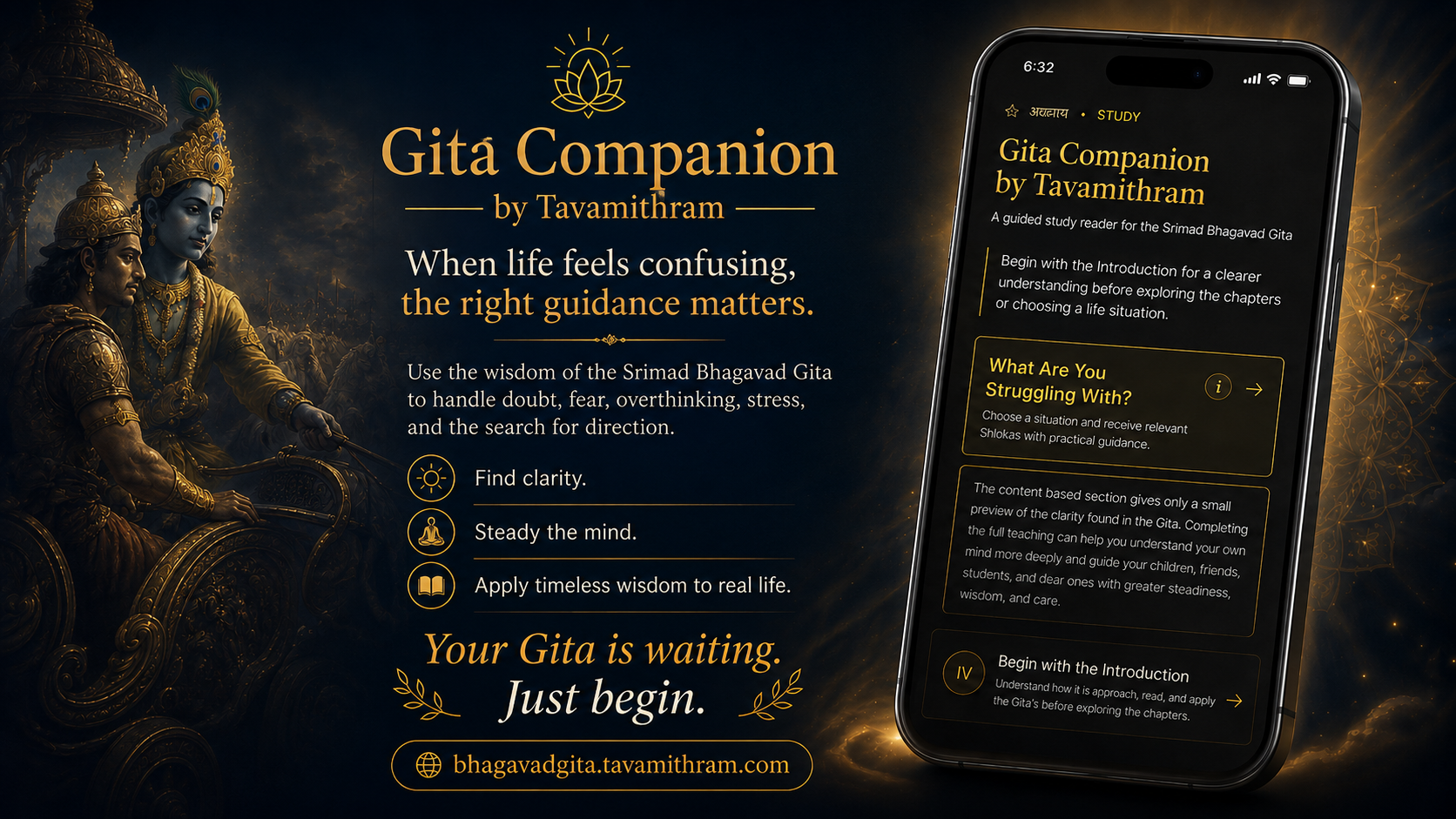
Bhagavad Gita Companion by Tavamithram web app

When you are facing a serious problem, whom would you rather speak to? Someone as confused, stressed and disturbed as you are, or someone with a calmer mind who can look at your situation from a little distance, see what you may not be seeing, and help you think it through rationally?

Every one of us meets situations in which the mind becomes disturbed. There are choices to make, relationships to handle, losses to accept, fears to overcome, anger to control, and moments when we simply do not know what to do. This is ordinary and human.

The Srimad Bhagavad Gita can itself be read as an externalisation of that inner turmoil. Arjuna’s crisis becomes the setting in which questions about action, judgement, responsibility, fear, attachment and life itself are examined.

The One-of-a-kind Bhagavad Gita Companion by Tavamithram puts that examination within immediate reach.

Rather than expecting you to know in advance which chapter or shloka to look for, it lets you begin with what you are actually facing: anger, fear, relationships, confusion, loss and grief, attachment, uncertainty, difficult decisions, inner conflict, and other concerns that arise in life. Seventeen of them are covered, each taking you through the problem, the principles involved, and the teachings of the Srimad Bhagavad Gita that bear on it.

The purpose is not to hand you another quotation. It is to help you think clearly at the moment your thinking is under most pressure.

Distress often makes people confide in whoever is nearby, and they later regret what they revealed. The Gita Companion by Tavamithram offers a private space instead: somewhere to examine the situation, understand yourself better, and gradually absorb what is needed to think for yourself. A firm grasp of the Srimad Bhagavad Gita enables a person to be guided by their own intellect rather than led about by uncontrolled senses, emotions and impulses, or left permanently dependent on the counsel of others.

Many years of study, analysis and painstaking work lie behind this web app, all of it directed at one purpose: making the philosophy of the Srimad Bhagavad Gita understandable, accessible and applicable to daily life.

The concern-based section is only one part of it. The Companion also carries all 18 chapters and 701 shlokas in the original Sanskrit, with romanisation, English translation and audio recitation.

You do not need to wait until you are old before you ‘study’ the Srimad Bhagavad Gita and someday learn to use it. Use it while you are living your life, when you are confused, when emotions are interfering with your judgement, when a difficult decision is in front of you, and when life tests you.

As the knowledge becomes internalised, you increasingly learn to recognise the relevant principles yourself when situations arise. The Gita Companion by Tavamithram thus helps you develop the clarity and intellectual independence to rely less on others for counsel and increasingly on your own informed and disciplined intellect.

You should not merely own a copy of the Srimad Bhagavad Gita. You should carry its knowledge with you.

Your Gita is waiting.
Just begin.

Are You Ready to Call Yourself a Modern Rishi?

The Modern Rishi does not escape life, but transcends illusion.

For many years I have said that Vedanta is not blind belief, ritual repetition, personality worship or spiritual entertainment. It exists to produce clarity. It helps us examine what we have assumed, see the forces that shape our thinking, and recognise what is real beneath inherited identity, fear and conditioning.

The Modern Rishi Movement is the next step in that work.

It is for people who question what others repeat, who examine what others merely believe, and who would rather face an uncomfortable truth than live inside a convenient illusion.

This movement is not for everyone.

If you repeat mantras daily without ever asking what they mean, you will find nothing here. If you prefer inherited belief to direct understanding, or want another guru to follow, another personality to worship, another comforting system to tell you what to think, look elsewhere. And if you are unwilling to question your own assumptions, identities, loyalties and conclusions, you are not ready for this yet.

A mantra is not a mechanical refuge from thought. A teaching memorised while life continues unchanged has achieved nothing. The words of Vedanta and the Srimad Bhagavad Gita have to be examined and understood before they can mean anything at all. They exist to transform perception, bring clarity to action and free the mind from confusion.

Who is a Modern Rishi?

A Modern Rishi lives fully in the world without being ruled by its noise, acts with awareness rather than reaction, and values truth above emotional convenience.

There is no withdrawal from responsibility here. The Modern Rishi works, creates, leads, protects and serves, but is not imprisoned by status, praise, fear, ideology or the demand for approval. Divisions of gender, religion, nationality, class and wealth are recognised as conditions of human life, not as the truth of what one is.

None of this means passivity, detachment or indifference to suffering. It means living with greater attention, discipline, courage and compassion.

Why this movement now?

Information has never been more abundant. Clarity is still rare.

People inherit beliefs before they are capable of examining them. They are taught whom to admire, whom to fear, what to defend and what must never be questioned. Political identity, religious identity, social labels, media narratives and group loyalty colour perception until people can no longer separate what they see from what they have been trained to see.

The Modern Rishi Movement begins with the willingness to examine that colouring. It asks:

What do I actually know?
What have I only repeated?
What has shaped the person I take myself to be?
Am I seeing clearly, or through filters handed to me?

How Tavamithram Led to the Modern Rishi Movement

Through Tavamithram, I have presented Vedanta and the Srimad Bhagavad Gita as instruments of understanding and freedom, never of religious authority or blind faith.

The Modern Rishi Movement carries that work into a wider space. It examines perception, identity, social conditioning, inherited belief and intellectual courage, and how these forces shape the way we think, react and live. Its foundation is Vedanta; what it addresses is life as it is lived now.

The movement formally begins on 15 August 2026. Until then, the new Modern Rishi site will introduce its vision, principles, films and reflections.

Are you ready?

You do not need to agree with me, accept a doctrine or surrender your intelligence to anyone. You do need to be willing to look. Question what you have inherited, investigate what you repeat, and examine whether your convictions arise from understanding or from conditioning.

If you are ready for that, enter.

Atma Bodha: A Complete English Rendering of the 68 Shlokas

Many people spend years looking for guidance, blessings, secret methods, special experiences, and spiritual personalities to follow but somehow never take the small step of reading the texts that actually contain the teaching.

The Srimad Bhagavad Gita, at least a few of the principal Upanishads, Nirvana Shatkam, and Atma Bodha are not hidden. They are freely available. They do not require theatrical devotion, emotional dependence, or loyalty to a personality. They require a serious mind.

Atma Bodha, said to have been composed by Shri Adi Shankaracharya about 1400 years ago, is short enough to be read in about half an hour. Yet, if approached with an open mind, it can give extraordinary clarity. Its purpose is not to create a believer. Its purpose is to remove confusion and delusional beliefs, including religious ones. The 68 Shlokas can be divided in thre movements, which I have compressed the three sections in this post on Substack. CONTINUE READING ON SUBSTACK.

This video is for those who want to approach Vedanta with clarity, seriousness, and direct enquiry.

Watch the full video here, or if you want the compressed version first, you may go to the Substack post.

Don’t believe. Know!

Self-Enquiry in Advaita Vedanta: What Remains?

Sometimes you identify with your body and say, ‘I look good,’ ‘I am fat,’ ‘I am getting old,’ ‘I am sick.’ Other times, you identify with your mind and say, ‘I am excited,’ ‘I am depressed,’ ‘I am angry.’ When life is going well, you say you have a great life, and when you feel low, you say your life is terrible.

Your body changes. Your mind changes. Your story changes.

What are you, then, when everything you call yourself keeps changing?

Give me less than ten minutes.

CONTINUE READING ON SUBSTACK

The Robe, the Matted Hair, the Beard, and the Blind Spot

Why outward appearance so often replaces enquiry

Some years ago, while passing through security at the airport in Hyderabad, India, I noticed a man in saffron robes, with long white hair and a beard, walking past, accompanied by two female assistants dressed in similar mendicant attire.

A few people nearby, who had also just cleared security, immediately folded their hands in deep respect.

I asked them who he was.

They said they did not know.

They did not know, and yet they expressed such visible reverence for him.

More than a thousand years ago, this was already exposed.
And yet, nothing much has changed. CLICK HERE TO READ ON

CONTINUE READING ON SUBSTACK

Don’t waste your life. Read The Srimad Bhagavad Gita

Why the Ego Prefers Ignorance to Truth

Most people polish the bars of their own prison. Vedanta offers the courage to burn the cage to the ground.

The Grand Illusion of the Mind

What traps human beings is not iron chains, not political systems, and not physical prisons. The most suffocating prison is the one the mind quietly constructs.

Below is the transcript of the video, tidied for clarity.


The Prison Built by the Mind

The most suffocating prison is not made of steel and stone.
It is the one the mind has built.

CONTINUE READING ON SUBSTACK

You Say ‘I’ All Day. But What Exactly Is It?

Every human being uses the word “I” countless times a day.

I am happy.
I am tired.
I am thinking.
I am worried.

But a very strange thing happens when we pause for a moment and ask a simple question:

What exactly is this “I”?

Is it the body?

Is it the mind?

Is it something inside the body?

Or is it something entirely different from what we normally assume?

Most people never examine this question seriously. They simply inherit an idea of who they are and carry it throughout their lives without investigation.

Vedanta does something very different.

It asks us to look carefully, logically, and honestly at the one thing we take for granted more than anything else.

The word “I.”

Instead of giving explanations here, let us examine the question directly through a rapid-fire enquiry.

Watch carefully how one assumption after another begins to dissolve.

If the reasoning is followed honestly, the result is not a belief or a mystical claim.

It is clarity.

And as Krishna says in the Srimad Bhagavad Gita (4:38):

There is nothing more purifying than knowledge.

Not mystical language, but the natural result of uncompromising enquiry.

12 Years of Clarity: The Journey of Tavamithram Sarvada

Twelve years ago, in February 2014, Tavamithram Sarvada began quietly. There was no grand announcement, no strategy to gather followers, and no desire to become an authority. It began from a simple, unwavering intention: clarity. I wanted a space where truth could be examined honestly, where ideas could be tested, and where understanding would matter more than approval.

This platform was never meant to impress. It was meant to illuminate.

From the very beginning, the aim was to share what truly helps a human being live with steadiness, intelligence, and inner freedom. Not borrowed knowledge. Not inherited beliefs. Not emotional comfort. But understanding grounded in observation, reason, and direct insight.

Over these twelve years, I have shared what I have studied, tested, experienced, and verified for myself. The central focus has always remained the same: the nature of the mind, the root of suffering, and the possibility of freedom through clarity.

One truth stands out above all. Disturbance does not come from situations. It comes from interpretation. Events are neutral. It is the mind’s reaction that creates agitation. When perception becomes clear, reaction becomes intelligent. And when reaction becomes intelligent, calmness is no longer something to be practised. It becomes natural.

Many believe calmness means suppressing emotion. That is not calmness. Calmness is understanding. When something is fully understood, it no longer disturbs. This is why I have always emphasised observation before change. Just as a doctor diagnoses before treatment, one must observe the mind before trying to control it. Without understanding, all effort becomes struggle. With understanding, transformation becomes effortless.

Throughout these years, I have consistently pointed to one direct and reliable source of supreme knowledge: the Srimad Bhagavad Gita. Not as a religious text, not as mythology, not as ritual instruction, but as a precise manual of clarity. When understood rationally, it cuts through confusion faster than any other teaching. It dismantles fear, exposes illusion, dissolves dependency, and frees a person from mental slavery to belief systems, authorities, and imagined limitations.

The Srimad Bhagavad Gita does not ask for belief. It leads a seeker towards understanding. And understanding is liberation.

Everything shared through Tavamithram Sarvada has revolved around this principle: verify for yourself. Do not accept something because it is ancient. Do not reject something because it is unfamiliar. Examine, reflect, and understand. Truth does not fear inquiry.

Over these twelve years, this platform has grown into a body of work that includes writings, explanations, lessons, reflections, and practical frameworks for living with clarity. Many readers have written to say that they think more clearly now, react less impulsively, and feel stronger inwardly. That is the only measure that matters. Not numbers. Not recognition. Transformation.

What makes this work different is simple. It does not ask anyone to follow. It asks them to understand. It does not create dependence. It encourages independence. It does not promise comfort. It offers clarity. Comfort weakens. Clarity strengthens.

Tavamithram Sarvada began as a silent movement for those who have had enough of religious nonsense sold to them and are ready for the ultimate truth of Vedanta. It is a reminder. A reminder that every human being already possesses the capacity for insight, steadiness, and freedom. Nothing new needs to be added. Only confusion needs to be removed.

To everyone who has read, reflected, questioned, disagreed, or grown through these writings over the years, you have my sincere appreciation. Your willingness to think deeply keeps this space alive and meaningful.

Twelve years have passed. The purpose has not changed. The direction has not shifted. And the commitment remains exactly what it was on day one: clarity above all.

The journey continues.

With love and affection.

Tavamithram Sarvada

What Next?: The End of Inner Conflict

He Who Conquers His Mind Is the Mightiest Warrior

People think strength is aggression. They think power is domination. Many think victory means defeating an external opponent.

That understanding does not survive scrutiny.

Real strength has nothing to do with overpowering others. It has everything to do with … CONTINUE READING ON SUBSTACK

The Secret Battle Inside Your Head (And How to Win It)

The mind presents a profound paradox. It is a collection of beliefs, attitudes, delusions, and illusions, yet it remains the core of our intellect. It can craft either ‘heaven’ or ‘hell’ within the span of a single breath. Learning to manage this incredibly powerful instrument, which can also act as a destructive weapon, is arguably life’s most important mastery.

My talk, How to Stop Being Triggered | The Way Out of the Mind Trap, shows how Vedanta provides the ultimate framework for understanding, training, and ultimately transcending the restless mind.

Engage with this talk, reflect deeply, and uncover the hidden mechanism behind every emotion, along with the path to freedom from it. By the end, it becomes clear that whatever is experienced arises in the mind, and that life and one’s world can be transformed by working on one’s perception and reaction.