The Shiva Tandava Stotra is one of the most striking and philosophically layered compositions in Sanskrit literature. Traditionally attributed to Ravana, the king of Lanka, this hymn occupies a unique place in Shaiva thought, not merely as an act of devotion, but as a profound symbolic exposition of reality, consciousness, and transformation.
Unlike many devotional hymns that praise a deity through submission or supplication, this Stotra is intense, rhythmic, and uncompromising. Its imagery is fierce, expansive, and unapologetically cosmic. It does not sentimentalise Shiva. It presents him as the very principle that governs creation, destruction, and the restless movement of existence itself.
Ravana: The Composer and the Paradox
Ravana is not a conventional devotee. He is described in the epics as supremely learned, extraordinarily powerful, and overwhelmingly egoic. He represents intellect without restraint, ambition without humility, and mastery without surrender. In this sense, Ravana signifies extreme ego, the height of self-assertion. That such a figure composes the Shiva Tandava Stotra is not accidental. The Stotra arises at the edge of confrontation between ego and reality. Ravana’s strength, knowledge, and pride reach a limit where they collide with something that cannot be dominated or possessed. Shiva, in this context, is not an object of worship but a force that dissolves arrogance by sheer clarity.
The Stotra is therefore not the voice of submission. It is the voice of recognition. Ravana does not diminish himself. Instead, his ego is forced to acknowledge a reality that cannot be controlled, threatened, or negotiated with. The intensity of the verses reflects this encounter. The hymn becomes an expression of awe, not obedience, and insight, not fear.
The Tandava as a Cosmic Vision
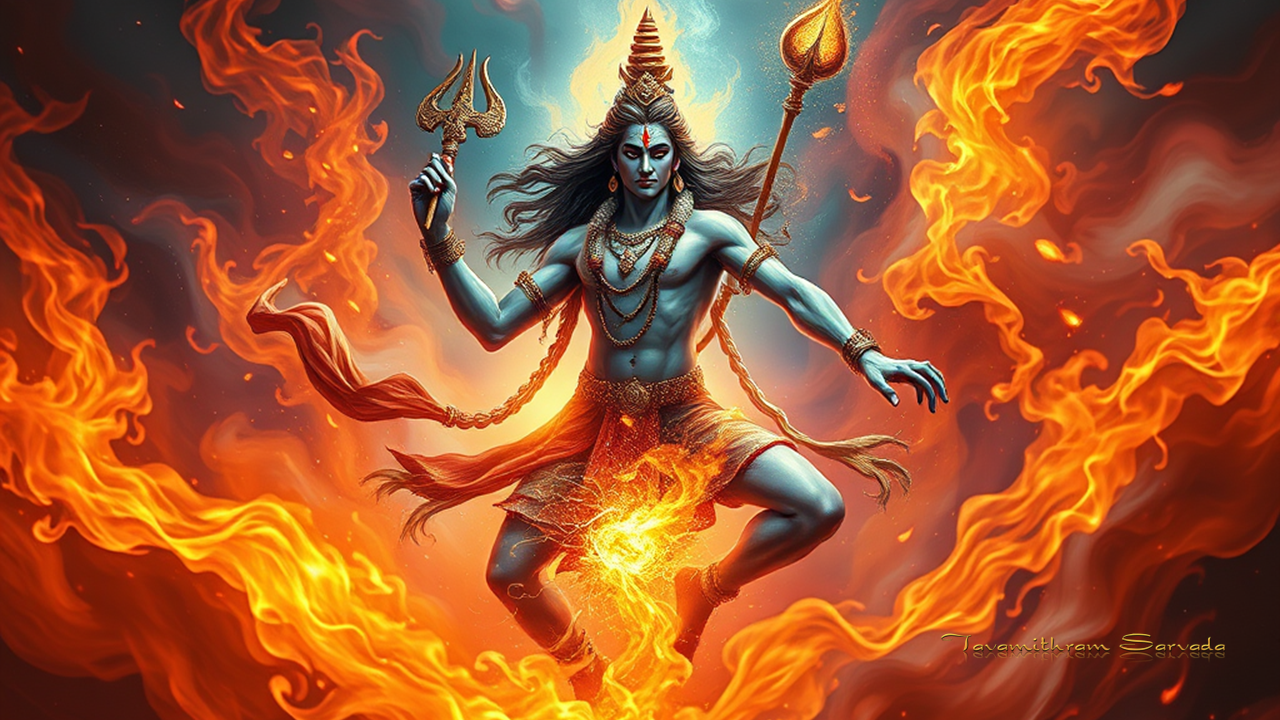
The dance described in the Shiva Tandava Stotra is not a physical performance confined to form or location. It is a cosmic metaphor for the nature of existence itself.
The Tandava represents the ceaseless movement of reality. Nothing in the universe is static. Forms arise, transform, and dissolve continuously. Creation and destruction are not opposing events but phases of the same ongoing process. Shiva’s dance symbolises this unbroken rhythm that governs matter, energy, time, and life.
The circle of flames within which Shiva dances represents the total field of existence. It encompasses space, time, mass, energy, and all phenomena that appear within them. The flames signify impermanence. Everything within this circle is subject to change. Nothing endures as form.
The ‘damaru’, a small hand drum, held in one hand symbolises rhythm and order, the principle through which manifestation occurs. Sound here is not mere noise but pattern, sequence, and structure. In another hand, Shiva holds fire, the force of transformation and dissolution. Creation and destruction are thus shown as inseparable, emerging from the same source.
Shiva’s flowing, matted hair symbolises yogic awareness. It extends outward, suggesting that contemplation does not withdraw from the universe but includes it entirely. Awareness is not confined or limited. It is vast enough to contain all movement without being disturbed by it.
One hand is raised in reassurance. This gesture conveys fearlessness. Despite constant change, decay, and uncertainty, existence is not hostile. When understood rightly, the movement of life does not threaten awareness.
Ego, Ignorance, and Liberation
Beneath Shiva’s foot lies the dwarf of ignorance, often interpreted as ego. This figure does not represent moral evil but psychological bondage. Ego is the false centre that claims ownership, control, and permanence in a world that offers none. The dwarf is not destroyed. It is restrained. This is significant. The ego cannot be eliminated by force or denial. It must be seen clearly and placed in its proper position. Shiva’s foot presses upon it, indicating mastery rather than annihilation.
The raised foot represents transcendence. It is lifted against gravity, symbolising freedom from compulsive identification with form, fear, and desire. This lifted foot points to contemplation, inward stillness, and clarity. Liberation is not an escape from the world but a release from misidentification within it.
The Tandava also includes suffering. Shiva dances not only in celebration but in cremation grounds. Death, loss, decay, and dissolution are not excluded from the vision. They are integral to it. The Stotra does not deny pain or impermanence. It demands their acceptance as part of the total movement of existence.
Shiva and Shakti: Awareness and Existence
The Tandava cannot be understood without recognising the role of Shakti, Shiva’s consort.
Shiva represents pure awareness, unmoving, unchanged, and self-luminous. Shakti represents existence itself, movement, energy, form, and expression. All action, transformation, creation, and dissolution belong to Shakti. All knowing, witnessing, and clarity belong to Shiva.
They are not two separate realities. They are two aspects of the same truth. Awareness without existence would have nothing to illuminate. Existence without awareness would be blind and meaningless.
The dance occurs because of Shakti. The still centre of the dance is Shiva. This expresses a fundamental insight: awareness does not act, yet nothing acts without awareness. The universe moves, transforms, and dissolves within awareness, not outside it.
To see Shiva and Shakti as separate is ignorance. To recognise their unity is understanding. The Tandava shows that stillness and movement, silence and sound, being and becoming are not opposites. They are inseparable.
The Meaning of the Stotra
The Shiva Tandava Stotra is therefore not merely a devotional hymn. It is a complete symbolic vision of reality. It explains the cosmos outside and the turbulence within the human mind through a single, integrated metaphor.
Ravana’s ego confronts the absolute. The universe dances. Awareness remains untouched. Existence moves endlessly. Liberation lies not in stopping the dance, but in understanding its nature.
This is the vision that unfolds in the Shlokas that follow.
1
जटाटवीगलज्जलप्रवाहपावितस्थले
गलेऽवलम्ब्य लम्बितां भुजङ्गतुङ्गमालिकाम् ।
डमड्डमड्डमड्डमन्निनादवड्डमर्वयं
चकार चण्डताण्डवं तनोतु नः शिवः शिवम् ॥१॥
jataa tavee gala jala pravaaha paavitha sthale
galae valambya lambitaam bhujanga tunga maalikaam
damad damad damad damanni naadha vadda marvayam
chakaara chaNda thaaNdavam thanothu nah shivah shivam.
On the sacred ground made pure by the streams flowing down from the forest of matted locks,
with a lofty and hanging garland of serpents adorning the neck,
as the damaru resounds again and again with its thunderous rhythm,
may Shiva, who performs the fierce Tandava, bestow auspiciousness upon us.
2
जटाकटाहसम्भ्रमभ्रमन्निलिम्पनिर्झरी
विलोलवीचिवल्लरीविराजमानमूर्धनि ।
धगद्धगद्धगज्जलल्ललाटपट्टपावके
किशोरचन्द्रशेखरे रतिः प्रतिक्षणं मम ॥२॥
jataa kataaha sambhrama bhramanni nilimpa nirjharee
vilola veechi vallaree viraaja maana moordhani
dhagad dhagad dhagaj jvalal lalaata patta paavake
kishora chandra shekhare ratih pratikshaNam mama.
As the celestial river whirls restlessly through the cauldron-like mass of matted hair,
with rippling waves spreading and adorning the head in restless motion,
while the blazing fire crackles fiercely across the broad forehead,
my mind finds delight at every moment in the one crowned with the youthful crescent moon.
3
धराधरेन्द्रनन्दिनीविलासबन्धुबन्धुर
स्फुरद्दिगन्तसन्ततिप्रमोदमानमानसे ।
कृपाकटाक्षधोरणीनिरुद्धदुर्धरापदि
क्वचिद्दिगम्बरे मनो विनोदमेतु वस्तुनि ॥३॥
dharaa dharendra nandinee vilaasa bandhu bandhura
sphurad diganta santati pramoda maana maanase
krupaa kataaksha dhoraNee niruddha durdharaa padi
kvachid digambare mano vinoda mettu vastuni.
Bound in playful companionship with the daughter of the mountain king,
whose mind rejoices as joy spreads to the farthest horizons,
whose steady stream of compassionate glances restrains even unbearable calamity,
may my mind find delight in that sky-clad, boundless reality.
4
जटाभुजङ्गपिङ्गलस्फुरत्फणामणिप्रभा
कदम्बकुङ्कुमद्रवप्रलिप्तदिग्वधूमुखे ।
मदान्धसिन्धुरस्फुरत्त्वगुत्तरीयमेदुरे
मनो विनोदमद्भुतं बिभर्तु भूतभर्तरि ॥४॥
jataa bhujanga pingala sphurat phanaa mani prabhaa
kadhamba kumkuma drava pralipta dig vadhuu mukhae
madaandha sindhura sphurat tvagut tareeya medure
mano vinoda madbhutam bibhartu bhoota bhartari.
From the tawny serpents coiled in the matted hair, the radiance of the jewels on their raised hoods flashes forth,
smearing the faces of the directions as if with flowing kadamba and vermilion,
while the quivering hide of an intoxicated elephant forms a powerful covering,
may the sustainer of all beings hold my mind in wondrous delight.
5
सहस्रलोचनप्रभृत्यशेषलेखशेखर
प्रसूनधूलिधोरणी विधूसराङ्घ्रिपीठभूः ।
भुजङ्गराजमालया निबद्धजाटजूटक
श्रियै चिराय जायतां चकोरबन्धुशेखरः ॥५॥
sahasra lochana prabhrutya shesha lekha shekhara
prasoona dhooli dhoranee vidhoosara anghri peethabhuh
bhujanga raaja maalayaa nibaddha jaata jootaka
shriyai chiraaya jaayatam chakora bandhu shekharah.
Adorned by the assembled hosts beginning with the thousand-eyed one,
whose footrest is dusted and greyed by streams of flower pollen,
whose matted locks are bound by a garland of the king of serpents,
may the moon-crested one, the companion of the chakora bird, arise for enduring prosperity.
6
ललाटचत्वरज्वलद्धनञ्जयस्फुलिङ्गभा
निपीतपञ्चसायकं नमन्निलिम्पनायकम् ।
सुधामयूखलेखया विराजमानशेखरं
महाकपालिसम्पदेशिरोजटालमस्तु नः ॥६॥
lalaata chatvara jvalad dhananjaya sphulinga bhaa
nipeeta pancha saayakam namanni nilimpa naayakam
sudhaa mayookha lekhayaa viraaja maana shekharam
mahaa kapaali sampade shiro jataala mastu nah.
From the blazing centre of the forehead flashes the conquering spark of fire,
which consumed the five arrows and before whom the celestial beings bow,
whose head shines adorned with the crescent traced in nectar-like rays,
may the great skull-bearing one, with matted locks, grant us prosperity.
7
करालभालपट्टिकाधगद्धगद्धगज्ज्वलद्
धनञ्जयाहुतीकृतप्रचण्डपञ्चसायके ।
धराधरेन्द्रनन्दिनीकुचाग्रचित्रपत्रक
प्रकल्पनैकशिल्पिनि त्रिलोचने रतिर्मम ॥७॥
karaala bhaala pattikaa dhagad dhagad dhagaj jvalad
dhananjayaa huthee kruta prachanda pancha saayake
dharaa dharendra nandinee kuchaagra chitra patraka
prakalpanaika shilpini trilochane ratir mama.
As the fearsome fire blazes across the broad surface of the forehead,
having reduced the fierce five arrows to a sacrificial offering,
while the movements of the dance trace wondrous patterns upon the bosom of the mountain’s daughter, my devotion rests in the three-eyed one, the sole master craftsman of creation.
8
नवीनमेघमण्डली निरुद्धदुर्धरस्फुरत्
कुहूनिशीथिनीतमः प्रबन्धबद्धकन्धरः ।
निलिम्पनिर्झरीधरस्तनोतु कृत्तिसिन्धुरः
कलानिधानबन्धुरः श्रियं जगद्धुरंधरः ॥८॥
naveena megha mandalee niruddha durdhara sphurat
kuhoo nisheethi neetamah prabandha baddha kandharah
nilimpa nirjharee dharas tanotu krutti sindhurah
kalaa nidhaana bandhurah shriyam jagat dhurandharah.
With the dense brilliance of newly formed cloud-clusters restrained around the neck,
binding the deep darkness of the moonless night in a continuous band,
the bearer of the celestial river and the wearer of the elephant hide,
the beloved source of all arts, the sustainer of the universe’s prosperity, may bestow auspiciousness.
9
प्रफुल्लनीलपङ्कजप्रपञ्चकालिमप्रभा
वलम्बिकण्ठकन्दलीरुचिप्रबद्धकन्धरम् ।
स्मरच्छिदं पुरच्छिदं भवच्छिदं मखच्छिदं
गजच्छिदान्धकच्छिदं तमन्तकच्छिदं भजे ॥९॥
prafulla neela pankaja prapancha kaalima prabhaa
valambi kantha kandalee ruchi prabaddha kandharam
smaracchidam puracchidam bhavacchidam makhacchidam
gajacchidandhakacchidam tamantakacchidam bhaje.
Whose dark radiance spreads like fully bloomed blue lotuses across the expanse,
whose neck bears that lustre, held and bound in glowing brilliance,
the destroyer of desire, the destroyer of the cities, the destroyer of becoming, the destroyer of sacrifice,
the slayer of Gaja and Andhaka, the bringer of death to death itself, that one I revere.
10
अखर्वसर्वमङ्गलाकलाकदम्बमञ्जरी
रसप्रवाहमाधुरीविजृम्भणामधुव्रतम् ।
स्मरान्तकं पुरान्तकं भवान्तकं मखान्तकं
गजान्तकान्धकान्तकं तमन्तकान्तकं भजे ॥१०॥
akharva sarva mangalaa kalaa kadamba manjaree
rasa pravaaha maadhuri vijrumbhanaa madhu vratam
smaraantakam puraantakam bhavaantakam makhaantakam
gajaantakaandhakaantakam tamanta kaantakam bhaje.
An unceasing cluster of all auspicious arts, unfolding in abundance,
from whom flows a stream of sweetness, expanding like nectar in full bloom,
the transcender of desire, the transcender of the cities, the transcender of becoming, the transcender of sacrifice,
the destroyer of Gaja and Andhaka, the transcender of death itself, that one I revere.
11
जयत्वदभ्रविभ्रमभ्रमद्भुजङ्गमश्वसद्
विनिर्गमत्क्रमस्फुरत्करालभालहव्यवाट् ।
धिमिद्धिमिद्धिमिध्वनन्मृदङ्गतुङ्गमङ्गल
ध्वनिक्रमप्रवर्तितप्रचण्डताण्डवः शिवः ॥११॥
jayatva dabhravibhrama bhramad bhujangam ashvasad
vinirgamat krama sphurat karaala bhaala havya vaat
dhimid dhimid dhimid dhvanan mrudanga tunga mangala
dhvani krama pravartita prachanda taandavah shivah.
Victory to Shiva, whose fierce Tandava surges forth,
as serpents whirl and hiss in restless motion,
while the blazing altar of the fearsome forehead pulses in rising flames,
driven by the powerful, auspicious rhythms of the ‘mridanga’ sounding dhimid, dhimid, again and again.
12
स्पृषद्विचित्रतल्पयोर्भुजङ्गमौक्तिकस्रजोर्
गरिष्ठरत्नलोष्ठयोः सुहृद्विपक्षपक्षयोः ।
तृणारविन्दचक्षुषोः प्रजामहीमहेन्द्रयोः
समप्रवृत्तिकः कदा सदाशिवं भजाम्यहम् ॥१२॥
sprushad vichitra talpayor bhujanga mauktika srajor
garishtha ratna loshthayoh suhrud vipaksha pakshayoh
trunaaravinda chakshushoh prajaa mahee mahendrayoh
sama pravrittikah kadaa sadaashivam bhajaamyaham.
When shall I revere Sadashiva with equal vision,
seeing no difference between a splendid couch and the bare ground,
between a serpent’s pearl garland and a lump of clay, between friend and foe,
between blade of grass and lotus, between a subject and a sovereign?
13
कदा निलिम्पनिर्झरीनिकुञ्जकोटरे वसन्
विमुक्तदुर्मतिः सदा शिरस्थमञ्जलिं वहन् ।
विलोललोललोचनो ललामभाललग्नकः
शिवेति मन्त्रमुच्चरन्कदा सुखी भवाम्यहम् ॥१३॥
kadaa nilimpa nirjharee nikunja kotare vasan
vimukta durmateeh sadaa shirastha manjalim vahan
vilola lola lochano lalaama bhaala lagnakah
shiveti mantra muchcharan kadaa sukhee bhavaamyaham.
When shall I dwell in a forest hollow beside the celestial river,
freed from distorted thought, bearing folded hands upon my head,
with unsteady eyes and the sacred mark fixed upon the forehead,
uttering the mantra “Shiva”, when shall I abide in happiness?
14
इदम् हि नित्यमेवमुक्तमुत्तमोत्तमं स्तवं
पठन्स्मरन्ब्रुवन्नरो विशुद्धिमेतिसंततम् ।
हरे गुरौ सुभक्तिमाशु याति नान्यथा गतिं
विमोहनं हि देहिनां सुशङ्करस्य चिन्तनम् ॥१४॥
idam hi nityam eva muktam uttamottamam stavam
pathan smaran bruvan naro vishuddhim eti santatam
hare gurau subhaktim aashu yaati na anyathaa gatim
vimohanam hi dehinaam sushankarasya chintanam.
Whoever continually recites, remembers, and speaks this supreme hymn
attains lasting inner purity,
quickly developing unwavering devotion toward Hara and the guiding teacher, with no other path remaining,
for contemplation of Shankara alone dispels the delusion of embodied beings.
15
पूजावसानसमये दशवक्त्रगीतं
यः शम्भुपूजनपरं पठति प्रदोषे ।
तस्य स्थिरां रथगजेन्द्रतुरङ्गयुक्तां
लक्ष्मीं सदैव सुमुखीं प्रददाति शम्भुः ॥१५॥
pooja vasaana samaye dashavaktra geetam
yah shambhu poojana param pathati pradoshe
tasya sthiraam ratha gajendra turanga yuktaam
lakshmeem sadaiva sumukheem pradadaati shambhuh.
Whoever recites this hymn sung by the ten-faced one
at the close of worship, devoted to Shambhu, at the sacred twilight hour,
to that person is granted enduring prosperity, accompanied by chariots, elephants, and horses,
and Lakshmi ever bestows her gracious presence.
इति श्रीरावणकृतं
शिवताण्डवस्तोत्रं
सम्पूर्णम् ॥
iti shri raavana krutam
shiva taandava Stotram
sampoornam.
Thus ends the Shiva Tandava Stotra,
composed by Ravana,
complete.