Most people live their lives filled with noise, dogma, and contradiction, making sense of life a challenging task. They have unanswered questions, such as, “Who am I?” or “What’s the point of all this?” They are either caught up in beliefs and rituals, have no inclination to engage with such questions, or, due to their beliefs, are afraid to question traditions, or simply too busy to stop and think.
Religions and ideologies claim to offer answers, but more often than not, they leave us confused and divided. They demand belief, but fail to encourage true understanding.
Vedanta is not another belief system. It offers a unique method – a way of seeing – that helps you distinguish between what is real and what is assumed. It doesn’t require blind faith. Instead, it invites you to look within and engage with your own direct experience.
What if everything you worship, think, and perceive is not the ultimate truth?
The Kenopanishad shakes the very foundation of our understanding by revealing that Brahman—the ultimate reality—is not what the senses perceive, nor what the mind can grasp. It is that by which all perception happens, yet remains beyond perception itself.
I am pleased to share my English explanation of the Kenopanishad, now available on the new Vedanta channel, Timeless Vedanta. This Upanishad is a profound text that explores the nature of ultimate reality, the limitations of perception, and the essence of Brahman—the supreme truth that is beyond the grasp of the senses and intellect.
This video presents a clear and insightful analysis of the Kenopanishad, encouraging deeper reflection and self-inquiry. Watch, learn, and break free from blind beliefs to embrace the wisdom of Vedanta.
Your engagement helps spread the knowledge of Advaita Vedanta and enables more seekers to benefit from these ancient yet ever-relevant teachings.
Summary of the Kenopanishad
The Kenopanishad from the Sama Veda’s Talavakara Brahmana is a profound exploration of Brahman, the ultimate reality that transcends sensory perception and intellectual comprehension. It is structured into four sections, addressing the nature of consciousness, the limitations of the mind and senses, and the necessity of realisation beyond mere knowledge.
I. The Nature of Brahman
The text begins with fundamental inquiries: What is the force behind the mind, speech, and senses? What enables perception and cognition? The answer given is that Brahman is the unseen power that enables all faculties yet remains beyond their grasp.
Brahman is the “ear of the ear, the mind of the mind, the speech of speech, the life of life, and the eye of the eye.”
The wise attain immortality by renouncing identification with the senses and realising this truth.
Brahman is beyond thought, speech, and sight, yet it is that by which the mind thinks, speech expresses, and the eyes see.
“Nedam-yadidam-upaasate” – That which is worshipped as an object is not Brahman; the real Brahman is that which enables perception itself.
II. The Paradox of Knowing Brahman
The Upanishad asserts that Brahman is not fully knowable, nor is it completely unknown. It is beyond dualistic comprehension:
If one thinks, “I know Brahman,” they have only a partial understanding.
Brahman is known by those who realise they do not fully know and remains unknown to those who think they know it completely.
True knowledge of Brahman leads to immortality, strength, and ultimate fulfilment.
III. The Parable of the Gods and Brahman’s Revelation
The Upanishad illustrates the ignorance of the gods through a symbolic story:
After a great victory, the gods (Agni, Vayu, and Indra) assume their triumph is solely their own.
Brahman appears as an unknown Yaksha (divine being) to humble them.
Agni, the fire god, fails to burn a blade of grass; Vayu, the wind god, fails to lift it—revealing their limited power.
Indra, seeking answers, meets Uma (Parvati), the embodiment of wisdom, who reveals that their victory was due to Brahman alone.
Indra, being the first to realise this, is praised above the other gods.
IV. The Flash of Realisation
Brahman is realised like a lightning flash or a blink of an eye—sudden and beyond conceptualisation.
The seeker must meditate on Brahman as “Tadvana” (the most desirable).
Austerity, self-restraint, and righteous action serve as the foundation for realisation.
One who attains this knowledge becomes established in Brahman, free from ignorance, confusion, suffering, and Karma
The Kenopanishad asserts that Brahman is the essence of all experience but cannot be objectified. It must be known intuitively, not intellectually. The Upanishad leads the seeker away from external worship to direct self-inquiry, revealing that the ultimate truth is not in what is perceived but in that which enables perception itself.
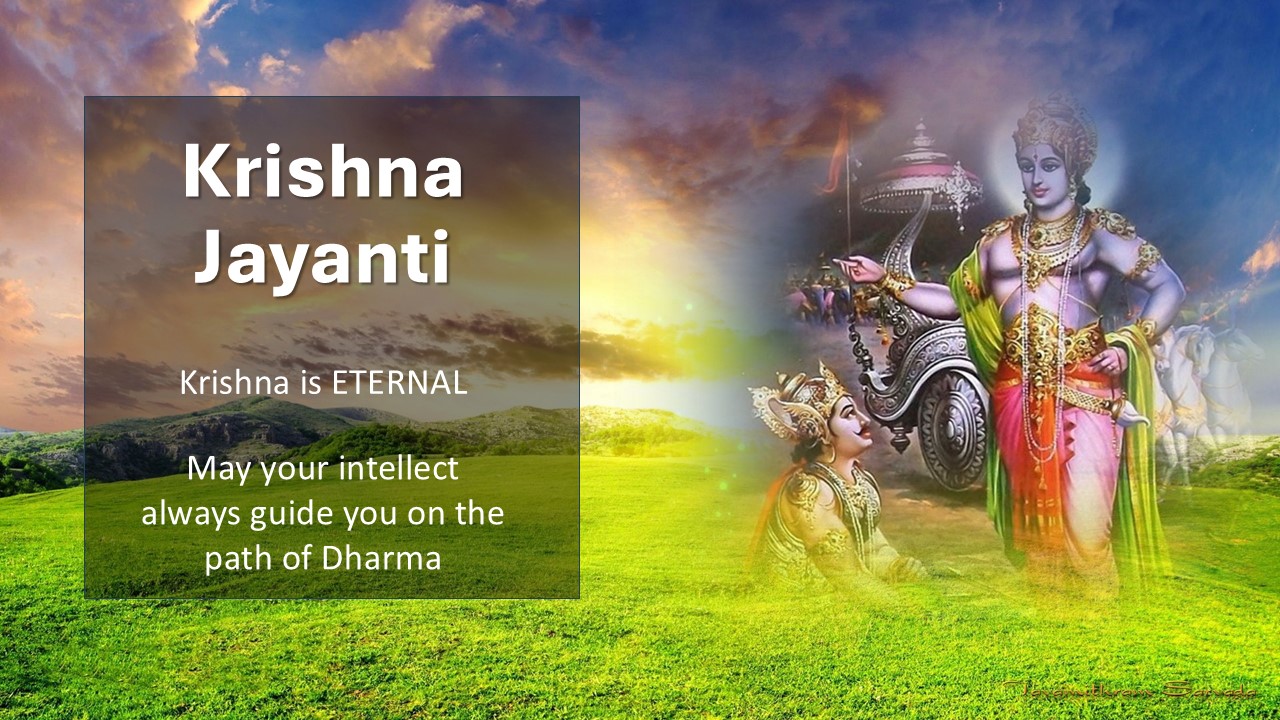
Krishna Jayanti, or Janmashtami, marks the celebrated ‘birth’ of Bhagavan Shri Krishna, an event cherished across the globe. But how does this celebration reconcile with Krishna’s own words in the Srimad Bhagavad Gita, where he declares that He was never born, nor will He ever die?
Consider this profound Shloka:
नत्वेवाहं जातु नासं न त्वं नेमे जनाधिपाः | न चैव न भविष्यामः सर्वे वयमतः परम् || २ १२ ||
na tvevaaham jaatu naasam na tvam neme janaadhi-paaha na chaiva na bhavishyaa-maha sarve vayam-ataha param SBG 2:12
“There never was a time when I did not exist, nor you, nor all these kings. We will also never cease to exist.”
In this Shloka, Krishna emphasises the eternal nature of the Atman. The physical birth and death that we observe are but mere transitions in the infinite existence of the SELF. Krishna, as the Supreme Being, transcends these limitations of time and space.
Arjuna, puzzled by this concept, continues with his questions and, in Chapter 4, asks Krishna as follows:
अर्जुन उवाच | अपरं भवतो जन्म परं जन्म विवस्वतः | कथमेतद्विजानीयां त्वमादौ प्रोक्तवानिति || ४ ४ ||
Arjuna said: “Your birth was after the birth of Vivasvaan. How should I understand when You say that You taught this Yoga to him?”
To this, Krishna responds, illuminating the mystery of His divine nature:
श्रीभगवानुवाच | बहूनि मे व्यतीतानि जन्मानि तव चार्जुन | तान्यहं वेद सर्वाणि न त्वं वेत्थ परंतप || ४ ५ ||
sri bhagavan uvaacha bahuuni me vyatii-taani janmaani tava-chaarjuna taan-yaham veda sarvaaNi na tvam vettha parantapa SBG 4:05
Sri Krishna said: “Many births of mine as well as yours have passed. I know all of them, but you don’t, O Parantapa (Arjuna – destroyer of enemies).”
Here, Krishna acknowledges the cyclical nature of birth and rebirth, highlighting that while He is aware of all His incarnations, Arjuna remains unaware.
Krishna then reveals the ultimate truth of His existence:
अजोऽपि सन्नव्ययात्मा भूतानामीश्वरोऽपि सन् | प्रकृतिं स्वामधिष्ठाय संभवाम्यात्ममायया || ४ ६ ||
ajo ‘pi san-navya-yaathma bhuuthaanaa-miishvaro ‘pi san prakrthim svaa-madhisht-haaya sambhavaa-myaathma-maayayaa SBG 4:06
“Though I am unborn and imperishable, and although I am the Bhagavan of all beings, I do incarnate by my own Maya or My Divine Energy.”
Krishna’s ‘birth’ is not conventional; it is a divine descent, an incarnation born of His own will and energy, symbolising the emergence of pure intellect after dispelling layers and layers of ignorance. Krishna Jayanti, while celebrating His appearance, also invites us to reflect on the deeper spiritual truths He embodies.
In this short video I’ve created, I delve into the essence of Krishna Janmashtami and how embracing these teachings can transform your life and lead to enduring bliss: At the end of the short video, I have translated Shloka SBG 2:12 into six Indian languages apart from English.
It is crucial to remember that taking scriptural texts literally can lead one astray from the true path of Self-Realisation, potentially fostering rigid belief systems or cult-like thinking. The Srimad Bhagavad Gita offers profound wisdom—absorb its philosophy, and use it to cultivate a life of fulfilment and spiritual growth.
A ‘disclaimer’ from Srimad Bhagavatam (not Srimad Bhagavad Gita)
“Shukadeva Gosvami spoke: O mighty King Parikshith, I have shared with you the accounts of these illustrious kings, whose fame and great deeds echoed worldwide before their departure. However, my fundamental intention has always been to impart the wisdom of the transcendental and the path of renunciation. Although the stories of kings embellish these narratives with grandeur and opulence, they, in and of themselves, do not represent the ultimate essence of knowledge.“
Contains information related to marketing campaigns of the user. These are shared with Google AdWords / Google Ads when the Google Ads and Google Analytics accounts are linked together.
90 days
__utma
ID used to identify users and sessions
2 years after last activity
__utmt
Used to monitor number of Google Analytics server requests
10 minutes
__utmb
Used to distinguish new sessions and visits. This cookie is set when the GA.js javascript library is loaded and there is no existing __utmb cookie. The cookie is updated every time data is sent to the Google Analytics server.
30 minutes after last activity
__utmc
Used only with old Urchin versions of Google Analytics and not with GA.js. Was used to distinguish between new sessions and visits at the end of a session.
End of session (browser)
__utmz
Contains information about the traffic source or campaign that directed user to the website. The cookie is set when the GA.js javascript is loaded and updated when data is sent to the Google Anaytics server
6 months after last activity
__utmv
Contains custom information set by the web developer via the _setCustomVar method in Google Analytics. This cookie is updated every time new data is sent to the Google Analytics server.
2 years after last activity
__utmx
Used to determine whether a user is included in an A / B or Multivariate test.
18 months
_ga
ID used to identify users
2 years
_gali
Used by Google Analytics to determine which links on a page are being clicked
30 seconds
_ga_
ID used to identify users
2 years
_gid
ID used to identify users for 24 hours after last activity
24 hours
_gat
Used to monitor number of Google Analytics server requests when using Google Tag Manager
1 minute
Marketing cookies are used to follow visitors to websites. The intention is to show ads that are relevant and engaging to the individual user.
A video-sharing platform for users to upload, view, and share videos across various genres and topics.
Registers a unique ID on mobile devices to enable tracking based on geographical GPS location.
1 day
VISITOR_INFO1_LIVE
Tries to estimate the users' bandwidth on pages with integrated YouTube videos. Also used for marketing
179 days
PREF
This cookie stores your preferences and other information, in particular preferred language, how many search results you wish to be shown on your page, and whether or not you wish to have Google’s SafeSearch filter turned on.
10 years from set/ update
YSC
Registers a unique ID to keep statistics of what videos from YouTube the user has seen.
Session
DEVICE_INFO
Used to detect if the visitor has accepted the marketing category in the cookie banner. This cookie is necessary for GDPR-compliance of the website.
179 days
LOGIN_INFO
This cookie is used to play YouTube videos embedded on the website.