
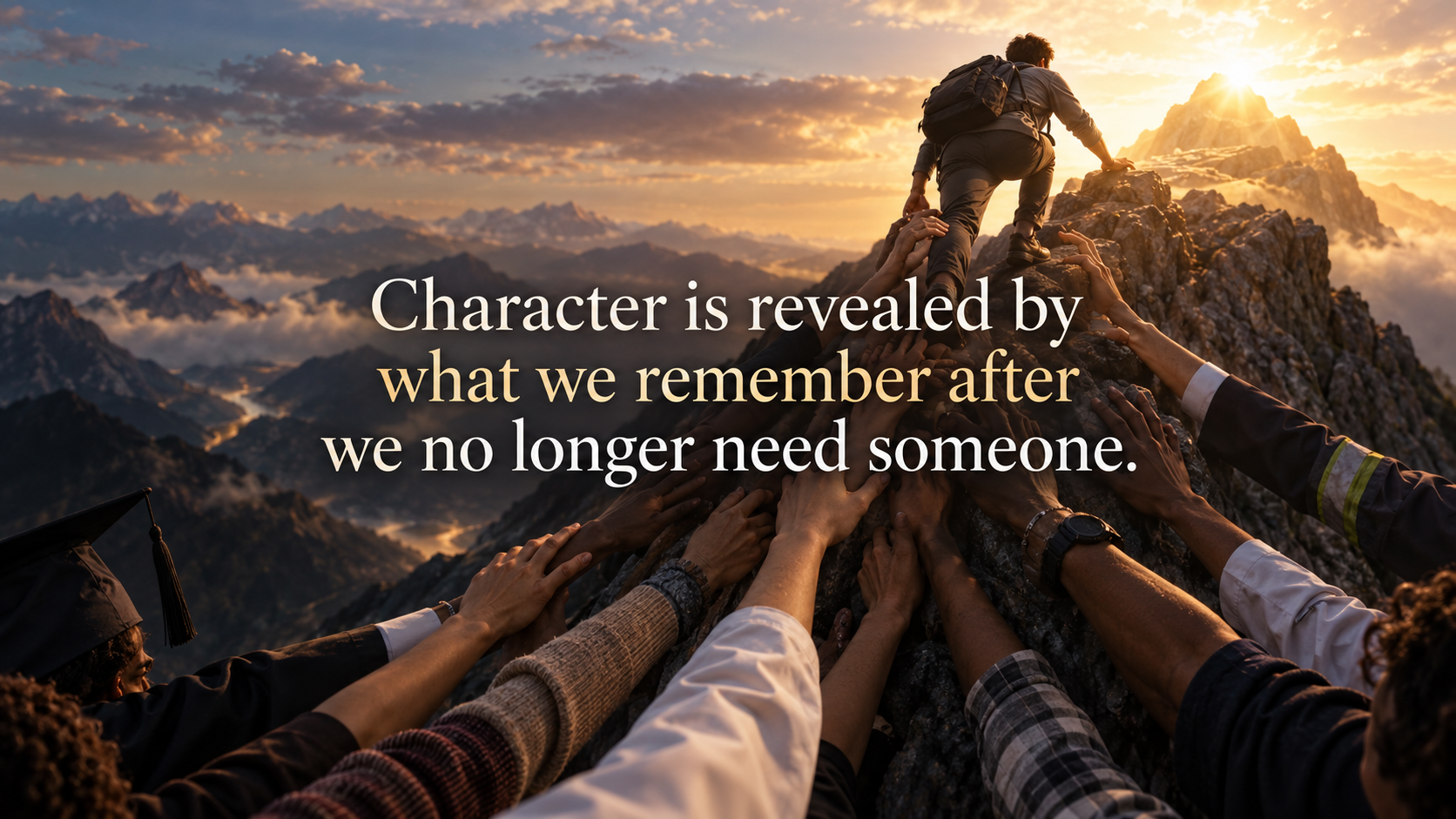
A man spends years helping a younger colleague find his feet. He answers calls at odd hours, opens what doors he can, and never once asks for anything back. Time passes. The younger man succeeds. One day somebody mentions the person who once helped him. He smiles politely and says, ‘Oh yes, I knew him once.’
Nobody lied. Nothing was stolen. A history was simply edited down to half a sentence.
There comes a point when something simply ends. No drama, no revenge, only clarity. Trust can survive disagreement, distance, disappointment and even long periods of silence, but deliberate betrayal destroys it. Once something fundamental has been broken, pretending that nothing has changed helps nobody.
Betrayal, though, is only one form of a much larger human problem, and the deeper issue is usually gratitude.
We tend to treat gratitude as a matter of manners. Someone does something for us, we say thank you, and the account is considered settled. But an attitude of gratitude is a good deal larger than politeness. It is a way of understanding one’s own life, and it begins with an obvious fact that most of us manage to forget: none of us arrived where we are entirely through our own effort.
Along the way, people teach us and correct us, open doors we could not have opened, offer chances we could not have created for ourselves, or turn up at the moment when their presence matters. Some contributions change the direction of a life. Others amount to a single sentence still remembered four decades later. Parents, siblings, teachers, classmates, friends, bosses, colleagues, neighbours, strangers and people from whom our paths eventually separated may all have played a part. The size of the contribution is not the important thing. The ability to remember it is.

Before any of us could speak, somebody had already given up a great deal on our behalf. A woman carried us inside her body for nine months and then risked her life to deliver us, and for most of human history that risk was very far from theoretical. Around that beginning were parents or caregivers taking on responsibilities that would continue for years, earning, feeding, protecting, worrying, sacrificing and doing whatever was necessary to keep a child alive and give that child a future.
What followed were years of labour that children rarely notice while it is being done. The earning and the feeding. The illnesses nursed through the night. The education paid for, the personal desires postponed, the responsibilities that had no end date.
No infant on earth survives alone. Every achievement any of us lists, and every confident opinion we hold about how life ought to be lived, rests on years of care given before we were capable of noticing it was being given. Nothing we could offer equals care of that order. The only thing worth anything here is remembering, and saying so while the people concerned are still alive to hear it.
That is why I consider an attitude of gratitude among the highest of human virtues. It encompasses so many others within it: humility, loyalty, decency, memory, acknowledgement and respect for what we have received from others.
There is something deeply grounding about looking back over the road behind you and asking one plain question: Who helped me get here? The question is not about who made me successful or who deserves the credit. It is about who added something, however small, that made the road easier, clearer or possible at all. Sometimes the honest answer includes a person who rejected us, dismissed us or let us go, since an ending that felt like a wound at the time may have been the thing that cleared the space for whatever came next.
None of this needs to be sentimental, and none of it creates a debt.
Helping someone does not purchase their loyalty, and teaching someone gives us no ownership over their future. Kindness entitles nobody to permanent agreement, admiration or closeness, and the moment generosity turns into an invoice it has stopped being generosity. A person may receive our help and later disagree with us completely. They may leave, grow in another direction, build another life, or decide the relationship has run its course. That is not ingratitude. That is simply a life taking its own shape.
Ingratitude begins somewhere quite different. It begins when history gets rewritten because acknowledgement has become inconvenient, and it shows itself most clearly in people who grow so impressed by where they have arrived that they start believing they travelled there alone. Help that once mattered is downgraded to something insignificant, guidance is minimised or denied, and opportunities are quietly reinterpreted as inevitabilities until the contribution of others has vanished from the story altogether. That kind of erasure is not bad manners. It reveals how a person sees the world.
An attitude of gratitude does the opposite. It keeps achievement in proportion, so that a successful person still recalls the beginner they once were, and whoever now teaches has not lost sight of the people who taught them.
This has mattered to me for as long as I can remember. Even as a boy I felt a need to acknowledge anyone who had done something for me, and over the years I have gone back to people decades later just to say that what they once did was remembered. More often than not they had forgotten it themselves, which is exactly why it was worth saying. A good act does not lose its value because the person who performed it no longer remembers performing it.
This way of looking at life changes how we understand broken trust as well. A relationship can end without becoming a war, and a person can lose their place in our life without being turned into an enemy. Forgiveness need not mean renewed access, and understanding somebody’s weakness is not an obligation to invite that weakness back into one’s house. There are doors that can stay closed for good with nothing but quiet behind them.
Here is where nonduality stops being philosophy and becomes something you can actually use. If existence is one, expressed through countless forms, then the apparent separateness between one person and another is not the final truth about either of them. Ego makes that separation feel absolute, and entitlement, fear and delusion take turns defending it. The obsession with ‘me’ and ‘mine’ is what makes it possible to use another human being as though their experience had nothing to do with our own, and out of that imagined separateness come exploitation, ingratitude and betrayal.
Gratitude weakens the illusion, because to be grateful is to recognise relationship. Something reached us through another person. Their hand may have been a small one in the story of our life, but it was still a hand.
That recognition binds us to nobody forever. A relationship may end, trust may disappear permanently, two people may never speak again, and none of it requires us to deny what was once good, or to pretend that what happened afterwards did not happen. Both truths stand together perfectly well. A person can have helped us and later hurt us, or occupied a central place in our life and forfeited it entirely.
Gratitude does not falsify the present. It simply refuses to falsify the past, and that may be its greatest strength. A grateful person has no need to romanticise anybody. Such a person only declines to let disappointment reach back through their own history and erase every good thing that came before it. Remembering something without clinging to it, and moving on without rewriting the record, is a quieter form of strength than most people give it credit for.
People have come to me at very different points in their lives. Some needed nothing more than a little guidance or encouragement. Others came when they felt utterly rejected, broken or alone, and a few spoke openly of wanting to harm themselves. I gave them whatever time, attention or counsel I could, and never asked for anything back. That was never a transaction. I mention it only because ‘Your friend forever’ was never intended as a pleasant phrase at the bottom of a page. It was meant literally.
A relationship can end. Trust can end. A place once occupied in somebody’s life can vanish permanently. The truth that connects us does not.
That is why, when the time came to name this blog in February 2014, I did not go looking for something clever. I chose the Sanskrit for ‘your friend forever’, Tavamithram Sarvada, and I meant it without a single condition attached. Not friendship on condition of agreement, and not friendship only while it remains convenient. Nothing held in reserve, and no dependence on how anyone chooses to behave. Friendship with conditions attached is not friendship. It is a deal. That was the principle I began with, and after all these years I see no reason to revise it.
Your friend forever.