Beyond the Herd: Unmasking the Myths of Group Belonging

Why Tavamithram is Never Aligned to Any Particular Group, Ashram, Agama, Paddhathi, Sects, Subsects, Guru, Swamy, Dress Code, Traditions, Religion etc.

Please read the post before listening to the podcast discussing the post

Throughout my life, I have observed a significant connection between beliefs, the desire to belong to groups, and the thirst for knowledge and self-confidence. My personal attitude has always been to stand alone. Itโ€™s crucial to clarify that my reluctance to belong to groups should not be mistaken for hubris. I simply prefer solitude, as my strong ideas often diverge from the majority, who are frequently swept away by traditionsโ€”something Krishna himself admonishes even before the conclusion of Chapter 2 in the Srimad Bhagavad Gita.

To illustrate the extent to which I go to avoid belonging to a group, let me share anLeonardo_Phoenix_a_dramatic_highcontrast_cinematic_photograph_3 example from my past. Many years ago, I was a motorcycle stuntman in Indian films, doubling for lead stars and performing death-defying stunts. In the film industry, numerous unions exist for various trades, including actors, directors, make-up artists, dancers, photographers, and others. Naturally, there was also a union for stuntmen, and I was expected to join. However, I refused to be tied down by group membership, choosing instead to remain independent. Consequently, I willingly accepted a penalty of twenty-five per cent of my earnings for not being a member. Despite this, I chose to pay the penalty each time I earned money performing stunts.

Iโ€™ve observed that individuals who are rather low on self-confidence or a sense of personal substance usually seek strength in numbers by joining groups. Being part of a group provides reassurance and a sense of belonging. Within these groups, members usually share common beliefs or philosophies, forming the basis of their unity. However, I think that belonging to a group compels individuals to adopt the groupโ€™s ideology, limiting their ability to think and act independently. I prefer the freedom to think for myself and analyse matters in my own way. Groups typically consist of like-minded individuals, which signifies a lack of diverse thought. This, in turn, stifles intellectual development and curtails opportunities for new ideas to emerge.

As an ardent learner, I find great fascination in encountering people whose ideas challenge my own, compelling me to think outside the box. This is the essence of personal evolution.

Itโ€™s essential to clarify that I do not hold beliefs in the conventional sense; instead, I possess perspectives. I have unwavering trust in my intelligence, intellect, and experiences, considering myself a keen learner in every situation I encounter.

While belonging to a group can provide a sense of security, it can also hinder personal growth and self-discovery. True self-confidence emerges from understanding and standing firm in oneโ€™s perspectives, even when they diverge from the prevailing norms of a group. By cultivating self-awareness and introspection, individuals can develop a stronger, more authentic sense of self. I am not suggesting anything against groups; rather, I strongly advocate for retaining oneโ€™s freedom to question, think, and express oneself.

Among the most detrimental effects groups can have on intellectual development is the deification of central figures, often referred to as Gurus or Babas. The story of the 24 Gurus of Sage Dattatreya aims to dismantle the false notion of being tethered to a single guru, suggesting that anything and everything that helps dispel ignorance can be considered a guru. To quote Shri Ramana Maharshi: โ€œYour own Self-Realisation is the greatest service you can render the world.โ€

In Shloka SBG 2:45, Krishna instructs Arjuna: โ€œVedic literature deals with subjects that fall under the three Gunas. O Arjuna, you should rise above the three, be free from dualities, always remain in Sattva or goodness, and be established in the Self.โ€

A true teacher should guide individuals to clear their ignorance and advance towards the ultimate goal of Atma-gnyaana, or knowledge of the Self. However, how many truly do this? Many, adorned in flowing robes and sporting long beards, strut about like proud peacocks, claiming to possess all knowledge.

It is indeed disheartening to witness children and youth from families not converted to foreign religions being lured into the illusory world of meaningless beliefs, rites, and rituals.

I conclude this post with Shlokas SBG 4:37 and 38. 

37: “Just as a blazing fire burns firewood into ashes, O Arjuna, knowledge burns all actions and reactions into ashes.” 

38: “There is certainly nothing more purifying than knowledge. He who is perfect in Yoga finds it in the Self in due course of time.”

May you stay abundantly blessed.


Jai Shri Krishna

Why me – เคฎเฅˆเค‚ เคนเฅ€ เค•เฅเคฏเฅ‹เค‚ – เฎจเฎพเฎฉเฏ เฎเฎฉเฏ?

Understanding Destiny through the Srimad Bhagavad Gita

Every morning can be treated as a new Janma (birth), carrying forward the thoughts and mindset from the previous day, thus continuing life patterns. Changing oneโ€™s life for the better is not difficult if one understands the natural principle of cause and effect and works towards acquiring the knowledge of the all-pervading Self, Brahman, or Krishna. As long as one thinks of Krishna as a separate entity, they will have expectations, which naturally lead to disappointments. Krishna is everywhere, in all beings, and is existence itself. Rise above dualitym accept responsibility and make the necessary course corrections in life. The Srimad Bhagavad Gita clearly states that the path of knowledge is the highest. Check out Shloka SBG 4:37-38.

To illustrate these concepts, I created three videos in three different languages using easy-to-understand analogies. When I made the Hindi video, one of our family members, Mr. Anupam Agarwal helped me in reviewing the Hindi script. Special thanks to him.

Additionally, I offer my latest book, ‘The Ever-Relevant Gita: A Present-Day Rendering’. This book can answer almost all possible questions one might have about destiny, karma, dharma, Krishna, birth, life, and death.

Embracing the Path of Knowledge

It is an irrefutable fact that everyone possesses some degree of a personality trait called narcissism. The degree of narcissism in a person separates a normal individual from someone who needs professional help. Even a small amount of narcissism can push a person towards feelings of entitlement, selfishness, and the typical ‘Why me?’ question. Oneโ€™s own answer to this question is usually based on self-pity and a sense of being a victim of others, external forces, or misfortune.

People who care to set aside their narcissistic traits, however small and insignificant, and their feelings of victimhood, can find not just an answer to the ‘Why me?’ question but a permanent solution to it.

The following presentation analyses the ‘Why me?’ question, the principle of cause and effect, and ways to carve out a clearer, better, enjoyable, and enriching destiny with the help of teachings from the Srimad Bhagavad Gita.

May peace reign in your heart, mind, and soul, and may your life be blessed with an abundance of Divine Grace.

Jai Shri Krishna

Watch the video in the language of your choice, reflect, and take action.

Two Golden ‘Mantras’ to Destroy Negative Karma and Start Afresh

Have you ever felt trapped in a cycle of negativity, brooding over past traumas, and struggling to find a way out? You’re not alone. Many people fall into the habit of self-pity, which can be a powerful and destructive force.

In my latest video, I share the two simple yet profound mantras that have helped me break free from the shadows of my past and step confidently into a brighter future. These mantras have been my guiding light, empowering me to overcome challenges and embrace a life full of possibilities.

Curious to learn more? Watch the video to discover how “So What?” and “What Next?” can transform your life too.

Reset your Karma

Self-Pity is a DRUG

Google Translate

Hindi

Tamil

Marathi

Kannada

Telugu

Malayalam

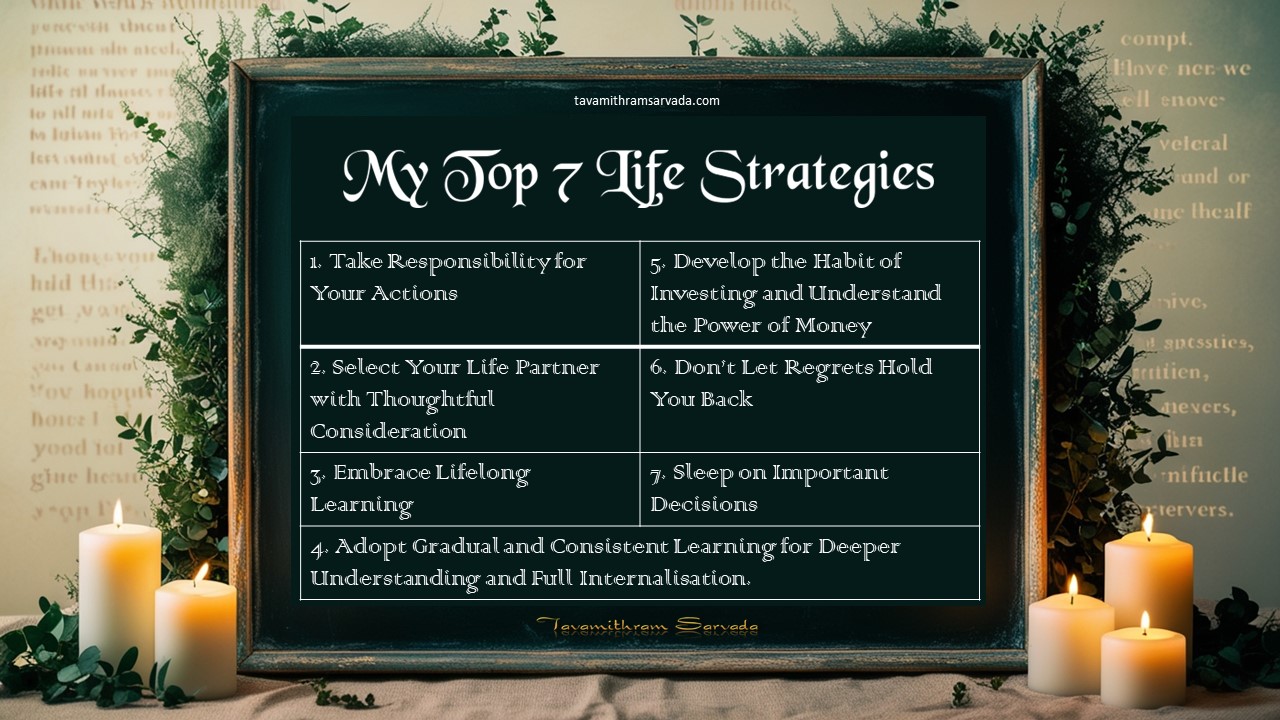
My Top 7 Life Strategies

Grasping life’s fundamental truths often takes years, causing many to look back with regret, wishing they had learned these lessons sooner. By adopting these seven Life Strategies, you can navigate your journey with greater confidence and fulfilment, avoiding the pitfalls that others have encountered. Embrace these principles now to set yourself on a path toward a more successful and enriching life.

If you’re in your early twenties and take the time to study and internalise these strategies, youโ€™ll save yourself a great deal of time and effort in your pursuit of a fulfilling life.

1. Take Responsibility for Your Actions

Stop blaming others and start taking full responsibility for your actions. You alone are accountable for your decisions. Owning up to your actions empowers you to make positive changes and steer your life in the direction you want.

Example: If a project at work doesnโ€™t succeed, instead of blaming your team, reflect on what you could have done differently and use that knowledge to improve future projects.

2. Select Your Life Partner with Thoughtful Consideration

Choosing your spouse is one of the most crucial decisions you’ll ever make. A good partner brings joy and support, while a poor choice can lead to unhappiness. Never decide in a hurry or when under pressure. Friedrich Nietzsche wisely advised, “When marrying, ask yourself this question: ‘Do you believe that you will be able to converse well with this person into your old age? Everything else in marriage is transitory.'”

Example: Imagine spending your life with someone who shares your interests and values, and with whom you can have deep, meaningful conversations. This is the foundation of a lasting and fulfilling marriage.

3. Embrace Lifelong Learning

Donโ€™t let financial constraints hold you back from investing in your career development. The internet is full of resources offering vast opportunities for learning and growth. While degrees can be valuable, they donโ€™t solely define your knowledge, wisdom, or capabilities.

Example: Many successful entrepreneurs have used online resources to learn new skills like coding, digital marketing, or design, and have built thriving businesses without formal education in those fields.

4. Adopt Gradual and Consistent Learning for Deeper Understanding and Full Internalisation.

Take your time to learn slowly, carefully, and steadily. By doing so, you’ll realise that you have the ability to achieve anything. Donโ€™t let others discourage you. Give things a go and be prepared to fail before conceding defeat prematurely.

Example: Consider training for a marathon. At first, the goal may seem overwhelming, but by committing to a steady, incremental training plan, you build endurance and confidence over time. Each small, consistent effort contributes to your overall progress, transforming a seemingly insurmountable challenge into an achievable accomplishment. Similarly, learning a new skill or mastering a subject takes persistent, gradual effort, leading to profound understanding and success.

5. Develop the Habit of Investing and Understand the Power of Money

Start investing as early as possible. The earlier you begin, the more time your investments have to grow, providing you with financial security and freedom. Many of lifeโ€™s problems can be alleviated with money. Financial stability provides the means to address challenges and seize opportunities. While money doesnโ€™t buy happiness, it reduces stress and grants you the freedom to pursue your passions and goals.

Example: Starting an investment account with a small monthly contribution in your 20s can lead to significant savings by the time you reach retirement age, thanks to compound interest. Having a financial safety net can help you handle unexpected expenses like medical bills or car repairs without falling into debt or significant stress.

6. Donโ€™t Let Regrets Hold You Back

Regrets are unproductive. Instead of dwelling on what could have been, focus on making the most of the present. Every moment spent regretting is a moment lost that could be used for positive action and growth.

Even if youโ€™ve faced deep pain or significant losses, ask yourself, โ€œSo what?โ€ followed by โ€œWhat next?โ€ and focus on your next steps. The past is gone and will never return, but it can sabotage your future if you allow it.

Example: Imagine you regret not taking a chance on a business idea years ago. Instead of ruminating on missed opportunities, redirect that energy into launching a new venture now. Research your market, develop a solid plan, and connect with potential mentors or investors. By focusing on actionable steps, you turn regret into motivation and create new possibilities for yourself.

7. Sleep on Important Decisions

Before making an important decision, take a pause and avoid deciding immediately. Instead, let it sit overnight. This brief delay allows you to gain clarity, giving you time to weigh the pros and cons thoughtfully, rather than being driven solely by emotions or excitement.

Example: If you receive a job offer, take a night to think it over. This allows you to assess the offer with a clear mind and make a well-considered decision.

By internalising and practising these seven strategies, you can navigate life with greater confidence, resilience, and fulfilment. Remember, the journey is just as important as the destination, so embrace each step with an open mind and a determined heart.

Fate and Time: The Tragic Story of Mike Lynch

In my latest video, I delve into the poignant and impactful story of Mike Lynch, a man whose life and career were marked by remarkable achievements and profound challenges. Despite his success, Lynchโ€™s life took a tragic turn with his untimely death while on his yachtโ€”a stark reminder of how swiftly fate can alter our course.

In this video, I offer an introspective look at Lynchโ€™s journey, touching on the themes of fate, the passage of time, and the importance of living fully in the present. I explore how Lynchโ€™s story serves as a powerful lesson about the unpredictable nature of life and the significance of embracing each moment with gratitude and responsibility.

Join me as I unravel the elements of Lynch’s life and legacy, and reflect on the crucial lessons we can learn from his experiences. Don’t miss this opportunity to gain insight into how to navigate life’s uncertainties with grace and mindfulness.

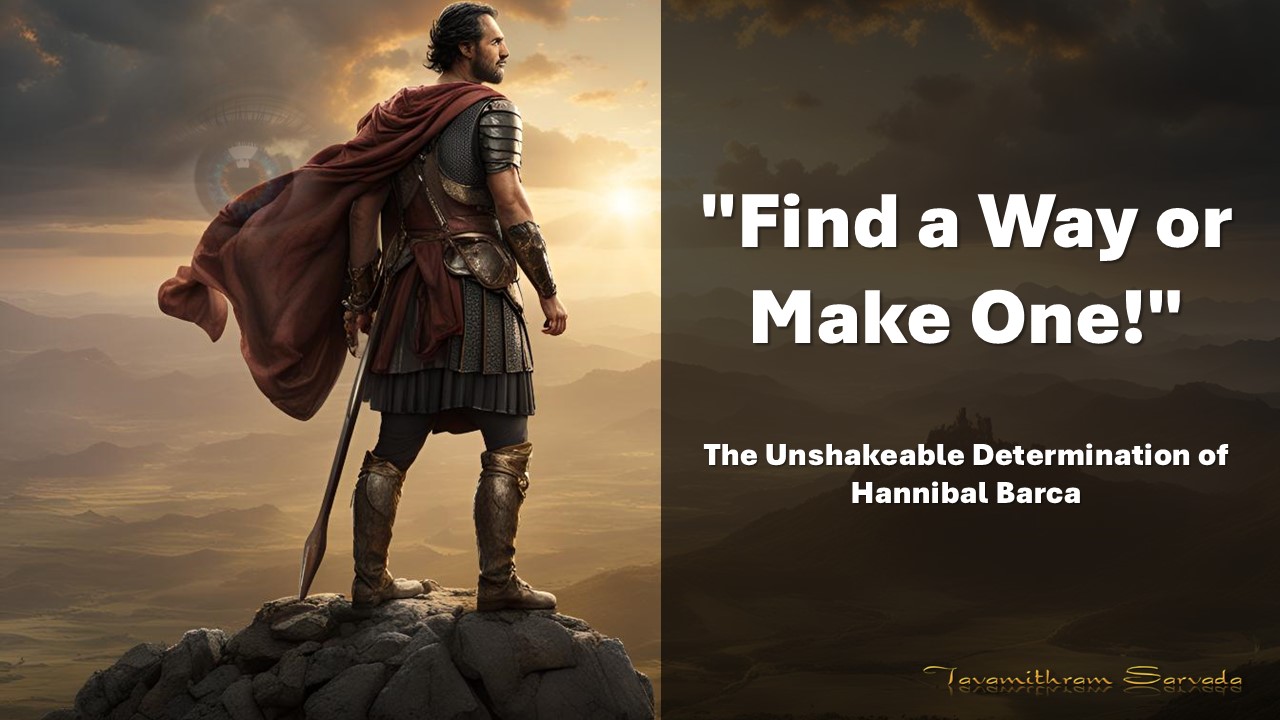
“Find a Way, or Make One!” The Unshakeable Determination of Hannibal Barca

Overcoming the Impossible with Sheer Will

Unyielding Determination: The Legacy of Hannibal Barca

In a world where challenges are constant and obstacles seem insurmountable, the story of Hannibal Barca serves as a beacon of inspiration. Born in 247 BCE in Carthage, a powerful city-state in North Africa, Hannibal became one of historyโ€™s greatest military leaders, known for his daring campaigns against the Roman Empire during the Punic Wars.

Hannibalโ€™s life is a demonstration to the power of unwavering determination and relentless ambition. From his daring feats against Rome to his famous declaration, “I will either find a way or make one,” Hannibal’s journey offers timeless lessons that are just as relevant today as they were over two millennia ago.

In my latest video, I explore the mindset and principles that made Hannibal an enduring symbol of perseverance. Watch the video below to discover how Hannibal’s legacy can inspire you to overcome any challenge and reach your own goals, no matter how distant they may seem.

The Chrysalis: Change is Inevitable; Evolution is Eternal

Transformation is lifeโ€™s enduring promise

TRANSFORMATION FUELS THE FUTURE

(someone sent me this beautiful time-lapse video)

Please watch this short video, and then read the post below, or listen to the audio.

Evolution is the natural order of life. Just as a pupa transforms into a beautiful butterfly, everything in nature is in a constant state of change and growth. This transformation is not just necessary but inevitable, driven by the forces of nature to improve, adapt, and thrive.

However, some choose to resist this natural process, clinging to outdated ways of thinking, strange beliefs in the name of religion, lost positions or property, former relationships, and old ways of being. This resistance is a denial of lifeโ€™s fundamental principleโ€”growth. By refusing to evolve, they remain stagnant, living in a state of delusion. In doing so, they waste the precious resources that nature provides, occupying space without contributing to the flow of progress.

Just as the butterflyโ€™s emergence from its chrysalis is a testament to the power of transformation, so too should we embrace our own potential for growth. To resist evolution is to deny the very essence of life. By choosing to evolve, we not only fulfil our purpose but also honour the natural world that supports us.

Let’s embrace CHANGE, and EVOLVE.

From Frustration to Fulfilment

The Essential Guide to Overcoming Lifeโ€™s Unfavourable Situations

*SUBSCRIBE TO MY SUBSTACK โ€“ ITโ€™S FREE*

Breaking Free from the Cycle

Many of us find ourselves stuck in a cycle of complaining, brooding, and feeling generally dissatisfied with our circumstances. Whether it’s our job, relationships, or personal achievements, the tendency to ruminate on what’s wrong can be overwhelming. And yet, despite the temporary relief we might find in venting to a friend or relative, we often wake up the next day only to repeat the same routine, with nothing having changed. The question then arises: how can we expect change when we continue to do the same thing?

The Unproductive Cycle of Complaints

Complaining and brooding are natural human responses to dissatisfaction. It’s almost instinctual to express our frustrations when things don’t go as planned. However, these actions rarely lead to meaningful change. Instead, they often serve as a temporary release, a way to momentarily ease the pressure without addressing the underlying issues. As a result, we remain stuck in the same unfavourable situation, repeating the cycle day after day.

To break free from this cycle, it’s crucial to take a different approachโ€”one rooted in clarity and action. The key lies in defining your problems and goals with precision. Let me take you back to my childhood to illustrate this point.

As a young boy, I was naturally curious and had a mechanical aptitude that drove me to understand how things worked. I was always eager to get to the bottom of things, refusing to accept anything at face value without clear evidence. When I was reprimanded by elders or teachers for my behaviour, I didn’t just accept the scolding. Instead, I wanted to know what I had done wrong and, more importantly, what I should do right. However, my requests for guidance were often met with silence or a cold stare, leaving me with unanswered questions.

This experience taught me a vital lesson: in any situation, if something is wrong, it’s essential to ask, “What is right?” This principle can be applied to any area of life:

  1. If youโ€™re dissatisfied with your job, ask: What is my ideal job?
  2. If you donโ€™t like your life, ask yourself: What would my ideal life look like?
  3. If youโ€™re unhappy in a relationship, ask: What is the ideal relationship I want?

The Three-Step Approach to Change

Once you’ve asked these questions, the next step is to define your situation clearly. Here’s a practical approach:

  1. Identify What You Donโ€™t Like and Why: Be specific about what bothers you. Is it the long hours at work, the lack of appreciation, or perhaps a feeling of being stuck? Understand the root cause of your dissatisfaction.

  2. Create a Clear Vision of What You Want: Visualise your ideal situation in detail. What does your perfect job look like? What qualities define your ideal relationship? Be as specific as possible, down to the finest details.

  3. Develop a Plan to Achieve Your Vision: Identify the steps you need to take to move from your current situation to your ideal one. This might involve learning new skills, making lifestyle changes, or even having difficult conversations. The key is to take actionable steps that lead you closer to your goal.

The Danger of Temporary Fixes

Many people, when faced with an unfavourable situation, seek quick fixes to ease their minds temporarily. Whether it’s pouring out your woes to a friend, closing your eyes and sitting under a tree or in a religious place, or even turning to substances, these methods offer only momentary relief. They donโ€™t address the core issues and often lead to more frustration when the problem inevitably resurfaces.

Please always remember that if someone truly wants something, they will find a way to get it. Consider alcohol and substance addicts or those addicted to gamblingโ€”they always manage to obtain what they crave. If you feel youโ€™ve been working hard with no improvement in your life, instead of adopting a victim or ‘poor me’ attitude, try to view it from another perspective. Perhaps your efforts are insufficient, misdirected, or lack proper direction.

Summing up and Learning to Take Control of Your Life

If youโ€™re unhappy with your current situation, donโ€™t waste time complaining or seeking temporary distractions. Instead, follow the steps Iโ€™ve outlined:

  1. Define your issue clearly.
  2. Visualise your ideal situation.
  3. Take actionable steps to achieve your vision.

By doing so, youโ€™ll find that you have the power to transform your life into something truly fulfilling. These steps may seem simple, but they are profoundly effectiveโ€”I speak from experience.

Never forget that many people donโ€™t know exactly what they want. Complaining and feeling depressed require less effort than reflecting and strategising, which is why slipping into self-pity is so easy. For anything good and positive to materialise, there must first be a clear image in the mind. So, the next time you feel the urge to complain or brood, make sure you know exactly what you want.

Real change begins with a clear definition of your goals and a commitment to taking action.

A Mind-Bending Voyage

Experience the Vastness and Awesomeness of Existence

Reality, Perception, and the Awakening of Consciousness

*SUBSCRIBE TO MY SUBSTACK โ€“ ITโ€™S FREE*

*Please listen to the audio or read the post before watching the video.

After a decade away, I found myself standing once more in front of the house where I had lived until I was 11. This was the place where my sister and I used to walk to school, hand in hand, through green fields, joyfully crossing a small brook along the way. But as I stood there, I was struck by how different everything seemed. The street that once seemed so long and wide now appeared short and narrow. The house, which I remembered as spacious, looked small. The distance to my school, which had once felt like a great journey, now seemed trivial.

What had happened? When I left Poona, I was 11 years old. Now, I was 21. I had grown taller, and my perspective had shifted. The distances and proportions I held in my mind were relative to my height and understanding as a child.

This experience confirmed a profound truth: what we call reality is shaped entirely by our perception. When I was a child, my world seemed vast. As an adult, returning to that same world, it appeared small and contained. The reality I perceived at 11 was not an absolute truthโ€”it was a reflection of my limited perception at that time.

This realisation extends far beyond childhood memories. It speaks to the very nature of our existence and the limitations we impose upon ourselves. Those who are deluded into believing they are merely their bodies, confined by irrational religious beliefs and paralysed by the fear of defying some ‘heavenly figure’, are trapped in a narrow reality. Their consciousness is limited, their minds blocked by layers of fear, dogma, and superstition.

But imagine if they could step out of these mental prisonsโ€”if they could free themselves from the beliefs that restrict their consciousness and their ability to think freely. They would rise above these illusions and delusions, and experience the ultimate truth of their existence: the realisation of their true SELF as subjective awareness, which is formless and, once not mentally limited to the body, is all-pervading.

This is the essence of the awakening journeyโ€”transcending the childish beliefs, religions, cults, and sects that confine us, and attaining the highest state of understanding. It is a journey from the narrow confines of perception to the boundless expanses of consciousness.

Take this fascinating virtual flight through space to the end of the observable universe and back. As you do, realise the vastness and awesomeness of existence. Let it inspire you to rise above the illusions that bind you and to reach for that highest state of awareness where the ultimate truth resides, far beyond the constructs of human beliefs.

Amritabindu Upanishad on Substack

The MIND – Man’s Greatest Tool

*SUBSCRIBE TO MY SUBSTACK – IT’S FREE*

Learning to use the MIND as a Churning Stick to realise your TRUE DIVINE SELF!

The Amritabindu Upanishad, part of the Krishna Yajur Veda, is a concise and powerful text for true seekers of spiritual wisdom. CONTINUE ON SUBSTACK
ย 

ย 

Treat Insults and Setbacks as โ€˜ROCKETย FUELโ€™

Shatter the Cycle: BURN and RESET yourย Karma!


The Ever-Relevant Gita: A Present-Day Rendering’

FREE PROMO CODES: LIMITED OFFER

The Greatest Gift to Yourself for 2024 and the Future

Nonduality #Vedanta #SelfDiscovery #Consciousness #Spirituality #TruthSeeker”