
The Robe, the Matted Hair, the Beard, and the Blind Spot

Why outward appearance so often replaces enquiry

Some years ago, while passing through security at the airport in Hyderabad, India, I noticed a man in saffron robes, with long white hair and a beard, walking past, accompanied by two female assistants dressed in similar mendicant attire.

A few people nearby, who had also just cleared security, immediately folded their hands in deep respect.

I asked them who he was.

They said they did not know.

They did not know, and yet they expressed such visible reverence for him.

More than a thousand years ago, this was already exposed.
And yet, nothing much has changed.

Before you fold your hands,
before you bow your head,
pause for a moment.

Because this is not a small thing.

It is the difference between
clarityโ€ฆ and conditioning.

There is something important worth asking.

Do we actually know who we are bowing to, or why we are doing so?

Pause.

This is not a criticism.

This is an observation.

And it is not new.

This exact pattern is pointed out in the Bhaja Govindam song, attributed to Shri Adi Shankaracharya.

เคœเคŸเคฟเคฒเฅ‹ เคฎเฅเคฃเฅเคกเฅ€ เคฒเฅเคžเฅเค›เคฟเคคเค•เฅ‡เคถเคƒ (jatilo mundi luncchita-keshah)
เค•เคพเคถเคพเคฏเคพเคฎเฅเคฌเคฐเคฌเคนเฅเค•เฅƒเคคเคตเฅ‡เคทเคƒ เฅค (kaashaayaambara-bahu-krita-veshah)
เคชเคถเฅเคฏเคจเฅเคจเคชเคฟ เคš เคจ เคชเคถเฅเคฏเคคเคฟ เคฎเฅ‚เคขเคƒ (pashyann api cha na pashyati moodhah)
เค‰เคฆเคฐเคจเคฟเคฎเคฟเคคเฅเคคเค‚ เคฌเคนเฅเค•เฅƒเคคเคตเฅ‡เคทเคƒ เฅฅ (udara-nimittam bahu-krita-veshah)

The Shloka describes a situation.

Many individuals adopt different outward appearances.
One grows matted locks of hair
Another shaves his head.
Another plucks out his hair.
Some wear saffron robes, others adopt various appearances.

All these are merely different disguises to fill their stomach.

Even while seeing, the fool does not truly see.

Now, please bear with me as Iโ€™ll give you a word-by-word translation of this Shloka:

เคœเคŸเคฟเคฒเฅ‹ เคฎเฅเคฃเฅเคกเฅ€ เคฒเฅเคžเฅเค›เคฟเคคเค•เฅ‡เคถเคƒ (jatilo mundi luncchita-keshah)
One with matted hair, one with a shaved head, one with hair plucked out,

เค•เคพเคถเคพเคฏเคพเคฎเฅเคฌเคฐเคฌเคนเฅเค•เฅƒเคคเคตเฅ‡เคทเคƒ เฅค (kaashaayaambara-bahu-krita-veshah)
wearing ochre robes, assuming many forms of appearance,

เคชเคถเฅเคฏเคจเฅเคจเคชเคฟ เคš เคจ เคชเคถเฅเคฏเคคเคฟ เคฎเฅ‚เคขเคƒ (pashyann api cha na pashyati moodhah)
even while seeing, the fool does not truly see,

เค‰เคฆเคฐเคจเคฟเคฎเคฟเคคเฅเคคเค‚ เคฌเคนเฅเค•เฅƒเคคเคตเฅ‡เคทเคƒ เฅฅ (udara-nimittam bahu-krita-veshah)
all these many disguises are for the sake of the stomach.

Notice the reason:

โ€œall these many disguises are for the sake of the stomach,
meaning for their livelihood.โ€

It then adds something more important.

โ€œEven while seeing, the fool does not truly see.โ€

It means that even when the truth is right in front of them, those fools do not recognise it – โ€œSeeingโ€ฆ yet not seeing.โ€

That is the exact point being made.

The Shloka is not discussing clothing.

It is pointing to something deeper.

Outward appearance can create an impression.

And that impression can be accepted without enquiry.

This same tendency is addressed in the Srimad Bhagavad Gita, in 2:42 to 46.

In those Shlokas, Krishna describes those who are unintelligent, whose minds are filled with desires, and who are drawn to the flowery statements of the Vedas, considering heaven to be the highest goal, with nothing beyond it.

They speak of Vedic rites that promise good birth, power, and enjoyment, believing that there is nothing higher than a life of pleasure and wealth.

Those who are attached to such gratification and power are carried away by these words and do not attain the firm and steady intellect to attain supreme mental equanimity.

And then it adds a final perspective.

In Shloka 2:46, Krishna says that for the one of Self-realisation, the role of the Vedas is like that of a small well when everything is flooded.

There, the focus is on people becoming absorbed in words, rituals, and promises,
while missing the essential understanding.

So the Shloka from the Bhaja Govindam song is not asking for rejection.

It urges people to be wary of those who adopt certain appearances for their livelihood, and instead seek clarity.

Not blind acceptance.

Not reaction based on appearance.

But understanding.
Understanding universal oneness.

This naturally raises a question:

When reverence arises,
is it based on true understanding
or on appearance?

The Shloka leaves that for the listener to examine.

If the question stays,
the enquiry has already begun.

READ THIS ARTICLE ON SUBSTACK

Don’t waste your life. Read The Srimad Bhagavad Gita

Continue the enquiry

The Bhagavad Gita teaches how to distinguish understanding from ritual, appearance and desire-driven thinking. Modern Rishi continues the same enquiry into conditioning, identity, ego, authority and the Self.
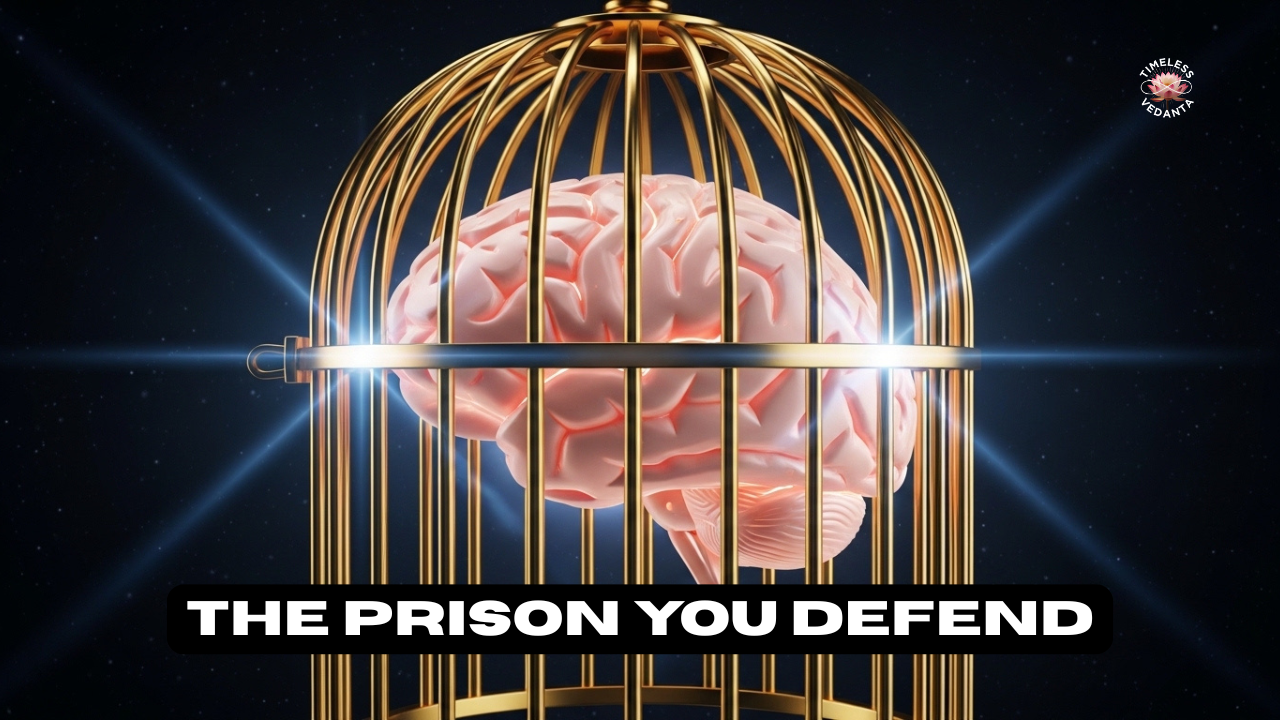

Why the Ego Prefers Ignorance to Truth

Most people polish the bars of their own prison. Vedanta offers the courage to burn the cage to the ground.

The Grand Illusion of the Mind

What traps human beings is not iron chains, not political systems, and not physical prisons. The most suffocating prison is the one the mind quietly constructs.

Below is the transcript of the video, tidied for clarity.


The Prison Built by the Mind

The most suffocating prison is not made of steel and stone.
It is the one the mind has built.

Brick by brick.

It is crafted by conditioning, fortified by unquestioned beliefs, and guarded by the egoโ€™s relentless grip on illusion.

Few ever chose these walls. Yet they polish the bars, defend them as sacred, and in some cases even kill to preserve them.

Lifetimes are spent worshipping their own captivity.

Why?

Because the ego would rather drown in the familiar waters of ignorance than swim towards the uncharted shores of truth.

It fears the death of its identity.
It fears the collapse of its carefully constructed world of illusion.


What Vedanta Reveals

Vedanta does not offer comfort.

It offers freedom.

It shatters every illusion:

The separation between self and other is a lie.
The hierarchy of teacher and disciple is a mirage.
The duality of master and servant is a delusion.

When these deceptions crumble, what remains is pure awareness.

Untouched.
Unshakable.
Eternal.


Beyond Belief

This is not about swapping one belief for another.

This is about burning all beliefs to the ground until nothing remains but the truth.

Aham Asmi.

โ€œI am.โ€

Not โ€œI am this.โ€
Not โ€œI am that.โ€

The pure, formless Self.

I am beyond labels, beyond control, beyond all limitation.


The Real Question

The question is not whether you can awaken.

The question is whether you will.

Will you sleepwalk through life, shackled by dogma and self-styled godmen with their hollow promises?

Or will you dare to see beyond illusion?

As Mark Twain once said:

โ€œIt is easier to fool people than to convince them they have been fooled.โ€


The Choice

The choice is yours.

Stay trapped in the grand illusion. A prisoner of your own mind. Enslaved by mental masters who profit from your ignorance.

Or break free.

Shatter the chains of deception and awaken to the infinite freedom Vedanta reveals.

One path keeps you blind, bound, and begging for answers.

The other leads you to the truth that has always been with you.


The Invitation

If you are ready to awaken, to see the world stripped of illusion, subscribe to this channel.

Dive into the Srimad Bhagavad Gita.
Study Vedanta.

Liberate yourself from belief, dogma, and manipulation.

You do not need to master it all today. Just understanding the fundamentals can save you from a lifetime of suffering.

Suffering is born from misperceptions and from refusing to see reality as it is.


The Courage to See

The truth is not for the faint of heart. It demands courage.

But if you seek it with unwavering determination, it will set you free.

There is nothing to believe.
No dogma.
No doctrine.

Only the truth to realise.

The truth that already resides within you, unseen and unrecognised, leaving you prey to charlatans and mountebanks who strut in flowing robes, their costumes masquerading as authority, a faรงade the masses mistake for wisdom.

Truth is not a belief.

It is a revelation.

A bolt of thunder in the darkness of illusion.


One Step

Please follow the blog at:

tavamithramsarvada.com

The journey to freedom begins with a single step.

The question is:

Will you take it?

READ THIS ARTICLE ON SUBSTACK

Continue beyond belief

If you are prepared to question conditioning, inherited identity, ego and second-hand claims, continue the enquiry through the two paths Tavamithram offers. Study Bhagavan Krishna’s teaching directly in the Gita Companion, or continue into Self-enquiry, identity, mind and Vedanta through Modern Rishi.

You Say โ€˜Iโ€™ All Day. But What Exactly Is It?

Every human being uses the word โ€œIโ€ countless times a day.

I am happy.
I am tired.
I am thinking.
I am worried.

But a very strange thing happens when we pause for a moment and ask a simple question:

What exactly is this โ€œIโ€?

Is it the body?

Is it the mind?

Is it something inside the body?

Or is it something entirely different from what we normally assume?

Most people never examine this question seriously. They simply inherit an idea of who they are and carry it throughout their lives without investigation.

Vedanta does something very different.

It asks us to look carefully, logically, and honestly at the one thing we take for granted more than anything else.

The word โ€œI.โ€

Instead of giving explanations here, let us examine the question directly through a rapid-fire enquiry.

Watch carefully how one assumption after another begins to dissolve.

If the reasoning is followed honestly, the result is not a belief or a mystical claim.

It is clarity.

And as Krishna says in the Srimad Bhagavad Gita (4:38):

There is nothing more purifying than knowledge.

Not mystical language, but the natural result of uncompromising enquiry.

Do This AT LEAST ONCE in Your Lifetime – Only 3 Hours!

No Mantras, No Prayers, No Fasting – Just 3 Hours to Smash Illusion and Gain the Supreme Truth!

I am not saying this. KRISHNA SAYS IT IN THE SRIMAD BHAGAVAD GITA.

All worries, fears, stress, anger, envy, and every negative force that can block, weaken, or destroy your chance of living a truly beautiful and fulfilling life will be crushed to smithereens and pulverised to dust.

With soothing sound, captivating visuals, and clear English text to follow along.

Please let me be honest, my dear brothers and sisters, I find it utterly saddening that so many people have been convinced that the Srimad Bhagavad Gita is โ€œtoo difficult to comprehendโ€ and that without a โ€œgood guruโ€ they can never learn it.

In Shloka SBG 9:02, Bhagavan Krishna clearly says that this knowledge is not only VERY EASY, but also it is also VERY EASY TO PRACTISE and it is EVERLASTING. All it takes is the small effort of sitting down and reading a simple translation of the 700 Shlokas. In fact, I must have read this supreme scripture over a thousand times, and I never tire of it. The same applies to every genuine seeker. You cannot read it once and expect to fully grasp it. But at the very least, read it, listen to it, or go through it ONCE BEFORE YOU DIE!

As part of my SBG for ALL Mission, here is my humble offering: a three-hour guided study of this life-changing scripture, a true gift to humanity.

Experience this once, and the weight of your illusions will collapse into nothing.

Please, take this opportunity. Whatever you think it is worth, COMPLETE IT. Do it at least for your brotherโ€™s sake. You can thank me later ๐Ÿ™‚

JAI SHRI KRISHNA.