Self-Enquiry in Advaita Vedanta: What Remains?

Sometimes you identify with your body and say, โ€˜I look good,โ€™ โ€˜I am fat,โ€™ โ€˜I am getting old,โ€™ โ€˜I am sick.โ€™ Other times, you identify with your mind and say, โ€˜I am excited,โ€™ โ€˜I am depressed,โ€™ โ€˜I am angry.โ€™ When life is going well, you say you have a great life, and when you feel low, you say your life is terrible.

Your body changes. Your mind changes. Your story changes.

What are you, then, when everything you call yourself keeps changing?

Give me less than ten minutes.


1: You Are Not the Body

The body is known.

You see it and feel it; you watch it change. It was small once. It is different now. One day it will be frail and unrecognisable. It has never stopped changing since the moment it appeared.

Now, here is the question: can the known be the knower? Obviously not.

You have a body. But you are not the body.


2: You Are Not the Mind

Thoughts appear and disappear. Anger arrives and leaves. Fear comes and goes. Even the silence between thoughts comes and goes.

So, if everything in the mind is passing through, what are you? You are the one in whom all of it is happening. The knower of the mind cannot be the mind. You are not the thought. You are not the thinker. You are what remains when the noise stops.


3: You Are Not Your Story

Your name was given to you by others. Your past is memory. Your identity is a collection of recorded experiences that the mind calls โ€œmine.โ€

Stop at that word. Mine.

You say โ€œmy childhood,โ€ โ€œmy pain,โ€ โ€œmy reputation,โ€ โ€œmy achievement,โ€ and even โ€œmy lifeโ€! If it is โ€œmy,โ€ it is not the final โ€œI.โ€ The story is known. You are not the story.


4: What Remains?

When the body is set aside as known, when the mind is set aside as known, when the story is set aside as known, what is left?

Awareness. Not a theory, not a religious claim, not something you need to practise into existence. It is the simple, undeniable fact of knowing. Before thought, it is there. During thought, it is there. After thought fades, it is still there.

You do not create it. You have simply been overlooking it.

That is what you are.


5: Why Suffering Begins

Now look at this carefully.

The body changes, and fear begins. The mind changes, and confusion begins. Peopleโ€™s opinions shift, and insecurity begins. Circumstances move, and anxiety begins.

Why? Because you placed yourself inside what was changing. You took the known to be the knower. You took the passing story to be the real โ€œI.โ€

That single error is the entire root of human suffering. Not sin. Not karma. Not fate. One misidentification. That is bondage.


6: Do Not Turn This Into Another Idea

At this point, the mind may try to grab the teaching and convert it into a new identity.

โ€œI am awareness.โ€ โ€œI know Vedanta.โ€ โ€œI understand Brahman.โ€ โ€œI am beyond the body and mind.โ€

Careful.

That may only be the ego wearing new clothes.

Vedanta is not a sentence to repeat. It is not a badge. It is not a spiritual status.

The question is not whether you can say โ€œI am awareness.โ€ The question is whether you still collapse when the body is criticised, the mind is disturbed, the story is threatened, or your image is insulted.

That is where the enquiry becomes real.


7: What Vedanta Actually Does

Vedanta does not hand you a new belief to replace the old one.

It removes error.

You already are the awareness because of which the body, the mind, the thought, the memory, and the entire world are known. Vedanta does not manufacture this truth. It exposes the confusion that has been covering it.

It does not say, โ€œBecome something else.โ€ It says, โ€œSee clearly what you have been mistaking yourself for.โ€ Nothing is added. Everything false is removed.


8: What Brahman Actually Means

Brahman is not a bearded โ€˜godโ€™ above the clouds. Not a cosmic authority watching from a throne.

Brahman is the reality because of which anything is known at all. The body appears in it. The mind moves in it. The world arises in it. Even this moment of reading or listening is happening because of it.

Not an object to be reached. Not a reward to be earned. It is the ground that is already here, making all experience possible.


9: What Liberation Actually Means

Liberation is not escape to another world. It is not joining an ashram, acquiring a title, or becoming someone others regard as spiritually elevated.

Liberation is the collapse of the central error.

The body continues to act. The mind continues to think. Life continues with all its weight and texture. But the root mistake is gone: the belief that โ€œI am this body-mind storyโ€ is gone.

Once that error is genuinely seen, and not merely understood as an interesting idea, life stops being driven by fear, vanity, and borrowed identity.


10: Final Strike

Do not believe me.

See it.

Everything you have ever called โ€œIโ€ has been known. The body, known. The mind, known. The story, known. The fear, the desire, and the confusion, all known.

You are the knower. You have never been the known.

That is Vedanta.


No costume. No institution. No borrowed holiness. No performance.

If the false โ€œIโ€ survives this enquiry untouched, nothing has happened. Sorry. But if the false โ€œIโ€ collapses, Vedanta has done its work.

Costume cannot replace clarity. Institution cannot replace enquiry. And no teacher has done the job if the false โ€œIโ€ walks out intact.

The special clothes were never the point. The real โ€œIโ€ was always the point.

The โ€˜Iโ€™ you have been protecting all your life was never you.

What you truly are has never been born, has never suffered, and has never needed saving.

READ THIS ARTICLE ON SUBSTACK

Continue the enquiry into the โ€œIโ€

If this question has become real for you, continue with Modern Rishi. It is built around the same enquiry into identity, the mind, the Self, conditioning, ego, responsibility and living with clarity.

Understanding Shiva Tandava Stotra: Ego and Liberation

The Shiva Tandava Stotra is one of the most striking and philosophically layered compositions in Sanskrit literature. Traditionally attributed to Ravana, the king of Lanka, this hymn occupies a unique place in Shaiva thought, not merely as an act of devotion, but as a profound symbolic exposition of reality, consciousness, and transformation.

Unlike many devotional hymns that praise a deity through submission or supplication, this Stotra is intense, rhythmic, and uncompromising. Its imagery is fierce, expansive, and unapologetically cosmic. It does not sentimentalise Shiva. It presents him as the very principle that governs creation, destruction, and the restless movement of existence itself.

Ravana: The Composer and the Paradox
Ravana is not a conventional devotee. He is described in the epics as supremely learned, extraordinarily powerful, and overwhelmingly egoic. He represents intellect without restraint, ambition without humility, and mastery without surrender. In this sense, Ravana signifies extreme ego, the height of self-assertion. That such a figure composes the Shiva Tandava Stotra is not accidental. The Stotra arises at the edge of confrontation between ego and reality. Ravanaโ€™s strength, knowledge, and pride reach a limit where they collide with something that cannot be dominated or possessed. Shiva, in this context, is not an object of worship but a force that dissolves arrogance by sheer clarity.

The Stotra is therefore not the voice of submission. It is the voice of recognition. Ravana does not diminish himself. Instead, his ego is forced to acknowledge a reality that cannot be controlled, threatened, or negotiated with. The intensity of the verses reflects this encounter. The hymn becomes an expression of awe, not obedience, and insight, not fear.

The Tandava as a Cosmic Vision
The dance described in the Shiva Tandava Stotra is not a physical performance confined to form or location. It is a cosmic metaphor for the nature of existence itself.

The Tandava represents the ceaseless movement of reality. Nothing in the universe is static. Forms arise, transform, and dissolve continuously. Creation and destruction are not opposing events but phases of the same ongoing process. Shivaโ€™s dance symbolises this unbroken rhythm that governs matter, energy, time, and life.

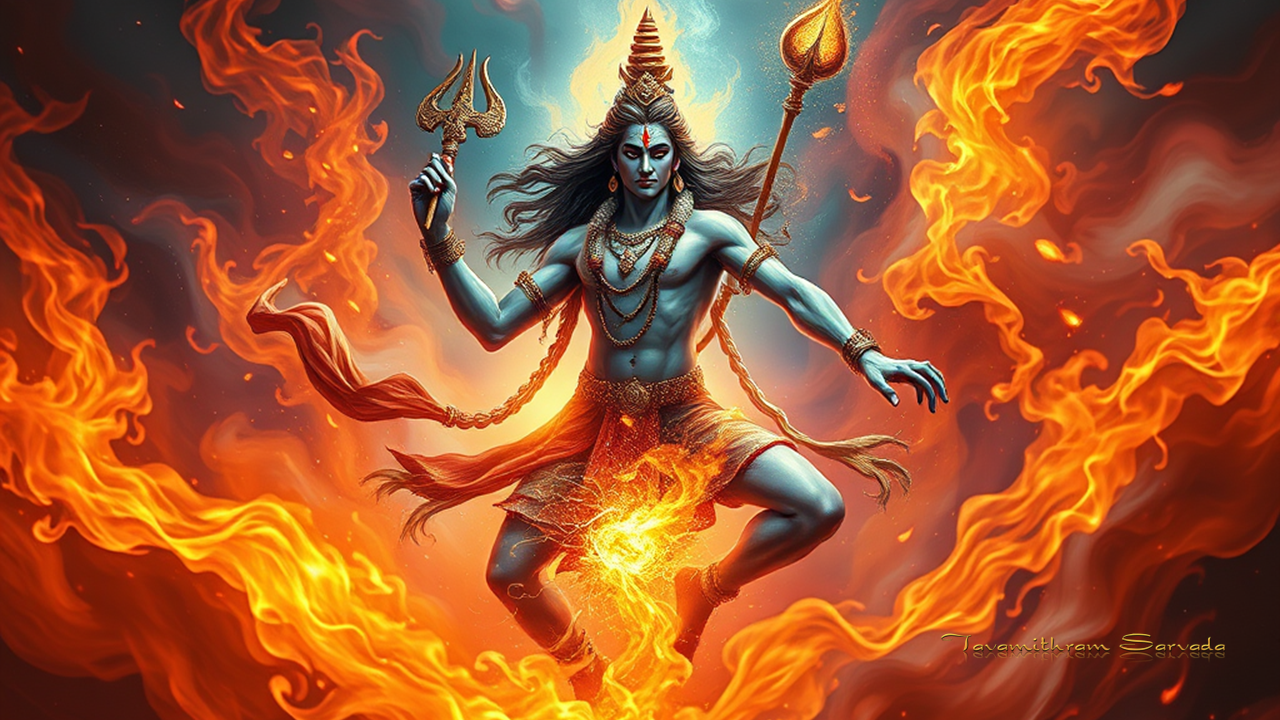
The circle of flames within which Shiva dances represents the total field of existence. It encompasses space, time, mass, energy, and all phenomena that appear within them. The flames signify impermanence. Everything within this circle is subject to change. Nothing endures as form.

The โ€˜damaruโ€™, a small hand drum, held in one hand symbolises rhythm and order, the principle through which manifestation occurs. Sound here is not mere noise but pattern, sequence, and structure. In another hand, Shiva holds fire, the force of transformation and dissolution. Creation and destruction are thus shown as inseparable, emerging from the same source.

Shivaโ€™s flowing, matted hair symbolises yogic awareness. It extends outward, suggesting that contemplation does not withdraw from the universe but includes it entirely. Awareness is not confined or limited. It is vast enough to contain all movement without being disturbed by it.

One hand is raised in reassurance. This gesture conveys fearlessness. Despite constant change, decay, and uncertainty, existence is not hostile. When understood rightly, the movement of life does not threaten awareness.

Ego, Ignorance, and Liberation
Beneath Shivaโ€™s foot lies the dwarf of ignorance, often interpreted as ego. This figure does not represent moral evil but psychological bondage. Ego is the false centre that claims ownership, control, and permanence in a world that offers none. The dwarf is not destroyed. It is restrained. This is significant. The ego cannot be eliminated by force or denial. It must be seen clearly and placed in its proper position. Shivaโ€™s foot presses upon it, indicating mastery rather than annihilation.

The raised foot represents transcendence. It is lifted against gravity, symbolising freedom from compulsive identification with form, fear, and desire. This lifted foot points to contemplation, inward stillness, and clarity. Liberation is not an escape from the world but a release from misidentification within it.

The Tandava also includes suffering. Shiva dances not only in celebration but in cremation grounds. Death, loss, decay, and dissolution are not excluded from the vision. They are integral to it. The Stotra does not deny pain or impermanence. It demands their acceptance as part of the total movement of existence.

Shiva and Shakti: Awareness and Existence
The Tandava cannot be understood without recognising the role of Shakti, Shivaโ€™s consort.

Shiva represents pure awareness, unmoving, unchanged, and self-luminous. Shakti represents existence itself, movement, energy, form, and expression. All action, transformation, creation, and dissolution belong to Shakti. All knowing, witnessing, and clarity belong to Shiva.

They are not two separate realities. They are two aspects of the same truth. Awareness without existence would have nothing to illuminate. Existence without awareness would be blind and meaningless.

The dance occurs because of Shakti. The still centre of the dance is Shiva. This expresses a fundamental insight: awareness does not act, yet nothing acts without awareness. The universe moves, transforms, and dissolves within awareness, not outside it.

To see Shiva and Shakti as separate is ignorance. To recognise their unity is understanding. The Tandava shows that stillness and movement, silence and sound, being and becoming are not opposites. They are inseparable.

The Meaning of the Stotra
The Shiva Tandava Stotra is therefore not merely a devotional hymn. It is a complete symbolic vision of reality. It explains the cosmos outside and the turbulence within the human mind through a single, integrated metaphor.

Ravanaโ€™s ego confronts the absolute. The universe dances. Awareness remains untouched. Existence moves endlessly. Liberation lies not in stopping the dance, but in understanding its nature.

This is the vision that unfolds in the Shlokas that follow.

1
เคœเคŸเคพเคŸเคตเฅ€เค—เคฒเคœเฅเคœเคฒเคชเฅเคฐเคตเคพเคนเคชเคพเคตเคฟเคคเคธเฅเคฅเคฒเฅ‡
เค—เคฒเฅ‡เคฝเคตเคฒเคฎเฅเคฌเฅเคฏ เคฒเคฎเฅเคฌเคฟเคคเคพเค‚ เคญเฅเคœเค™เฅเค—เคคเฅเค™เฅเค—เคฎเคพเคฒเคฟเค•เคพเคฎเฅ เฅค
เคกเคฎเคกเฅเคกเคฎเคกเฅเคกเคฎเคกเฅเคกเคฎเคจเฅเคจเคฟเคจเคพเคฆเคตเคกเฅเคกเคฎเคฐเฅเคตเคฏเค‚
เคšเค•เคพเคฐ เคšเคฃเฅเคกเคคเคพเคฃเฅเคกเคตเค‚ เคคเคจเฅ‹เคคเฅ เคจเคƒ เคถเคฟเคตเคƒ เคถเคฟเคตเคฎเฅ เฅฅเฅงเฅฅ

jataa tavee gala jala pravaaha paavitha sthale
galae valambya lambitaam bhujanga tunga maalikaam
damad damad damad damanni naadha vadda marvayam
chakaara chaNda thaaNdavam thanothu nah shivah shivam.

On the sacred ground made pure by the streams flowing down from the forest of matted locks,
with a lofty and hanging garland of serpents adorning the neck,
as the damaru resounds again and again with its thunderous rhythm,
may Shiva, who performs the fierce Tandava, bestow auspiciousness upon us.

2
เคœเคŸเคพเค•เคŸเคพเคนเคธเคฎเฅเคญเฅเคฐเคฎเคญเฅเคฐเคฎเคจเฅเคจเคฟเคฒเคฟเคฎเฅเคชเคจเคฟเคฐเฅเคเคฐเฅ€
เคตเคฟเคฒเฅ‹เคฒเคตเฅ€เคšเคฟเคตเคฒเฅเคฒเคฐเฅ€เคตเคฟเคฐเคพเคœเคฎเคพเคจเคฎเฅ‚เคฐเฅเคงเคจเคฟ เฅค
เคงเค—เคฆเฅเคงเค—เคฆเฅเคงเค—เคœเฅเคœเคฒเคฒเฅเคฒเคฒเคพเคŸเคชเคŸเฅเคŸเคชเคพเคตเค•เฅ‡
เค•เคฟเคถเฅ‹เคฐเคšเคจเฅเคฆเฅเคฐเคถเฅ‡เค–เคฐเฅ‡ เคฐเคคเคฟเคƒ เคชเฅเคฐเคคเคฟเค•เฅเคทเคฃเค‚ เคฎเคฎ เฅฅเฅจเฅฅ

jataa kataaha sambhrama bhramanni nilimpa nirjharee
vilola veechi vallaree viraaja maana moordhani
dhagad dhagad dhagaj jvalal lalaata patta paavake
kishora chandra shekhare ratih pratikshaNam mama.

As the celestial river whirls restlessly through the cauldron-like mass of matted hair,
with rippling waves spreading and adorning the head in restless motion,
while the blazing fire crackles fiercely across the broad forehead,
my mind finds delight at every moment in the one crowned with the youthful crescent moon.

3
เคงเคฐเคพเคงเคฐเฅ‡เคจเฅเคฆเฅเคฐเคจเคจเฅเคฆเคฟเคจเฅ€เคตเคฟเคฒเคพเคธเคฌเคจเฅเคงเฅเคฌเคจเฅเคงเฅเคฐ
เคธเฅเคซเฅเคฐเคฆเฅเคฆเคฟเค—เคจเฅเคคเคธเคจเฅเคคเคคเคฟเคชเฅเคฐเคฎเฅ‹เคฆเคฎเคพเคจเคฎเคพเคจเคธเฅ‡ เฅค
เค•เฅƒเคชเคพเค•เคŸเคพเค•เฅเคทเคงเฅ‹เคฐเคฃเฅ€เคจเคฟเคฐเฅเคฆเฅเคงเคฆเฅเคฐเฅเคงเคฐเคพเคชเคฆเคฟ
เค•เฅเคตเคšเคฟเคฆเฅเคฆเคฟเค—เคฎเฅเคฌเคฐเฅ‡ เคฎเคจเฅ‹ เคตเคฟเคจเฅ‹เคฆเคฎเฅ‡เคคเฅ เคตเคธเฅเคคเฅเคจเคฟ เฅฅเฅฉเฅฅ

dharaa dharendra nandinee vilaasa bandhu bandhura
sphurad diganta santati pramoda maana maanase
krupaa kataaksha dhoraNee niruddha durdharaa padi
kvachid digambare mano vinoda mettu vastuni.

Bound in playful companionship with the daughter of the mountain king,
whose mind rejoices as joy spreads to the farthest horizons,
whose steady stream of compassionate glances restrains even unbearable calamity,
may my mind find delight in that sky-clad, boundless reality.

4
เคœเคŸเคพเคญเฅเคœเค™เฅเค—เคชเคฟเค™เฅเค—เคฒเคธเฅเคซเฅเคฐเคคเฅเคซเคฃเคพเคฎเคฃเคฟเคชเฅเคฐเคญเคพ
เค•เคฆเคฎเฅเคฌเค•เฅเค™เฅเค•เฅเคฎเคฆเฅเคฐเคตเคชเฅเคฐเคฒเคฟเคชเฅเคคเคฆเคฟเค—เฅเคตเคงเฅ‚เคฎเฅเค–เฅ‡ เฅค
เคฎเคฆเคพเคจเฅเคงเคธเคฟเคจเฅเคงเฅเคฐเคธเฅเคซเฅเคฐเคคเฅเคคเฅเคตเค—เฅเคคเฅเคคเคฐเฅ€เคฏเคฎเฅ‡เคฆเฅเคฐเฅ‡
เคฎเคจเฅ‹ เคตเคฟเคจเฅ‹เคฆเคฎเคฆเฅโ€เคญเฅเคคเค‚ เคฌเคฟเคญเคฐเฅเคคเฅ เคญเฅ‚เคคเคญเคฐเฅเคคเคฐเคฟ เฅฅเฅชเฅฅ

jataa bhujanga pingala sphurat phanaa mani prabhaa
kadhamba kumkuma drava pralipta dig vadhuu mukhae
madaandha sindhura sphurat tvagut tareeya medure
mano vinoda madbhutam bibhartu bhoota bhartari.

From the tawny serpents coiled in the matted hair, the radiance of the jewels on their raised hoods flashes forth,
smearing the faces of the directions as if with flowing kadamba and vermilion,
while the quivering hide of an intoxicated elephant forms a powerful covering,
may the sustainer of all beings hold my mind in wondrous delight.

5
เคธเคนเคธเฅเคฐเคฒเฅ‹เคšเคจเคชเฅเคฐเคญเฅƒเคคเฅเคฏเคถเฅ‡เคทเคฒเฅ‡เค–เคถเฅ‡เค–เคฐ
เคชเฅเคฐเคธเฅ‚เคจเคงเฅ‚เคฒเคฟเคงเฅ‹เคฐเคฃเฅ€ เคตเคฟเคงเฅ‚เคธเคฐเคพเค™เฅเค˜เฅเคฐเคฟเคชเฅ€เค เคญเฅ‚เคƒ เฅค
เคญเฅเคœเค™เฅเค—เคฐเคพเคœเคฎเคพเคฒเคฏเคพ เคจเคฟเคฌเคฆเฅเคงเคœเคพเคŸเคœเฅ‚เคŸเค•
เคถเฅเคฐเคฟเคฏเฅˆ เคšเคฟเคฐเคพเคฏ เคœเคพเคฏเคคเคพเค‚ เคšเค•เฅ‹เคฐเคฌเคจเฅเคงเฅเคถเฅ‡เค–เคฐเคƒ เฅฅเฅซเฅฅ

sahasra lochana prabhrutya shesha lekha shekhara
prasoona dhooli dhoranee vidhoosara anghri peethabhuh
bhujanga raaja maalayaa nibaddha jaata jootaka
shriyai chiraaya jaayatam chakora bandhu shekharah.

Adorned by the assembled hosts beginning with the thousand-eyed one,
whose footrest is dusted and greyed by streams of flower pollen,
whose matted locks are bound by a garland of the king of serpents,
may the moon-crested one, the companion of the chakora bird, arise for enduring prosperity.

6
เคฒเคฒเคพเคŸเคšเคคเฅเคตเคฐเคœเฅเคตเคฒเคฆเฅเคงเคจเคžเฅเคœเคฏเคธเฅเคซเฅเคฒเคฟเค™เฅเค—เคญเคพ
เคจเคฟเคชเฅ€เคคเคชเคžเฅเคšเคธเคพเคฏเค•เค‚ เคจเคฎเคจเฅเคจเคฟเคฒเคฟเคฎเฅเคชเคจเคพเคฏเค•เคฎเฅ เฅค
เคธเฅเคงเคพเคฎเคฏเฅ‚เค–เคฒเฅ‡เค–เคฏเคพ เคตเคฟเคฐเคพเคœเคฎเคพเคจเคถเฅ‡เค–เคฐเค‚
เคฎเคนเคพเค•เคชเคพเคฒเคฟเคธเคฎเฅเคชเคฆเฅ‡เคถเคฟเคฐเฅ‹เคœเคŸเคพเคฒเคฎเคธเฅเคคเฅ เคจเคƒ เฅฅเฅฌเฅฅ

lalaata chatvara jvalad dhananjaya sphulinga bhaa
nipeeta pancha saayakam namanni nilimpa naayakam
sudhaa mayookha lekhayaa viraaja maana shekharam
mahaa kapaali sampade shiro jataala mastu nah.

From the blazing centre of the forehead flashes the conquering spark of fire,
which consumed the five arrows and before whom the celestial beings bow,
whose head shines adorned with the crescent traced in nectar-like rays,
may the great skull-bearing one, with matted locks, grant us prosperity.

7
เค•เคฐเคพเคฒเคญเคพเคฒเคชเคŸเฅเคŸเคฟเค•เคพเคงเค—เคฆเฅโ€เคงเค—เคฆเฅโ€เคงเค—เคœเฅเคœเฅเคตเคฒเคฆเฅ
เคงเคจเคžเฅเคœเคฏเคพเคนเฅเคคเฅ€เค•เฅƒเคคเคชเฅเคฐเคšเคฃเฅเคกเคชเคžเฅเคšเคธเคพเคฏเค•เฅ‡ เฅค
เคงเคฐเคพเคงเคฐเฅ‡เคจเฅเคฆเฅเคฐเคจเคจเฅเคฆเคฟเคจเฅ€เค•เฅเคšเคพเค—เฅเคฐเคšเคฟเคคเฅเคฐเคชเคคเฅเคฐเค•
เคชเฅเคฐเค•เคฒเฅเคชเคจเฅˆเค•เคถเคฟเคฒเฅเคชเคฟเคจเคฟ เคคเฅเคฐเคฟเคฒเฅ‹เคšเคจเฅ‡ เคฐเคคเคฟเคฐเฅเคฎเคฎ เฅฅเฅญเฅฅ

karaala bhaala pattikaa dhagad dhagad dhagaj jvalad
dhananjayaa huthee kruta prachanda pancha saayake
dharaa dharendra nandinee kuchaagra chitra patraka
prakalpanaika shilpini trilochane ratir mama.

As the fearsome fire blazes across the broad surface of the forehead,
having reduced the fierce five arrows to a sacrificial offering,
while the movements of the dance trace wondrous patterns upon the bosom of the mountainโ€™s daughter, my devotion rests in the three-eyed one, the sole master craftsman of creation.

8
เคจเคตเฅ€เคจเคฎเฅ‡เค˜เคฎเคฃเฅเคกเคฒเฅ€ เคจเคฟเคฐเฅเคฆเฅโ€เคงเคฆเฅเคฐเฅเคงเคฐเคธเฅเคซเฅเคฐเคคเฅ
เค•เฅเคนเฅ‚เคจเคฟเคถเฅ€เคฅเคฟเคจเฅ€เคคเคฎเคƒ เคชเฅเคฐเคฌเคจเฅเคงเคฌเคฆเฅเคงเค•เคจเฅเคงเคฐเคƒ เฅค
เคจเคฟเคฒเคฟเคฎเฅเคชเคจเคฟเคฐเฅเคเคฐเฅ€เคงเคฐเคธเฅเคคเคจเฅ‹เคคเฅ เค•เฅƒเคคเฅเคคเคฟเคธเคฟเคจเฅเคงเฅเคฐเคƒ
เค•เคฒเคพเคจเคฟเคงเคพเคจเคฌเคจเฅเคงเฅเคฐเคƒ เคถเฅเคฐเคฟเคฏเค‚ เคœเค—เคฆเฅเคงเฅเคฐเค‚เคงเคฐเคƒ เฅฅเฅฎเฅฅ

naveena megha mandalee niruddha durdhara sphurat
kuhoo nisheethi neetamah prabandha baddha kandharah
nilimpa nirjharee dharas tanotu krutti sindhurah
kalaa nidhaana bandhurah shriyam jagat dhurandharah.

With the dense brilliance of newly formed cloud-clusters restrained around the neck,
binding the deep darkness of the moonless night in a continuous band,
the bearer of the celestial river and the wearer of the elephant hide,
the beloved source of all arts, the sustainer of the universeโ€™s prosperity, may bestow auspiciousness.

9
เคชเฅเคฐเคซเฅเคฒเฅเคฒเคจเฅ€เคฒเคชเค™เฅเค•เคœเคชเฅเคฐเคชเคžเฅเคšเค•เคพเคฒเคฟเคฎเคชเฅเคฐเคญเคพ
เคตเคฒเคฎเฅเคฌเคฟเค•เคฃเฅเค เค•เคจเฅเคฆเคฒเฅ€เคฐเฅเคšเคฟเคชเฅเคฐเคฌเคฆเฅเคงเค•เคจเฅเคงเคฐเคฎเฅ เฅค
เคธเฅเคฎเคฐเคšเฅเค›เคฟเคฆเค‚ เคชเฅเคฐเคšเฅเค›เคฟเคฆเค‚ เคญเคตเคšเฅเค›เคฟเคฆเค‚ เคฎเค–เคšเฅเค›เคฟเคฆเค‚
เค—เคœเคšเฅเค›เคฟเคฆเคพเคจเฅเคงเค•เคšเฅเค›เคฟเคฆเค‚ เคคเคฎเคจเฅเคคเค•เคšเฅเค›เคฟเคฆเค‚ เคญเคœเฅ‡ เฅฅเฅฏเฅฅ

prafulla neela pankaja prapancha kaalima prabhaa
valambi kantha kandalee ruchi prabaddha kandharam
smaracchidam puracchidam bhavacchidam makhacchidam
gajacchidandhakacchidam tamantakacchidam bhaje.

Whose dark radiance spreads like fully bloomed blue lotuses across the expanse,
whose neck bears that lustre, held and bound in glowing brilliance,
the destroyer of desire, the destroyer of the cities, the destroyer of becoming, the destroyer of sacrifice,
the slayer of Gaja and Andhaka, the bringer of death to death itself, that one I revere.

10
เค…เค–เคฐเฅเคตเคธเคฐเฅเคตเคฎเค™เฅเค—เคฒเคพเค•เคฒเคพเค•เคฆเคฎเฅเคฌเคฎเคžเฅเคœเคฐเฅ€
เคฐเคธเคชเฅเคฐเคตเคพเคนเคฎเคพเคงเฅเคฐเฅ€เคตเคฟเคœเฅƒเคฎเฅเคญเคฃเคพเคฎเคงเฅเคตเฅเคฐเคคเคฎเฅ เฅค
เคธเฅเคฎเคฐเคพเคจเฅเคคเค•เค‚ เคชเฅเคฐเคพเคจเฅเคคเค•เค‚ เคญเคตเคพเคจเฅเคคเค•เค‚ เคฎเค–เคพเคจเฅเคคเค•เค‚
เค—เคœเคพเคจเฅเคคเค•เคพเคจเฅเคงเค•เคพเคจเฅเคคเค•เค‚ เคคเคฎเคจเฅเคคเค•เคพเคจเฅเคคเค•เค‚ เคญเคœเฅ‡ เฅฅเฅงเฅฆเฅฅ

akharva sarva mangalaa kalaa kadamba manjaree
rasa pravaaha maadhuri vijrumbhanaa madhu vratam
smaraantakam puraantakam bhavaantakam makhaantakam
gajaantakaandhakaantakam tamanta kaantakam bhaje.

An unceasing cluster of all auspicious arts, unfolding in abundance,
from whom flows a stream of sweetness, expanding like nectar in full bloom,
the transcender of desire, the transcender of the cities, the transcender of becoming, the transcender of sacrifice,
the destroyer of Gaja and Andhaka, the transcender of death itself, that one I revere.

11
เคœเคฏเคคเฅเคตเคฆเคญเฅเคฐเคตเคฟเคญเฅเคฐเคฎเคญเฅเคฐเคฎเคฆเฅโ€เคญเฅเคœเค™เฅเค—เคฎเคถเฅเคตเคธเคฆเฅ
เคตเคฟเคจเคฟเคฐเฅเค—เคฎเคคเฅเค•เฅเคฐเคฎเคธเฅเคซเฅเคฐเคคเฅเค•เคฐเคพเคฒเคญเคพเคฒเคนเคตเฅเคฏเคตเคพเคŸเฅ เฅค
เคงเคฟเคฎเคฟเคฆเฅเคงเคฟเคฎเคฟเคฆเฅเคงเคฟเคฎเคฟเคงเฅเคตเคจเคจเฅเคฎเฅƒเคฆเค™เฅเค—เคคเฅเค™เฅเค—เคฎเค™เฅเค—เคฒ
เคงเฅเคตเคจเคฟเค•เฅเคฐเคฎเคชเฅเคฐเคตเคฐเฅเคคเคฟเคคเคชเฅเคฐเคšเคฃเฅเคกเคคเคพเคฃเฅเคกเคตเคƒ เคถเคฟเคตเคƒ เฅฅเฅงเฅงเฅฅ

jayatva dabhravibhrama bhramad bhujangam ashvasad
vinirgamat krama sphurat karaala bhaala havya vaat
dhimid dhimid dhimid dhvanan mrudanga tunga mangala
dhvani krama pravartita prachanda taandavah shivah.

Victory to Shiva, whose fierce Tandava surges forth,
as serpents whirl and hiss in restless motion,
while the blazing altar of the fearsome forehead pulses in rising flames,
driven by the powerful, auspicious rhythms of the โ€˜mridangaโ€™ sounding dhimid, dhimid, again and again.

12

เคธเฅเคชเฅƒเคทเคฆเฅเคตเคฟเคšเคฟเคคเฅเคฐเคคเคฒเฅเคชเคฏเฅ‹เคฐเฅเคญเฅเคœเค™เฅเค—เคฎเฅŒเค•เฅเคคเคฟเค•เคธเฅเคฐเคœเฅ‹เคฐเฅ
เค—เคฐเคฟเคทเฅเค เคฐเคคเฅเคจเคฒเฅ‹เคทเฅเค เคฏเฅ‹เคƒ เคธเฅเคนเฅƒเคฆเฅเคตเคฟเคชเค•เฅเคทเคชเค•เฅเคทเคฏเฅ‹เคƒ เฅค
เคคเฅƒเคฃเคพเคฐเคตเคฟเคจเฅเคฆเคšเค•เฅเคทเฅเคทเฅ‹เคƒ เคชเฅเคฐเคœเคพเคฎเคนเฅ€เคฎเคนเฅ‡เคจเฅเคฆเฅเคฐเคฏเฅ‹เคƒ
เคธเคฎเคชเฅเคฐเคตเฅƒเคคเฅเคคเคฟเค•เคƒ เค•เคฆเคพ เคธเคฆเคพเคถเคฟเคตเค‚ เคญเคœเคพเคฎเฅเคฏเคนเคฎเฅ เฅฅเฅงเฅจเฅฅ

sprushad vichitra talpayor bhujanga mauktika srajor
garishtha ratna loshthayoh suhrud vipaksha pakshayoh
trunaaravinda chakshushoh prajaa mahee mahendrayoh
sama pravrittikah kadaa sadaashivam bhajaamyaham.

When shall I revere Sadashiva with equal vision,
seeing no difference between a splendid couch and the bare ground,
between a serpentโ€™s pearl garland and a lump of clay, between friend and foe,
between blade of grass and lotus, between a subject and a sovereign?

13

เค•เคฆเคพ เคจเคฟเคฒเคฟเคฎเฅเคชเคจเคฟเคฐเฅเคเคฐเฅ€เคจเคฟเค•เฅเคžเฅเคœเค•เฅ‹เคŸเคฐเฅ‡ เคตเคธเคจเฅ
เคตเคฟเคฎเฅเค•เฅเคคเคฆเฅเคฐเฅเคฎเคคเคฟเคƒ เคธเคฆเคพ เคถเคฟเคฐเคธเฅเคฅเคฎเคžเฅเคœเคฒเคฟเค‚ เคตเคนเคจเฅ เฅค
เคตเคฟเคฒเฅ‹เคฒเคฒเฅ‹เคฒเคฒเฅ‹เคšเคจเฅ‹ เคฒเคฒเคพเคฎเคญเคพเคฒเคฒเค—เฅเคจเค•เคƒ
เคถเคฟเคตเฅ‡เคคเคฟ เคฎเคจเฅเคคเฅเคฐเคฎเฅเคšเฅเคšเคฐเคจเฅเค•เคฆเคพ เคธเฅเค–เฅ€ เคญเคตเคพเคฎเฅเคฏเคนเคฎเฅ เฅฅเฅงเฅฉเฅฅ

kadaa nilimpa nirjharee nikunja kotare vasan
vimukta durmateeh sadaa shirastha manjalim vahan
vilola lola lochano lalaama bhaala lagnakah
shiveti mantra muchcharan kadaa sukhee bhavaamyaham.

When shall I dwell in a forest hollow beside the celestial river,
freed from distorted thought, bearing folded hands upon my head,
with unsteady eyes and the sacred mark fixed upon the forehead,
uttering the mantra โ€œShivaโ€, when shall I abide in happiness?

14
เค‡เคฆเคฎเฅ เคนเคฟ เคจเคฟเคคเฅเคฏเคฎเฅ‡เคตเคฎเฅเค•เฅเคคเคฎเฅเคคเฅเคคเคฎเฅ‹เคคเฅเคคเคฎเค‚ เคธเฅเคคเคตเค‚
เคชเค เคจเฅเคธเฅเคฎเคฐเคจเฅเคฌเฅเคฐเฅเคตเคจเฅเคจเคฐเฅ‹ เคตเคฟเคถเฅเคฆเฅเคงเคฟเคฎเฅ‡เคคเคฟเคธเค‚เคคเคคเคฎเฅ เฅค
เคนเคฐเฅ‡ เค—เฅเคฐเฅŒ เคธเฅเคญเค•เฅเคคเคฟเคฎเคพเคถเฅ เคฏเคพเคคเคฟ เคจเคพเคจเฅเคฏเคฅเคพ เค—เคคเคฟเค‚
เคตเคฟเคฎเฅ‹เคนเคจเค‚ เคนเคฟ เคฆเฅ‡เคนเคฟเคจเคพเค‚ เคธเฅเคถเค™เฅเค•เคฐเคธเฅเคฏ เคšเคฟเคจเฅเคคเคจเคฎเฅ เฅฅเฅงเฅชเฅฅ

idam hi nityam eva muktam uttamottamam stavam
pathan smaran bruvan naro vishuddhim eti santatam
hare gurau subhaktim aashu yaati na anyathaa gatim
vimohanam hi dehinaam sushankarasya chintanam.

Whoever continually recites, remembers, and speaks this supreme hymn
attains lasting inner purity,
quickly developing unwavering devotion toward Hara and the guiding teacher, with no other path remaining,
for contemplation of Shankara alone dispels the delusion of embodied beings.

15
เคชเฅ‚เคœเคพเคตเคธเคพเคจเคธเคฎเคฏเฅ‡ เคฆเคถเคตเค•เฅเคคเฅเคฐเค—เฅ€เคคเค‚
เคฏเคƒ เคถเคฎเฅเคญเฅเคชเฅ‚เคœเคจเคชเคฐเค‚ เคชเค เคคเคฟ เคชเฅเคฐเคฆเฅ‹เคทเฅ‡ เฅค
เคคเคธเฅเคฏ เคธเฅเคฅเคฟเคฐเคพเค‚ เคฐเคฅเค—เคœเฅ‡เคจเฅเคฆเฅเคฐเคคเฅเคฐเค™เฅเค—เคฏเฅเค•เฅเคคเคพเค‚
เคฒเค•เฅเคทเฅเคฎเฅ€เค‚ เคธเคฆเฅˆเคต เคธเฅเคฎเฅเค–เฅ€เค‚ เคชเฅเคฐเคฆเคฆเคพเคคเคฟ เคถเคฎเฅเคญเฅเคƒ เฅฅเฅงเฅซเฅฅ

pooja vasaana samaye dashavaktra geetam
yah shambhu poojana param pathati pradoshe
tasya sthiraam ratha gajendra turanga yuktaam
lakshmeem sadaiva sumukheem pradadaati shambhuh.

Whoever recites this hymn sung by the ten-faced one
at the close of worship, devoted to Shambhu, at the sacred twilight hour,
to that person is granted enduring prosperity, accompanied by chariots, elephants, and horses,
and Lakshmi ever bestows her gracious presence.

เค‡เคคเคฟ เคถเฅเคฐเฅ€เคฐเคพเคตเคฃเค•เฅƒเคคเค‚
เคถเคฟเคตเคคเคพเคฃเฅเคกเคตเคธเฅเคคเฅ‹เคคเฅเคฐเค‚
เคธเคฎเฅเคชเฅ‚เคฐเฅเคฃเคฎเฅ เฅฅ

iti shri raavana krutam
shiva taandava Stotram
sampoornam.

Thus ends the Shiva Tandava Stotra,
composed by Ravana,
complete.

Truth Doesnโ€™t Care About Your Beliefs: Uncover the Ultimate Reality

READ AND WATCH THROUGH MY SUBSTACK

Youโ€™ve been told what to think. Youโ€™ve been conditioned to accept, obey, and conform. But what if everything you believeโ€”everything you rely onโ€”has been carefully placed there to keep you from seeing the truth?

What if the world around you isnโ€™t what it seems?

This isnโ€™t just another talk. Itโ€™s an experienceโ€”one that might shake the very foundation of what you think is real. But be warned: once you step through this door, there is no going back.

Are you ready to challenge everything? Watch now.

From Frustration to Fulfilment

The Essential Guide to Overcoming Lifeโ€™s Unfavourable Situations

*SUBSCRIBE TO MY SUBSTACK โ€“ ITโ€™S FREE*

Breaking Free from the Cycle

Many of us find ourselves stuck in a cycle of complaining, brooding, and feeling generally dissatisfied with our circumstances. Whether it’s our job, relationships, or personal achievements, the tendency to ruminate on what’s wrong can be overwhelming. And yet, despite the temporary relief we might find in venting to a friend or relative, we often wake up the next day only to repeat the same routine, with nothing having changed. The question then arises: how can we expect change when we continue to do the same thing?

The Unproductive Cycle of Complaints

Complaining and brooding are natural human responses to dissatisfaction. It’s almost instinctual to express our frustrations when things don’t go as planned. However, these actions rarely lead to meaningful change. Instead, they often serve as a temporary release, a way to momentarily ease the pressure without addressing the underlying issues. As a result, we remain stuck in the same unfavourable situation, repeating the cycle day after day.

To break free from this cycle, it’s crucial to take a different approachโ€”one rooted in clarity and action. The key lies in defining your problems and goals with precision. Let me take you back to my childhood to illustrate this point.

As a young boy, I was naturally curious and had a mechanical aptitude that drove me to understand how things worked. I was always eager to get to the bottom of things, refusing to accept anything at face value without clear evidence. When I was reprimanded by elders or teachers for my behaviour, I didn’t just accept the scolding. Instead, I wanted to know what I had done wrong and, more importantly, what I should do right. However, my requests for guidance were often met with silence or a cold stare, leaving me with unanswered questions.

This experience taught me a vital lesson: in any situation, if something is wrong, it’s essential to ask, “What is right?” This principle can be applied to any area of life:

  1. If youโ€™re dissatisfied with your job, ask: What is my ideal job?
  2. If you donโ€™t like your life, ask yourself: What would my ideal life look like?
  3. If youโ€™re unhappy in a relationship, ask: What is the ideal relationship I want?

The Three-Step Approach to Change

Once you’ve asked these questions, the next step is to define your situation clearly. Here’s a practical approach:

  1. Identify What You Donโ€™t Like and Why: Be specific about what bothers you. Is it the long hours at work, the lack of appreciation, or perhaps a feeling of being stuck? Understand the root cause of your dissatisfaction.

  2. Create a Clear Vision of What You Want: Visualise your ideal situation in detail. What does your perfect job look like? What qualities define your ideal relationship? Be as specific as possible, down to the finest details.

  3. Develop a Plan to Achieve Your Vision: Identify the steps you need to take to move from your current situation to your ideal one. This might involve learning new skills, making lifestyle changes, or even having difficult conversations. The key is to take actionable steps that lead you closer to your goal.

The Danger of Temporary Fixes

Many people, when faced with an unfavourable situation, seek quick fixes to ease their minds temporarily. Whether it’s pouring out your woes to a friend, closing your eyes and sitting under a tree or in a religious place, or even turning to substances, these methods offer only momentary relief. They donโ€™t address the core issues and often lead to more frustration when the problem inevitably resurfaces.

Please always remember that if someone truly wants something, they will find a way to get it. Consider alcohol and substance addicts or those addicted to gamblingโ€”they always manage to obtain what they crave. If you feel youโ€™ve been working hard with no improvement in your life, instead of adopting a victim or ‘poor me’ attitude, try to view it from another perspective. Perhaps your efforts are insufficient, misdirected, or lack proper direction.

Summing up and Learning to Take Control of Your Life

If youโ€™re unhappy with your current situation, donโ€™t waste time complaining or seeking temporary distractions. Instead, follow the steps Iโ€™ve outlined:

  1. Define your issue clearly.
  2. Visualise your ideal situation.
  3. Take actionable steps to achieve your vision.

By doing so, youโ€™ll find that you have the power to transform your life into something truly fulfilling. These steps may seem simple, but they are profoundly effectiveโ€”I speak from experience.

Never forget that many people donโ€™t know exactly what they want. Complaining and feeling depressed require less effort than reflecting and strategising, which is why slipping into self-pity is so easy. For anything good and positive to materialise, there must first be a clear image in the mind. So, the next time you feel the urge to complain or brood, make sure you know exactly what you want.

Real change begins with a clear definition of your goals and a commitment to taking action.

A Mind-Bending Voyage

Experience the Vastness and Awesomeness of Existence

Reality, Perception, and the Awakening of Consciousness

*SUBSCRIBE TO MY SUBSTACK โ€“ ITโ€™S FREE*

*Please listen to the audio or read the post before watching the video.

After a decade away, I found myself standing once more in front of the house where I had lived until I was 11. This was the place where my sister and I used to walk to school, hand in hand, through green fields, joyfully crossing a small brook along the way. But as I stood there, I was struck by how different everything seemed. The street that once seemed so long and wide now appeared short and narrow. The house, which I remembered as spacious, looked small. The distance to my school, which had once felt like a great journey, now seemed trivial.

What had happened? When I left Poona, I was 11 years old. Now, I was 21. I had grown taller, and my perspective had shifted. The distances and proportions I held in my mind were relative to my height and understanding as a child.

This experience confirmed a profound truth: what we call reality is shaped entirely by our perception. When I was a child, my world seemed vast. As an adult, returning to that same world, it appeared small and contained. The reality I perceived at 11 was not an absolute truthโ€”it was a reflection of my limited perception at that time.

This realisation extends far beyond childhood memories. It speaks to the very nature of our existence and the limitations we impose upon ourselves. Those who are deluded into believing they are merely their bodies, confined by irrational religious beliefs and paralysed by the fear of defying some ‘heavenly figure’, are trapped in a narrow reality. Their consciousness is limited, their minds blocked by layers of fear, dogma, and superstition.

But imagine if they could step out of these mental prisonsโ€”if they could free themselves from the beliefs that restrict their consciousness and their ability to think freely. They would rise above these illusions and delusions, and experience the ultimate truth of their existence: the realisation of their true SELF as subjective awareness, which is formless and, once not mentally limited to the body, is all-pervading.

This is the essence of the awakening journeyโ€”transcending the childish beliefs, religions, cults, and sects that confine us, and attaining the highest state of understanding. It is a journey from the narrow confines of perception to the boundless expanses of consciousness.

Take this fascinating virtual flight through space to the end of the observable universe and back. As you do, realise the vastness and awesomeness of existence. Let it inspire you to rise above the illusions that bind you and to reach for that highest state of awareness where the ultimate truth resides, far beyond the constructs of human beliefs.

The Journey Within: Exploring Vedanta and Self-Realisation

From Illusion to Insight

Click HERE to go to my Substack. Join it. It’s FREE!

Exploring the Depths of Vedanta

Ever since I began my blog and YouTube channel in 2014, my mission has been to inspire individuals to delve deeper into the profound teachings of the Srimad Bhagavad Gita and Vedanta. These ancient philosophies offer timeless wisdom that can guide us towards self-realisation and inner peace.

In our modern world, it’s easy to get lost in the noise and distractions of daily life. However, the teachings of Vedanta provide a path to clarity and understanding. By focusing on the principles of unity and non-duality, we can transcend superficial differences and connect with our true selves.

One of the most powerful aspects of Vedanta is its emphasis on inquiry and the pursuit of knowledge. This philosophy encourages us to ask questions and seek deeper truths, fostering personal growth and mental clarity.

In my next video, I will be discussing these themes in greater detail, exploring how Vedanta can help us lead more meaningful and fulfilling lives. Stay tuned for insights and practical applications that can transform your perspective and approach to life.

Join me as we embark on this journey of self-discovery and enlightenment. Letโ€™s explore the depths of Vedanta together!

Beyond the Veil of Illusion – Unveiling the Atman and Exposing the Claims of a ‘DEATH EXPERT’!

Unveiling the Ultimate Reality: Discover the Truth Behind Your Existence

Click HERE to go to my Substack. Join it. It’s FREE!

Have you ever found yourself pondering the nature of your existence, questioning the essence of who you are? Dive into a journey that promises to challenge your perceptions and reveal the profound truth hidden within your own being. Our latest video, โ€œBeyond the Veil of Illusion: Unveiling the Atman and Exposing the Claims of a ‘DEATH EXPERT’!โ€, explores the depths of consciousness and the elusive concept of the Atman.

In this intriguing exploration, we delve into ancient wisdom and contemporary misconceptions, challenging common beliefs about the soul and self. The video introduces you to the fundamental principles of Vedanta and self-inquiry, drawing insights from revered texts like the Mandukya Upanishad and the Srimad Bhagavad Gita.

What if you could peel away the layers of illusion that obscure your true essence? Imagine discovering that the answers you seek are not in distant realms or spiritual leaders but within your very core.

Prepare to question everything you thought you knew about identity, existence, and the nature of reality. Why do some spiritual seekers chase after external validation when the truth lies within? How can understanding the Atman transform your perception of the world?

The video also takes a critical look at the claims made by so-called ‘death experts’ and spiritual mediums, challenging the prevalent myths about separate ‘souls’ or ‘atmas.’ Is it possible that these claims stem from a misunderstanding of what the Atman truly represents?

Join me on this enlightening journey to uncover the ultimate reality that transcends all illusions. Click the video below and embark on a path of self-discovery that might just change the way you see yourself and the world around you.

Harmonising Patriotism: A Tribute to India’s National Anthem, Freedom, and Heroes

  • Press play, and then click on the YouTube logo on the videos to open them on YouTube.

Introduction:

In the symphony of a nation’s history, few melodies resonate as powerfully as the Indian national anthem. A harmonious blend of musical notes, emotions, and values, the anthem encapsulates the essence of patriotism, freedom, and self-reliance that defines India. As the country proudly claims its position as the fifth-largest economy, it’s a moment to pause, reflect, and honour the remarkable journey that has led us here. In this blog post, we pay tribute not only to the anthem itself but also to the brave freedom fighters, armed forces, educators, medical professionals, and every individual who tirelessly serves the nation and its people.

India’s Economic Ascent and Vibrant Youth:

The echoes of India’s national anthem harmonise seamlessly with its recent economic accomplishments, propelling it to become the fifth-largest economy in the world. This achievement underscores the resilience and determination that characterise the nation. What adds an even more vibrant hue to this ascent is the youthful energy that fuels progress. With the largest population of young individuals, India’s future is painted with shades of promise and innovation.

Patriotism and Homage to Freedom Fighters:

Beyond its musical notes, the Indian national anthem represents a powerful embodiment of unwavering patriotism that has fuelled the hearts of generations. A tribute to the sacrifices of countless freedom fighters, the anthem’s harmonious tune becomes a symphony of gratitude. As we listen, the courage, determination, and undying spirit of those who fought for independence resonate within us.

Honouring the Pillars of Service:

The greatness of a nation rests upon its people and the selfless contributions of those who serve it. From the valiant armed forces protecting our borders to the dedicated educators shaping young minds, the compassionate medical professionals healing our ailments, and the diligent police force upholding law and order, these pillars play a pivotal role in shaping the nation’s destiny. Through my harmonica rendition of the national anthem, I extend a heartfelt tribute to these unsung heroes, the backbone of our society.

Conclusion:

In the rhythmic harmony of the Indian national anthem, we find an expression of love, pride, and unity that transcends boundaries and resonates in every corner of the nation. It embodies the spirit of a country that has emerged as a global force, yet remains deeply rooted in its heritage. As I present our harmonica cover of the anthem, I pray it serves as a testament to our shared values, aspirations, and profound appreciation for every individual who has played a role in shaping this remarkable journey.

Let us join together in celebrating the harmonious essence of India’s past, present, and future through the universal language of music and patriotism. Let my simple harmonica rendition of our national anthem remind us of the unbreakable bond that unites us as a nation and the bright possibilities that lie ahead.

Vande Mataram.

Attaining Mental Strength: Three Crucial Points from the Vedanta Philosophy

  • Press play, and then click on the YouTube logo on the videos to open them on YouTube.
The Bitter Pill of TRUTH
You are the Master of your FATE

Introduction:

Namaste, seekers of wisdom! In this insightful blog post, we will explore three crucial points from the realm of Vedanta philosophy that can empower you to face life’s challenges with unwavering mental strength. Just as a bitter pill is swallowed for the sake of health, these transformative insights might challenge your perspective, but they hold the potential to lead you to profound understanding and inner strength. So, are you ready to embark on this journey of self-discovery and empowerment? Let’s dive into the essence of these teachings.

Point 1: Embrace the Idea of Being Ready to Die Now

In the first point, we confront a fundamental fear that often grips human minds โ€“ the fear of death. This might sound intense, but when we truly internalise the impermanence of physical existence, a profound transformation occurs. Think of brave soldiers on the frontlines who acknowledge the possibility of death but remain steadfast in their duty. Similarly, understanding the inevitability of physical death frees us from the shackles of fear, empowering us to lead courageous lives.

SBG 2:38
เคธเฅเค–เคฆเฅเคƒเค–เฅ‡ เคธเคฎเฅ‡ เค•เฅƒเคคเฅเคตเคพ เคฒเคพเคญเคพเคฒเคพเคญเฅŒ เคœเคฏเคพเคœเคฏเฅŒ |
เคคเคคเฅ‹ เคฏเฅเคฆเฅเคงเคพเคฏ เคฏเฅเคœเฅเคฏเคธเฅเคต เคจเฅˆเคตเค‚ เคชเคพเคชเคฎเคตเคพเคชเฅเคธเฅเคฏเคธเคฟ || เฅจ เฅฉเฅฎ ||
sukhaduh-khe same krtvaa
laabhaa-laabhau jayaa-jayau
thatho yuddhaaya yujyasva
naivam paapam-avaapsyasi (SBG 2:38)
Fight the battle, treating alike pleasure and pain, gain and loss as well as victory and defeat. By doing so, you will not sin.

Point 2: Coming to Terms with Situations

Moving forward, we explore the art of coming to terms with various life situations. When faced with challenges or losses, our intelligence often gets clouded by emotions. Temporarily accepting the situation, allows us to think rationally and make informed choices. Just as Krishna advises Arjuna to treat pleasure and pain, gain and loss, equally, we too can maintain equanimity by not allowing external circumstances to control our inner state.

Point 3: You Are the Architect of Your Life

In the final point, we delve into the concept of personal responsibility. Acknowledge that you are the sole creator of your experiences, including the good and the challenging. This understanding liberates us from the notion of attributing outcomes to external forces. Just as planting a seed yields a corresponding plant, our actions have consequences. By internalising this cause-and-effect relationship, we empower ourselves to shape our lives consciously.

SBG 4:37
เคฏเคฅเฅˆเคงเคพเค‚เคธเคฟ เคธเคฎเคฟเคฆเฅเคงเฅ‹เคฝเค—เฅเคจเคฟเคฐเฅเคญเคธเฅเคฎเคธเคพเคคเฅเค•เฅเคฐเฅเคคเฅ‡เคฝเคฐเฅเคœเฅเคจ |
เคœเฅเคžเคพเคจเคพเค—เฅเคจเคฟเคƒ เคธเคฐเฅเคตเค•เคฐเฅเคฎเคพเคฃเคฟ เคญเคธเฅเคฎเคธเคพเคคเฅเค•เฅเคฐเฅเคคเฅ‡ เคคเคฅเคพ || เฅช เฅฉเฅญ ||
yathaidhaamsi samiddhoโ€™gnir-
bhasmasaath-kuruteโ€™rjuna
gnyaanaagnih sarvakarmaaNi
bhasmasaath-kurute tathaa (SBG 4:37)
Just as a blazing fire burns firewood into ashes, O Arjuna, knowledge burns all actions and reactions due to material activities, into ashes.
โ€”โ€”โ€”โ€”โ€”โ€”โ€”โ€”โ€”โ€”
SBG 4:38
เคจ เคนเคฟ เคœเฅเคžเคพเคจเฅ‡เคจ เคธเคฆเฅƒเคถเค‚ เคชเคตเคฟเคคเฅเคฐเคฎเคฟเคน เคตเคฟเคฆเฅเคฏเคคเฅ‡ |
เคคเคคเฅเคธเฅเคตเคฏเค‚ เคฏเฅ‹เค—เคธเค‚เคธเคฟเคฆเฅเคงเคƒ เค•เคพเคฒเฅ‡เคจเคพเคคเฅเคฎเคจเคฟ เคตเคฟเคจเฅเคฆเคคเคฟ || เฅช เฅฉเฅฎ ||
na hi gnyaanena sadrisham
pavitra-miha vidhyathe
tath-svayam yoga-samsiddhah
kaalenaath-mani vindati (SBG 4:38)
There is certainly nothing more purifying than knowledge. He who is perfect in Yoga finds it in the Self, in due course of time.

The Path of Self-Realisation: Beyond Dualism

As we progress on our journey of self-realisation, it’s important to recognise the pitfalls of dualistic thinking. Vedanta teaches us to transcend the limitations of viewing the Divine as a separate entity or as entities. Instead, visualise the universe existing within your consciousness, just as heavenly bodies exist within the sky. By understanding the interconnectedness of all things and realising your role as an architect of your destiny, you can experience true freedom and bliss.

Conclusion: Embarking on the Vedanta Journey

In this exploration of Vedanta philosophy, we’ve touched upon three pivotal points that can revolutionise your perspective and empower you to navigate life’s challenges with mental fortitude. Remember, Vedanta is not about blind belief; it’s about knowledge, understanding, and self-realisation. By delving into the wisdom of ancient texts like the Srimad Bhagavad Gita and the Upanishads, you can embark on a transformative voyage toward a harmonious, fulfilled, and enlightened existence.

It’s time to intellectually and spiritually ‘grow up’ and give up all kinds of dualistic, meaningless rites and rituals. If you’re prepared to embark on this profound journey, don’t hesitate to reach out to me. Together, we’ll delve deeper into the enlightening teachings of Vedanta, unravelling the enigmas of existence, and achieving inner serenity and lucidity. Let’s traverse the path of knowledge, self-discovery, and empowerment hand in hand.

Thank you for joining me on this voyage toward self-discovery and wisdom.

Jai Shri Krishna ๐Ÿ™

Beyond Belief and Ideology: Vedanta’s Perspective on Human Understanding

(Note: This presentation is created for individuals with an open-minded approach, seeking knowledge that extends beyond the boundaries of organised belief systems. It delves into concepts and ideas, with the aim of fostering exploration rather than undermining personal convictions.

My unwavering commitment revolves around deconstructing intricate notions into easily comprehensible steps, empowering individuals to attain a foundational grasp of Vedanta. This pursuit holds the potential to rescue them from expending a number of years, and perhaps even decades, entwined in dualistic contemplations, apprehensions towards allegorical divine entities that are taken too literally, and various forms of mental servitude.)

Introduction:ย  Belief, Ideology, and Vedanta

Within the expansive fabric of human awareness, the threads of spiritual exploration are intricately intertwined. Each thread contributes to the rich fabric of spiritual evolution, shaping individual perspectives and collective worldviews. In this exploration, we delve into the profound interplay of these elements, seeking to understand how they influence societal norms, personal convictions, and the transformative journey of self-realisation.

Belief and Ideology: Unravelling the Threads

At the heart of human cognition lies belief, a potent force that underpins our perception of reality. Belief, often rooted in personal experiences, cultural influences, and upbringing, is the cornerstone of our understanding. It embodies the subjective acceptance of truths, whether they pertain to religious beliefs, moral values, or scientific theories. Our beliefs extend their grasp over our thoughts, emotions, and actions, painting the canvas of our lives with hues of conviction.

Ideology: The Grand Tapestry of Thought

While belief is a solitary brushstroke, ideology emerges as a masterpiece painted by collective minds. It transcends individual convictions, weaving together a structured framework of beliefs, ideas, and principles that form the bedrock of a social, political, or economic system. Ideologies such as democracy, communism, and feminism shape societies, influencing policies and norms. They are the collective manifestations of human thought, guiding communities towards shared visions and common purposes.

The Dance of Evolution: Spiritual Progress through Vedanta

In this symphony of belief and ideology, Vedanta emerges as a distinct melody. Rooted in the pinnacle of Vedic studies, VVedanta guides seekers on a transformative and evolutionary journey. Unlike belief-bound ideologies, Vedanta is a rational and analytical process of negation and elimination, which is popularly known as โ€˜Neti netiโ€™ or โ€˜Not this, not this,โ€™.ย 

Drawing an analogy to algebraic equations, the โ€˜Neti netiโ€™ method is akin to solving for an unknown variable by systematically eliminating possibilities. Just as algebraic equations involve subtracting or cancelling out terms to isolate the desired variable, the “neti neti” approach entails negating, or mentally discarding, aspects that are not the ultimate reality. By progressively eliminating finite attributes and limitations that don’t define the infinite Brahman, one unveils a clearer understanding of what remains – the formless and indescribable essence that underlies all existence.ย 

Vedanta is completely devoid of blind faith. It leads individuals towards experiential wisdom, offering a profound understanding of existence beyond the confines of belief, dogma, or religion.

Societal Impact: Organised Religions and the Power of Belief

Organised religions stand as towering structures of belief, meticulously weaving ideologies that unite the masses under shared dogmas. Judaism, Christianity, and Islam exemplify this, drawing strength from strong confessions, the profession of faith, and robust belief systems. Membership in these religions hinges on a shared adherence to specific ideologies, emphasising the symbiotic relationship between belief and collective identity.

Vedic Dharma and Vedanta: Transcending Belief

In contrast, the Vedic Dharma with Vedanta at its pinnacle, offers a direct path to seeking the realisation of the ultimate Truth. Vedanta, the zenith of Vedic studies, stands as a beacon of rationality. It invites seekers to transcend duality, such as the โ€˜godโ€™ and I, or โ€˜the world and Iโ€™ concepts, and mere beliefs through introspection and analysis. Pseudo-religious cults, and breakaway dualistic sects born from the ignorance of the purest form of Advaita Vedanta, demonstrate the consequence of neglecting Vedantaโ€™s profound wisdom, leading to the emergence of fragmented ‘isms’ and what one might call, ‘tvas.’

Unveiling the Truth: Navigating the Path of Spiritual Wisdom

The Metaphor of Existence: Beyond Belief and Rituals

The Srimad Bhagavad Gita, a timeless scripture, serves as a guiding light, revealing the path beyond belief-bound rituals. Its Shlokas illuminate the metaphor of existence, dispelling misconceptions of spirituality confined to rites and rituals. Krishna’s teachings advocate understanding, reflection, and action aligned with one’s inner calling, transcending the realm of mere belief.

Vedanta, the crown of the Vedas

Vedanta, crowned as the zenith of wisdom, dismisses the confinement of religious dogma. It empowers seekers to embrace open-mindedness, rejecting fanaticism that arises from rigid belief systems. Unlike blind faith, Vedanta encourages rational exploration, urging individuals to experience truth firsthand.

Embarking on the Journey: Self-Realisation through Vedanta

The Quest for Atmagnyana: Journeying Within

As seekers traverse the labyrinth of beliefs and ideologies, Vedanta illuminates the path towards SELF-realisation, known as Atmagnyana. This transformative journey goes beyond mere intellectual comprehension, guiding individuals to embody the teachings and experience the divine essence within.

Beyond Rituals: The Essence of Spiritual Awakening

The trajectory of spiritual awakening often encounters misconceptions, including the association of spirituality with going to temples and practising rites and rituals. However, a profound exploration of the Srimad Bhagavad Gita dismantles these preconceived notions. The metaphors within this scripture dismiss the emphasis on beliefs and superficial rituals, inviting seekers to transcend the ordinary and embrace higher realms of understanding.

Towards the end of His discourse in Shloka 18:63, Krishna bestows upon Arjuna the autonomy to contemplate His teachings and guide his actions in accordance with his own discernment. This elevation of personal reflection underscores the essence of genuine comprehension, casting aside blind adherence, and, illuminating the path of profound insight.

Vedanta and the Spectrum of Knowledge

My Personal Approach to Study: A Holistic Perspective

When delving into various philosophies, languages, or ideologies, my preferred methodology has consistently involved gaining an initial panoramic understanding of the subject. I begin by acquiring a bird’s-eye view, grasping its fundamental principles before meticulously dissecting each component in detail.

A Gentle Reminder Before Summarising

Before providing a summary, I wish to emphasise that whatever I say or write is intended for those with open minds, rather than individuals firmly entrenched within a particular belief system or religious affiliation. I extend an invitation to engage with my thoughts openly.

The Evolution of Belief and Its Potential Pitfalls

The moment an individual professes unwavering belief in something or subscribes to a particular notion, there’s a potential halt in their personal evolution. Such a stance can inadvertently lead to fanaticism, escalating disagreements even among close relationships. This tendency to break ties due to differing beliefs is exacerbated when adherents of various organised religions fervently strive to convert others. In contrast, the guiding light of Vedic Dharma, underpinned by Vedanta, steers seekers towards an all-encompassing realisation of their non-dual, all-pervasive SELF.

Embarking on a Journey of SELF-realisation

If you find yourself convinced of your detachment from organised religion, and of your freedom to pursue knowledge, I extend a warm invitation to you to accompany me on a transformative voyage towards the pinnacle of SELF-realisation.ย 

While I do not claim to be an expert, I can say with certainty that the guiding principles my dear father and mother instilled in me and my extensive studies in philosophy have greatly facilitated my life’s journey, which has been characterised by significant events and difficult challenges.ย 

These elements have consistently empowered me to perceive each experience, no matter how daunting, as an invaluable learning opportunity. This journey serves as a pathway to the ultimate goal of Atmagnyana, which is the profound realisation of the SELF.

The Path to Transcendence

Embrace the liberation from belief systems, relinquish the shackles of rituals, and navigate the realm beyond dualistic notions of appeasing an external entity. The truth, elusive yet omnipresent, rests within โ€“ you are the essence of Brahman, the embodiment of Krishna. The journey towards this realisation requires shedding the veneer of blind belief, for within you lies the key to unveiling the profound truths that await your discovery.

Embark on this journey of transcendence, and let the flame of knowledge illuminate your path. The skies of enlightenment await your exploration.

Thank you

Have a fascinatingly blessed life ahead.

Jai Shri Krishna

Keywords: Belief, Ideology, Vedanta, Spiritual evolution, Collective beliefs, Personal convictions, Social norms, Cultural influences, Vedic studies, Religious beliefs, Philosophical systems, Transcending beliefs, Individual perspectives, Societal change, Rational analysis, Worldview, Spiritual wisdom, Srimad Bhagavad Gita, Self-realization,ย  Self-realisation, Atmagnyana, Pseudo-religious cults, Vedic Dharma, Divine knowledge, Spiritual journey, Guided by Vedanta, Rituals and rites, Metaphor of existence, Supreme scriptures, Open-mindedness, Transformative growth.