How Good a Judge Are You?

How Good a Judge Are You?

Ram was at home one day when he heard activity outside and realised that new neighbours were moving in.

A family had arrived with a moving truck: a middle-aged couple and their two teenage children. They seemed cheerful, friendly and easy-going. Ram stepped outside, exchanged greetings with them and watched them carry boxes into the house.

A little later, the new neighbour came over and introduced himself as Gaurav. He said that the family had just moved from another city, and that once they had settled in properly, he would come over again so that the two of them could sit together and chat over a cup of tea.

The first impression could hardly have been better. Ram went back inside thinking he had been fortunate to get such warm, decent and friendly neighbours.

The next day, Ram went to a nearby hair salon. As usually happens in such places, he and the hairstylist began chatting about local matters, and Ram mentioned that a new family had moved into the house next to his.

Ram talking with the hairstylist after mentioning his new neighbour Gaurav.

‘They seem like really nice people,’ he said. ‘Very friendly.’

The hairstylist asked who they were, and Ram gave him the name.

The hairstylist suddenly looked interested. ‘Do you mean the tall fellow with the beard and moustache? A little plump, not much hair on his head?’

‘Yes.’

‘And he said he came from another city?’

‘Yes.’

‘Two teenage children?’

‘Yes.’

The hairstylist lowered his voice. ‘Do you know who that man is? In the city he came from, he is known as a con man. He has cheated a lot of people.’

That was the whole of it. No evidence, no document, no police report, no second source. Just a short conversation in a hair salon.

Yet something had already happened. Gaurav had changed, not in reality, but in Ram’s mind.

When Ram got home later, he saw Gaurav outside near his car. Gaurav smiled and greeted him, and Ram barely responded. The friendliness of the previous day had given way to suspicion. The man he had thought pleasant and trustworthy now looked dangerous and dishonest.

A few days later, the truth emerged. The hairstylist had confused Gaurav with somebody else. Gaurav was not the person he had been talking about at all.

Now Ram felt terrible. He was ashamed of having treated an innocent man coldly and wondered how he could possibly explain his behaviour.

But the most important part of this story is not the hairstylist’s mistake. It is what happened inside the listener.

Nothing about Gaurav had changed. His face, his voice, his family and his conduct were exactly as they had been the day before. Only one new piece of information had entered Ram’s mind, and that single piece of information completely altered his judgement of the man.

This is how easily our minds work. We perceive something, we interpret it, and we form a conclusion. Our judgement depends first on what reaches us through the senses, but what often affects us most strongly is what we hear from another person. Someone tells us something about somebody, and from that moment we no longer see that person in the same way. The troubling part is that we rarely stop to ask whether the information is accurate, complete, relevant or even about the right person.

Emotion then enters the picture. Fear, anger, loyalty, resentment, sympathy, suspicion or excitement can cloud the intellect. Once emotion takes control, judgement becomes far less reliable, and decisions made in that state may later become a source of regret.

This is why I have started a new interactive Tavamithram series called What’s Your Verdict?

You will be given a situation and asked to judge it based on the information available to you at that moment. Then more information will appear. You may discover that something important was missing, or that your first judgement still stands, or that the new details change everything. Then you will be asked again: do you stand by your verdict, or would you change it?

The purpose is not to trick you. It is to let you observe something that normally happens too quickly for us to notice: the formation of judgement itself. How quickly do you reach a conclusion? What information do you trust? What assumptions do you make? How much does emotion influence your decision, and how willing are you to revise your view when new facts appear?

And perhaps the most important question of all: how often in real life have we judged a person without knowing the whole story?

The first case opens on 22 September 2026 at 02:00 GMT.

Read carefully. Decide honestly. Then wait for the rest of the story.

What Would You Do? A New Daily Tavamithram Series

You probably have a fairly clear idea of the kind of person you are.

You know what you consider right and wrong. You know what you would tolerate, what you would never do, whom you would trust, when you would walk away and when you would stand your ground.

At least, that is what most of us think.

But put yourself inside a real situation, remove the comfortable distance, add money, loyalty, friendship, family, betrayal, ambition or fear, and suddenly the answer is not always so obvious.

That is where it becomes interesting.

I have started a new daily Tavamithram series called What Would You Do?

Every day, you are given three real-life situations.

You read the situation. You decide what you would do. Then you see a short reflection that may make you look at your choice again.

There is no need to impress anybody. There is only one person whose answer matters here: you.

Your choices stay in your browser for the day. They are not displayed publicly.

And if you are someone who prefers to think rather than simply follow what everybody else says, you may find this rather addictive.

Three situations. Three decisions. Every day.

So, how well do you actually know your own mind?

Practical Bhagavad Gita for Modern Life

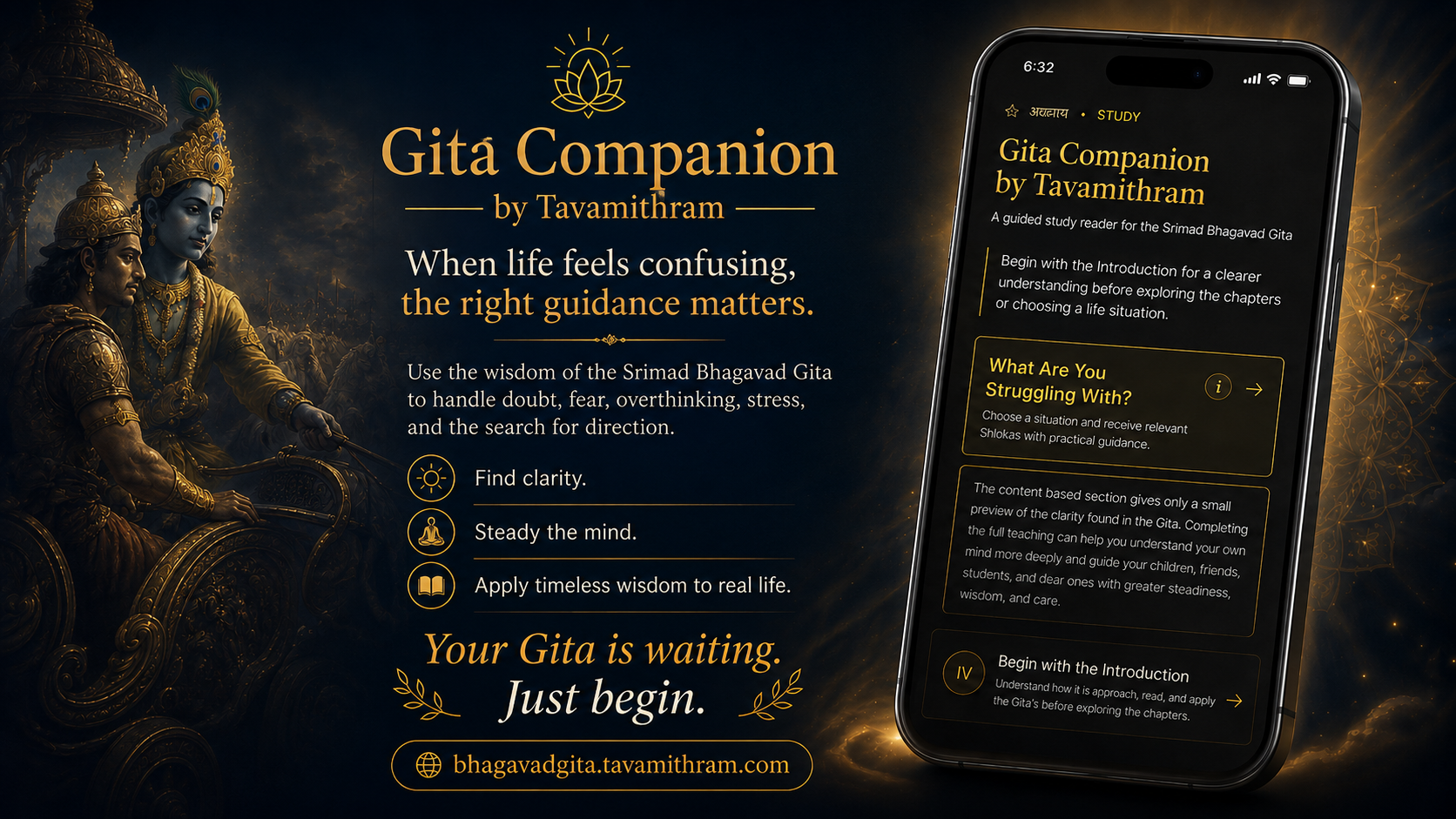
Bhagavad Gita Companion: Ancient Wisdom for the Problems You Face Today. Learn to apply the knowledge of the Gita to Real Life.


Bhagavad Gita Companion by Tavamithram web app

When you are facing a serious problem, whom would you rather speak to? Someone as confused, stressed and disturbed as you are, or someone with a calmer mind who can look at your situation from a little distance, see what you may not be seeing, and help you think it through rationally?

Every one of us meets situations in which the mind becomes disturbed. There are choices to make, relationships to handle, losses to accept, fears to overcome, anger to control, and moments when we simply do not know what to do. This is ordinary and human.

The Srimad Bhagavad Gita can itself be read as an externalisation of that inner turmoil. Arjuna’s crisis becomes the setting in which questions about action, judgement, responsibility, fear, attachment and life itself are examined.

The One-of-a-kind Bhagavad Gita Companion by Tavamithram puts that examination within immediate reach.

Rather than expecting you to know in advance which chapter or shloka to look for, it lets you begin with what you are actually facing: anger, fear, relationships, confusion, loss and grief, attachment, uncertainty, difficult decisions, inner conflict, and other concerns that arise in life. Seventeen of them are covered, each taking you through the problem, the principles involved, and the teachings of the Srimad Bhagavad Gita that bear on it.

The purpose is not to hand you another quotation. It is to help you think clearly at the moment your thinking is under most pressure.

Distress often makes people confide in whoever is nearby, and they later regret what they revealed. The Gita Companion by Tavamithram offers a private space instead: somewhere to examine the situation, understand yourself better, and gradually absorb what is needed to think for yourself. A firm grasp of the Srimad Bhagavad Gita enables a person to be guided by their own intellect rather than led about by uncontrolled senses, emotions and impulses, or left permanently dependent on the counsel of others.

Many years of study, analysis and painstaking work lie behind this web app, all of it directed at one purpose: making the philosophy of the Srimad Bhagavad Gita understandable, accessible and applicable to daily life.

The concern-based section is only one part of it. The Companion also carries all 18 chapters and 701 shlokas in the original Sanskrit, with romanisation, English translation and audio recitation.

You do not need to wait until you are old before you ‘study’ the Srimad Bhagavad Gita and someday learn to use it. Use it while you are living your life, when you are confused, when emotions are interfering with your judgement, when a difficult decision is in front of you, and when life tests you.

As the knowledge becomes internalised, you increasingly learn to recognise the relevant principles yourself when situations arise. The Gita Companion by Tavamithram thus helps you develop the clarity and intellectual independence to rely less on others for counsel and increasingly on your own informed and disciplined intellect.

You should not merely own a copy of the Srimad Bhagavad Gita. You should carry its knowledge with you.

Your Gita is waiting.
Just begin.