
The Robe, the Matted Hair, the Beard, and the Blind Spot

Why outward appearance so often replaces enquiry

Some years ago, while passing through security at the airport in Hyderabad, India, I noticed a man in saffron robes, with long white hair and a beard, walking past, accompanied by two female assistants dressed in similar mendicant attire.

A few people nearby, who had also just cleared security, immediately folded their hands in deep respect.

I asked them who he was.

They said they did not know.

They did not know, and yet they expressed such visible reverence for him.

More than a thousand years ago, this was already exposed.
And yet, nothing much has changed.

Before you fold your hands,
before you bow your head,
pause for a moment.

Because this is not a small thing.

It is the difference between
clarity… and conditioning.

There is something important worth asking.

Do we actually know who we are bowing to, or why we are doing so?

Pause.

This is not a criticism.

This is an observation.

And it is not new.

This exact pattern is pointed out in the Bhaja Govindam song, attributed to Shri Adi Shankaracharya.

जटिलो मुण्डी लुञ्छितकेशः (jatilo mundi luncchita-keshah)
काशायाम्बरबहुकृतवेषः । (kaashaayaambara-bahu-krita-veshah)
पश्यन्नपि च न पश्यति मूढः (pashyann api cha na pashyati moodhah)
उदरनिमित्तं बहुकृतवेषः ॥ (udara-nimittam bahu-krita-veshah)

The Shloka describes a situation.

Many individuals adopt different outward appearances.
One grows matted locks of hair
Another shaves his head.
Another plucks out his hair.
Some wear saffron robes, others adopt various appearances.

All these are merely different disguises to fill their stomach.

Even while seeing, the fool does not truly see.

Now, please bear with me as I’ll give you a word-by-word translation of this Shloka:

जटिलो मुण्डी लुञ्छितकेशः (jatilo mundi luncchita-keshah)
One with matted hair, one with a shaved head, one with hair plucked out,

काशायाम्बरबहुकृतवेषः । (kaashaayaambara-bahu-krita-veshah)
wearing ochre robes, assuming many forms of appearance,

पश्यन्नपि च न पश्यति मूढः (pashyann api cha na pashyati moodhah)
even while seeing, the fool does not truly see,

उदरनिमित्तं बहुकृतवेषः ॥ (udara-nimittam bahu-krita-veshah)
all these many disguises are for the sake of the stomach.

Notice the reason:

“all these many disguises are for the sake of the stomach,
meaning for their livelihood.”

It then adds something more important.

“Even while seeing, the fool does not truly see.”

It means that even when the truth is right in front of them, those fools do not recognise it – “Seeing… yet not seeing.”

That is the exact point being made.

The Shloka is not discussing clothing.

It is pointing to something deeper.

Outward appearance can create an impression.

And that impression can be accepted without enquiry.

This same tendency is addressed in the Srimad Bhagavad Gita, in 2:42 to 46.

In those Shlokas, Krishna describes those who are unintelligent, whose minds are filled with desires, and who are drawn to the flowery statements of the Vedas, considering heaven to be the highest goal, with nothing beyond it.

They speak of Vedic rites that promise good birth, power, and enjoyment, believing that there is nothing higher than a life of pleasure and wealth.

Those who are attached to such gratification and power are carried away by these words and do not attain the firm and steady intellect to attain supreme mental equanimity.

And then it adds a final perspective.

In Shloka 2:46, Krishna says that for the one of Self-realisation, the role of the Vedas is like that of a small well when everything is flooded.

There, the focus is on people becoming absorbed in words, rituals, and promises,
while missing the essential understanding.

So the Shloka from the Bhaja Govindam song is not asking for rejection.

It urges people to be wary of those who adopt certain appearances for their livelihood, and instead seek clarity.

Not blind acceptance.

Not reaction based on appearance.

But understanding.
Understanding universal oneness.

This naturally raises a question:

When reverence arises,
is it based on true understanding
or on appearance?

The Shloka leaves that for the listener to examine.

If the question stays,
the enquiry has already begun.

READ THIS ARTICLE ON SUBSTACK

Don’t waste your life. Read The Srimad Bhagavad Gita

Continue the enquiry

The Bhagavad Gita teaches how to distinguish understanding from ritual, appearance and desire-driven thinking. Modern Rishi continues the same enquiry into conditioning, identity, ego, authority and the Self.

Religion Failed You – Vedanta Won’t

VEDANTA DOESN’T NEGATE ‘GOD’, IT ….. (READ ON AND WATCH THE VIDEO)

Vedanta gets you out of DELUSION.

READ ON SUBSTACK. JOIN MY SUBSTACK. HURRY UP! THIS SITE WILL SOON MOVE TO SUBSTACK!

What if everything you’ve been taught about ‘god’, worship, and salvation is just the kindergarten of the path of the rational philosophy of Vedanta?

The ancient Rishis (wise, selfless sages) spoke in metaphors and extensive analogies—not to hide the truth, but because ultimate reality must be directly experienced. It cannot be handed to you as dogma or belief.

Yet what do the ignorant masses do? They take the allegories literally and spin them into entire new cults, sects, and traditions! Haven’t you seen all those ‘I-know-it-all’ bearded men in flowing robes strutting around like proud peacocks who spin yarns about being reincarnations of some old sages who existed 50,000 years ago and so on? Where does all that come from? How do those people even get there? One reason: The IGNORANCE of the masses strengthened by the disease of DUALITY infused into them – or rather, the lack of knowledge of NONDUALITY or universal oneness in them.

Watch the video presentation below to understand why such profound analogies exist in the Puranas, Itihasas, and Vedantic scriptures at all.

It is indeed comforting to believe in a ‘divine father’ watching over us—listening to our prayers, changing all his plans only because we were ‘good children’ or fasted sincerely, rewarding good, punishing evil. Temples and prayers sustain this. A necessary beginning, maybe, but it is like ‘spiritual kindergarten’. True awakening requires quitting kindergarten and progressing toward Vedanta’s university.

Below are a few points why Vedanta stands apart:
• It rejects all blind belief in any supernatural being or other such unintelligent stuff in favour of direct knowledge
• It transcends ritual worship through Self-inquiry
• Through studying the master-disciple dialogues, seekers systematically remove ignorance to recognise their true nature – which the Srimad Bhagavad Gita reveals as the highest state of consciousness – SBG 2:72

What we call “spiritual seeking” often becomes mental chasing. Vedanta ends this by revealing:
✓ The illusion of separation between seeker and sought
✓ That rituals cannot give what you already are
✓ How to recognise the eternal presence beyond birth and death
✓ That the ultimate goal isn’t conceptual – it’s a transformed state of mind (what the Gita calls “sthita-pragnyaa”) SBG 2:55

This isn’t about new beliefs – it’s about realising the truth that:
• Liberates from all mental conditioning
• Establishes one in natural peace
• Reveals consciousness as your fundamental state

This is not about adopting new beliefs—it’s about transcending belief itself, to know truth directly.

📽️ Watch “Vedanta vs Religion: The Truth Will Set You Free”
(For those ready to move from concepts to direct realisation)

The wave need not believe it is the ocean—it need only look and realise that it is the ocean.

Aum Tat Sat.

This knowledge isn’t “enlightenment” — it’s what remains when all illusions fall away.

🔄 I know few will read this or watch the myth-shattering video – truth tends to terrify the comfortable. But if these words stir even the faintest doubt in some corner of your conditioned mind, share it with someone still trapped in ‘spiritual kindergarten’. They might just deserve their first taste of freedom.

Blind Belief: The Lazy Man’s presumed ‘Shortcut to Spirituality’

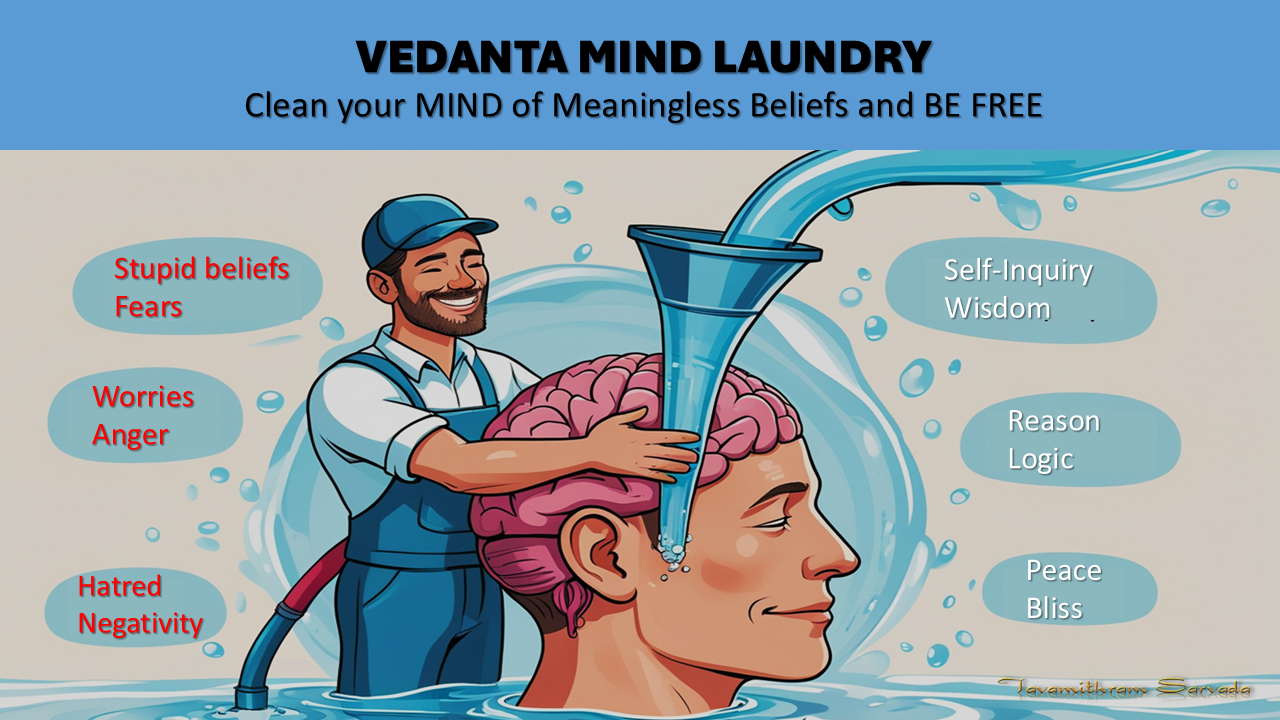
Vedanta ‘MIND LAUNDRY’

The other day, I was speaking with an old friend when the conversation turned to the tragic stampede at the Kumbh Mela in February 2025 and the official reports highlighting severe faecal contamination in the very waters where thousands had taken ‘holy’ dips. My friend took offence at my remarks and became almost aggressive and confrontational. He insisted that people have the right to their beliefs and that I had no business questioning them.

I want to highlight two important points here:

  1. My friend, like many others, fails to recognise that while he demands respect for people’s beliefs, there are also those who do not subscribe to such beliefs—and they, too, have a right to their views.
  2. My argument was never about belief itself, but about the reckless endangerment of thousands of lives and the pollution of a river they themselves deem ‘holy’ with faecal contamination!

The issue with my friend remains unresolved! So, my old friend is willing to risk our friendship over this thing called belief! Christopher Hitchens rightly said that religion poisons everything.

The most crucial point, however, is that in Advaita Vedanta, the highest attainment on the Vedic path known as Sanatana Dharma, there is no concept of belief. It is a path of knowledge, direct experience, and realisation, not blind faith.

Yet, many continue to follow irrational beliefs and rituals without questioning their origins or validity. These inherited practices are often carried out simply because they are part of tradition, with little thought given to their purpose. How often do people stop to ask: “Why am I doing this?” “Does it make sense?”

To encourage critical thinking and deeper reflection, I am reposting two videos that examine the absurdity of beliefs and rituals. These videos challenge the notion that faith alone is enough, exposing how unquestioned traditions shape societies and hinder individuals from seeking true knowledge.

Vedanta emphasises reason and self-inquiry. Instead of surrendering to superstition, one must strive to understand reality as it is, not as it is imagined or dictated by blind faith. True wisdom lies in breaking free from irrational dogmas and seeing the world with clarity.

Unfortunately, as laziness is easier and more comfortable than using our brains and thinking critically, most people prefer the easier route of blindly believing things rather than questioning, studying, and researching.

I invite you to watch these videos with an open mind and reflect on the impact of unquestioned beliefs in your own life.

Newspaper article regarding the pollution of the river Ganga:
“High levels of faecal coliform (microbes from human and animal excreta) were found in river water in which people took holy dip during Maha Kumbh in Prayagraj of Uttar Pradesh, according to a report submitted to the National Green Tribunal by the Central Pollution Control Board.”

https://newsth.live/8g6mIp