
If we know enough to hide something, surely we know enough to ask what should exist in its place.
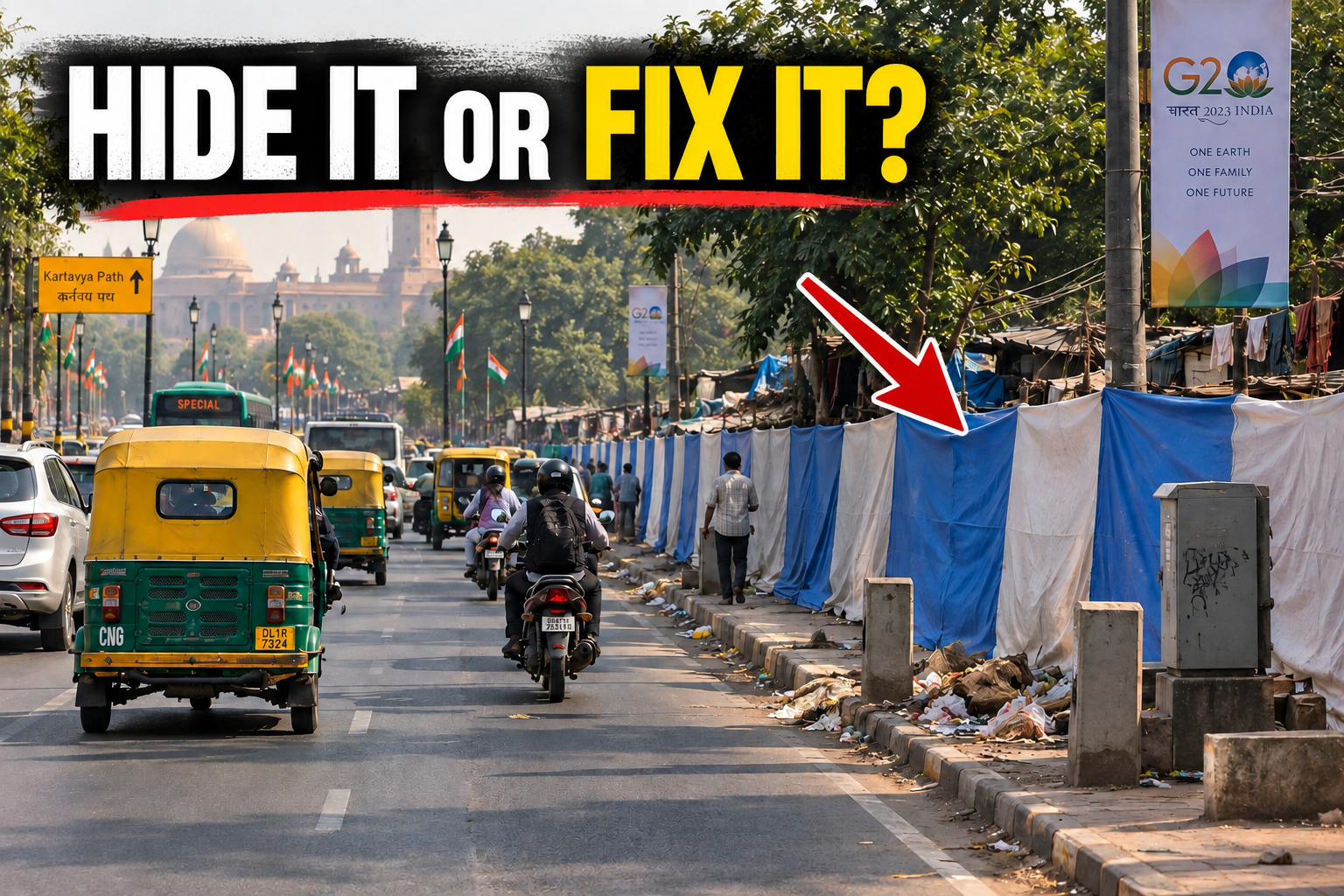
On 12 and 13 September 2026, while world leaders were in New Delhi for the 18th BRICS Summit, blue and white screens appeared around Coolie Camp, a low-income settlement in Vasant Vihar. Residents said similar screens had appeared during the G20 Summit in 2023, and Brut India reported some of them asking, ‘Why hide us?’ Some believed the purpose was to conceal the settlement from visiting dignitaries. Others saw the screens simply as part of making Delhi presentable for an international event.

Either way, the images immediately raised a question in my mind. Not a political question, and not a question about which party governs Delhi or which party governed it before. A much simpler one.
Why cover it?
If I cover something before guests enter my house, there is already an acknowledgement that what lies behind the covering is not how I would like my house to be seen. That means something important has already happened. I have recognised a difference between what is and what should be.
Alright. Then tell me: what should be?
That, to me, is the real question.
We know very well what we don’t want
For as long as I can remember, I have seen streets, roads, corners and public spaces in India that are filthy, badly organised or simply unfinished. I am not saying ‘India is dirty’. That is a meaningless generalisation about an enormous country. I am talking about something far more specific.
Anyone looking at rubbish accumulating on a street knows that it should not be there. An open drain strikes us as undesirable, a badly finished pavement as wrong, and nobody looks at a filthy river and believes that this could possibly be the desired condition. If screens are put in front of an impoverished settlement when important international visitors arrive, whatever the official reason, we certainly understand the concept of presentation.
Recognition, then, is not the problem. We know what we don’t want. But do we know, precisely, what we want instead? That is where I think the real problem begins.
Ask people what they want
I understood this many years ago while teaching young people. I would sometimes ask my students, ‘What is your ambition? What do you want from life?’
The answers rarely varied. A great job. A nice house. A nice car. Lots of money. A beautiful wife. Happiness.
And I would tell them: none of those is an answer.
What is a ‘great job’? Do you want to be a salesman? A sales manager? A doctor, an engineer, a director, a CEO, a policeman? What is a ‘nice car’? A small one, a sports car, a Mercedes, a BMW? Which model, which colour? And what is ‘lots of money’? One million? Ten? A hundred? Five hundred? What exactly are you talking about?
I had another exercise. I would tell them, ‘Imagine Shri Krishna himself suddenly appeared before you and said: Ask me for whatever you want. Anything. But you have only ten seconds.’
Then I would count. One. Two. Three. Four.
Very often, nothing came. That was the whole point. People have desires, fears and frustrations, and they can tell you endlessly what they dislike. Ask them what exactly they want instead, and suddenly things become difficult.
‘Discipline is next to godliness’ or ‘Cleanliness is next to godliness’.
I remember hearing statements like these in India. Very impressive. Now define ‘discipline’ or ‘cleanliness’.
What exactly does a disciplined person do? What does a clean and disciplined school look like, or disciplined traffic? What does civic discipline require of someone who has just finished eating something from a packet? Where does the empty packet go? What happens if there is no bin? Who is responsible for providing one, how often is it emptied, who makes sure that actually happens, and who measures whether the system is working?
The moment we start asking such questions, the grand word ‘discipline’ has to come down from the slogan and enter reality.
The same applies to another favourite word: ‘development’. We want India to become a developed country. Excellent. Define ‘developed’.
Suppose I say, ‘I want Indian roads to be like German roads.’ I still haven’t defined anything. What exactly about the German road do I want? Its surface, drainage and markings? The pavement and the junction between pavement and road? Its maintenance, the behaviour of the traffic, the enforcement, the accessibility, the construction standards?
There is no use pointing vaguely towards another country and saying, ‘Like that.’ What exactly do you want from ‘that’? How will you measure it, and how will you know when you have achieved it?
The little strip of mud
There is one particular thing that has bothered me since I was young, and I have seen it in countless places in India.
A road is constructed. Beside it is a pavement. Between the road and the pavement, somebody leaves a little strip of exposed earth. Perhaps 80 or 90 per cent of the job is beautifully completed, but that small portion is mud.
People walk over it, and vehicles sometimes drive over it. Wind and rain move the earth onto the pavement and road. It dries, becomes dust and spreads. Before long, the entire place looks filthy.
The interesting thing is that I have seen old Indian films in which roads and pavements were properly connected. That little unfinished strip was never some inevitable feature of Indian geography. At some stage, somewhere, somebody must have accepted a lower definition of ‘finished’. Others copied it until the defect became normal, and once something becomes normal, people stop seeing it as a defect.
That is how standards deteriorate.
I had to discover this about myself too
I am certainly not writing this as somebody who believes he was somehow born above all this. Quite the contrary.
When I was young, I travelled almost everywhere in India by motorcycle and car. I worked in films and as a motorcycle stuntman. I had covered enormous distances behind handlebars and steering wheels, so naturally I thought I knew how to drive.
Then I came to Europe and discovered how much I didn’t know. That was one of the most useful discoveries of my life. Experience, it turned out, is not necessarily the same thing as knowing the standard. There were rules, conventions and standards I had never learnt properly, and habits I had acquired without ever examining them.
So what did I do? I went to driving school.
After all the driving I had already done, I had to start again from scratch, sitting in classes where some of my fellow learners were very young people barely old enough for a licence. So what? I was not there to compare myself with anybody. I was there to learn what I did not know, and for that purpose my age, my experience and my ego were irrelevant.
I could have said, ‘Who are you to teach me? I have ridden motorcycles and driven cars all over India. I was a motorcycle stuntman.’ And what would that have achieved? I would simply have protected my ego and preserved my ignorance.
My father had raised me differently. If somebody tells me something I genuinely don’t know, my job is not to become offended. My job is to shut up and listen.
There is a line in Hamlet where Polonius advises Laertes: ‘Give every man thy ear, but few thy voice.’ Listen more than you speak. Knowledge offered to you is not an insult. It is free knowledge.
I raised my son on essentially the same principle.
But offence can become a barrier to knowledge
This brings me to something I have repeatedly observed among Indians. Tell somebody that something could be done differently and a very common reaction is, ‘Who are you to tell me? I know what I’m doing.’
Think about the absurdity of that sentence. If I already know everything, what can anybody possibly teach me? If every correction becomes an insult to my identity, I have made learning almost impossible.
This becomes particularly dangerous when combined with civilisational pride.
India is an ancient civilisation. Extraordinary philosophy, mathematics, linguistics, literature, architecture and scientific thought arose on the Indian subcontinent. That is worth knowing and preserving. But none of it answers the question: what are we today?
I cannot indefinitely live on the intellectual achievements of people who lived hundreds or thousands of years before me. Their achievements are theirs. I have to ask what I am producing now, what standards I maintain now and what I contribute now.
A glorious inheritance is something to study, understand and build upon. It is not a certificate exempting the present generation from examination.
There is, in my experience, also an excessive sense of entitlement among many Indians, combined with the conviction that India is somehow already more advanced than much of the world because it represents an ancient civilisation. Ancient is not the same as advanced. History is not the present. What matters is what exists now. And if pride in ancient achievement leaves us unable to acknowledge present deficiencies, it has stopped being healthy pride. It has become an obstacle to improvement.
What are we doing to the Ganga?
This is where the hypocrisy becomes impossible for me to ignore.
The Ganga is called Mother. People speak about her sanctity and perform elaborate rituals in her honour. Yet parts of the Ganga remain severely polluted.
Now consider what happened in London on 13 September 2026. Thousands gathered at the Old Royal Naval College in Greenwich for a Ganga Aarti on the banks of the Thames, organised by Chinmaya Mission UK as part of the Totally Thames festival. It was presented as an expression of gratitude and reverence towards rivers and nature.
There is nothing inherently wrong with performing an Aarti beside the Thames. But I cannot look at something like this without asking a much more uncomfortable question.
What about the Ganga?
Before taking Ganga Aarti to the Thames and showing Britain how we revere rivers, shouldn’t we demonstrate that reverence at home by taking care of the river whose name the ceremony carries?
In fact, the organisers in London explicitly instructed participants that flowers, idols and other offerings were not to be put into the Thames, in keeping with environmental protection.
Think about the irony. We go to Britain to demonstrate our reverence for rivers, and there we carefully follow environmental rules to protect the Thames. Meanwhile, we have been struggling for decades to restore the Ganga.
Why should our reverence be most impressive when it is being displayed? Why shouldn’t the Ganga itself be the demonstration?
That, to me, is where the hypocrisy lies. It should begin at home.
Make the Ganga so clean that anybody standing beside it can look at it with pride. Bring the ghats and the surrounding streets to an exemplary condition, until sewage entering the river becomes unthinkable and dumping waste there becomes socially unacceptable. Then, when somebody asks what Indian reverence for rivers means, we don’t need a ceremony in London to explain it. We can point to the Ganga. That is a living example.
And there is another uncomfortable fact. India has received substantial international assistance to clean and rejuvenate the Ganga. Germany has provided technical cooperation, the Netherlands has cooperated on water management and river pollution abatement, and Japan’s JICA has provided major financing for Ganga and Yamuna projects.
I am not going to pretend that receiving foreign expertise is shameful. The whole argument of this article is that we should learn from anyone who knows something useful. What I find shameful is needing outsiders to remind us, through their expertise, money or participation, how to protect something that we ourselves proclaim sacred.
If Europeans or Japanese people are helping us clean and restore the Ganga, our response should not be wounded pride. It should be gratitude followed immediately by a question: why were we not already doing this well enough ourselves?
A civilisation does not impress the world by telling the world how great it is. It impresses the world by being the example.
Perhaps this is where the real problem lies
India became independent in 1947 after a long period of British rule. Independence and Partition came together with enormous upheaval, mass migration and terrible loss of life. I am deliberately not entering here into why the British left, who was responsible for Partition, or what should have happened differently. Those are separate subjects.
My question begins after independence. Once the foreign ruler had gone, what exactly were we trying to become?
Independence answers one question: who governs us? It does not answer another: what are we building?
What was the reference point? What should an Indian city eventually look like, or an Indian village? What should be the minimum acceptable standard for housing, sewage, drinking water, roads, pavements, public toilets, schools, hospitals, railway stations, rubbish collection, air quality, public behaviour, civic responsibility, education, health, income and human dignity?
Saying ‘progress’ answers none of those questions. Neither does ‘development’ or ‘discipline’. These are words. Where are the definitions?
A symbol is not a destination
I have never believed that poverty, primitiveness or unnecessary physical hardship should be romanticised. Human beings did not progress by deciding that whatever their ancestors did must remain the ideal forever.
Sanitation, electricity, modern medicine, machines, trains, cars, aircraft and telecommunications came from human beings refusing to accept existing limitations. Diseases that once killed enormous numbers of people can now be treated. Children who once would never have survived their first few years now grow into adults. Journeys that once took months can take hours.
This is what happens when human beings acquire knowledge and apply it.
The spinning wheel may have had enormous symbolic importance during India’s independence movement. But a symbol of resistance cannot be the destination of a civilisation. Once independence was achieved, the question could no longer be merely how we free ourselves from somebody else. It also had to become: what precisely do we intend to become ourselves?
Pride, entitlement and respect
This is where civilisational pride can turn into entitlement. There can be a feeling that because India represents an ancient civilisation, respect is somehow automatically due. But respect does not work like that.
These days there is considerable discussion about racism and hostility towards Indians abroad. Racism against Indians certainly exists, and it should be identified as such when it occurs. But not every negative reaction to an Indian is racism. That distinction matters.
If I move to another country and make no serious effort to understand its language, social norms or ordinary standards of public behaviour, I cannot automatically classify every unfavourable reaction as racial prejudice.
Being excessively loud in a place where people normally speak quietly is behaviour. Throwing rubbish where others do not is behaviour. Disregarding a queue is behaviour. Living in another country for decades without making a serious effort to communicate according to the linguistic conventions of that society is something I can examine, and the same goes for dress or conduct inappropriate for a particular setting.
None of these things is inherent in being Indian. They are behaviours, and behaviours can change.
There is an important distinction here. Equal treatment is a right. Nobody should be denied justice, employment, housing, dignity or equal treatment because of race, colour or origin. Personal respect is different. Respect cannot simply be demanded. If I want another human being to respect me, I must also ask whether my conduct gives that person reasons to do so.
Instead of always asking why they don’t respect us, sometimes the more useful question is: what are we giving them to respect?
A country faces essentially the same question. If India wants to impress the world, it does not need to keep telling the world that it is an ancient civilisation. Set standards, reach them, live by them, and become the example. That makes a far greater impression than any slogan, ceremony or claim about the past.
Knowledge begins where entitlement ends
And now we return to knowledge.
The Srimad Bhagavad Gita, which encourages enquiry rather than blind belief, says in Shloka 4:38 that nothing is more purifying than knowledge. I have always found that statement extraordinarily powerful. But knowledge requires something from us before it can purify anything. It requires the possibility that I may not know.
The moment I say ‘Who are you to tell me?’, ‘I already know’, ‘Our civilisation is thousands of years old’, ‘We taught the world everything’ or ‘You are insulting my country’, the door begins to close. Knowledge cannot enter through a door we have locked from inside.
The intellectual achievements of ancient India should produce curiosity, enquiry and intellectual discipline. They should not produce entitlement. If our ancestors knew something extraordinary, the appropriate response is not ‘Therefore I am extraordinary.’ The useful response is to find out what they knew, how they arrived at it, whether I actually understand it, what I can learn from it and what I can add to it.
That is how an intellectual tradition remains alive.
Now return to those curtains
This is why those blue and white screens in Delhi struck me so strongly. The important thing is not merely that something was covered. It is what the act of covering reveals.
Somebody already knows that there is a gap. There is the condition behind the curtain, and somewhere in our minds there is another condition that we consider presentable. But perhaps we have never properly defined it.
And there it is. The missing reference point.
There is something else we must not conveniently forget. Those blue and white screens were not merely covering rubbish, broken pavements or ugly buildings. Behind them were human beings. Families living on very low incomes, in conditions that somebody apparently considered unsuitable for visiting world leaders to see.
Covering them does nothing to change their circumstances. Why are they poor? What education have they received, what prevents them from earning enough to live differently, and what kind of work could give them a sustainable income? What knowledge and training would enable them to do it?
But even those questions are not enough. What exactly is the living standard we want every human being in this country to attain? What should adequate housing mean, and what level of sanitation, healthcare, education, safety and income should constitute the minimum? What should a dignified human life actually look like?
Unless there is a clear answer, ‘uplifting the poor’ remains another vague expression like ‘development’, ‘progress’ and ‘discipline’. There is no destination towards which to work and no way of knowing whether we are getting closer to it.
The people behind that curtain do not need to be hidden from the world. They need a clearly established standard of human dignity that the country commits itself to helping them reach. If we do not know what that standard is, how can we possibly create the path to get them there?
We need to stop saying we want better cities, cleanliness, discipline, progress and development, and start asking what exactly each of those words means. Describe it. Define it. Where possible, measure it. Set the minimum acceptable standard.
Then something changes. For the first time, we have two points: where we are and where we want to be. The distance between those two points is the problem to be solved. Once that distance is known, a path can be created. Without the second point, there is no path.
You can spend enormous amounts of money, announce schemes, build roads, bridges, airports and monuments, and work incredibly hard. But if nobody has clearly defined the destination, activity can easily be mistaken for progress. The existing condition can then continue for another fifty years, or another hundred.
A society needs a reference standard
That, ultimately, is what has been missing: a clearly defined reference standard.
This is not about whether India is great or not, nor is it about intelligence, ability, patriotism or national pride. It is about something far simpler. You cannot reach a destination that you have not defined. Saying that we want a clean, developed, disciplined, prosperous or world-class India does not define a destination. These are merely words until we decide exactly what they mean in measurable reality. Once we establish that reference point, we can compare where we are with where we want to be. The difference between the two is the actual problem before us, and only then can we create a path to solve it. That is the point I am making.
I am not talking about finding another foreign master or blindly imitating another country. Nor am I suggesting that Indians should feel inferior to anybody. I am talking about knowing exactly what standard we intend to reach.
Look around the world. If somebody has solved a problem better than you have, study it. Learn from Japan where Japan has something to teach, from Germany where Germany has something to teach, from Singapore where Singapore has something to teach. And where India does something exceptionally well, let others learn from India. Knowledge does not have a nationality.
Take what works and understand why it works. Decide what is appropriate for your circumstances and define the standard you intend to reach. Measure the present condition against it. The difference gives you the gap, and the gap tells you what has to be done. Then do it.
There is no humiliation in learning from somebody who knows something you don’t. The humiliation is in knowing that something is unacceptable, covering it with a cloth, becoming offended when somebody mentions it, boasting about what our ancestors achieved thousands of years ago, and leaving the thing behind the curtain exactly as it was.
Give the destination a picture
Perhaps the simplest way to understand what I mean by a reference standard is to make it visual.
Google the Rhine in Germany. Look at the Seine flowing through Paris. Look at the waterways of Switzerland, Austria or Japan. Don’t merely admire the photographs. Study them.
Then look at the Ganga and say: I want my Ganga to look like that.
Now we have something. We are no longer saying, ‘We must clean the Ganga.’ What does clean mean? Clean compared with what? How clean? What should the banks, the water, the ghats and the streets leading to them look like?
Give the mind a picture. I want water of this quality and riverbanks maintained to this standard. I want no sewage entering the river and no rubbish floating in it. I want people to be able to walk beside our river and experience the same cleanliness, order and beauty that they experience beside some of the best-maintained rivers elsewhere in the world.
Now there is a destination. Once you can see where you want to go, you can begin asking how to get there.
That was exactly what I was trying to teach my students all those years ago. ‘I want a nice life’ gives you nowhere to go. ‘I want this’ gives you a direction.
A country is no different.
And then do something we have not done before
There is another part to this.
Governments have an extraordinary tendency to respond to a problem by creating another committee, another department, another hierarchy, another chain of officials, another budget and another scheme. Then years pass, governments change, money is spent, reports are produced, and we discover that the original problem is still there.
One realisation changed my own life about thirty years ago: if I continue doing what I have always done, I will continue getting what I have always got.
So why repeat the same method? If we genuinely want a radically different result, try a radically different approach.
Choose a few specific projects. A stretch of the Ganga. A district. A railway station and everything surrounding it. A sewage system. A section of a city.
Define exactly what the finished result must look like. Then invite companies or engineering organisations with proven experience from countries such as Japan, Singapore, Germany or elsewhere to bid for the entire job as a turnkey project.
Give the selected contractor the budget, the necessary legal authority, access to resources and the manpower required. Define measurable outcomes and a deadline. Then let the specialists design and execute the project without inserting another enormous administrative hierarchy into every engineering decision.
And watch. Learn from what they do. Study their planning, materials, workflows, quality control, maintenance systems and standards. Train Indian engineers, workers and administrators alongside them. When the project reaches the agreed standard, hand it over.
There is absolutely no shame in this. Every serious learner begins by learning from somebody who already knows how to do something better. I did precisely that when, after years of driving all over India, I sat down in a driving school and started from scratch. Countries can do the same thing.
India at independence inherited an extraordinarily complicated political and administrative landscape, including hundreds of princely states that had to be integrated with the former provinces of British India. Independence was accompanied by Partition, mass displacement and enormous violence. There was no clean moment in which somebody simply handed over a perfectly unified, finished modern state and said, ‘Here you are.’
Nearly eighty years have passed, however. That history can explain part of where we began. It cannot indefinitely determine where we remain.
One thing I realised decades ago has stayed with me ever since: what has not been defined cannot be refined. Pick a destination. Define the standard. Bring in whoever genuinely knows how to reach it. Learn from them. Reach it. Maintain it. Then do the next river, the next district, the next city.
Eventually, we will no longer need to tell visitors what India aspires to be. They will be able to see it.
What the curtain cannot do
A curtain can change what a visiting dignitary sees. It cannot change the reality behind it.
The families living behind those screens remain in exactly the same circumstances after the curtain goes up. If those living conditions are unacceptable enough to be hidden, the question is not how to hide them better. The question is what standard of life those families should be able to attain, and what has to be done to get them there.
Once that is defined, we have a destination. We can measure the distance, create the path and begin closing the gap.
That is when ‘development’ stops being a word and becomes a standard we actually live by.
Krishna Ravindra writes on Vedanta and philosophy under the name Tavamithram Sarvada, and on the mind, human behaviour and life as KK Ravin.