You’ve been told what to think. You’ve been conditioned to accept, obey, and conform. But what if everything you believe—everything you rely on—has been carefully placed there to keep you from seeing the truth?
What if the world around you isn’t what it seems?
This isn’t just another talk. It’s an experience—one that might shake the very foundation of what you think is real. But be warned: once you step through this door, there is no going back.
India is witnessing an alarming rise in suicides among young men, many of whom feel trapped in toxic relationships, crushed by societal pressures, and ignored by the legal system. They suffer in silence, battling emotional turmoil with no real support. But what if they knew that strength is a choice, and weakness is not a compulsion?
In this video, we will look at the real reason behind emotional suffering—how unchecked emotions shroud intelligence, making it impossible to perceive situations clearly. We will see why men must reclaim their inner strength, break free from despair, and learn to master their minds instead of succumbing to hopelessness.
The primary cause of mental suffering was the inability to perceive situations with detachment, instead of viewing them through the distorting lens of emotion. This emotional entanglement prevented individuals from coming to terms with reality, trapping them in cycles of distress and confusion. When emotions took control, they completely obscured intelligence, making rational thought and objective decision-making nearly impossible.
What You’ll Learn in This Video: -Why young men are struggling and what’s fueling the crisis -How toxic relationships and emotional weakness lead to mental destruction -The powerful wisdom from the Srimad Bhagavad Gita that can save lives -Real-life examples of resilience that prove strength is a choice, not an accident
If you are a young man feeling lost, disrespected, or emotionally broken—this message is for you. If you know someone who is suffering, share this with them. There is a way forward, and it starts with mastering your emotions and taking control of your life.
💪 Watch Now & Take the First Step Towards Strength! 💪
DON’T DELAY. LISTEN TO THIS TODAY!
The Complete Srimad Bhagavad Gita – Explained Simply | No Confusion, Only Clarity!
What if everything you worship, think, and perceive is not the ultimate truth?
The Kenopanishad shakes the very foundation of our understanding by revealing that Brahman—the ultimate reality—is not what the senses perceive, nor what the mind can grasp. It is that by which all perception happens, yet remains beyond perception itself.
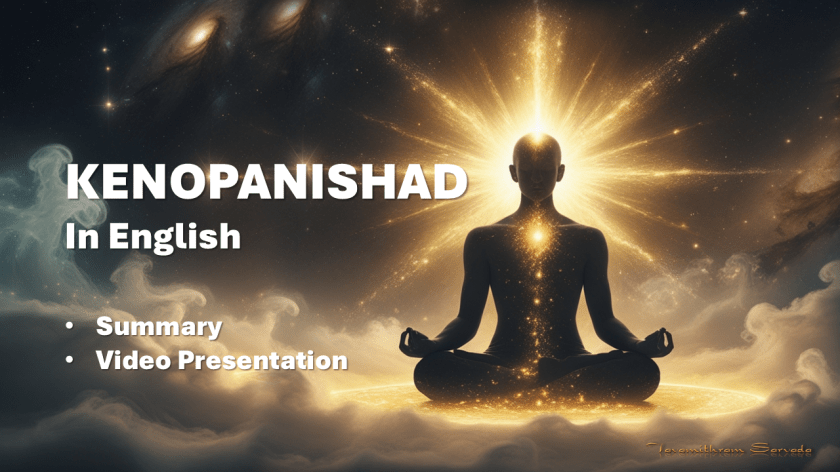
I am pleased to share my English explanation of the Kenopanishad, now available on the new Vedanta channel, Timeless Vedanta. This Upanishad is a profound text that explores the nature of ultimate reality, the limitations of perception, and the essence of Brahman—the supreme truth that is beyond the grasp of the senses and intellect.
This video presents a clear and insightful analysis of the Kenopanishad, encouraging deeper reflection and self-inquiry. Watch, learn, and break free from blind beliefs to embrace the wisdom of Vedanta.
Your engagement helps spread the knowledge of Advaita Vedanta and enables more seekers to benefit from these ancient yet ever-relevant teachings.
Summary of the Kenopanishad
The Kenopanishad from the Sama Veda’s Talavakara Brahmana is a profound exploration of Brahman, the ultimate reality that transcends sensory perception and intellectual comprehension. It is structured into four sections, addressing the nature of consciousness, the limitations of the mind and senses, and the necessity of realisation beyond mere knowledge.
I. The Nature of Brahman
The text begins with fundamental inquiries: What is the force behind the mind, speech, and senses? What enables perception and cognition? The answer given is that Brahman is the unseen power that enables all faculties yet remains beyond their grasp.
Brahman is the “ear of the ear, the mind of the mind, the speech of speech, the life of life, and the eye of the eye.”
The wise attain immortality by renouncing identification with the senses and realising this truth.
Brahman is beyond thought, speech, and sight, yet it is that by which the mind thinks, speech expresses, and the eyes see.
“Nedam-yadidam-upaasate” – That which is worshipped as an object is not Brahman; the real Brahman is that which enables perception itself.
II. The Paradox of Knowing Brahman
The Upanishad asserts that Brahman is not fully knowable, nor is it completely unknown. It is beyond dualistic comprehension:
If one thinks, “I know Brahman,” they have only a partial understanding.
Brahman is known by those who realise they do not fully know and remains unknown to those who think they know it completely.
True knowledge of Brahman leads to immortality, strength, and ultimate fulfilment.
III. The Parable of the Gods and Brahman’s Revelation
The Upanishad illustrates the ignorance of the gods through a symbolic story:
After a great victory, the gods (Agni, Vayu, and Indra) assume their triumph is solely their own.
Brahman appears as an unknown Yaksha (divine being) to humble them.
Agni, the fire god, fails to burn a blade of grass; Vayu, the wind god, fails to lift it—revealing their limited power.
Indra, seeking answers, meets Uma (Parvati), the embodiment of wisdom, who reveals that their victory was due to Brahman alone.
Indra, being the first to realise this, is praised above the other gods.
IV. The Flash of Realisation
Brahman is realised like a lightning flash or a blink of an eye—sudden and beyond conceptualisation.
The seeker must meditate on Brahman as “Tadvana” (the most desirable).
Austerity, self-restraint, and righteous action serve as the foundation for realisation.
One who attains this knowledge becomes established in Brahman, free from ignorance, confusion, suffering, and Karma
The Kenopanishad asserts that Brahman is the essence of all experience but cannot be objectified. It must be known intuitively, not intellectually. The Upanishad leads the seeker away from external worship to direct self-inquiry, revealing that the ultimate truth is not in what is perceived but in that which enables perception itself.
The other day, I was speaking with an old friend when the conversation turned to the tragic stampede at the Kumbh Mela in February 2025 and the official reports highlighting severe faecal contamination in the very waters where thousands had taken ‘holy’ dips. My friend took offence at my remarks and became almost aggressive and confrontational. He insisted that people have the right to their beliefs and that I had no business questioning them.
I want to highlight two important points here:
My friend, like many others, fails to recognise that while he demands respect for people’s beliefs, there are also those who do not subscribe to such beliefs—and they, too, have a right to their views.
My argument was never about belief itself, but about the reckless endangerment of thousands of lives and the pollution of a river they themselves deem ‘holy’ with faecal contamination!
The issue with my friend remains unresolved! So, my old friend is willing to risk our friendship over this thing called belief! Christopher Hitchens rightly said that religion poisons everything.
The most crucial point, however, is that in Advaita Vedanta—the highest attainment on the Vedic path known as Sanatana Dharma—there is no concept of belief. It is a path of knowledge, direct experience, and realisation, not blind faith.
Yet, many continue to follow irrational beliefs and rituals without questioning their origins or validity. These inherited practices are often carried out simply because they are part of tradition, with little thought given to their purpose. How often do people stop to ask: Why am I doing this? Does it make sense?
To encourage critical thinking and deeper reflection, I am reposting two videos that examine the absurdity of beliefs and rituals. These videos challenge the notion that faith alone is enough, exposing how unquestioned traditions shape societies and hinder individuals from seeking true knowledge.
Vedanta emphasises reason and self-inquiry. Instead of surrendering to superstition, one must strive to understand reality as it is, not as it is imagined or dictated by blind faith. True wisdom lies in breaking free from irrational dogmas and seeing the world with clarity.
Unfortunately, as laziness is easier and more comfortable than using our brains and thinking critically, most people prefer the easier route of blindly believing things rather than questioning, studying, and researching.
I invite you to watch these videos with an open mind and reflect on the impact of unquestioned beliefs in your own life.
Newspaper article regarding the pollution of the river Ganga: “High levels of faecal coliform (microbes from human and animal excreta) were found in river water in which people took holy dip during Maha Kumbh in Prayagraj of Uttar Pradesh, according to a report submitted to the National Green Tribunal by the Central Pollution Control Board.”
Many seekers struggle with the concept of the Self, often expressing confusion and frustration over their inability to “connect” with it. I’ve heard people saying things like, “I feel the disconnect with my own self,” and so forth. The fact is that such statements are logically flawed. Why? Because the Self is not something to be seen or grasped—it can only be realised. CONTINUE READING AND WATCHING THE VIDEO ON SUBSTACK.
It was after one of the many miracles in my life that I started this blog back in 2014. My intention was not only to share my knowledge of Vedanta, but also to walk alongside fellow seekers on the path of self-inquiry and truth. I created a website dedicated to the Srimad Bhagavad Gita, featuring Sanskrit Shlokas, transliterations, and my own English translations. Over the years, thousands have visited my blogs, and I have published accessible translations of the Srimad Bhagavad Gita along with hundreds of videos.
Today, as we begin the 12th year of this blog, and as a gesture of friendship and affection, I am releasing my latest audiobook as a YouTube video. The video is as long as a typical feature film, but the difference is profound—the three hours you invest in this audiobook can transform your entire outlook on yourself, others, and life itself.
All you have to do is press play and listen to it. I have explained the entire text in an easily relatable manner.
As someone deeply devoted to sharing the wisdom of the Srimad Bhagavad Gita and the Upanishads, I have never promoted rites and rituals in my work. Anything or anyone that obstructs one’s realisation of truth or delays their pursuit of true knowledge is best avoided. All dualistic beliefs and attachments inevitably lead to suffering. The only path to liberation is the pursuit of the ultimate non-dual truth—beyond which nothing more remains to be attained.
Despite offering free copies of this audiobook through promo codes, many still do not complete the book. It is this widespread ignorance that religious figures exploit, building their own cults and keeping followers perpetually ‘drugged’ on beliefs, myths, and rituals.
The Srimad Bhagavad Gita itself states that the supreme truth is easy to attain. What is required is ‘Jignyaasa’—curiosity, inquisitiveness, and a sincere desire for knowledge.
Since this audiobook is now available on YouTube, all that is required is to start the video and listen.
With affection and best wishes, I urge you to watch the entire video without skipping or missing any parts.
Bhaja Govindam: The Song That Will Transform Your Life
Most people listen to or recite Bhaja Govindam without grasping its true essence—but this profound composition by Shri Adi Shankara is far profound than what most people might think. It is a bold call to awaken from ignorance, starting with the striking words, “O Fool,” and leading to a life of wisdom and responsibility.
In this video, The Bhaja Govindam Song on the new Timeless Vedanta YouTube Channel, I unravel the deeper meaning of each Shloka, providing an English translation alongside a downloadable PDF with the original Sanskrit, transliteration, and translation.
Bhaja Govindam is not about blind beliefs or meaningless rituals but about attaining SELF-knowledge (Atmagnyaana), freeing the mind from delusions, and embracing Vedantic clarity. This understanding is vital in today’s world, where distractions pull us away from truth.
Discover the Mandukya Upanishad: The Essence of AUM and the Four States of Consciousness
Welcome to TimeLess Vedanta, where ancient wisdom meets modern seekers. In this video, we will dive into one of the most profound texts in the Vedanta philosophy—the Mandukya Upanishad.
The Mandukya Upanishad, though the shortest of the 108 Upanishads, holds the key to understanding the essence of AUM and the four states of consciousness: waking, dreaming, deep sleep, and the transcendent state of Turiya. This Upanishad is a gateway to self-realisation, offering timeless insights into the nature of reality and your true Self.
In this video, we explore:
The significance of AUM and its connection to the three states of consciousness.
The fourth state, Turiya, which underlies and transcends all other states.
How the Mandukya Upanishad can guide you to realise your divine nature and break free from the illusions of the mind.
Whether you’re new to Vedanta or a seasoned seeker, this video will inspire you to look within and discover the divinity that resides in you.
Free PDF Included: To deepen your understanding, I’ve also prepared a beautifully formatted guide to the Mandukya Upanishad. Download it now and embark on your journey to self-realisation.
Join me on this transformative exploration of the Mandukya Upanishad. Watch the video below, download the PDF, and let the wisdom of the ancients illuminate your path.
ॐ शान्तिः शान्तिः शान्तिः
Subscribe to TimeLess Vedantafor more insights into Vedanta, the Upanishads, and the timeless truths that can transform your life.
Don’t we often wonder why true peace feels so elusive in a world filled with noise and endless pursuits? What if the solutions to life’s greatest challenges were already within you, waiting to be discovered?
As we take a moment to reflect on our lives, let’s remind ourselves that a new year, whether it’s the Gregorian year or any other marker of time, by itself cannot do anything. It is our perception of things and our attitude towards life that truly influence our lives.
In my opinion, what we need to first strive for is clarity—clarity in the way we think, perceive, and judge. For this, some fundamental understanding of oneself and universal oneness is essential.
In our world, filled with numerous cults, groups, spiritual leaders and gurus, it is crucial to recognise the true qualities of divinity, which are honesty, sincerity, compassion, modesty, and gratitude. These virtues surpass any specific doctrine or tradition.
TThe Vedas, Upanishads, and the Srimad Bhagavad Gita are invaluable tools designed to guide individuals towards selflessness. However, although they make things easier for a seeker, they are not the only path to achieving a divine state. Many remarkable people who have never encountered these texts exhibit profound divinity, suggesting that true spirituality transcends any specific set of teachings.
In the Srimad Bhagavad Gita, Shloka 2:46, Krishna says that one who has attained SELF-realisation needs the Vedas as much as one would need a well when it is flooded everywhere. This illustrates that attaining supreme knowledge is the highest goal.
Everyone’s spiritual journey is unique. The purpose of Karma Yoga, or performing one’s duty without expecting results, is to maintain a balanced state of mind. Emotions such as happiness, sadness, anger, hatred, and envy are born from our perceptions. These emotions are merely waves in the otherwise tranquil ocean of awareness.
When we learn to perceive things differently, we can face and handle challenges better. However, the root causes of mental pain, sadness, and suffering are often attachments and our expectations.
The greatest lesson I have learned from life’s ups and downs is to never expect anything from anyone or life itself. Instead, relish every moment, knowing that anything can happen at any time. Being alive, healthy, sane, and conscious is a gift to be celebrated.
I think that feeling upset about things can also be seen as a form of arrogance or entitlement. It is because it overlooks the miracle of life happening with every heartbeat, which, by the way, can stop at any time.
BBy cultivating a profound understanding of this, we can achieve peace in any circumstance. Introspecting and recognising our fundamentally innate honest and sincere nature reveals the misguided notions arising from a lack of clarity, which obscure our divine true self. Challenging situations refine and polish us, leading to the highest clarity and the ultimate state of Krishna.
Please reflect on the following Shlokas from the Srimad Bhagavad Gita:
SBG 14:23 Krishna says: “He remains unattached and is not moved by sense objects. He knows that it is the senses and the mind born of the Gunas that act while his real Self remains unwavering in all situations.”
SBG 14:24 “He is the same in pleasure as well as in pain; is established in the Self; he is one to whom a lump of earth, a stone and gold are no different from each other; he treats equally the friendly and the unfriendly, and accepts praise or criticism with equanimity.”
SBG 14:25 “He who remains unmoved in honour and dishonour; is the same to friend and foe, and has renounced all actions by giving up claims of being the ‘Doer’, is said to have transcended the three Gunas.”
SBG 14:26 “He who serves Me with unflinching devotion and transcends the Gunas, is fit for becoming Brahman.”
SBG 14:27 “For I am the abode of the formless Brahman, the imperishable and the immutable, of eternal Dharma and of absolute bliss.”
Reflect on these teachings to find peace and equanimity in your spiritual journey. Once such clarity has been achieved, every new day can be celebrated as the first day of the rest of your life, without waiting for any calendar to announce and validate it.
As we embark on our own journeys, let us seek the fruits of the Tree of Abundance. This metaphorical tree, rooted in the fertile soil of knowledge and wisdom, offers us an endless bounty. From its branches hang the fruits of health, prosperity, and happiness, each one a result of the nurturing power of understanding and insight. When we cultivate our minds with learning and awareness, we gain the true wealth that life has to offer. May the Tree of Abundance bless you with its riches, nourishing every aspect of your life and guiding you towards a future filled with endless possibilities.
Please remember that if you continue to be what you have always been and do what you have always done, your life will continue to be how it has always been. Different results need different inputs. It all starts with knowledge. It is usually through the transformative power of knowledge that one can plant the seeds of change and harvest a future abundant with new possibilities.