Tree of Abundance

A Message of Reflection and Clarity

As we take a moment to reflect on our lives, let’s remind ourselves that a new year, whether it’s the Gregorian year or any other marker of time, by itself cannot do anything. It is our perception of things and our attitude towards life that truly influence our lives.

In my opinion, what we need to first strive for is clarity—clarity in the way we think, perceive, and judge. For this, some fundamental understanding of oneself and universal oneness is essential.

In our world, filled with numerous cults, groups, spiritual leaders and gurus, it is crucial to recognise the true qualities of divinity, which are honesty, sincerity, compassion, modesty, and gratitude. These virtues surpass any specific doctrine or tradition.

TThe Vedas, Upanishads, and the Srimad Bhagavad Gita are invaluable tools designed to guide individuals towards selflessness. However, although they make things easier for a seeker, they are not the only path to achieving a divine state. Many remarkable people who have never encountered these texts exhibit profound divinity, suggesting that true spirituality transcends any specific set of teachings.

In the Srimad Bhagavad Gita, Shloka 2:46, Krishna says that one who has attained SELF-realisation needs the Vedas as much as one would need a well when it is flooded everywhere. This illustrates that attaining supreme knowledge is the highest goal.

Everyone’s spiritual journey is unique. The purpose of Karma Yoga, or performing one’s duty without expecting results, is to maintain a balanced state of mind. Emotions such as happiness, sadness, anger, hatred, and envy are born from our perceptions. These emotions are merely waves in the otherwise tranquil ocean of awareness.

When we learn to perceive things differently, we can face and handle challenges better. However, the root causes of mental pain, sadness, and suffering are often attachments and our expectations.

The greatest lesson I have learned from life’s ups and downs is to never expect anything from anyone or life itself. Instead, relish every moment, knowing that anything can happen at any time. Being alive, healthy, sane, and conscious is a gift to be celebrated.

I think that feeling upset about things can also be seen as a form of arrogance or entitlement. It is because it overlooks the miracle of life happening with every heartbeat, which, by the way, can stop at any time.

BBy cultivating a profound understanding of this, we can achieve peace in any circumstance. Introspecting and recognising our fundamentally innate honest and sincere nature reveals the misguided notions arising from a lack of clarity, which obscure our divine true self. Challenging situations refine and polish us, leading to the highest clarity and the ultimate state of Krishna.

Please reflect on the following Shlokas from the Srimad Bhagavad Gita:

SBG 14:23
Krishna says: “He remains unattached and is not moved by sense objects. He knows that it is the senses and the mind born of the Gunas that act while his real Self remains unwavering in all situations.”

SBG 14:24
“He is the same in pleasure as well as in pain; is established in the Self; he is one to whom a lump of earth, a stone and gold are no different from each other; he treats equally the friendly and the unfriendly, and accepts praise or criticism with equanimity.”

SBG 14:25
“He who remains unmoved in honour and dishonour; is the same to friend and foe, and has renounced all actions by giving up claims of being the ‘Doer’, is said to have transcended the three Gunas.”

SBG 14:26
“He who serves Me with unflinching devotion and transcends the Gunas, is fit for becoming Brahman.”

SBG 14:27
“For I am the abode of the formless Brahman, the imperishable and the immutable, of eternal Dharma and of absolute bliss.”

Reflect on these teachings to find peace and equanimity in your spiritual journey. Once such clarity has been achieved, every new day can be celebrated as the first day of the rest of your life, without waiting for any calendar to announce and validate it.

As we embark on our own journeys, let us seek the fruits of the Tree of Abundance. This metaphorical tree, rooted in the fertile soil of knowledge and wisdom, offers us an endless bounty. From its branches hang the fruits of health, prosperity, and happiness, each one a result of the nurturing power of understanding and insight. When we cultivate our minds with learning and awareness, we gain the true wealth that life has to offer. May the Tree of Abundance bless you with its riches, nourishing every aspect of your life and guiding you towards a future filled with endless possibilities.

Please remember that if you continue to be what you have always been and do what you have always done, your life will continue to be how it has always been. Different results need different inputs. It all starts with knowledge. It is usually through the transformative power of knowledge that one can plant the seeds of change and harvest a future abundant with new possibilities.

Thank you.

Have a great life ahead.

Stay blessed.

Jai Shri Krishna.

Why Spirituality? Knowing Your True SELF

Join my Substack. IT IS FREE.

This is a brief journey of SELF-discovery and inner transformation. Explore the timeless wisdom of the Srimad Bhagavad Gita and Vedanta as we look into the essence of SELF-awareness and consciousness. Discover how …. READ ON SUBSTACK

The Ultimate Science: How Vedanta Bridges Spirituality and Science

Join my Substack. IT IS FREE!

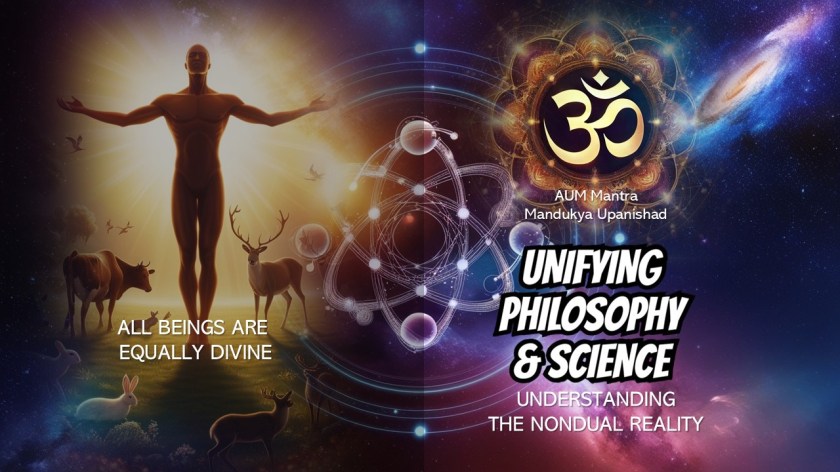
Learning to Understand the Mysteries of the Universe – Ancient Vedantic Wisdom Meets Modern Science

In this day and age, with scientific advancements revolutionising every field, it’s increasingly challenging to accept traditional narratives like ‘god’ creating man in his image or crafting the universe in six days and so on. Such beliefs often lead to the perplexing question: who created ‘god’? This inquiry spirals into an infinite regress, providing no satisfying answers.

However,…CONTINUE READING

Advaita Vedanta Video Collection: A Resource for Serious Seekers

I am pleased to share a comprehensive resource for those dedicated to the pursuit of self-realisation through Advaita Vedanta. This collection of 45 videos, hosted on YouTube, serves as a guided journey to help you internalise the profound teachings of non-dual Vedanta, the pinnacle of all Vedic studies. Each video is thoughtfully designed to facilitate a smoother path towards the realisation of Atma-Gnyaana — the knowledge of your own true, all-pervading, and attributeless SELF, known as Brahman or Krishna.

For your convenience, I have compiled these videos into a single PDF index with clickable links, allowing you to easily access each video at your own pace.

Download the PDF Index here: Understanding Vedanta with Tavamithram 03 (50 videos)

May this resource inspire and aid you in your quest for self-awareness and enlightenment, freeing you from all fears and negative emotions. These emotions can only rob you of your most precious asset — time on this planet — without offering true happiness in return.

The Path of Knowledge has been accorded the highest status among all paths towards Self-Realisation: Shloka SBG 4:38

From Unfounded Beliefs to Clarity Through Vedanta

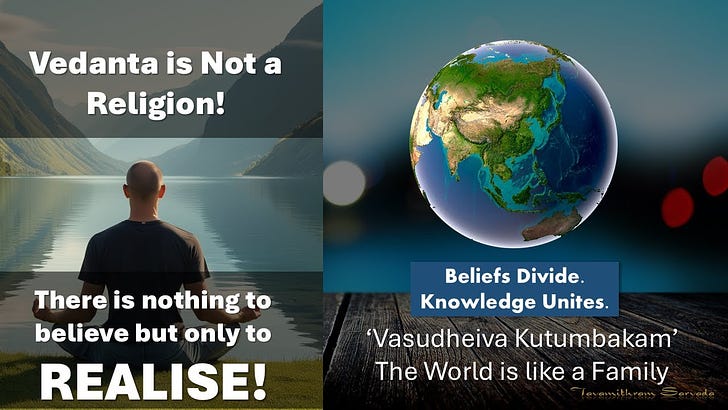
Beliefs Divide, Vedanta Unites!

JOIN MY SUBSTACK – IT’S FREE

Religion often relies on beliefs without evidence, creating divisions and control through fear and greed.

In contrast, Vedanta, the pinnacle of spiritual understanding from the Indian subcontinent, promotes unity and true knowledge, urging individuals to rise above dualistic beliefs and introspect for deeper understanding. READ ON SUBSTACK

Trapped by Tradition: What Monkeys Teach Us About Blind Conformity

JOIN MY SUBSTACK – IT IS FREE

This video sheds light on an intriguing experiment that reveals deep insights into human behaviour and the importance of questioning established norms. The story serves as a powerful metaphor for how traditions and social customs can become…READ ON SUBSTACK AND WATCH THE VIDEO

Two ‘Mantras’ to Destroy Negative Karma and Start Afresh

Life is too precious. Nothing and no one is worth wasting your time on in life.

Discover simple steps to navigate even the most challenging times in life.

No matter how tough or daunting your situation might be, the first step is to come to terms with it – at least temporarily.

This acceptance allows your intellect to push your emotions aside and function fully, enabling you to come up with a solution.

General George S. Patton said, “Accept the challenges so that you can feel the exhilaration of victory.”

In the video presentation ‘So What? What Next?’, I explain two simple two-word ‘Mantras’ that can greatly help overcome the delusion caused by a sense of entitlement and the tendency to avoid troubles and risks.And in the other titled ‘Reset Karma’, I explain simple ways to change unfavourable patterns in life to more favourable ones.

It is primarily one’s sense of entitlement, ingrained since childhood, that often becomes a significant barrier to success. Believing they deserve only the best and most comfortable things in life, individuals can become morally weakened when faced with challenges. This mental block prevents them from recognising their own capabilities.

No matter how tough or daunting your situation might be, the first step is to come to terms with it, at least temporarily. This acceptance allows your intellect to function fully, pushing emotions aside and enabling you to find a solution. Whatever the situation, even if someone is facing a life-or-death scenario, they need to come out of denial, accept the truth, and start thinking rationally about what they can do to survive. Doing so removes the greatest obstacles in the form of fear, anger, or any other destructive emotions.

From Stagnation to Success: Mastering Negative Karmic Inertia

Shattering All Blockades in Life

Understanding the Three Gunas: A Path to Self-Improvement

Understanding the three Gunas explained in the Srimad Bhagavad Gita offers profound insights into human behaviour and consciousness. These three fundamental qualities—Sattva (goodness), Rajas (passion), and Tamas (ignorance)—shape our thoughts, actions, and overall life experience. Among these, the Tamasa Guna, which embodies indolence, laziness, lethargy, negativity, and pessimism, often acts as a significant impediment to personal growth and productivity. I refer to this as ‘Negative Karmic Inertia.’

Much like maintaining a good hormonal balance is crucial for physical health, achieving a harmonious balance of the three Gunas is essential for a fulfilling and enriching life. By understanding and managing our Guna levels, we can enhance our self-awareness and work towards self-improvement. The real transformation happens within, even if the knowledge and inspiration come from external sources.

The Role of Tamasa Guna

Excessive Tamas is like a heavy weight that chains a person to the ground, preventing any positive change and perpetuating a state of lethargy and inertia. It not only affects one’s behaviour but also distorts one’s ability to rationalise and make sound decisions. A person overwhelmed by Tamas might find themselves stuck in a cycle of inaction and negativity, unable to break free and achieve their true potential.

The Three Gunas explained in the Bhagavad Gita

The Srimad Bhagavad Gita provides a detailed explanation of the three Gunas and their effects on individuals:

SBG 14:5 – “The three Gunas or qualities are Sattva, which is the quality of goodness; Rajas, which is the quality of passion; and Tamas, which is the quality of ignorance; O mighty-armed one. They are born of Prakriti which is Nature. These qualities bind very fast the immutable embodied Self in the body.”

SBG 14:6 – “Of these, Sattva, which, due to its purity, is luminous and healthy, frees a person of all Karmic reactions. Those of this Guna are attached to knowledge and to happiness, O sinless one.”

SBG 14:7 – “You should know Rajas to be the Guna or nature of passion, which is the source of desire and attachment. O Arjuna, it binds fast to the embodied Self by attachment to action.”

SBG 14:8 – “Tamas is born of ignorance and deludes all embodied beings. O Arjuna, this results in the binding of the embodied soul by negligence, sleep and laziness!”

SBG 14:9 – “O Arjuna, Sattva binds one to happiness, Rajas to action, while Tamas shrouds knowledge and binds one to idiocy.”

SBG 14:10 – “O descendant of Bharata (Arjuna), Sattva prevails over Rajas and Tamas, while Rajas manifests itself by overpowering Sattva and Tamas; and Tamas manifests itself by subduing Sattva and Rajas.”

SBG 14:11 – “When the light of wisdom shines through every sense in this body, it may be known that Sattva is predominant.”

SBG 14:12 – “When greed, endeavour for material gains, restlessness and longing arise; Rajas is predominant, O Arjuna.”

SBG 14:13 – “The presence of illusion, darkness, recklessness and delusion in a person indicate the predominance of Tamas in them, O Arjuna.”

Overcoming Negative Karmic Inertia

Many people struggle with feelings of demotivation and an inability to achieve their goals. This internal blockage often stems from an excess of the Tamasa Guna. Conversely, those driven by an excessive Rajas Guna might find themselves aggressive and even harmful in their pursuit of desires.

Managing Rajas

SBG 3:36-37: Arjuna asks Krishna: What prompts a man to perform sinful deeds, O descendant of Vrshni? Why does he commit such acts even without desiring to do them, as if he were forced?

Shri Bhagavan Krishna replies: Lust and anger are born out of the material nature called Rajoguna, which is insatiable and prompts man to commit sin. You must know that this is the greatest enemy in a man’s spiritual life.

Understanding one’s Guna ratio is akin to a doctor diagnosing a patient: it allows for targeted self-improvement. By identifying and addressing the predominant Guna that is out of balance, individuals can work on the specific areas needed to overcome unwanted situations in life.

Self-Study and Introspection

The path to self-improvement begins with self-study and introspection. Rather than casting blame on external factors, it is crucial to look within and understand the internal dynamics that drive our behaviour. By doing so, we can achieve a harmonious balance of the Gunas, leading to a more pleasant, enriching, and fulfilling life.

Finally, the knowledge of the three Gunas offers a powerful tool for self-awareness and personal growth. By recognising the influence of Tamas and working to balance it with Sattva and Rajas, we can overcome negative karmic inertia and realise our true potential. The journey to self-improvement is an inward one, and the key to success lies in understanding and managing the forces within us.

Reflect on your own Guna ratio, identify the areas that need attention, and take the necessary steps to bring balance and harmony into your life. Embrace the power of self-awareness and let it guide you towards a brighter, more fulfilling future.

If you truly want to change your life, it is you who must change, for the world will not bend to your will.

“Who looks outside dreams; who looks inside awakes.” – Carl Jung

The Ever-Relevant Gita: A Present-Day Rendering

Embracing the Blissful Journey: The Ever-Relevant Gita – A Present-Day Rendering by Tavamithram Sarvada

Now available in various online store fronts, such as: Amazon InternationalINDEUKAUNLCAFRESPLITBRMX

*The paperback version is not available on Amazon India.

Part 1: Preface and Introduction + Chapters 1-6

The preface and introduction lay the foundation for your exploration. Don't be tempted to skip these initial chapters; they are the compass guiding you through the intricate terrain of the Gita's philosophy. Understand the core teachings, and you'll find yourself motivated to delve deeper, perhaps into the rich Bhashyams or commentaries of Shri Adi Shankara and other great teachers.

Part 2: Chapters 7-12

As you progress through these chapters, absorb the profound insights that unfold. The clarity of understanding achieved in the earlier sections becomes the stepping stone for an even more profound comprehension of Krishna's teachings.

Part 3: Chapters 13-18 + Outro

The culmination of your journey awaits in the final chapters. The outro ties the threads together, offering a comprehensive view of the Gita's timeless wisdom. This concluding section is not to be missed; it holds the key to empowerment and self-confidence.

Namaste Seekers,

Embark on a profound journey into the timeless wisdom of the Srimad Bhagavad Gita with ‘The Ever-Relevant Gita: A Present-day Rendering by Tavamithram Sarvada.’ Below, I’ll elucidate the profound significance of this work and its potential to illuminate the path to self-realisation.

In a fast-paced world fraught with complexities, the solace found in ancient wisdom often remains unexplored. 'The Ever-Relevant Gita – A Present-day Rendering by Tavamithram Sarvada’ endeavours to bridge this gap, bringing forth the profound teachings of the Srimad Bhagavad Gita to everyone, irrespective of age, background, or familiarity with ancient scriptures.

Dispelling Myths and Misconceptions

The main challenge involves dispelling misconceptions that surround the Srimad Bhagavad Gita—misconceptions about its perceived depth, religious connotations, and its relevance limited to the elderly or devout individuals. In this modern interpretation, we untangle myths and present timeless wisdom in a manner that aligns with the sensibilities of the contemporary mind.

A Unique Approach: Audio, Video, and E-book Formats

Understanding the daunting nature of lengthy translations, a unique approach has been taken by creating easily digestible audio recordings of each chapter. These recordings allow listeners to absorb the essence of the Gita at their own pace, breaking down barriers that often deter individuals from exploring this ageless scripture.

Beyond presentation, this initiative is a call to embark on a blissful journey of self-discovery. In my life, which has been shaped by numerous challenges and life-altering situations, the importance of a well-trained instinct and a balanced mindset has become crystal clear to me. A clear understanding of the fundamental principles of the teachings in the Srimad Bhagavad Gita certainly plays a pivotal role in shaping attitudes, cultivating fearlessness, and fostering rational thinking during critical moments.

Practical Insights for Daily Application

The true power of the Srimad Bhagavad Gita lies in its application in everyday life. The focus is not merely on delivering a rendition or chanting Shlokas, but on providing practical insights that enable individuals to apply these teachings in their daily lives, leading to a more fulfilling and blissful existence.

In essence, the mission is to make the teachings of the Srimad Bhagavad Gita easily accessible, relatable, and applicable to everyone, fostering a deeper understanding of life's intricacies. Join me on this enlightening journey, and let's journey through the supreme scripture together.

Those who would like a promo code for a free download of the Audiobook version of the ‘The Ever-Relevant Gita – A Present-Day Rendering by Tavamithram Sarvada’ may email their request to tavamithramoffice@gmail.com

Jai Shri Krishna

What Lies Beyond ‘You’? The Ultimate Truth in Vedanta

Who Am I? Uncovering the Timeless Mystery of Self

Subscribe to my FREE SUBSTACK for insights on self-discovery, consciousness, and Vedanta. Join now and connect with fellow seekers on a deeper journey!

Click on the image below to go directly to my Substack, read the full post, and watch a video presentation.