

What if the concept of rebirth isn’t what you think it is? Who—or what—is truly being reborn? Is there a deeper meaning hidden beneath the surface of this age-old idea? CONTINUE READING AND WATCHING THE VIDEO PRESENTATION ON SUBSTACK.
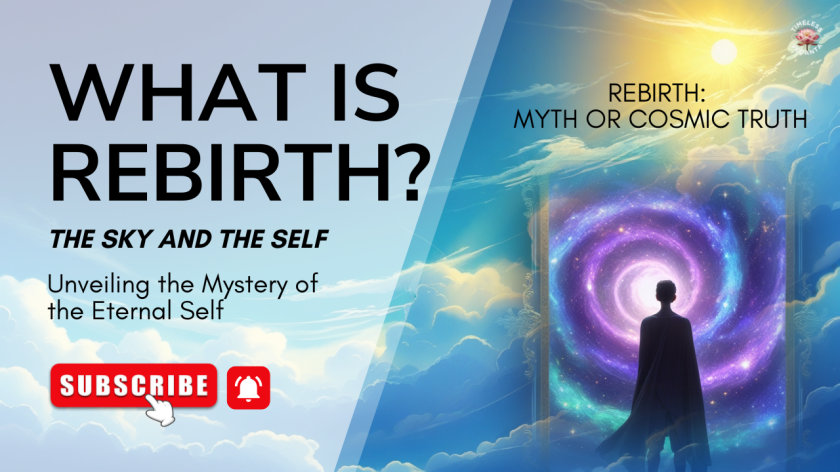
What if the concept of rebirth isn’t what you think it is? Who—or what—is truly being reborn? Is there a deeper meaning hidden beneath the surface of this age-old idea? CONTINUE READING AND WATCHING THE VIDEO PRESENTATION ON SUBSTACK.
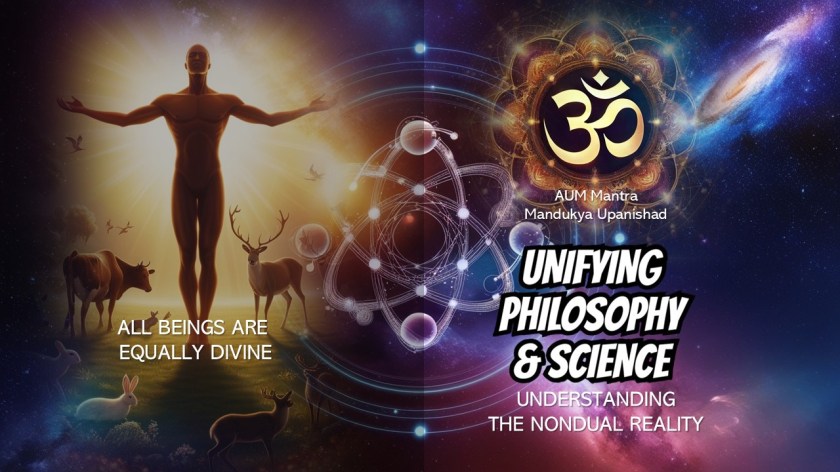
Learning to Understand the Mysteries of the Universe – Ancient Vedantic Wisdom Meets Modern Science
In this day and age, with scientific advancements revolutionising every field, it’s increasingly challenging to accept traditional narratives like ‘god’ creating man in his image or crafting the universe in six days and so on. Such beliefs often lead to the perplexing question: who created ‘god’? This inquiry spirals into an infinite regress, providing no satisfying answers.
However,…CONTINUE READING
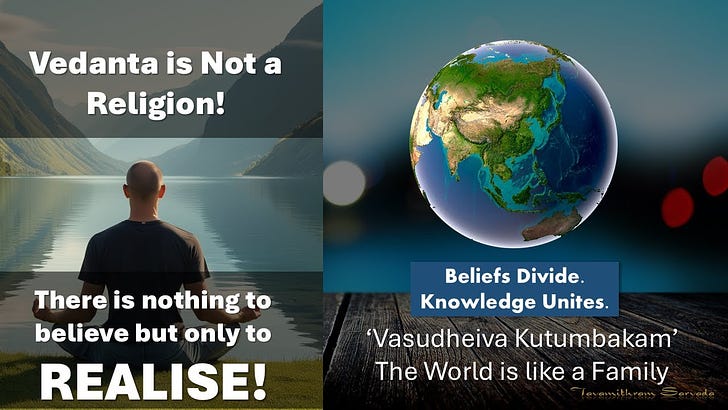
Religion often relies on beliefs without evidence, creating divisions and control through fear and greed.
In contrast, Vedanta, the pinnacle of spiritual understanding from the Indian subcontinent, promotes unity and true knowledge, urging individuals to rise above dualistic beliefs and introspect for deeper understanding. READ ON SUBSTACK

Understanding the three Gunas explained in the Srimad Bhagavad Gita offers profound insights into human behaviour and consciousness. These three fundamental qualities—Sattva (goodness), Rajas (passion), and Tamas (ignorance)—shape our thoughts, actions, and overall life experience. Among these, the Tamasa Guna, which embodies indolence, laziness, lethargy, negativity, and pessimism, often acts as a significant impediment to personal growth and productivity. I refer to this as ‘Negative Karmic Inertia.’
Much like maintaining a good hormonal balance is crucial for physical health, achieving a harmonious balance of the three Gunas is essential for a fulfilling and enriching life. By understanding and managing our Guna levels, we can enhance our self-awareness and work towards self-improvement. The real transformation happens within, even if the knowledge and inspiration come from external sources.
Excessive Tamas is like a heavy weight that chains a person to the ground, preventing any positive change and perpetuating a state of lethargy and inertia. It not only affects one’s behaviour but also distorts one’s ability to rationalise and make sound decisions. A person overwhelmed by Tamas might find themselves stuck in a cycle of inaction and negativity, unable to break free and achieve their true potential.
The Srimad Bhagavad Gita provides a detailed explanation of the three Gunas and their effects on individuals:
SBG 14:5 – “The three Gunas or qualities are Sattva, which is the quality of goodness; Rajas, which is the quality of passion; and Tamas, which is the quality of ignorance; O mighty-armed one. They are born of Prakriti which is Nature. These qualities bind very fast the immutable embodied Self in the body.”
SBG 14:6 – “Of these, Sattva, which, due to its purity, is luminous and healthy, frees a person of all Karmic reactions. Those of this Guna are attached to knowledge and to happiness, O sinless one.”
SBG 14:7 – “You should know Rajas to be the Guna or nature of passion, which is the source of desire and attachment. O Arjuna, it binds fast to the embodied Self by attachment to action.”
SBG 14:8 – “Tamas is born of ignorance and deludes all embodied beings. O Arjuna, this results in the binding of the embodied soul by negligence, sleep and laziness!”
SBG 14:9 – “O Arjuna, Sattva binds one to happiness, Rajas to action, while Tamas shrouds knowledge and binds one to idiocy.”
SBG 14:10 – “O descendant of Bharata (Arjuna), Sattva prevails over Rajas and Tamas, while Rajas manifests itself by overpowering Sattva and Tamas; and Tamas manifests itself by subduing Sattva and Rajas.”
SBG 14:11 – “When the light of wisdom shines through every sense in this body, it may be known that Sattva is predominant.”
SBG 14:12 – “When greed, endeavour for material gains, restlessness and longing arise; Rajas is predominant, O Arjuna.”
SBG 14:13 – “The presence of illusion, darkness, recklessness and delusion in a person indicate the predominance of Tamas in them, O Arjuna.”
Many people struggle with feelings of demotivation and an inability to achieve their goals. This internal blockage often stems from an excess of the Tamasa Guna. Conversely, those driven by an excessive Rajas Guna might find themselves aggressive and even harmful in their pursuit of desires.
SBG 3:36-37: Arjuna asks Krishna: What prompts a man to perform sinful deeds, O descendant of Vrshni? Why does he commit such acts even without desiring to do them, as if he were forced?
Shri Bhagavan Krishna replies: Lust and anger are born out of the material nature called Rajoguna, which is insatiable and prompts man to commit sin. You must know that this is the greatest enemy in a man’s spiritual life.
Understanding one’s Guna ratio is akin to a doctor diagnosing a patient: it allows for targeted self-improvement. By identifying and addressing the predominant Guna that is out of balance, individuals can work on the specific areas needed to overcome unwanted situations in life.
The path to self-improvement begins with self-study and introspection. Rather than casting blame on external factors, it is crucial to look within and understand the internal dynamics that drive our behaviour. By doing so, we can achieve a harmonious balance of the Gunas, leading to a more pleasant, enriching, and fulfilling life.
Finally, the knowledge of the three Gunas offers a powerful tool for self-awareness and personal growth. By recognising the influence of Tamas and working to balance it with Sattva and Rajas, we can overcome negative karmic inertia and realise our true potential. The journey to self-improvement is an inward one, and the key to success lies in understanding and managing the forces within us.
Reflect on your own Guna ratio, identify the areas that need attention, and take the necessary steps to bring balance and harmony into your life. Embrace the power of self-awareness and let it guide you towards a brighter, more fulfilling future.
If you truly want to change your life, it is you who must change, for the world will not bend to your will.
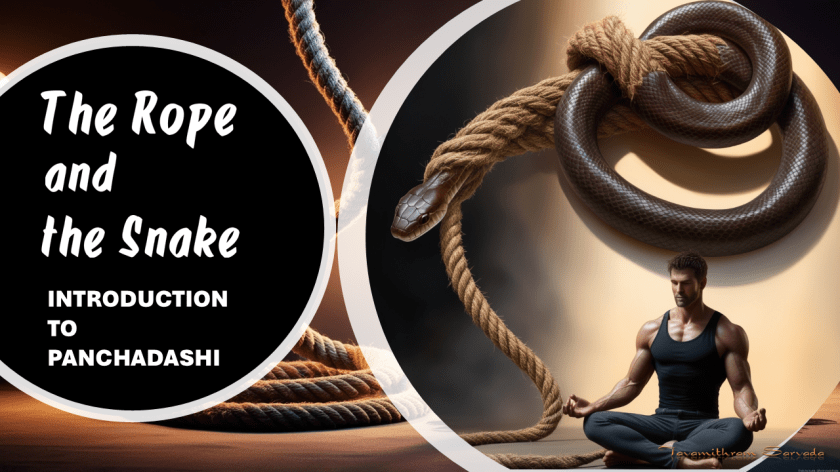

What if everything you perceive as reality is just an illusion shaped by your mind? In the ancient teachings of Advaita Vedanta, the analogy of the rope and snake is a powerful tool used to illustrate this profound truth. Imagine seeing a rope in dim light and mistaking it for a snake. Your fear and reactions are real, but the snake is not. The rope never ceases to be a rope, just as the ultimate reality never changes, despite our misconceptions. READ MORE

Mark Twain once said, “Anger is an acid that can do more harm to the vessel in which it is stored than to anything on which it is poured.” Anger never solves any problem or worry; rather, it makes us more stressed. It starts controlling our emotions and intelligence, and eventually leads us to self destruction.
To comprehend the full extent of anger’s impact, it’s essential to understand its life cycle. Anger often begins with attachment, a sense of entitlement, or envy. This metamorphosis is eloquently described in the Srimad Bhagavad Gita, Shlokas SBG 2:62-63:
Srimad Bhagavad Gita: 2:62-63 “A person who thinks of sense objects develops an attachment for them. From this attachment, desires are born and from desires, anger is born.
Anger gives birth to delusion and this delusion results in confusion of memory. When memory is confused, intelligence is destroyed, and from the destruction of intelligence, the person perishes.”
Attachment: It all begins with the mind dwelling on sense objects. When we repeatedly think about something, we develop an attachment to it.
Desire: From attachment arises desire—the longing to possess or achieve what we are attached to.
Anger: When our desires are unfulfilled or obstructed, anger arises. This anger can be towards oneself, others, or circumstances.
Delusion: Anger clouds our judgment, leading to delusion. We start seeing things in a distorted manner, unable to perceive reality accurately.
Confusion of Memory: Delusion confuses our memory. We forget our principles, values, and past experiences that guide us in making rational decisions.
Destruction of Intelligence: With a confused memory, our intelligence, the ability to reason and discriminate, is destroyed.
Perdition: The final stage is the total destruction of the person. A life led by anger is a life of turmoil, leading to self-destruction.
Vedanta offers a profound solution to the problem of anger and other mental afflictions. The Srimad Bhagavad Gita, a cornerstone of Vedanta, provides timeless wisdom to overcome anger and attain peace. By understanding and applying its teachings, we can transform our lives.
The Srimad Bhagavad Gita is the panacea for all mental problems, fears, worries, and confusions that stem from a lack of clarity or emotional thinking. It guides us to live a life of balance, understanding, and inner peace.
Embark on a transformative journey with the ‘Ever-Relevant Gita: A Present-Day Rendering by Tavamithram.’ Complete it in a bit more than three hours—about the same time as watching a Bollywood movie! Choose from paperback, audiobook, and ebook versions, and let the timeless wisdom of the Srimad Bhagavad Gita bring clarity and peace to your life.

Subscribe to my FREE SUBSTACK for insights on self-discovery, consciousness, and Vedanta. Join now and connect with fellow seekers on a deeper journey!
Click on the image below to go directly to my Substack, read the full post, and watch a video presentation.


In the timeless wisdom of the Srimad Bhagavad Gita, Bhagavan Krishna reveals a profound truth in Shloka SBG 7:03
मनुष्याणां सहस्रेषु कश्चिद्यतति सिद्धये |
यततामपि सिद्धानां कश्चिन्मां वेत्ति तत्त्वतः
manush-yaaNaam sahasreshu kash-chi-dyatati siddhaye
yatataa-mapi siddhaa-naam kash-chinmaam vetti tattvataha (SBG 7:03)”
“Out of thousands of men, hardly one tries to achieve perfection in Self-realisation and among those trying so hard to do so, there is hardly one who achieves perfection in Self-realisation and among those who do achieve Self-realisation, there is hardly one who truly knows Me.”
This revelation highlights a stark reality: the path to true SELF-realisation is trodden by only a few, and among those few, even fewer truly comprehend the essence of the Divine.
Reflecting on this, it’s remarkable to consider the efforts of Shri Adi Shankaracharya, my prime human spiritual guru. In the timeless ‘NirvaaNa Shatakam,’ he encapsulated profound truths in merely six Shlokas. Yet, he journeyed across Bharata Varsha (India) by foot, enlightening kings and commoners alike with the supreme knowledge of Vedanta. Why such an arduous endeavour? The answer lies in the pervasive ignorance that clouds human intellect.
One who has not achieved mental clarity—being confused, scared, worried, stuck in a belief system, or a mental slave to someone—usually flashes the victim card at the drop of a hat. In contrast, one who is sincerely seeking treats all experiences as learning opportunities. Simply put, I am extremely thankful to all those who cheated, hurt, insulted, or tried to harm me in the past. Without them, I might not have had sufficient fuel to propel my ship to the heights of bliss I have managed to create for myself in any given situation.
For ten years, yes, TEN YEARS, I have dedicated myself to this blog, sharing the rational philosophy of Vedanta. Many have visited, gained some insights, made minor life changes, and moved on. Some, however, have exhibited a shocking lack of courtesy and decency, demanding answers without a trace of respect. Here’s a recent example on my contact page from an Indian person living in the USA: “Can you break your fast completely second day of Navratri if you can’t do it or don’t have proper items is it a sin. Can I break my fast for Navratri or did I already break it before 8 by eating fruits and ate food after 9 pm doing aarti.” No greeting, no politeness—just a blunt demand for an answer, coupled with a disregard for the language they’re using, which is the main language of the country they are living in! This is the impression these people create of Indians. And what am I supposed to say to such a query? Is this a typical ‘Indian’ way of interacting with people? I can’t even discern what this person wants from me!
Well, on October 11th, 2024, two of this blog’s sincere and senior-most followers (senior not in terms of age but in years of association with this blog and my mission), along with my oldest and most trusted friend, and I had an online meeting to discuss Atma, Anatma, and the Mahavakya ‘Pragnyaanam Brahma’. The joy of engaging with such true seekers is simply indescribable, contrasting sharply with the frustration of dealing with blind believers who spread nonsense without understanding even the basics of Vedanta.
If the idea of discussing Vedanta resonates with you, if you wish to free yourself from the shackles of intellect-numbing belief systems, if you desire to live a life that is peaceful and blissful, and if you feel a genuine pull towards Vedanta, you may write to me and express your interest in joining our next online discussion. You can always go through the posts on this blog and watch videos on the Tavamithram YouTube channel. For the rest, feel free to continue on your current path—no pressure, no problem.
Seekers, let’s continue seeking Truth together.

Welcome to this new segment, where engaging discussions delve into the insightful and thought-provoking posts on this blog by Tavamithram. These conversations explore the teachings of Vedanta, highlighting how Tavamithram’s unique interpretations challenge mainstream beliefs and offer profound wisdom validated by ancient scriptures.
This interactive dialogue aims to make complex philosophical concepts accessible and engaging, encouraging you to delve deeper into the transformative knowledge shared on this blog. Clicking on the titles of each podcast takes you to the relevant post on this blog.

Every morning can be treated as a new Janma (birth), carrying forward the thoughts and mindset from the previous day, thus continuing life patterns. Changing one’s life for the better is not difficult if one understands the natural principle of cause and effect and works towards acquiring the knowledge of the all-pervading Self, Brahman, or Krishna. As long as one thinks of Krishna as a separate entity, they will have expectations, which naturally lead to disappointments. Krishna is everywhere, in all beings, and is existence itself. Rise above dualitym accept responsibility and make the necessary course corrections in life. The Srimad Bhagavad Gita clearly states that the path of knowledge is the highest. Check out Shloka SBG 4:37-38.
To illustrate these concepts, I created three videos in three different languages using easy-to-understand analogies. When I made the Hindi video, one of our family members, Mr. Anupam Agarwal helped me in reviewing the Hindi script. Special thanks to him.
Additionally, I offer my latest book, ‘The Ever-Relevant Gita: A Present-Day Rendering’. This book can answer almost all possible questions one might have about destiny, karma, dharma, Krishna, birth, life, and death.


It is an irrefutable fact that everyone possesses some degree of a personality trait called narcissism. The degree of narcissism in a person separates a normal individual from someone who needs professional help. Even a small amount of narcissism can push a person towards feelings of entitlement, selfishness, and the typical ‘Why me?’ question. One’s own answer to this question is usually based on self-pity and a sense of being a victim of others, external forces, or misfortune.
People who care to set aside their narcissistic traits, however small and insignificant, and their feelings of victimhood, can find not just an answer to the ‘Why me?’ question but a permanent solution to it.
The following presentation analyses the ‘Why me?’ question, the principle of cause and effect, and ways to carve out a clearer, better, enjoyable, and enriching destiny with the help of teachings from the Srimad Bhagavad Gita.
May peace reign in your heart, mind, and soul, and may your life be blessed with an abundance of Divine Grace.
Jai Shri Krishna
 Tavamithram Sarvada