Free Downloads – Quick Reference Shlokas from the Bhagavad Gita

Shlokas for different situations

I am happy to share with you, six insightful and transformative downloadable PDFs, each addressing a crucial aspect of personal growth and spiritual development. These resources are designed to help you navigate life’s challenges with wisdom and grace:

  1. Krishna: The Divine Father and Mother – Explore Krishna’s nurturing and protective aspects, embodying both paternal and maternal love.
  2. KILL Fear and Anger – Learn practical techniques to overcome fear and anger, transforming these negative emotions into sources of strength.
  3. Remove Demotivation – Discover effective strategies to reignite your passion and drive, helping you stay motivated in all aspects of life.
  4. Handling Temptation – Gain insights into resisting temptations and making choices that align with your highest values and goals.
  5. Fighting Laziness – Equip yourself with tools and tips to combat laziness and cultivate a proactive and energetic mindset.
  6. How to Become Dear to Krishna? – Uncover the steps and practices to deepen your relationship with Krishna, fostering a sense of closeness and devotion.

Download these PDFs now to embark on a journey of self-improvement and spiritual enlightenment.

The Curse of Duality

Take to Sheer and Pure Vedanta and BE FREE

* This is a post on Substack. Please note that pledging support for the newsletter is only optional. Subscribing to my Substack does not cost anything!

Srimad Bhagavad Gita 7:03 presents a profound insight: “Out of thousands of men, hardly one tries to achieve perfection in Self-realisation…and among those who do achieve Self-realisation, there is hardly one who truly knows Me.” This Shloka highlights the rarity of individuals who question, seek understanding, and reject unfounded beliefs.

Influenced by organised religions and personality cults, the concept of duality has entrenched itself in the minds of many Indians and those of Indian origin. This post aims to clarify that Vedanta transcends mere belief systems. For that matter,…READ ON SUBSTACK

‘The Curse of Duality’ on Substack


The Ever-Relevant Gita: A Present-Day Rendering’

FREE PROMO CODES: LIMITED OFFER

The Greatest Gift to Yourself for 2024 and the Future

The Bhaja Govindam Song – Sanskrit Text, Transliteration, and English Translation

Shri Adi Shankaracharya

Aum Shri Gurubhyo Namaha

Introducing the Bhaja Govindam Song: A Code for Responsible Living

Have you ever wondered about the true meaning behind the captivating Bhaja Govindam song? Often recited and sung without understanding, this song holds profound wisdom that transcends mere prayer.

In my latest video, I delve deep into the essence of Bhaja Govindam, offering an English translation that unlocks the hidden messages within each Shloka. Additionally, I provide a PDF file containing the original Sanskrit Shlokas, transliteration, and translation for those who wish to explore further.

Contrary to popular belief, Bhaja Govindam is not exactly a conventional prayer song. It begins with the bold declaration, “O Fool,” setting the tone for a profound exploration of life’s responsibilities and truths. This song serves as a code for responsible living, urging individuals to shed ignorance and false beliefs.

In the video, I discuss how Shri Adi Shankara categorised his works into three groups, each tailored for individuals at different levels of understanding. However, throughout his teachings, Shankaracharya emphasises the importance of attaining SELF-knowledge (Atmagnyaana) and dispelling ignorance.

Moreover, I highlight the significance of gaining clarity of mind through understanding Vedanta, rather than blindly adhering to rituals and rites. In today’s world, where external influences seek to sway individuals from their spiritual path, it is crucial to grasp the essence of Vedantic teachings.

If you haven’t yet acquired my latest work, titled ‘The Ever-Relevant Gita: A Present-Day Rendering,’ please do so at your earliest convenience. The wisdom gained from exploring this song along with one or two reads of my book will undoubtedly bring clarity to your mind, leading to a peaceful, enjoyable, stress-free, calm, enriching, and fulfilling life.

The Ever-Relevant Gita: A Present-Day Rendering’

FREE PROMO CODES: LIMITED OFFER

The Greatest Gift to Yourself for 2024 and the Future

BhajaGovindam #VedantaWisdom #AdiShankara #SelfKnowledge #SpiritualJourney

Bhaja Govindam, Vedanta Wisdom, Adi Shankara, Self Knowledge, Spiritual Journey

Anthropomorphisation: Beyond Dualistic Worship and Confusion

A Gateway to Understanding Vedic Symbolism

Learning to Decode the Mysteries of Vedic Anthropomorphisation

The renowned Greek philosopher Seneca said, “We suffer more often in imagination than in reality.”

Isn’t it true? Many people are eternally afraid of a ‘heavenly ‘god”, who they fear would ‘punish’ them for wrongdoings or for not being ‘pious’ and ‘religious’ enough! What does such baseless fear stem from? From DUALITY or DUALISM, of course! Even the fear of death, which is the mother of all fears, stems from duality!

‘Anthropomorphisation’ is a term I used in one of my first posts on this blog. The post is titled ‘Fearlessness – achieving it by understanding the ‘God’ Concept.’

Since July 2014, my journey has been dedicated to elucidating the concept of anthropomorphisation and guiding individuals away from the veils of ignorance fostered by duality and dualistic worship, perpetuated by miscommunication from previous generations. Young children are often taught to believe in and pray to imaginary beings, which can hinder their intellectual development. Through the teachings of the Srimad Bhagavad Gita, we’ll explore how such dualistic thinking can limit understanding of the all-pervading nature of the SELF or Krishna, as described in the supreme scripture. Fools, in the words of the supreme scripture, are those who do not grasp this.

Think about it. Arjuna says to Shri Krishna in Shloka SBG 11:23 “Having seen You, O mighty-armed One (Shri Bhagavan Krishna), in your Cosmic form, with many faces, eyes, many arms, many thighs, many legs, many bellies, and many terrifying teeth, all the planets are perturbed. I too am aghast.”

Can this be taken literally? Can you imagine Krishna as a being with ‘many faces, eyes, arms, thighs, legs, bellies, and terrifying teeth’ in a literal sense?

Understanding anthropomorphisation is pivotal to grasping the essence of Vedic Dharma, which advocates progressing from simplistic worship of the various forces of nature towards intellectual enlightenment and the attainment of Atmagnyana, or SELF-knowledge.

SBG 3:21 (Krishna says) “Whatever or whichever action an important person does, others follow him and emulate him. What he does becomes a standard for the others.”
It’s a stark reality that some practices and traditions of certain people in the past have morphed into rigid superstitions and belief systems, steering people away from the path of knowledge and towards cults and sects. 

The primary cause of such decay in Dharmic society is the widespread ignorance about Vedanta, exploited by charlatans and self-proclaimed religious leaders to amass followers and material wealth.

Vedanta, signifying the culmination, end, or zenith of the Vedas, represents the ultimate goal. As affirmed by Krishna in Shloka SBG 9:02
राजविद्या राजगुह्यं पवित्रमिदमुत्तमम् |
प्रत्यक्षावगमं धर्म्यं सुसुखं कर्तुमव्ययम् || ९ २ ||
raaja-vidyaa raaja-guhyam
pavitra mida-muttamam
pratyakshaa-vagamam dharmyam
su-sukham kartu mavyayam (SBG 9:02)
“This is the royal science, the supremely holy and profound secret that can be experienced directly and with ease. It is very easy to practise and is everlasting.”

All it requires is a simple comprehension of texts like the Srimad Bhagavad Gita, shedding dualistic thoughts, and delving into the anthropomorphisation and allegory prevalent in Vedic scriptures such as the Srimad Bhagavad Gita and the Srimad Bhagavatam.

The Srimad Bhagavatam explicitly states in SB 12:3:14:
कथा इमास्ते कथिता महीयसां विताय लोकेषु यशः परेयुषाम् ।
विज्ञानवैराग्यविवक्षया विभो वचोविभूतीर्न तु पारमार्थ्यम् ॥ १२.३.१४॥
kathaa imaaste kathita mahiiyasaam vitaaya lokeshu yashah pareyushaam
vignyaana-vairaagya-vivakshayaa vibho vachovibhootiirna tu paaramaartham
(Rishi Shuka, the narrator of the Srimad Bhagavatam, said to Parikshith), “I have narrated to you the stories of great kings to embellish my narrations with power and opulence. However, my primary aim has been to impart transcendental knowledge and renunciation. These stories contribute to the richness of my narrative but do not embody the highest knowledge.”

Further elucidation is provided by Shloka SBG 7:24:
अव्यक्तं व्यक्तिमापन्नं मन्यन्ते मामबुद्धयः |
परं भावमजानन्तो ममाव्ययमनुत्तमम् || ७ २४ ||
avyaktam vyakti-maapannam
manyante maam-abuddhayaha
param bhaava-majaa-nanto
mamaa-vyayaman-uttamam
(SBG 7:24)
“Foolish people who do not know My formless, exalted, imperishable, and supreme nature think I assume a manifest human form.”

Can you imagine adults using an abacus to tally their finances? That would look silly, wouldn’t it? Persisting in a dualistic approach, even in later years, reflects ignorance, laziness, and the reluctance to transcend one’s current level of understanding, hindering progress towards the ultimate goal of Atmagnyaana.

To reiterate: all deities, gods, and goddesses are anthropomorphisations or personifications of various natural factors. Brahman, the all-pervading substance or substrate of everything, is unseen, while the deities represent their ‘Vibhuti’, created by humans for relatability.

In my book ‘The Ever-Relevant Gita: A Contemporary Interpretation by Tavamithram Sarvada‘, I delve into the symbolism of the main characters:

1. The Kauravas and Pandavas serve as personifications of the conflicting forces within the human psyche.

2. Arjuna’s adversaries, including family, friends, and mentors, symbolize the emotional attachments to people, possessions, and ideologies that ensnare individuals.

3. The battlefield of Kurukshetra allegorically represents the perpetual struggle of conflicting ideals within the human consciousness.

4. The beloved figures in the narrative epitomise the myriad attachments that can undermine one’s mental fortitude, leading some to forsake their aspirations.

5. Arjuna embodies the archetype of the ordinary individual who, despite possessing education, wisdom, and experience, succumbs to emotional turmoil and contemplates retreat.

6. Krishna embodies the intellect, representing the potential for enlightenment attainable by those who master their thoughts, exhibit unwavering responsibility, and adhere to the path of righteousness.

7. In Shloka SBG 5:13, Krishna metaphorically depicts the human body as a city with nine gates, known as ‘Dwaras,’ hence the term Dwaraka. As explained in SBG 10:20, Shri Krishna the ruler of Dwaraka, symbolises the SELF within each individual: Makes sense?

If you’ve been a regular visitor to this blog/site but haven’t yet read or listened to the Srimad Bhagavad Gita, despite the decade of assistance and free resources I’ve offered, and if you still believe that reciting or, rather, regurgitating Sanskrit mantras or visiting mountaintop temples can resolve your problems, then I can only express my sympathy for you.

However, it’s never too late. NOW is the first moment of the rest of your life. Reach out to me should you need help, and I will share with you whatever humble knowledge and experience I have gained during my journey through life until now.

It’s time to transcend petty disputes over gods, deities, and temples. Embrace Vedanta, and lead a blissful life.

Jai Shri Krishna.

The 3 Steps to a Balanced Life

Have a Healthy, Happy, Peaceful, fearless, and Fulfilling Life

(Republishing an old post) Namaste. I am delighted to present to you a transformative exploration into the profound teachings of the Srimad Bhagavad Gita, a timeless scripture that encapsulates the essence of life, consciousness, and the path to self-realisation. In this video presentation, ‘3 STEPS to Being Healthy and Happy: It is not difficult at all! Why complicate life?’, I distil the wisdom of the rational philosophy of Srimad Bhagavad Gita into three practical steps that can be effortlessly incorporated into our lives. These steps offer a simplified yet profound approach to understanding and applying the teachings of the Srimad Bhagavad Gita, providing a gateway for anyone seeking a meaningful and fulfilling life.

CLICK HERE TO CONTINUE READING ON SUBSTACK

Crafting a Thoughtful Tomorrow: Choosing the Path of Responsible Living

Analysing the Three Kinds of Pleasure

Following this approach can protect you from major disappointments in life.

In our journey through life, we often encounter moments we wish we could undo. Words spoken in haste, actions taken impulsively—these instances can leave a lasting impact, shaping our experiences and relationships. How can we navigate the delicate balance between spontaneity and thoughtfulness?

CONTINUE READING ON SUBSTACK

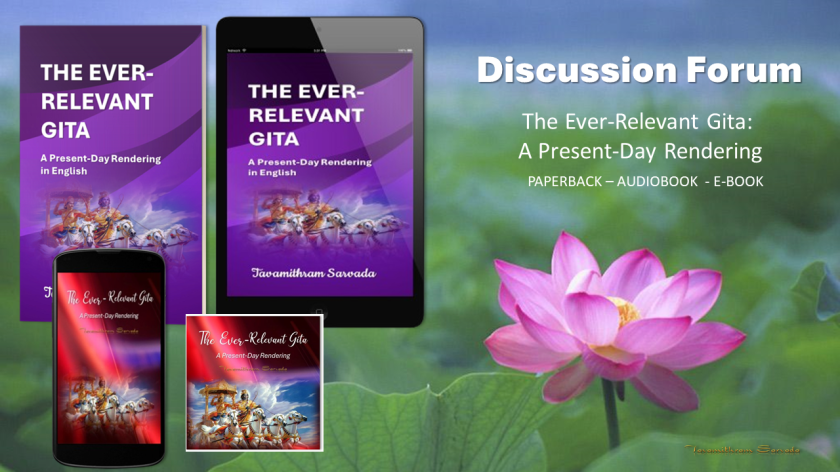
Announcing a New Discussion Forum

Discuss the Ever-Relevant Gita: A Present-Day Rendering and Vedanta as a whole

Click on the image to go to the Forum.

Introducing our Srimad Bhagavad Gita Discussion Forum!

Dear Seekers,

I’m glad to announce the launch of our new forum dedicated to “The Ever-Relevant Gita: A Present-Day Rendering.”

Join the Discussion
Engage in discussions, ask questions, and connect with like-minded individuals on a journey of self-discovery.

What Can You Expect?

  • Explore the SBG in-depth.
  • Q&A Sessions.
  • Book Insights.

How to Get Started?
Read or listen to “The Ever-Relevant Gita: A Present-Day Rendering by Tavamitharm Sarvada”, and post your questions, thoughts, and experiences.

Participate in the Forum Now

Let the Conversations Begin
Embark on this enriching journey. Learn the secret to living a peaceful, joyous, enriching, and peaceful life.

Krishnam vandé JagadGurum.

Beyond Opinions: A Journey to Inner Knowing

“The Greatest Deception…”

“The greatest deception men suffer from is their own opinions.” – Leonardo da Vinci

In a world rich with diverse beliefs and ideologies, our life’s journey is typically influenced by the constructs of our own minds. Opinions, deeply ingrained, can sometimes lead us away from the profound truth of our existence. The quest for self-realisation beckons us to transcend these constructs and discover the universal reality that goes beyond personal perspectives.

CONTINUE READING ON SUBSTACK

Managing Life like a Pilot: The ‘Cockpit of Life’

Learning from the Hudson River Hero, Captain ‘Sully’ Sullenberger


The ‘Cockpit of Life’

Embarking on a journey through the endless expanse of the sky, pilots navigate challenges with composure and skill, ensuring the safety of those on board. The parallels between a pilot’s approach to aviation and the principles outlined in the Srimad Bhagavad Gita offer profound insights into managing life’s complexities. Join me on a journey as we explore the art of managing your life like a pilot from the cockpit of your life.

CONTINUE READING ON SUBSTACK