

Vedanta ‘MIND LAUNDRY’
The other day, I was speaking with an old friend when the conversation turned to the tragic stampede at the Kumbh Mela in February 2025 and the official reports highlighting severe faecal contamination in the very waters where thousands had taken ‘holy’ dips. My friend took offence at my remarks and became almost aggressive and confrontational. He insisted that people have the right to their beliefs and that I had no business questioning them.
I want to highlight two important points here:
- My friend, like many others, fails to recognise that while he demands respect for people’s beliefs, there are also those who do not subscribe to such beliefs—and they, too, have a right to their views.
- My argument was never about belief itself, but about the reckless endangerment of thousands of lives and the pollution of a river they themselves deem ‘holy’ with faecal contamination!
The issue with my friend remains unresolved! So, my old friend is willing to risk our friendship over this thing called belief! Christopher Hitchens rightly said that religion poisons everything.
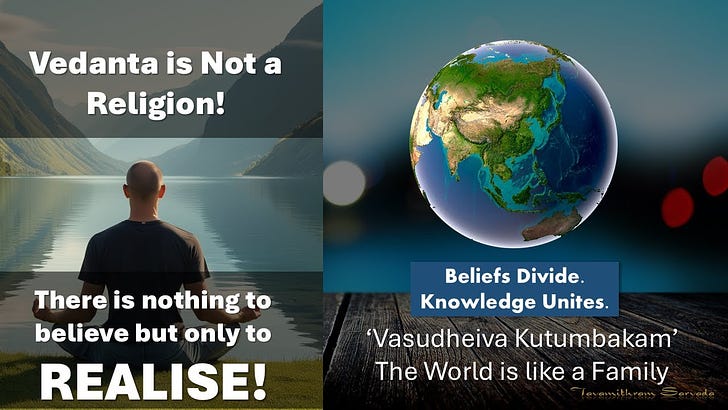
The most crucial point, however, is that in Advaita Vedanta, the highest attainment on the Vedic path known as Sanatana Dharma, there is no concept of belief. It is a path of knowledge, direct experience, and realisation, not blind faith.
Yet, many continue to follow irrational beliefs and rituals without questioning their origins or validity. These inherited practices are often carried out simply because they are part of tradition, with little thought given to their purpose. How often do people stop to ask: “Why am I doing this?” “Does it make sense?”
To encourage critical thinking and deeper reflection, I am reposting two videos that examine the absurdity of beliefs and rituals. These videos challenge the notion that faith alone is enough, exposing how unquestioned traditions shape societies and hinder individuals from seeking true knowledge.
Vedanta emphasises reason and self-inquiry. Instead of surrendering to superstition, one must strive to understand reality as it is, not as it is imagined or dictated by blind faith. True wisdom lies in breaking free from irrational dogmas and seeing the world with clarity.
Unfortunately, as laziness is easier and more comfortable than using our brains and thinking critically, most people prefer the easier route of blindly believing things rather than questioning, studying, and researching.
I invite you to watch these videos with an open mind and reflect on the impact of unquestioned beliefs in your own life.
Newspaper article regarding the pollution of the river Ganga:
“High levels of faecal coliform (microbes from human and animal excreta) were found in river water in which people took holy dip during Maha Kumbh in Prayagraj of Uttar Pradesh, according to a report submitted to the National Green Tribunal by the Central Pollution Control Board.”





 Tavamithram Sarvada