Blind Belief: The Lazy Man’s presumed ‘Shortcut to Spirituality’

Vedanta ‘MIND LAUNDRY’

The other day, I was speaking with an old friend when the conversation turned to the tragic stampede at the Kumbh Mela in February 2025 and the official reports highlighting severe faecal contamination in the very waters where thousands had taken ‘holy’ dips. My friend took offence at my remarks and became almost aggressive and confrontational. He insisted that people have the right to their beliefs and that I had no business questioning them.

I want to highlight two important points here:

  1. My friend, like many others, fails to recognise that while he demands respect for people’s beliefs, there are also those who do not subscribe to such beliefs—and they, too, have a right to their views.
  2. My argument was never about belief itself, but about the reckless endangerment of thousands of lives and the pollution of a river they themselves deem ‘holy’ with faecal contamination!

The issue with my friend remains unresolved! So, my old friend is willing to risk our friendship over this thing called belief! Christopher Hitchens rightly said that religion poisons everything.

The most crucial point, however, is that in Advaita Vedanta—the highest attainment on the Vedic path known as Sanatana Dharma—there is no concept of belief. It is a path of knowledge, direct experience, and realisation, not blind faith.

Yet, many continue to follow irrational beliefs and rituals without questioning their origins or validity. These inherited practices are often carried out simply because they are part of tradition, with little thought given to their purpose. How often do people stop to ask: Why am I doing this? Does it make sense?

To encourage critical thinking and deeper reflection, I am reposting two videos that examine the absurdity of beliefs and rituals. These videos challenge the notion that faith alone is enough, exposing how unquestioned traditions shape societies and hinder individuals from seeking true knowledge.

Vedanta emphasises reason and self-inquiry. Instead of surrendering to superstition, one must strive to understand reality as it is, not as it is imagined or dictated by blind faith. True wisdom lies in breaking free from irrational dogmas and seeing the world with clarity.

Unfortunately, as laziness is easier and more comfortable than using our brains and thinking critically, most people prefer the easier route of blindly believing things rather than questioning, studying, and researching.

I invite you to watch these videos with an open mind and reflect on the impact of unquestioned beliefs in your own life.

Newspaper article regarding the pollution of the river Ganga:
“High levels of faecal coliform (microbes from human and animal excreta) were found in river water in which people took holy dip during Maha Kumbh in Prayagraj of Uttar Pradesh, according to a report submitted to the National Green Tribunal by the Central Pollution Control Board.”
https://newsth.live/8g6mIp

Pathetic people and their pathetic lives

I can understand the lives of people, whose forefathers had converted to foreign religions either due to fear, greed, or whatever reason. But what about those whose forefathers faced it all, stood tall, protected the Vedic Sanatana Dharma, and passed it on so that the present generation could benefit from the highest knowledge of Vedanta?

How pathetic can such a huge number of people be, to not put in at least minimal efforts to study the Srimad Bhagavad Gita, which is called the nectar of all the Upanishads, instead of becoming mental slaves of non-existent imaginary deities and of beef-eating men and women claiming to be special divine people; join cults, sects, groups and subgroups; and actually choose to suffer all through their lives! How pathetic!

Now, get this straight: If you do something, no matter how ‘religious’ or ‘pious’ you might think it is, but expect something in return, including simply ‘wanting to please ‘god”; you would only be going against the main principle of KarmaYoga:

कर्मण्येवाधिकारस्ते मा फलेषु कदाचन |
मा कर्मफलहेतुर्भूर्मा ते सङ्गोऽस्त्वकर्मणि || २ ४७ ||
karmaNye vaadhikaras te
maa phaleshu kadaachana
maa-karma-phala-hetur-bhuur-
maa te sango ‘stva karmaNi (SBG 2:47)
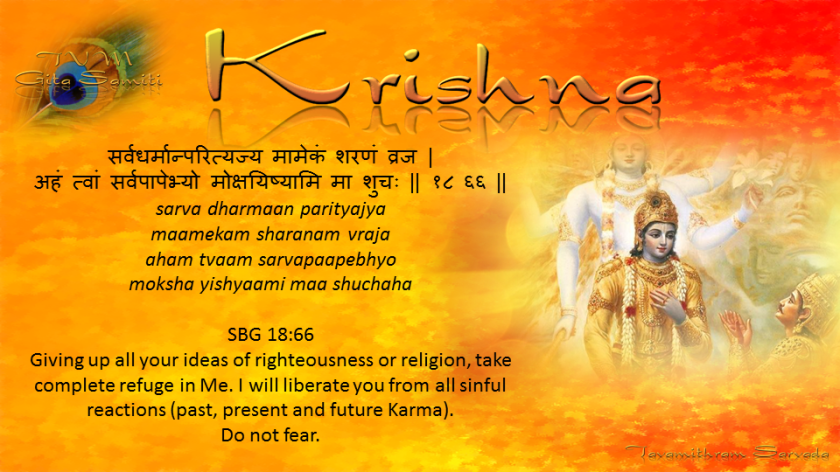
You only have the right to work, but never to claim its results. The results of your actions should never be your motive but at the same time, you should not be attached to inaction.

How miserable can people be, particularly those who consider themselves to be educated and knowledgeable, to ‘pray’ for special favours to something that does not even exist?

Please, remember that The Srimad Bhagavad Gita is a grand allegory. The Pandavas and the Kauravas are the positive and negative forces that continuously battle within one’s mind. Arjuna had Krishna as his own driver all through the war, but did he ever ask Krishna to ‘perform miracles’ and solve his problems? NO! Arjuna placed himself as a pupil of Krishna. See Shloka SBG 2:07. The moment any person, no matter m or f, positions himself or herself as an ‘Arjuna’, their ‘Krishna’ will appear and guide them through life. What I mean by ‘their ‘Krishna’ will appear’ is that their natural intellect, which has been, until then, shrouded by ignorance, ego, selfishness, and stupidity in the name of religion, misunderstood ‘shraddha’, ‘aasthaa’ or whatever, will start functioning well and help the person be open to true knowledge.

Krishna says:

अव्यक्तं व्यक्तिमापन्नं मन्यन्ते मामबुद्धयः |
परं भावमजानन्तो ममाव्ययमनुत्तमम् || ७ २४ ||
avyaktam vyakti-maapannam
manyante maam-abuddhayaha
param bhaava-majaa-nanto
mamaa-vyayaman-uttamam
(SBG 7:24)
Foolish people who do not know My formless, exalted, imperishable, and supreme nature think I assume a manifest human form.

अवजानन्ति मां मूढा मानुषीं तनुमाश्रितम् |
परं भावमजानन्तो मम भूतमहेश्वरम् || ९ ११ ||
avajaananti maam mood-haa
maanu-sheem tanum-aashritam
param bhaavam-ajaananto
mama bhoota-maheshvaram (SBG 9:11)
Foolish people, due to their lack of understanding of My higher nature as the Supreme Bhagavan of everything that exists, disregard Me when I descend in the human form.

What do the above Shlokas mean? It simply means that FOOLISH PEOPLE do not understand HIS Universal Nature because of silly beliefs that were injected into their heads through generations and generations of people who either had no idea of what they were saying or doing, or did such things deliberately in order to keep people in a state of intellectual and spiritual stupor. Puranas, which are meant to enable seekers better internalise the Supreme Truth of Vedanta are being taken literally and whole new cults are being created out of them!

Stop all the nonsensical rites and rituals you perform with your poor understanding of Vedanta believing they would ‘make ‘god’ happy’ and be helpful or useful to you; and study the Srimad Bhagavad Gita. There cannot be anything more important for you in life than something that can set your whole life straight.

Click here to look for suitable Gita resources and swear never to be pathetic or lead a pathetic life filled with fear, greed, anger, hatred, laziness, and the lack of true Vedantic Knowledge, simply because you do not care to study the Srimad Bhagavad Gita and are willing to spread the disease of pseudo-spirituality to others and to future generations.

STOP ALL STUPIDITY AND TAKE TO STUDYING KRISHNA’S TEACHINGS.

STUDY THE SRIMAD BHAGAVAD GITA.

Here is the solution. Can you invest three hours of your time in something that will change your life for the better?

Srimad Bhagavad Gita in 3 Hours – Guided Study for Clarity and Confidence