Nirvana Shatakam: The Bold Truth That Shatters Every Illusion You Hold Dear

“When you KNOW, you don’t need to BELIEVE.” – Tavamithram Sarvada

What if everything you believe about yourself—your identity, your desires, your fears—is nothing but an illusion? What if the very essence of who you are lies beyond the mind, the ego, and even the concept of “I”?

Enter the Nirvana Shatakam, a profound composition by the 8-year-old spiritual prodigy, Adi Shankaracharya. In just six verses, this masterpiece dismantles every label, every belief, and every ritual you’ve ever clung to. It doesn’t just challenge your worldview—it obliterates it.

Imagine a young boy, wandering the Himalayas, confronted by a sage who asks, “Who are you?” His response? A declaration so radical, so fearless, that it strips away every falsehood and points directly to the ultimate truth: “I am Shiva. I am pure consciousness.”

This isn’t just philosophy. This isn’t just spirituality. This is a call to awaken—to see beyond the illusions of identity, religion, and dogma. It’s a challenge to let go of everything you think you know and embrace the infinite truth of your being.

Are you ready to question everything? Are you ready to discover who you truly are? Watch the video now and let the Nirvana Shatakam guide you to the ultimate liberation.
Main Tavamithram Channel

Timeless Vedanta Channel

Not Your Body? Quick Tips to Discover Your True Self!

Join my SUBSTACK. It is FREE.

The Illusion of ‘Me’: Why You’re Not Your Body

In some major religions, creation is described as a divine act—’god’ creating humans in ‘his’ own image and forming the universe in six days, resting on the seventh. But what does it mean to be made in ‘god’s’ image? Is it about the physical form, or something deeper? From the largest of stars to the tiniest creatures on Earth, everything is a conglomeration of atoms—physical objects perceived through names and forms. Yet, identifying solely with these forms traps us in illusion, much like the prisoners in Socrates’ ‘Allegory of the Cave’, who mistook shadows for reality. READ AND WATCH THE SHORT VIDEO ON SUBSTACK

Bhaja Govindam on the Timeless Vedanta Channel

Bhaja Govindam: The Song That Will Transform Your Life

Most people listen to or recite Bhaja Govindam without grasping its true essence—but this profound composition by Shri Adi Shankara is far profound than what most people might think. It is a bold call to awaken from ignorance, starting with the striking words, “O Fool,” and leading to a life of wisdom and responsibility.

In this video, The Bhaja Govindam Song on the new Timeless Vedanta YouTube Channel, I unravel the deeper meaning of each Shloka, providing an English translation alongside a downloadable PDF with the original Sanskrit, transliteration, and translation.

Bhaja Govindam is not about blind beliefs or meaningless rituals but about attaining SELF-knowledge (Atmagnyaana), freeing the mind from delusions, and embracing Vedantic clarity. This understanding is vital in today’s world, where distractions pull us away from truth.

Watch the video, explore this timeless wisdom, and pair it with The Ever-Relevant Gita: A Present-Day Rendering—together, they will bring you clarity, peace, and a truly fulfilling life.

Mandukya Upanishad on TimeLess Vedanta

Discover the Mandukya Upanishad: The Essence of AUM and the Four States of Consciousness

Welcome to TimeLess Vedanta, where ancient wisdom meets modern seekers. In this    video, we will dive into one of the most profound texts in the Vedanta philosophy—the Mandukya Upanishad.

The Mandukya Upanishad, though the shortest of the 108 Upanishads, holds the key to understanding the essence of AUM and the four states of consciousness: waking, dreaming, deep sleep, and the transcendent state of Turiya. This Upanishad is a gateway to self-realisation, offering timeless insights into the nature of reality and your true Self.

In this video, we explore:

  • The significance of AUM and its connection to the three states of consciousness.
  • The fourth state, Turiya, which underlies and transcends all other states.
  • How the Mandukya Upanishad can guide you to realise your divine nature and break free from the illusions of the mind.

Whether you’re new to Vedanta or a seasoned seeker, this video will inspire you to look within and discover the divinity that resides in you.

Free PDF Included: To deepen your understanding, I’ve also prepared a beautifully formatted guide to the Mandukya Upanishad. Download it now and embark on your journey to self-realisation.

Join me on this transformative exploration of the Mandukya Upanishad. Watch the video below, download the PDF, and let the wisdom of the ancients illuminate your path.

ॐ शान्तिः शान्तिः शान्तिः

Subscribe to TimeLess Vedanta for more insights into Vedanta, the Upanishads, and the timeless truths that can transform your life.

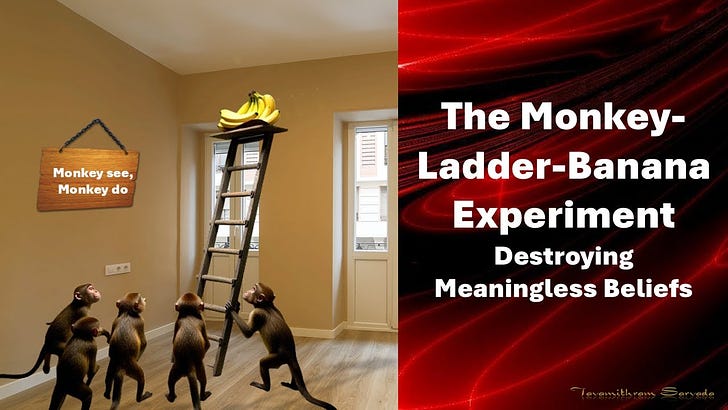
Trapped by Tradition: What Monkeys Teach Us About Blind Conformity

JOIN MY SUBSTACK – IT IS FREE

This video sheds light on an intriguing experiment that reveals deep insights into human behaviour and the importance of questioning established norms. The story serves as a powerful metaphor for how traditions and social customs can become…READ ON SUBSTACK AND WATCH THE VIDEO

Unlocking the Power of Your Choices

The Shocking Power of Your Choices: What You Sow Now, You Reap Later

Have you ever stopped to consider how the choices you made in the past have shaped your life today, and how the choices you make today will shape the life you’ll lead tomorrow? It’s a profound thought, one that often goes unnoticed in the hustle and bustle of daily life. Yet, the reality is that every decision, big or small, sets the stage for your future.

Imagine your life as a garden. The seeds you plant now—your choices, actions, and even thoughts—will grow and flourish, determining the landscape of your tomorrow. But here’s the kicker: not all seeds bear the fruit you desire. Some choices can lead to a bountiful harvest, while others may result in weeds that choke out your potential. Try it, and you will see that you can almost always trace everything you do, have, or not have to some small choice you made in the past.

In this video presentation, we will delve deep into this concept, exploring the hidden power of the everyday choices we make. We’ll uncover how every decision we make impacts our future, often in ways we can’t foresee. Through my own real-life example and thought-provoking insights, we’ll see how to make choices that align with the life we truly want to live.

Don’t miss out on this eye-opening exploration of how your current decisions will echo through the years to come. Watch the video and discover the importance of everything you think, say, or do that can plant the seeds of a fulfilling, successful, and happy future.

Are you ready to see how the power of choice shapes your destiny? Click play and start your journey to a better tomorrow.

Faith vs. Reason – Christianity vs. Vedanta

Unveiling the Shocking Truth: Christianity vs. Vedanta – Faith or Reason?

We live in a world filled with diverse beliefs and philosophies, in which, the quest for truth remains a constant journey. This video, “The Shocking Truth: Christianity vs. Vedanta – Faith or Reason?” takes you on an enlightening exploration of two profound world-views that have shaped human thought and spirituality for centuries.

The Clash of Faith and Reason

Christianity and Vedanta offer distinct paths to understanding the nature of existence, the divine, and our place in the cosmos. While Christianity is rooted in faith and belief in a personal God, Vedanta emphasises knowledge and SELF-realisation, guiding seekers towards the ultimate truth of oneness with Brahman.

What to Expect in the Video

This thought-provoking video, is a discussion on the core principles of both Christianity and Vedanta, comparing and contrasting their teachings. We discuss the concept of duality versus non-duality, the role of reason and logic in spiritual pursuit, and the historical context that has shaped these traditions.

The Mahavakya or grand statement “Aham Brahmasmi” (“I am Brahman”) from the Brihadaryanaka Upanishad is a powerful representation of the Vedantic experience of unity and self-realisation. This Mahavakya can be used as a gateway to begin understanding the profound insights of Vedanta.

Stay Connected

Don’t forget to like, share, and subscribe to the Tavamithram Sarvada blog and YouTube channel for more posts and videos on philosophy, spirituality, and self-discovery. Follow this blog for updates and more enlightening content.

Embark on this journey with me and uncover the shocking truth that lies at the intersection of faith and reason.

The Essence of Karma: Insights from the Srimad Bhagavad Gita

After six years, I am revisiting this post to shed more light on the principles of Karma, Karmayoga, Doership, and methods to manage one’s Karma.

Realisation is the crucial first step in managing and transforming your own Karma. Recognising that nothing is happening to you personally, but rather that all events in your life are the result of your Karma, which is shaped by your genetic inheritance, upbringing, education, and experiences—can open a new path for you. This awareness allows you to take corrective measures and actively alter the course of your life.

Blaming others for your circumstances and failing to take action to change them is a futile use of your time and energy.

Those who delve into the Srimad Bhagavad Gita recognise that attachment is the root of negative emotions such as sadness, dejection, anger, jealousy, and hatred. Attachment to the outcomes of one’s actions can diminish concentration and efficiency, causing immense pain when goals are not achieved.

One effective approach to reaching the ultimate goal is through Karma Marga—the path of righteous action performed without attachment to results. This practice ensures mental equilibrium, even in challenging circumstances.

Bhagavan Krishna imparted to Arjuna the significance of being a Karmayogi and provided guidance on adopting this path.

A common question from those unfamiliar with Karmayoga is, “How can one work without considering the outcome or aiming for a result?” This question arises from a misunderstanding of Krishna’s teachings, which emphasise that a doer should be entirely focused on their objective: SBG 2:41 “In this path, O Arjuna, there is a single point of focus and determination. The thoughts of the undecided are branched and are infinite.”

Attachment to results can lead to a loss of focus, as individuals may become preoccupied with the rewards of success or the fears of failure—scenarios that are purely speculative. This mental diversion compromises the quality of their work, steering them towards mediocrity.

02 Overcoming Fear: Stoic Resilience and Vedantic Enlightenment

What is Fear?

Dive into the profound wisdom of Stoicism and Vedanta to overcome fear and build inner resilience. In this video, we explore practical techniques and timeless teachings from these ancient philosophies that guide us in facing our fears with courage and clarity. Discover how understanding the nature of fear and applying these insights can lead to a life of greater peace and strength.

What You’ll Learn:

  • The Stoic perspective on fear and its management
  • Vedantic teachings on transcending fear through self-realisation
  • Practical steps to cultivate resilience and calm in the face of fear
  • Quotes and insights from Marcus Aurelius, Epictetus, and the Bhagavad Gita

Key Quotes:

“Men are disturbed not by things, but by the view they take of them.” – Epictetus
“The moment you fear, you are nobody.” – Swami Vivekananda

Topics Covered:

  • Understanding the nature of fear
  • Stoic technique of ‘premeditatio malorum’ (premeditation of evils)
  • Vedantic view of the eternal, unchanging self
  • Strategies for mental and emotional preparation

Stadt your journey towards inner peace and emotional resilience with the timeless wisdom of Stoicism and Vedanta. Watch now to learn how to transcend fear and embrace a life of purpose and strength.