Anthropomorphisation: Beyond Dualistic Worship and Confusion

A Gateway to Understanding Vedic Symbolism

Learning to Decode the Mysteries of Vedic Anthropomorphisation

The renowned Greek philosopher Seneca said, “We suffer more often in imagination than in reality.”

Isn’t it true? Many people are eternally afraid of a ‘heavenly ‘god”, who they fear would ‘punish’ them for wrongdoings or for not being ‘pious’ and ‘religious’ enough! What does such baseless fear stem from? From DUALITY or DUALISM, of course! Even the fear of death, which is the mother of all fears, stems from duality!

‘Anthropomorphisation’ is a term I used in one of my first posts on this blog. The post is titled ‘Fearlessness – achieving it by understanding the ‘God’ Concept.’

Since July 2014, my journey has been dedicated to elucidating the concept of anthropomorphisation and guiding individuals away from the veils of ignorance fostered by duality and dualistic worship, perpetuated by miscommunication from previous generations. Young children are often taught to believe in and pray to imaginary beings, which can hinder their intellectual development. Through the teachings of the Srimad Bhagavad Gita, we’ll explore how such dualistic thinking can limit understanding of the all-pervading nature of the SELF or Krishna, as described in the supreme scripture. Fools, in the words of the supreme scripture, are those who do not grasp this.

Think about it. Arjuna says to Shri Krishna in Shloka SBG 11:23 “Having seen You, O mighty-armed One (Shri Bhagavan Krishna), in your Cosmic form, with many faces, eyes, many arms, many thighs, many legs, many bellies, and many terrifying teeth, all the planets are perturbed. I too am aghast.”

Can this be taken literally? Can you imagine Krishna as a being with ‘many faces, eyes, arms, thighs, legs, bellies, and terrifying teeth’ in a literal sense?

Understanding anthropomorphisation is pivotal to grasping the essence of Vedic Dharma, which advocates progressing from simplistic worship of the various forces of nature towards intellectual enlightenment and the attainment of Atmagnyana, or SELF-knowledge.

SBG 3:21 (Krishna says) “Whatever or whichever action an important person does, others follow him and emulate him. What he does becomes a standard for the others.”
It’s a stark reality that some practices and traditions of certain people in the past have morphed into rigid superstitions and belief systems, steering people away from the path of knowledge and towards cults and sects. 

The primary cause of such decay in Dharmic society is the widespread ignorance about Vedanta, exploited by charlatans and self-proclaimed religious leaders to amass followers and material wealth.

Vedanta, signifying the culmination, end, or zenith of the Vedas, represents the ultimate goal. As affirmed by Krishna in Shloka SBG 9:02
राजविद्या राजगुह्यं पवित्रमिदमुत्तमम् |
प्रत्यक्षावगमं धर्म्यं सुसुखं कर्तुमव्ययम् || ९ २ ||
raaja-vidyaa raaja-guhyam
pavitra mida-muttamam
pratyakshaa-vagamam dharmyam
su-sukham kartu mavyayam (SBG 9:02)
“This is the royal science, the supremely holy and profound secret that can be experienced directly and with ease. It is very easy to practise and is everlasting.”

All it requires is a simple comprehension of texts like the Srimad Bhagavad Gita, shedding dualistic thoughts, and delving into the anthropomorphisation and allegory prevalent in Vedic scriptures such as the Srimad Bhagavad Gita and the Srimad Bhagavatam.

The Srimad Bhagavatam explicitly states in SB 12:3:14:
कथा इमास्ते कथिता महीयसां विताय लोकेषु यशः परेयुषाम् ।
विज्ञानवैराग्यविवक्षया विभो वचोविभूतीर्न तु पारमार्थ्यम् ॥ १२.३.१४॥
kathaa imaaste kathita mahiiyasaam vitaaya lokeshu yashah pareyushaam
vignyaana-vairaagya-vivakshayaa vibho vachovibhootiirna tu paaramaartham
(Rishi Shuka, the narrator of the Srimad Bhagavatam, said to Parikshith), “I have narrated to you the stories of great kings to embellish my narrations with power and opulence. However, my primary aim has been to impart transcendental knowledge and renunciation. These stories contribute to the richness of my narrative but do not embody the highest knowledge.”

Further elucidation is provided by Shloka SBG 7:24:
अव्यक्तं व्यक्तिमापन्नं मन्यन्ते मामबुद्धयः |
परं भावमजानन्तो ममाव्ययमनुत्तमम् || ७ २४ ||
avyaktam vyakti-maapannam
manyante maam-abuddhayaha
param bhaava-majaa-nanto
mamaa-vyayaman-uttamam
(SBG 7:24)
“Foolish people who do not know My formless, exalted, imperishable, and supreme nature think I assume a manifest human form.”

Can you imagine adults using an abacus to tally their finances? That would look silly, wouldn’t it? Persisting in a dualistic approach, even in later years, reflects ignorance, laziness, and the reluctance to transcend one’s current level of understanding, hindering progress towards the ultimate goal of Atmagnyaana.

To reiterate: all deities, gods, and goddesses are anthropomorphisations or personifications of various natural factors. Brahman, the all-pervading substance or substrate of everything, is unseen, while the deities represent their ‘Vibhuti’, created by humans for relatability.

In my book ‘The Ever-Relevant Gita: A Contemporary Interpretation by Tavamithram Sarvada‘, I delve into the symbolism of the main characters:

1. The Kauravas and Pandavas serve as personifications of the conflicting forces within the human psyche.

2. Arjuna’s adversaries, including family, friends, and mentors, symbolize the emotional attachments to people, possessions, and ideologies that ensnare individuals.

3. The battlefield of Kurukshetra allegorically represents the perpetual struggle of conflicting ideals within the human consciousness.

4. The beloved figures in the narrative epitomise the myriad attachments that can undermine one’s mental fortitude, leading some to forsake their aspirations.

5. Arjuna embodies the archetype of the ordinary individual who, despite possessing education, wisdom, and experience, succumbs to emotional turmoil and contemplates retreat.

6. Krishna embodies the intellect, representing the potential for enlightenment attainable by those who master their thoughts, exhibit unwavering responsibility, and adhere to the path of righteousness.

7. In Shloka SBG 5:13, Krishna metaphorically depicts the human body as a city with nine gates, known as ‘Dwaras,’ hence the term Dwaraka. As explained in SBG 10:20, Shri Krishna the ruler of Dwaraka, symbolises the SELF within each individual: Makes sense?

If you’ve been a regular visitor to this blog/site but haven’t yet read or listened to the Srimad Bhagavad Gita, despite the decade of assistance and free resources I’ve offered, and if you still believe that reciting or, rather, regurgitating Sanskrit mantras or visiting mountaintop temples can resolve your problems, then I can only express my sympathy for you.

However, it’s never too late. NOW is the first moment of the rest of your life. Reach out to me should you need help, and I will share with you whatever humble knowledge and experience I have gained during my journey through life until now.

It’s time to transcend petty disputes over gods, deities, and temples. Embrace Vedanta, and lead a blissful life.

Jai Shri Krishna.
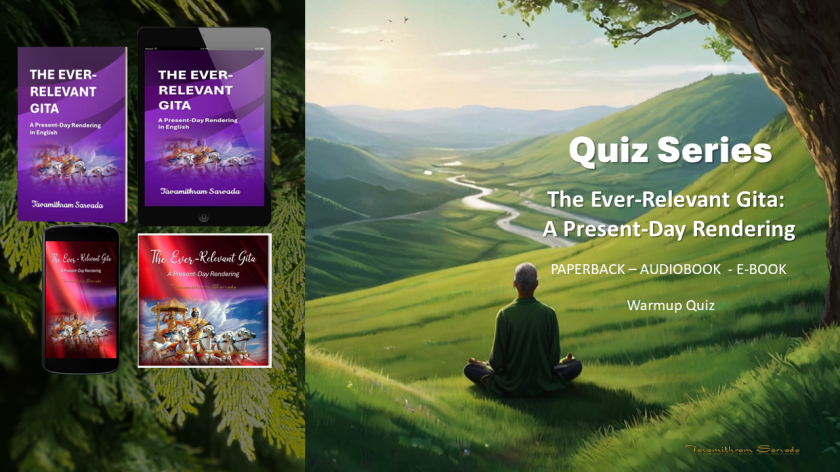
Warm-up Quiz – The Ever-Relevant Gita: A Present-Day Rendering

The first of a series of Quizzes – a Warm-up Quiz on The Ever-Relevant Gita: A Present-Day Rendering by Tavamithram Sarvada

Have you acquired for yourself a copy of the above-mentioned publication? It is available in paperback, audiobook, and e-book formats.

Please complete the Warm-up Quiz. You will need to sign using your Gmail ID.

Next              
A CRYSTAL CLEAR MIND free from doubts
Hurry! – FREE AUDIOBOOK OFFER ENDS SOON

The 3 Steps to a Balanced Life

Have a Healthy, Happy, Peaceful, fearless, and Fulfilling Life

(Republishing an old post) Namaste. I am delighted to present to you a transformative exploration into the profound teachings of the Srimad Bhagavad Gita, a timeless scripture that encapsulates the essence of life, consciousness, and the path to self-realisation. In this video presentation, ‘3 STEPS to Being Healthy and Happy: It is not difficult at all! Why complicate life?’, I distil the wisdom of the rational philosophy of Srimad Bhagavad Gita into three practical steps that can be effortlessly incorporated into our lives. These steps offer a simplified yet profound approach to understanding and applying the teachings of the Srimad Bhagavad Gita, providing a gateway for anyone seeking a meaningful and fulfilling life.

CLICK HERE TO CONTINUE READING ON SUBSTACK

Crafting a Thoughtful Tomorrow: Choosing the Path of Responsible Living

Analysing the Three Kinds of Pleasure

Following this approach can protect you from major disappointments in life.

In our journey through life, we often encounter moments we wish we could undo. Words spoken in haste, actions taken impulsively—these instances can leave a lasting impact, shaping our experiences and relationships. How can we navigate the delicate balance between spontaneity and thoughtfulness?

CONTINUE READING ON SUBSTACK

Beyond Opinions: A Journey to Inner Knowing

“The Greatest Deception…”

“The greatest deception men suffer from is their own opinions.” – Leonardo da Vinci

In a world rich with diverse beliefs and ideologies, our life’s journey is typically influenced by the constructs of our own minds. Opinions, deeply ingrained, can sometimes lead us away from the profound truth of our existence. The quest for self-realisation beckons us to transcend these constructs and discover the universal reality that goes beyond personal perspectives.

CONTINUE READING ON SUBSTACK

Managing Life like a Pilot: The ‘Cockpit of Life’

Learning from the Hudson River Hero, Captain ‘Sully’ Sullenberger


The ‘Cockpit of Life’

Embarking on a journey through the endless expanse of the sky, pilots navigate challenges with composure and skill, ensuring the safety of those on board. The parallels between a pilot’s approach to aviation and the principles outlined in the Srimad Bhagavad Gita offer profound insights into managing life’s complexities. Join me on a journey as we explore the art of managing your life like a pilot from the cockpit of your life.

CONTINUE READING ON SUBSTACK

The Symphony of Life – Exploring Cosmic and Microcosmic Connections

From Galaxies to Individual Cells

PLEASE READ THE POST BEFORE WATCHING THE VIDEO!

Introduction
Discover the captivating beauty of existence in the video, “The Symphony of Life.” This remarkable journey takes us from the vastness of galaxies to the intricacies of cells, exploring the profound connections that link the universe and the microcosm. Dive into the mysteries of life at every scale and be prepared to be amazed.

The Microcosm and Macrocosm Connection
Explore the profound relationship between the microcosm (the world within) and the macrocosm (the vast universe) in “The Symphony of Life.”

Srimad Bhagavad Gita SBG 8:9

कविं पुराणमनुशासितारं
अणोरणीयंसमनुस्मरेद्यः |
सर्वस्य धातारमचिन्त्यरूपं
आदित्यवर्णं तमसः परस्तात् || ८ ९ ||
kavim puraaNam-anushaa-sitaaram
aNora-Neeyam-samanu-smared-yaha
sarvasya dhaataaram-achintyaroopam
aaditya-varNam tamasah parastaat (SBG 8:09)
“The Parampurush is the Omniscient and Most Ancient Ruler, who is more minute than an atom, has an inconceivable Divine form, and is beyond the brightness of the sun and the darkness of ignorance.”

Ishavasya Upanishad IU05

तदेजति तन्नैजति
तद् दूरे तद्वन्तिके ।
तदन्तरस्य सर्वस्य
तदु सर्वस्यास्य बाह्यतः ॥ ५॥
tade-jati tannai-jati tadduure tadvantike
“tadan tarasya sarvasya
tadu-sarvasyaa-sya baahyataha (IU 05)
“It moves, and it does not move. It is far, yet so near. It exists within and also outside all this.”

Srimad Bhagavad Gita SBG 7:19

बहूनां जन्मनामन्ते ज्ञानवान्मां प्रपद्यते |
वासुदेवः सर्वमिति स महात्मा सुदुर्लभः || ७ १९ ||
bahoonaam janma naamante
jnaana-vaan-maam prapadyate
vaasudevah sarvamiti
sa mahaatmaa sudur-labhaha (SBG 7:19)
“Therefore, after innumerable births, the one who has perfected his or her wisdom, understanding fully My universal reality, surrenders to Me and such a soul is very rare.”

Aim to be that rare one, not a sycophantic follower of some cult or individual. Anyone who helps in removing ignorance, which exists due to the mind being shrouded by meaningless beliefs and illogical concepts, is a GURU, which means remover of darkness. I must admit that I have learned quite a few things from my son, and therefore, he too is my GURU.

ॐ ब्रह्मानन्दं परमसुखदं केवलं ज्ञानमूर्तिं
द्वन्द्वातीतं गगनसदृशं तत्त्वमस्यादिलक्ष्यम् ।
एकं नित्यं विमलमचलं सर्वधीसाक्षिभूतं
भावातीतं त्रिगुणरहितं सद्गुरुं तं नमामि ॥
Brahmaanandam parama sukhadam Kevalam gnyaana moortim
Dvandva teetam gagana sadrusham Tatvam asyaadi lakshyam
Ekam nityam vimalam achalam Sarvadhi saakshibhootam
Bhava teetam triguNa rahitam Sadhgurum tam namaami
“My obeisance to the Guru, the Bliss of Brahman, the One who bestows Supreme Happiness and is Knowledge personified.
To the One who transcends the pairs of opposites, is vast as the sky and who is known as “That you are”.
To the One who is eternal, pure, unchanging and is the witness of the functions of the intellect.
To the One who is above all mental states and the three Gunas.
My salutations to that Divine Guru.”

Remember that everything you come across in scriptures such as the Puranas is nothing but 100% allegory. The author of the Bhagavata PuraNa has given such a clear and precise disclaimer in the scripture.
कथा इमास्ते कथिता महीयसां विताय लोकेषु यशः परेयुषाम् ।
विज्ञानवैराग्यविवक्षया विभो वचोविभूतीर्न तु पारमार्थ्यम् ॥ १२.३.१४॥
kathaa imaaste kathita mahiiyasaam vitaaya lokeshu yashah pareyushaam
vignyaana-vairaagya-vivakshayaa vibho vachovibhootiirna tu paaramaartham

It was Shloka 12:3:14 of the Srimad Bhagavata PuraNa.

The son of sage VedaVyasa, Shukadeva Goswami, who is the main narrator of the Bhagavata Purana says to king Parikshith: “O mighty, king, I have told you tales of illustrious kings whose reputations have extended far and wide before their eventual passing. However, my primary objective has always been to impart the wisdom of transcendental knowledge and the importance of renunciation. Although these stories of great kings add grandeur and splendour to my narrations, they, on their own, do not constitute the ultimate knowledge.”

You are Divine. All beings are Divine. Divinity is all-pervading.
Vedanta has nothing to do with religion. It is the science of all sciences.

Stay blessed with great health, happiness, prosperity, and, above all, freedom.

Jai Shri Krishna.


Embrace Your Uniqueness – Don’t Let Labels Define You

Embrace Resilience: Rise Above Complaints, Victimhood, and Self-Pity

PLEASE READ THE POST BEFORE WATCHING THE VIDEO!


Denzel Washington, one of my favourite Hollywood actors, exudes brilliance in his style. His wisdom transcends all barriers, especially the common narrative of people feeling oppressed due to their ethnicity or skin colour.

When he declares, “I’m very proud to be black, but black is not all I am. That’s my cultural historical background, my genetic makeup, but it’s not all of who I am, nor is it the basis from which I answer every question,” he delivers a profound message that surpasses cultural, racial, and background constraints.

Breaking Free from Labels

Often, society encourages us to wear labels—to categorise ourselves based on culture, race, or social status. While these aspects are undeniably a part of our identity, they should not dominate or confine us. Denzel’s message is clear: embracing your individuality and understanding that labels do not define you are vital for personal growth and liberation.

The Pitfalls of Labelling

The act of labelling oneself comes with a set of risks. It can lead to a victim mentality, where one believes their background grants them certain entitlements or absolves them of accountability. Such an outlook constrains personal growth and hinders societal progress.

Equality and Unity

In a world that aspires to equality and unity, it’s crucial to acknowledge that our backgrounds, whether cultural, racial, or social, do not determine our worth. We are all equal members of the human race, and our actions, character, and integrity are the true measures of our essence. It’s our individual contributions and the values we uphold that leave an enduring imprint on the world.

Denzel Washington’s Wisdom

Denzel’s words echo the idea that while we should take pride in our backgrounds, they should not confine us. Let us celebrate our uniqueness and recognise that our character is the true basis from which we answer life’s questions. By shedding limiting labels, we open ourselves up to infinite opportunities and the chance to connect with others based on shared values and aspirations.

As Denzel Washington underscores, it is crucial to recognise that we are more than our cultural, racial, or social backgrounds. Our individuality is a cause for celebration, and it is through our shared humanity that we can work together to improve the world. So, let’s break free from labels, embrace our unique qualities, and stand together in unity and equality.

The Cantankerous Tenant – A parable to learn to Shift to Self Realisation

Study Vedanta – BE FREE

PLEASE READ THE POST BEFORE WATCHING THE VIDEO!


Learn to make the SHIFT from fears and worries to Total Freedom

Dear Seekers of Truth,

Prepare for this brief video that has the potential to reshape your perception of life and the world. It introduces you to the bliss and freedom that await you by studying Advaita Vedanta.

The Essence of Advaita Vedanta

This video will lead you to break free from the shackles of dualistic thinking in the name of religion and misunderstood ‘bhakti’, thereby awakening your inner strength and SELF-realisation

A Path to Self-Realisation

Advaita Vedanta, the pinnacle of Upanishads, empowers you to script your own destiny. It’s a journey that guides you towards SELF-realisation, fostering a sense of responsibility and inner strength.

Unveiling the Teachings

In the video, we dive into the core teachings of the Srimad Bhagavad Gita, a sacred scripture that embodies the essence of Vedanta. Discover how this wisdom can help you navigate life’s challenges with a fresh perspective and awaken to the power of oneness within.

Your Personal Transformation Awaits

Are you ready to redefine your life, free from fear and uncertainty? Join me on this short but captivating trip towards learning to attain SELF-realisation through Advaita Vedanta. Let the teachings guide you towards a path of empowerment and responsibility.

Don’t miss the opportunity to watch “The Cantankerous Tenant” and embark on this enlightening journey towards SELF-discovery and personal freedom.

Remember, in Advaita Vedanta, you hold the key to your own destiny.

Stay Blessed.

Jai Shri Krishna.