12 Years of Clarity: The Journey of Tavamithram Sarvada

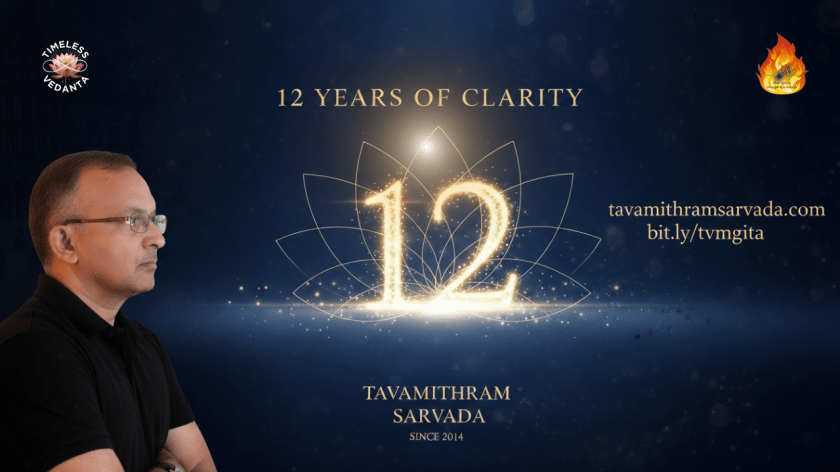
Twelve years ago, in February 2014, Tavamithram Sarvada began quietly. There was no grand announcement, no strategy to gather followers, and no desire to become an authority. It began from a simple, unwavering intention: clarity. I wanted a space where truth could be examined honestly, where ideas could be tested, and where understanding would matter more than approval.

This platform was never meant to impress. It was meant to illuminate.

From the very beginning, the aim was to share what truly helps a human being live with steadiness, intelligence, and inner freedom. Not borrowed knowledge. Not inherited beliefs. Not emotional comfort. But understanding grounded in observation, reason, and direct insight.

Over these twelve years, I have shared what I have studied, tested, experienced, and verified for myself. The central focus has always remained the same: the nature of the mind, the root of suffering, and the possibility of freedom through clarity.

One truth stands out above all. Disturbance does not come from situations. It comes from interpretation. Events are neutral. It is the mind’s reaction that creates agitation. When perception becomes clear, reaction becomes intelligent. And when reaction becomes intelligent, calmness is no longer something to be practised. It becomes natural.

Many believe calmness means suppressing emotion. That is not calmness. Calmness is understanding. When something is fully understood, it no longer disturbs. This is why I have always emphasised observation before change. Just as a doctor diagnoses before treatment, one must observe the mind before trying to control it. Without understanding, all effort becomes struggle. With understanding, transformation becomes effortless.

Throughout these years, I have consistently pointed to one direct and reliable source of supreme knowledge: the Srimad Bhagavad Gita. Not as a religious text, not as mythology, not as ritual instruction, but as a precise manual of clarity. When understood rationally, it cuts through confusion faster than any other teaching. It dismantles fear, exposes illusion, dissolves dependency, and frees a person from mental slavery to belief systems, authorities, and imagined limitations.

The Srimad Bhagavad Gita does not ask for belief. It leads a seeker towards understanding. And understanding is liberation.

Everything shared through Tavamithram Sarvada has revolved around this principle: verify for yourself. Do not accept something because it is ancient. Do not reject something because it is unfamiliar. Examine, reflect, and understand. Truth does not fear inquiry.

Over these twelve years, this platform has grown into a body of work that includes writings, explanations, lessons, reflections, and practical frameworks for living with clarity. Many readers have written to say that they think more clearly now, react less impulsively, and feel stronger inwardly. That is the only measure that matters. Not numbers. Not recognition. Transformation.

What makes this work different is simple. It does not ask anyone to follow. It asks them to understand. It does not create dependence. It encourages independence. It does not promise comfort. It offers clarity. Comfort weakens. Clarity strengthens.

Tavamithram Sarvada began as a silent movement for those who have had enough of religious nonsense sold to them and are ready for the ultimate truth of Vedanta. It is a reminder. A reminder that every human being already possesses the capacity for insight, steadiness, and freedom. Nothing new needs to be added. Only confusion needs to be removed.

To everyone who has read, reflected, questioned, disagreed, or grown through these writings over the years, you have my sincere appreciation. Your willingness to think deeply keeps this space alive and meaningful.

Twelve years have passed. The purpose has not changed. The direction has not shifted. And the commitment remains exactly what it was on day one: clarity above all.

The journey continues.

With love and affection.

Tavamithram Sarvada

Where Vedanta Begins, War Ends: How This Ancient Wisdom Can Transform The World

From Dogma to Direct Experience: The Practical Power of Vedanta

JOIN MY SUBSTACK. IT IS FREE.

Most people live their lives filled with noise, dogma, and contradiction, making sense of life a challenging task. They have unanswered questions, such as, “Who am I?” or “What’s the point of all this?” They are either caught up in beliefs and rituals, have no inclination to engage with such questions, or, due to their beliefs, are afraid to question traditions, or simply too busy to stop and think.

Religions and ideologies claim to offer answers, but more often than not, they leave us confused and divided. They demand belief, but fail to encourage true understanding.

Vedanta is not another belief system. It offers a unique method – a way of seeing – that helps you distinguish between what is real and what is assumed. It doesn’t require blind faith. Instead, it invites you to look within and engage with your own direct experience.

The power of Vedanta lies in…READ ON SUBSTACK

From Stagnation to Success: Mastering Negative Karmic Inertia

Shattering All Blockades in Life

Understanding the Three Gunas: A Path to Self-Improvement

Understanding the three Gunas explained in the Srimad Bhagavad Gita offers profound insights into human behaviour and consciousness. These three fundamental qualities—Sattva (goodness), Rajas (passion), and Tamas (ignorance)—shape our thoughts, actions, and overall life experience. Among these, the Tamasa Guna, which embodies indolence, laziness, lethargy, negativity, and pessimism, often acts as a significant impediment to personal growth and productivity. I refer to this as ‘Negative Karmic Inertia.’

Much like maintaining a good hormonal balance is crucial for physical health, achieving a harmonious balance of the three Gunas is essential for a fulfilling and enriching life. By understanding and managing our Guna levels, we can enhance our self-awareness and work towards self-improvement. The real transformation happens within, even if the knowledge and inspiration come from external sources.

The Role of Tamasa Guna

Excessive Tamas is like a heavy weight that chains a person to the ground, preventing any positive change and perpetuating a state of lethargy and inertia. It not only affects one’s behaviour but also distorts one’s ability to rationalise and make sound decisions. A person overwhelmed by Tamas might find themselves stuck in a cycle of inaction and negativity, unable to break free and achieve their true potential.

The Three Gunas explained in the Bhagavad Gita

The Srimad Bhagavad Gita provides a detailed explanation of the three Gunas and their effects on individuals:

SBG 14:5 – “The three Gunas or qualities are Sattva, which is the quality of goodness; Rajas, which is the quality of passion; and Tamas, which is the quality of ignorance; O mighty-armed one. They are born of Prakriti which is Nature. These qualities bind very fast the immutable embodied Self in the body.”

SBG 14:6 – “Of these, Sattva, which, due to its purity, is luminous and healthy, frees a person of all Karmic reactions. Those of this Guna are attached to knowledge and to happiness, O sinless one.”

SBG 14:7 – “You should know Rajas to be the Guna or nature of passion, which is the source of desire and attachment. O Arjuna, it binds fast to the embodied Self by attachment to action.”

SBG 14:8 – “Tamas is born of ignorance and deludes all embodied beings. O Arjuna, this results in the binding of the embodied soul by negligence, sleep and laziness!”

SBG 14:9 – “O Arjuna, Sattva binds one to happiness, Rajas to action, while Tamas shrouds knowledge and binds one to idiocy.”

SBG 14:10 – “O descendant of Bharata (Arjuna), Sattva prevails over Rajas and Tamas, while Rajas manifests itself by overpowering Sattva and Tamas; and Tamas manifests itself by subduing Sattva and Rajas.”

SBG 14:11 – “When the light of wisdom shines through every sense in this body, it may be known that Sattva is predominant.”

SBG 14:12 – “When greed, endeavour for material gains, restlessness and longing arise; Rajas is predominant, O Arjuna.”

SBG 14:13 – “The presence of illusion, darkness, recklessness and delusion in a person indicate the predominance of Tamas in them, O Arjuna.”

Overcoming Negative Karmic Inertia

Many people struggle with feelings of demotivation and an inability to achieve their goals. This internal blockage often stems from an excess of the Tamasa Guna. Conversely, those driven by an excessive Rajas Guna might find themselves aggressive and even harmful in their pursuit of desires.

Managing Rajas

SBG 3:36-37: Arjuna asks Krishna: What prompts a man to perform sinful deeds, O descendant of Vrshni? Why does he commit such acts even without desiring to do them, as if he were forced?

Shri Bhagavan Krishna replies: Lust and anger are born out of the material nature called Rajoguna, which is insatiable and prompts man to commit sin. You must know that this is the greatest enemy in a man’s spiritual life.

Understanding one’s Guna ratio is akin to a doctor diagnosing a patient: it allows for targeted self-improvement. By identifying and addressing the predominant Guna that is out of balance, individuals can work on the specific areas needed to overcome unwanted situations in life.

Self-Study and Introspection

The path to self-improvement begins with self-study and introspection. Rather than casting blame on external factors, it is crucial to look within and understand the internal dynamics that drive our behaviour. By doing so, we can achieve a harmonious balance of the Gunas, leading to a more pleasant, enriching, and fulfilling life.

Finally, the knowledge of the three Gunas offers a powerful tool for self-awareness and personal growth. By recognising the influence of Tamas and working to balance it with Sattva and Rajas, we can overcome negative karmic inertia and realise our true potential. The journey to self-improvement is an inward one, and the key to success lies in understanding and managing the forces within us.

Reflect on your own Guna ratio, identify the areas that need attention, and take the necessary steps to bring balance and harmony into your life. Embrace the power of self-awareness and let it guide you towards a brighter, more fulfilling future.

If you truly want to change your life, it is you who must change, for the world will not bend to your will.

“Who looks outside dreams; who looks inside awakes.” – Carl Jung