Stuck? Escape Regret. Get the Life You Deserve

Break Free from Emotional Baggage with This Transformative Two-Word Mantra

Are you tired of being stuck in repetitive emotional patterns, haunted by your past, and overwhelmed by regret? This powerful new video dives into a life-changing concept that blends spiritual clarity, emotional resilience, and mental discipline through the use of two deceptively simple yet profound mantras: “So what?” and “What next?”.

Rooted in Vedanta, and enriched by a personal journey of spiritual transformation, this message is a wake-up call for those ready to reclaim their power. Whether you’re on the path of self-inquiry, seeking personal development, or aiming to cultivate a growth mindset, this video offers direct and practical tools to help you move forward.

Let go of self-pity, stop dwelling on the past, and embrace conscious living. The time to transform your inner world is now.

Where Vedanta Begins, War Ends: How This Ancient Wisdom Can Transform The World

From Dogma to Direct Experience: The Practical Power of Vedanta

JOIN MY SUBSTACK. IT IS FREE.

Most people live their lives filled with noise, dogma, and contradiction, making sense of life a challenging task. They have unanswered questions, such as, “Who am I?” or “What’s the point of all this?” They are either caught up in beliefs and rituals, have no inclination to engage with such questions, or, due to their beliefs, are afraid to question traditions, or simply too busy to stop and think.

Religions and ideologies claim to offer answers, but more often than not, they leave us confused and divided. They demand belief, but fail to encourage true understanding.

Vedanta is not another belief system. It offers a unique method – a way of seeing – that helps you distinguish between what is real and what is assumed. It doesn’t require blind faith. Instead, it invites you to look within and engage with your own direct experience.

The power of Vedanta lies in…READ ON SUBSTACK

Truth Doesn’t Care About Your Beliefs: Uncover the Ultimate Reality

READ AND WATCH THROUGH MY SUBSTACK

You’ve been told what to think. You’ve been conditioned to accept, obey, and conform. But what if everything you believe—everything you rely on—has been carefully placed there to keep you from seeing the truth?

What if the world around you isn’t what it seems?

This isn’t just another talk. It’s an experience—one that might shake the very foundation of what you think is real. But be warned: once you step through this door, there is no going back.

Are you ready to challenge everything? Watch now.

Tree of Abundance

A Message of Reflection and Clarity

As we take a moment to reflect on our lives, let’s remind ourselves that a new year, whether it’s the Gregorian year or any other marker of time, by itself cannot do anything. It is our perception of things and our attitude towards life that truly influence our lives.

In my opinion, what we need to first strive for is clarity—clarity in the way we think, perceive, and judge. For this, some fundamental understanding of oneself and universal oneness is essential.

In our world, filled with numerous cults, groups, spiritual leaders and gurus, it is crucial to recognise the true qualities of divinity, which are honesty, sincerity, compassion, modesty, and gratitude. These virtues surpass any specific doctrine or tradition.

TThe Vedas, Upanishads, and the Srimad Bhagavad Gita are invaluable tools designed to guide individuals towards selflessness. However, although they make things easier for a seeker, they are not the only path to achieving a divine state. Many remarkable people who have never encountered these texts exhibit profound divinity, suggesting that true spirituality transcends any specific set of teachings.

In the Srimad Bhagavad Gita, Shloka 2:46, Krishna says that one who has attained SELF-realisation needs the Vedas as much as one would need a well when it is flooded everywhere. This illustrates that attaining supreme knowledge is the highest goal.

Everyone’s spiritual journey is unique. The purpose of Karma Yoga, or performing one’s duty without expecting results, is to maintain a balanced state of mind. Emotions such as happiness, sadness, anger, hatred, and envy are born from our perceptions. These emotions are merely waves in the otherwise tranquil ocean of awareness.

When we learn to perceive things differently, we can face and handle challenges better. However, the root causes of mental pain, sadness, and suffering are often attachments and our expectations.

The greatest lesson I have learned from life’s ups and downs is to never expect anything from anyone or life itself. Instead, relish every moment, knowing that anything can happen at any time. Being alive, healthy, sane, and conscious is a gift to be celebrated.

I think that feeling upset about things can also be seen as a form of arrogance or entitlement. It is because it overlooks the miracle of life happening with every heartbeat, which, by the way, can stop at any time.

BBy cultivating a profound understanding of this, we can achieve peace in any circumstance. Introspecting and recognising our fundamentally innate honest and sincere nature reveals the misguided notions arising from a lack of clarity, which obscure our divine true self. Challenging situations refine and polish us, leading to the highest clarity and the ultimate state of Krishna.

Please reflect on the following Shlokas from the Srimad Bhagavad Gita:

SBG 14:23
Krishna says: “He remains unattached and is not moved by sense objects. He knows that it is the senses and the mind born of the Gunas that act while his real Self remains unwavering in all situations.”

SBG 14:24
“He is the same in pleasure as well as in pain; is established in the Self; he is one to whom a lump of earth, a stone and gold are no different from each other; he treats equally the friendly and the unfriendly, and accepts praise or criticism with equanimity.”

SBG 14:25
“He who remains unmoved in honour and dishonour; is the same to friend and foe, and has renounced all actions by giving up claims of being the ‘Doer’, is said to have transcended the three Gunas.”

SBG 14:26
“He who serves Me with unflinching devotion and transcends the Gunas, is fit for becoming Brahman.”

SBG 14:27
“For I am the abode of the formless Brahman, the imperishable and the immutable, of eternal Dharma and of absolute bliss.”

Reflect on these teachings to find peace and equanimity in your spiritual journey. Once such clarity has been achieved, every new day can be celebrated as the first day of the rest of your life, without waiting for any calendar to announce and validate it.

As we embark on our own journeys, let us seek the fruits of the Tree of Abundance. This metaphorical tree, rooted in the fertile soil of knowledge and wisdom, offers us an endless bounty. From its branches hang the fruits of health, prosperity, and happiness, each one a result of the nurturing power of understanding and insight. When we cultivate our minds with learning and awareness, we gain the true wealth that life has to offer. May the Tree of Abundance bless you with its riches, nourishing every aspect of your life and guiding you towards a future filled with endless possibilities.

Please remember that if you continue to be what you have always been and do what you have always done, your life will continue to be how it has always been. Different results need different inputs. It all starts with knowledge. It is usually through the transformative power of knowledge that one can plant the seeds of change and harvest a future abundant with new possibilities.

Thank you.

Have a great life ahead.

Stay blessed.

Jai Shri Krishna.

First Achieve and Then Let Go!

Sour Grapes and Self-Pity – Escaping Life’s Responsibilities

JOIN MY SUBSTACK. IT IS FREE.

In my journey of counselling and guiding individuals over the last decade through my Tavamithram blog, I have encountered numerous men and women who, after interactions with me, emerged more courageous, fearless, and self-confident. There have been a couple of young women who imbibed the knowledge I imparted so well that they did things requiring extensive courage—actions that would make a regular man think not just twice but three times. However, there are exceptions. Despite receiving extensive personal counselling, some individuals persist in wallowing in self-pity, which is something I always try to nip in the bud. This phenomenon, especially among young men, often manifests as existential rhetoric and disillusionment with worldly pursuits. This certainly does not sound even fundamentally manly to me. CONTINUE READING ON SUBSTACK.

The Metamorphosis of ANGER

The Harmful Effects of Anger: Understanding Its Life Cycle and the Path to Peace

Mark Twain once said, “Anger is an acid that can do more harm to the vessel in which it is stored than to anything on which it is poured.” Anger never solves any problem or worry; rather, it makes us more stressed. It starts controlling our emotions and intelligence, and eventually leads us to self destruction.

To comprehend the full extent of anger’s impact, it’s essential to understand its life cycle. Anger often begins with attachment, a sense of entitlement, or envy. This metamorphosis is eloquently described in the Srimad Bhagavad Gita, Shlokas SBG 2:62-63:

Srimad Bhagavad Gita: 2:62-63 “A person who thinks of sense objects develops an attachment for them. From this attachment, desires are born and from desires, anger is born.
Anger gives birth to delusion and this delusion results in confusion of memory. When memory is confused, intelligence is destroyed, and from the destruction of intelligence, the person perishes.”

SBG 2:62-63

The Metamorphosis of Anger

  1. Attachment: It all begins with the mind dwelling on sense objects. When we repeatedly think about something, we develop an attachment to it.

  2. Desire: From attachment arises desire—the longing to possess or achieve what we are attached to.

  3. Anger: When our desires are unfulfilled or obstructed, anger arises. This anger can be towards oneself, others, or circumstances.

  4. Delusion: Anger clouds our judgment, leading to delusion. We start seeing things in a distorted manner, unable to perceive reality accurately.

  5. Confusion of Memory: Delusion confuses our memory. We forget our principles, values, and past experiences that guide us in making rational decisions.

  6. Destruction of Intelligence: With a confused memory, our intelligence, the ability to reason and discriminate, is destroyed.

  7. Perdition: The final stage is the total destruction of the person. A life led by anger is a life of turmoil, leading to self-destruction.

The Solution: Vedanta

Vedanta offers a profound solution to the problem of anger and other mental afflictions. The Srimad Bhagavad Gita, a cornerstone of Vedanta, provides timeless wisdom to overcome anger and attain peace. By understanding and applying its teachings, we can transform our lives.

The Srimad Bhagavad Gita is the panacea for all mental problems, fears, worries, and confusions that stem from a lack of clarity or emotional thinking. It guides us to live a life of balance, understanding, and inner peace.

Acquire Your Copy of the ‘Ever-Relevant Gita: A Present-Day Rendering’

Embark on a transformative journey with the ‘Ever-Relevant Gita: A Present-Day Rendering by Tavamithram.’ Complete it in a bit more than three hours—about the same time as watching a Bollywood movie! Choose from paperback, audiobook, and ebook versions, and let the timeless wisdom of the Srimad Bhagavad Gita bring clarity and peace to your life.

The Ever-Relevant Gita: A Present-Day Rendering

Embracing the Blissful Journey: The Ever-Relevant Gita – A Present-Day Rendering by Tavamithram Sarvada

Now available in various online store fronts, such as: Amazon InternationalINDEUKAUNLCAFRESPLITBRMX

*The paperback version is not available on Amazon India.

Part 1: Preface and Introduction + Chapters 1-6

The preface and introduction lay the foundation for your exploration. Don't be tempted to skip these initial chapters; they are the compass guiding you through the intricate terrain of the Gita's philosophy. Understand the core teachings, and you'll find yourself motivated to delve deeper, perhaps into the rich Bhashyams or commentaries of Shri Adi Shankara and other great teachers.

Part 2: Chapters 7-12

As you progress through these chapters, absorb the profound insights that unfold. The clarity of understanding achieved in the earlier sections becomes the stepping stone for an even more profound comprehension of Krishna's teachings.

Part 3: Chapters 13-18 + Outro

The culmination of your journey awaits in the final chapters. The outro ties the threads together, offering a comprehensive view of the Gita's timeless wisdom. This concluding section is not to be missed; it holds the key to empowerment and self-confidence.

Namaste Seekers,

Embark on a profound journey into the timeless wisdom of the Srimad Bhagavad Gita with ‘The Ever-Relevant Gita: A Present-day Rendering by Tavamithram Sarvada.’ Below, I’ll elucidate the profound significance of this work and its potential to illuminate the path to self-realisation.

In a fast-paced world fraught with complexities, the solace found in ancient wisdom often remains unexplored. 'The Ever-Relevant Gita – A Present-day Rendering by Tavamithram Sarvada’ endeavours to bridge this gap, bringing forth the profound teachings of the Srimad Bhagavad Gita to everyone, irrespective of age, background, or familiarity with ancient scriptures.

Dispelling Myths and Misconceptions

The main challenge involves dispelling misconceptions that surround the Srimad Bhagavad Gita—misconceptions about its perceived depth, religious connotations, and its relevance limited to the elderly or devout individuals. In this modern interpretation, we untangle myths and present timeless wisdom in a manner that aligns with the sensibilities of the contemporary mind.

A Unique Approach: Audio, Video, and E-book Formats

Understanding the daunting nature of lengthy translations, a unique approach has been taken by creating easily digestible audio recordings of each chapter. These recordings allow listeners to absorb the essence of the Gita at their own pace, breaking down barriers that often deter individuals from exploring this ageless scripture.

Beyond presentation, this initiative is a call to embark on a blissful journey of self-discovery. In my life, which has been shaped by numerous challenges and life-altering situations, the importance of a well-trained instinct and a balanced mindset has become crystal clear to me. A clear understanding of the fundamental principles of the teachings in the Srimad Bhagavad Gita certainly plays a pivotal role in shaping attitudes, cultivating fearlessness, and fostering rational thinking during critical moments.

Practical Insights for Daily Application

The true power of the Srimad Bhagavad Gita lies in its application in everyday life. The focus is not merely on delivering a rendition or chanting Shlokas, but on providing practical insights that enable individuals to apply these teachings in their daily lives, leading to a more fulfilling and blissful existence.

In essence, the mission is to make the teachings of the Srimad Bhagavad Gita easily accessible, relatable, and applicable to everyone, fostering a deeper understanding of life's intricacies. Join me on this enlightening journey, and let's journey through the supreme scripture together.

Those who would like a promo code for a free download of the Audiobook version of the ‘The Ever-Relevant Gita – A Present-Day Rendering by Tavamithram Sarvada’ may email their request to tavamithramoffice@gmail.com

Jai Shri Krishna

Forget the Heart, First Heal the Mind!

Beyond Prayers and Miracles – The Rational Path to Self-Realisation

Transform Your Life with Vedanta, The Science of all Sciences

WATCH THIS AND CLEAR YOUR HEAD OF ALL UNWANTED STUFF:

When ignorance becomes the norm, entire masses of people can be easily swayed to firmly believe the unreal to be real. The crucial factor in society that enables a select few to manipulate their minds is the ignorance of the masses, which basically stems from blind beliefs that numb their brains, and sheer laziness to make a move to get out of ignorance.

People come to my blog, watch some of my videos, and ask me what they should do to change their lives. Almost everyone wants instant solutions, and they are even willing to pay for shortcuts! One should not overlook the fact that even the act of going to a religious place and praying for what one wants is a form of seeking shortcuts.

But the truth is that everything has a price, and everything is part of the never-ending cause-and-effect chain. Asking someone or ‘god’ to give them what they want could only mean that the so-called ‘god’ changes his plans to suit the needs of the one praying. So, what about the others? Do their lives get destroyed because someone else prayed and got things done by ‘god’ to do things their way? Really? So, what happens when two entities at war with each other pray to the same ‘god’? Who do you think ‘god’ will bless with special favours?!

How many people really dare to make massive changes in their lives, have the courage to travel around, experience and learn more, and evolve? Krishna says in Shloka SBG 7:19, “Therefore, after innumerable births, the one who has perfected his or her wisdom, understanding fully My universal reality, surrenders to Me and such an individual is very rare.”

So, with a default state of mind of wanting to maintain the status quo, people tend to look for easy ways out, shortcuts, middlemen, and women who can help them achieve success through the short path, which is a form of corruption or fraud. It is because people want something without really working for it.

When did Krishna say in the Srimad Bhagavad Gita to go to his temples, perform meaningless rites and rituals with the mammary milk of poor voiceless animals, sing songs in His praise, chant Mantras the whole day, and do nothing else? The clear instruction in the second chapter is that you only have the right to work, but never to claim its results. The results of your actions should never be your motive, but at the same time, you should not be attached to inaction.

Then why do people perform religious rites to fulfill personal desires?

Vedanta and the Srimad Bhagavad Gita

Shloka 18:66 of the Srimad Bhagavad Gita does not mean that one should have blind belief in Krishna.

Krishna says in SBG 18:66, “Giving up all your ideas of righteousness or religion, take complete refuge in Me. I will liberate you from all sinful reactions. Do not fear.”

It means, “Give up all the nonsensical ideas you might have in the name of religion, and by adopting the logical analysis and reasoning provided throughout until the 18th chapter, become one with Krishna.”

The entire purpose of the Srimad Bhagavad Gita is to guide people to shed their false beliefs and take to a rational study of truth. The process is very simple with three stages:

  1. Sidhaanta – A Question, Idea, Concept, or Theory
  2. Saadhana – The means to study, including reading, listening, researching, analysing, debating, etc.
  3. Siddhi – Final understanding, internalisation, and experience, known as Anubhava in Sanskrit.

Scientists don’t believe anything without evidence, do they? Remember that Vedanta is the science of all sciences.

Reason and Logic in the Srimad Bhagavad Gita

The Srimad Bhagavad Gita talks about reason and logic and NEVER about belief.

SBG 13:4 states, “Great sages have sung about the absolute truth in various ways. They have stated the truth in Vedic hymns and have described it in the Brahma Sutras through reason and logic with unambiguous evidence.”

Shloka SBG 4:34 says, “Acquire knowledge through reverence to teachers who have known the Truth, serve them and ask them questions until all of them are answered. The wise who know the Truth will teach it to you.”

Definition of Religion

Religion is a system of beliefs, practices, and values often centred around the worship of a higher power or divine beings. It typically involves rituals, moral guidelines, and a community of followers who share the same belief and faith.

Did you find anything related to reason, rationality, science, inquiry, or logic in this definition?

Vedanta: The Pinnacle of Vedic Studies

Vedanta is the highest point of Vedic studies – right from the basic Karma Kaanda, Upaasana Kaanda to the Gnyaana Kaanda of the Upanishads.

If you are interested in changing your life COMPLETELY and are willing to clear your mind of all the unfounded beliefs you have been trained by your elders to blindly believe, please feel free to contact me.

I do not talk about miracles performed by some man in a cave, one with a long beard, or another with fuzzy hair. Out here, it is pure Advaita Vedanta – Nondual Vedanta, and the compact and best manual for attaining the highest understanding of the nondual, all-pervading SELF is the Srimad Bhagavad Gita.

A real shift to Vedanta is a complete change with no traces of illogical or irrational ideas sticking in the mind in the name of belief, ‘aastha’, religion, or whatever.

“Before you heal someone, ask him if he’s willing to give up the things that make him sick,” said Hippocrates. Just as baseless beliefs can be likened to mental diseases, one must be willing to abandon them to achieve true healing and enlightenment. Therefore, start with a clean slate.

SBG 4:38 Shri Krishna says: “There is certainly nothing more purifying than knowledge. He who is perfect in Yoga finds it in the Self in due course of time.”
Krishna Jayanti – Janmashtami: Celebrating the Unborn and Eternal

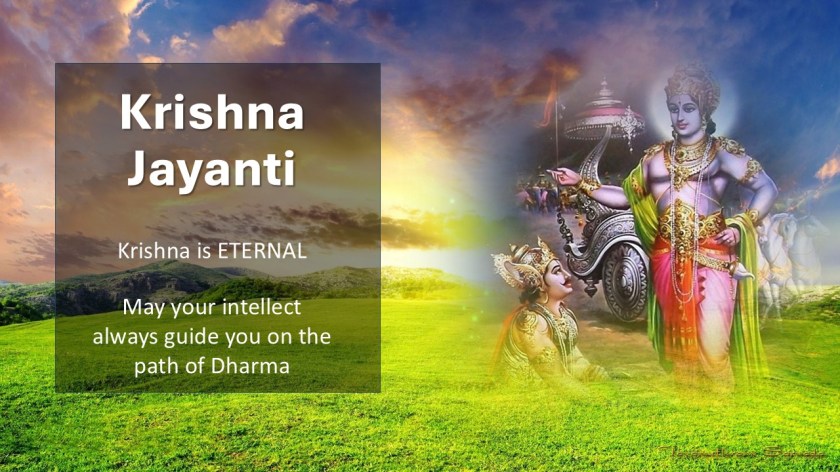
Krishna Jayanti, or Janmashtami, marks the celebrated ‘birth’ of Bhagavan Shri Krishna, an event cherished across the globe. But how does this celebration reconcile with Krishna’s own words in the Srimad Bhagavad Gita, where he declares that He was never born, nor will He ever die?

Consider this profound Shloka:

नत्वेवाहं जातु नासं
न त्वं नेमे जनाधिपाः |
न चैव न भविष्यामः
सर्वे वयमतः परम् || २ १२ ||

na tvevaaham jaatu naasam
na tvam neme janaadhi-paaha
na chaiva na bhavishyaa-maha
sarve vayam-ataha param

SBG 2:12

“There never was a time when I did not exist, nor you, nor all these kings. We will also never cease to exist.”

In this Shloka, Krishna emphasises the eternal nature of the Atman. The physical birth and death that we observe are but mere transitions in the infinite existence of the SELF. Krishna, as the Supreme Being, transcends these limitations of time and space.

Arjuna, puzzled by this concept, continues with his questions and, in Chapter 4, asks Krishna as follows:

अर्जुन उवाच |
अपरं भवतो जन्म परं जन्म विवस्वतः |
कथमेतद्विजानीयां त्वमादौ प्रोक्तवानिति || ४ ४ ||

arjuna uvaacha
aparam bhavatho janma
param janma vivasvathaha
katham-etha-dhvijaa-niiyaam
tva-maadhau proktavaa-nithi

SBG 4:04

Arjuna said: “Your birth was after the birth of Vivasvaan. How should I understand when You say that You taught this Yoga to him?”

To this, Krishna responds, illuminating the mystery of His divine nature:

श्रीभगवानुवाच |
बहूनि मे व्यतीतानि जन्मानि तव चार्जुन |
तान्यहं वेद सर्वाणि न त्वं वेत्थ परंतप || ४ ५ ||

sri bhagavan uvaacha
bahuuni me vyatii-taani
janmaani tava-chaarjuna
taan-yaham veda sarvaaNi
na tvam vettha parantapa

SBG 4:05

Sri Krishna said: “Many births of mine as well as yours have passed. I know all of them, but you don’t, O Parantapa (Arjuna – destroyer of enemies).”

Here, Krishna acknowledges the cyclical nature of birth and rebirth, highlighting that while He is aware of all His incarnations, Arjuna remains unaware.

Krishna then reveals the ultimate truth of His existence:

अजोऽपि सन्नव्ययात्मा
भूतानामीश्वरोऽपि सन् |
प्रकृतिं स्वामधिष्ठाय
संभवाम्यात्ममायया || ४ ६ ||

ajo ‘pi san-navya-yaathma
bhuuthaanaa-miishvaro ‘pi san
prakrthim svaa-madhisht-haaya
sambhavaa-myaathma-maayayaa

SBG 4:06

“Though I am unborn and imperishable, and although I am the Bhagavan of all beings, I do incarnate by my own Maya or My Divine Energy.”

Krishna’s ‘birth’ is not conventional; it is a divine descent, an incarnation born of His own will and energy, symbolising the emergence of pure intellect after dispelling layers and layers of ignorance. Krishna Jayanti, while celebrating His appearance, also invites us to reflect on the deeper spiritual truths He embodies.

In this short video I’ve created, I delve into the essence of Krishna Janmashtami and how embracing these teachings can transform your life and lead to enduring bliss:
At the end of the short video, I have translated Shloka SBG 2:12 into six Indian languages apart from English.

It is crucial to remember that taking scriptural texts literally can lead one astray from the true path of Self-Realisation, potentially fostering rigid belief systems or cult-like thinking. The Srimad Bhagavad Gita offers profound wisdom—absorb its philosophy, and use it to cultivate a life of fulfilment and spiritual growth.

A ‘disclaimer’ from Srimad Bhagavatam (not Srimad Bhagavad Gita)

Canto 12, Chapter 3, Shloka 14
Shloka 12:3:14 Srimad Bhagavatam

कथा इमास्ते कथिता महीयसां
विताय लोकेषु यशः परेयुषाम् ।
विज्ञानवैराग्यविवक्षया विभो
वचोविभूतीर्न तु पारमार्थ्यम् ॥ १२.३.१४॥

kathaa imaaste kathita mahiiyasaam
vitaaya lokeshu yashah pareyushaam
vignyaana-vairaagya-vivakshayaa vibho
vachovibhootiirna tu paaramaartham

Shukadeva Gosvami spoke: O mighty King Parikshith, I have shared with you the accounts of these illustrious kings, whose fame and great deeds echoed worldwide before their departure. However, my fundamental intention has always been to impart the wisdom of the transcendental and the path of renunciation. Although the stories of kings embellish these narratives with grandeur and opulence, they, in and of themselves, do not represent the ultimate essence of knowledge.

Feel free to explore the resources I offer to sincere seekers on this journey.
Srimad Bhagavad Gita Resources

Jai Shri Krishna

Embracing Vitality: The Real Measure of Age

Age Is Just a Number!

DIET – EXERCISE – ATTITUDE

In our culture, age often comes with preconceived notions and limitations. However, the concept that age is merely a number, challenges these views, highlighting that vitality and well-being are not solely defined by how many years we’ve lived.

Click on the image to watch the YouTube #shorts video

Think of your body as a vehicle. Just as a car requires regular maintenance to function optimally, our bodies need consistent care to stay in peak condition. This involves more than just physical fitness—it encompasses a balanced diet, mental wellness, and a positive outlook on life.

Prioritising health and fitness ensures that our ‘vehicle’ runs smoothly and efficiently, allowing us to live fully and energetically. It’s not about our chronological age but about how we maintain our health and approach life’s challenges.

Adopting this perspective means recognising that it’s never too late to improve your health. Whether you’re in your 30s, 50s, or beyond, making positive lifestyle changes can lead to a more vibrant and fulfilling life.

I got my son interested in fitness when he was in his early teens, and now that he’s turned 20, it’s clear that he’s been bitten by the fitness bug. It’s truly wonderful to see a young person, whether male or female, building their physique early in life.

For Indians, this can be especially important, as we often have a disadvantage compared to some other races when it comes to building muscle easily. And when I say muscle, I’m not talking about the kind of bulk a bodybuilder might have—I mean the muscle strength that everyone needs, regardless of age.

The best approach is to start early in life, but if you haven’t, make it a top priority and start today. Consult a fitness coach or find guidance online, and follow through with dedication.

Ultimately, our well-being is shaped by our choices and attitudes, not just the passage of time. By focusing on self-care and embracing a proactive approach to health, we can enjoy a dynamic and enriching life, no matter our age.

-Go VEGAN
-Exercise Regularly
-Adopt a Mindful Lifestyle