No Mantras, No Prayers, No Fasting – Just 3 Hours to Smash Illusion and Gain the Supreme Truth!
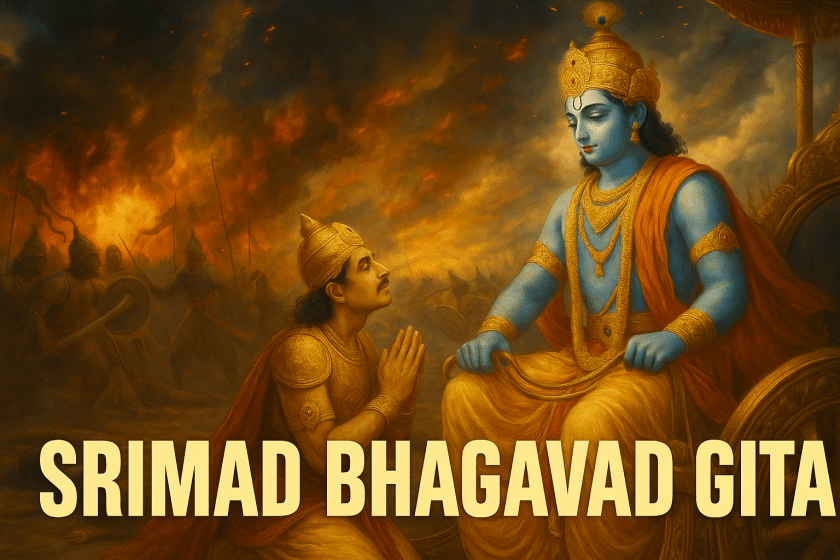
I am not saying this. KRISHNA SAYS IT IN THE SRIMAD BHAGAVAD GITA.
All worries, fears, stress, anger, envy, and every negative force that can block, weaken, or destroy your chance of living a truly beautiful and fulfilling life will be crushed to smithereens and pulverised to dust.
With soothing sound, captivating visuals, and clear English text to follow along.
Please let me be honest, my dear brothers and sisters, I find it utterly saddening that so many people have been convinced that the Srimad Bhagavad Gita is “too difficult to comprehend” and that without a “good guru” they can never learn it.
In Shloka SBG 9:02, Bhagavan Krishna clearly says that this knowledge is not only VERY EASY, but also it is also VERY EASY TO PRACTISE and it is EVERLASTING. All it takes is the small effort of sitting down and reading a simple translation of the 700 Shlokas. In fact, I must have read this supreme scripture over a thousand times, and I never tire of it. The same applies to every genuine seeker. You cannot read it once and expect to fully grasp it. But at the very least, read it, listen to it, or go through it ONCE BEFORE YOU DIE!
As part of my SBG for ALL Mission, here is my humble offering: a three-hour guided study of this life-changing scripture, a true gift to humanity.
Experience this once, and the weight of your illusions will collapse into nothing.
Please, take this opportunity. Whatever you think it is worth, COMPLETE IT. Do it at least for your brother’s sake. You can thank me later 🙂
Voyager 1 has been flying non-stop for nearly 48 years since 1977. It has already travelled over 24 billion kilometres and is still not even one light-day away from Earth. Let that sink in. Just one day of light-speed travel, and we haven’t reached it yet.
And here we are… On this tiny, fragile speck called Earth, floating in infinite space, Wasting our precious moment of life with ego, pride, inferiority, religious superiority, hatred, and greed.
All our religious places, ideologies, nations, and flags – they vanish into nothingness when seen from just a few kilometres above Earth, let alone from Voyager’s view.
The spacecraft carries a golden record of music and greetings from humanity, in case it ever meets another intelligent being. Imagine if it did. What would we say we stood for?
It’s time we grow up, let go of imaginary divisions, ridiculous beliefs, and cults, and embrace the sheer miracle of being alive at all. Because in the grand movie of the universe, we’re not even a pixel on the screen.
A Deeper Look into Stillness, Identity, and the Final Trap
Have you ever tried letting go of your worries, your fears, or your attachments, only to still feel like something remains? You’re not alone. For many sincere seekers, the final barrier is subtle: it’s not your thoughts, not your ego, not even your desires. It’s the silent identity hiding behind all of them. The witness.
In my latest video, I unpack what I call the final illusion: the quiet and respectable identity of the “observer”, the one who is calm, still, and watching. But here’s the truth: stillness too is a role. And unless that role drops, freedom will remain just out of reach.
Watch the Video: Why Life Gets Better When You Let Go
This is not about theory. It is not spiritual entertainment. This is PURE VEDANTIC CLARITY, aimed at dismantling the last mask the mind wears, even in meditation.
If you have ever searched for:
How to overcome suffering through awareness
How to let go of mental attachments, or
How to go beyond thought and ego
Then this video will show you what lies beyond even those answers.
No beliefs. No rituals. No frills. Just clear, unfiltered self-inquiry, rooted in the teachings of the Srimad Bhagavad Gita.
Most people live their lives filled with noise, dogma, and contradiction, making sense of life a challenging task. They have unanswered questions, such as, “Who am I?” or “What’s the point of all this?” They are either caught up in beliefs and rituals, have no inclination to engage with such questions, or, due to their beliefs, are afraid to question traditions, or simply too busy to stop and think.
Religions and ideologies claim to offer answers, but more often than not, they leave us confused and divided. They demand belief, but fail to encourage true understanding.
Vedanta is not another belief system. It offers a unique method – a way of seeing – that helps you distinguish between what is real and what is assumed. It doesn’t require blind faith. Instead, it invites you to look within and engage with your own direct experience.
What if everything you’ve been taught about ‘god’, worship, and salvation is just the kindergarten of the path of the rational philosophy of Vedanta?
The ancient Rishis (wise, selfless sages) spoke in metaphors and extensive analogies—not to hide the truth, but because ultimate reality must be directly experienced. It cannot be handed to you as dogma or belief.
Yet what do the ignorant masses do? They take the allegories literally and spin them into entire new cults, sects, and traditions! Haven’t you seen all those ‘I-know-it-all’ bearded men in flowing robes strutting around like proud peacocks who spin yarns about being reincarnations of some old sages who existed 50,000 years ago and so on? Where does all that come from? How do those people even get there? One reason: The IGNORANCE of the masses strengthened by the disease of DUALITY infused into them – or rather, the lack of knowledge of NONDUALITY or universal oneness in them.
Watch the video presentation below to understand why such profound analogies exist in the Puranas, Itihasas, and Vedantic scriptures at all.
It is indeed comforting to believe in a ‘divine father’ watching over us—listening to our prayers, changing all his plans only because we were ‘good children’ or fasted sincerely, rewarding good, punishing evil. Temples and prayers sustain this. A necessary beginning, maybe, but it is like ‘spiritual kindergarten’. True awakening requires quitting kindergarten and progressing toward Vedanta’s university.
Below are a few points why Vedanta stands apart: • It rejects all blind belief in any supernatural being or other such unintelligent stuff in favour of direct knowledge • It transcends ritual worship through Self-inquiry • Through studying the master-disciple dialogues, seekers systematically remove ignorance to recognise their true nature – which the Srimad Bhagavad Gita reveals as the highest state of consciousness – SBG 2:72
What we call “spiritual seeking” often becomes mental chasing. Vedanta ends this by revealing: ✓ The illusion of separation between seeker and sought ✓ That rituals cannot give what you already are ✓ How to recognise the eternal presence beyond birth and death ✓ That the ultimate goal isn’t conceptual – it’s a transformed state of mind (what the Gita calls “sthita-pragnyaa”) SBG 2:55
This isn’t about new beliefs – it’s about realising the truth that: • Liberates from all mental conditioning • Establishes one in natural peace • Reveals consciousness as your fundamental state
This is not about adopting new beliefs—it’s about transcending belief itself, to know truth directly.
📽️ Watch “Vedanta vs Religion: The Truth Will Set You Free” (For those ready to move from concepts to direct realisation)
The wave need not believe it is the ocean—it need only look and realise that it is the ocean.
Aum Tat Sat.
This knowledge isn’t “enlightenment” — it’s what remains when all illusions fall away.
🔄 I know few will read this or watch the myth-shattering video – truth tends to terrify the comfortable. But if these words stir even the faintest doubt in some corner of your conditioned mind, share it with someone still trapped in ‘spiritual kindergarten’. They might just deserve their first taste of freedom.
Is it a secluded beach at sunset? A mountaintop retreat? The moment after you achieve a long-sought goal?
A photography contest once asked this same question—and the winning answer stunned everyone.
It wasn’t the most beautiful image. It wasn’t the most dramatic. But when the judges saw it, they immediately knew: This is it. This is real peace.
What did they see that moved them so deeply?
And more importantly – how can you access that same unshakeable calm, no matter your circumstances?
I explore this in my new video, “The Essence of Peace: A Journey Beyond Fear and Attachment.” It’s not what you might expect.
You’ll discover:
The hidden trap in how we chase peace (and why it keeps slipping away)
The 2-word mental shift that dissolves worry instantly
What predators, bouncing cups, and your deepest fears all have in common
Why “preparing for the worst” is actually the key to fearless living
This isn’t theory. It’s a revelation hiding in plain sight—in a poor village, in life-threatening crises in my life, and in the quiet space between your thoughts.
Peace isn’t something you find. It’s something you stop losing.
Watch here:
“The battle was never with the world. It was always in the mind—and the mind was never really you.”
P.S. The most extraordinary truths often wear the disguise of ordinary moments. This one might catch you by surprise.
You’ve been told what to think. You’ve been conditioned to accept, obey, and conform. But what if everything you believe—everything you rely on—has been carefully placed there to keep you from seeing the truth?
What if the world around you isn’t what it seems?
This isn’t just another talk. It’s an experience—one that might shake the very foundation of what you think is real. But be warned: once you step through this door, there is no going back.
What if everything you worship, think, and perceive is not the ultimate truth?
The Kenopanishad shakes the very foundation of our understanding by revealing that Brahman—the ultimate reality—is not what the senses perceive, nor what the mind can grasp. It is that by which all perception happens, yet remains beyond perception itself.
I am pleased to share my English explanation of the Kenopanishad, now available on the new Vedanta channel, Timeless Vedanta. This Upanishad is a profound text that explores the nature of ultimate reality, the limitations of perception, and the essence of Brahman—the supreme truth that is beyond the grasp of the senses and intellect.
This video presents a clear and insightful analysis of the Kenopanishad, encouraging deeper reflection and self-inquiry. Watch, learn, and break free from blind beliefs to embrace the wisdom of Vedanta.
Your engagement helps spread the knowledge of Advaita Vedanta and enables more seekers to benefit from these ancient yet ever-relevant teachings.
Summary of the Kenopanishad
The Kenopanishad from the Sama Veda’s Talavakara Brahmana is a profound exploration of Brahman, the ultimate reality that transcends sensory perception and intellectual comprehension. It is structured into four sections, addressing the nature of consciousness, the limitations of the mind and senses, and the necessity of realisation beyond mere knowledge.
I. The Nature of Brahman
The text begins with fundamental inquiries: What is the force behind the mind, speech, and senses? What enables perception and cognition? The answer given is that Brahman is the unseen power that enables all faculties yet remains beyond their grasp.
Brahman is the “ear of the ear, the mind of the mind, the speech of speech, the life of life, and the eye of the eye.”
The wise attain immortality by renouncing identification with the senses and realising this truth.
Brahman is beyond thought, speech, and sight, yet it is that by which the mind thinks, speech expresses, and the eyes see.
“Nedam-yadidam-upaasate” – That which is worshipped as an object is not Brahman; the real Brahman is that which enables perception itself.
II. The Paradox of Knowing Brahman
The Upanishad asserts that Brahman is not fully knowable, nor is it completely unknown. It is beyond dualistic comprehension:
If one thinks, “I know Brahman,” they have only a partial understanding.
Brahman is known by those who realise they do not fully know and remains unknown to those who think they know it completely.
True knowledge of Brahman leads to immortality, strength, and ultimate fulfilment.
III. The Parable of the Gods and Brahman’s Revelation
The Upanishad illustrates the ignorance of the gods through a symbolic story:
After a great victory, the gods (Agni, Vayu, and Indra) assume their triumph is solely their own.
Brahman appears as an unknown Yaksha (divine being) to humble them.
Agni, the fire god, fails to burn a blade of grass; Vayu, the wind god, fails to lift it—revealing their limited power.
Indra, seeking answers, meets Uma (Parvati), the embodiment of wisdom, who reveals that their victory was due to Brahman alone.
Indra, being the first to realise this, is praised above the other gods.
IV. The Flash of Realisation
Brahman is realised like a lightning flash or a blink of an eye—sudden and beyond conceptualisation.
The seeker must meditate on Brahman as “Tadvana” (the most desirable).
Austerity, self-restraint, and righteous action serve as the foundation for realisation.
One who attains this knowledge becomes established in Brahman, free from ignorance, confusion, suffering, and Karma
The Kenopanishad asserts that Brahman is the essence of all experience but cannot be objectified. It must be known intuitively, not intellectually. The Upanishad leads the seeker away from external worship to direct self-inquiry, revealing that the ultimate truth is not in what is perceived but in that which enables perception itself.
As we take a moment to reflect on our lives, let’s remind ourselves that a new year, whether it’s the Gregorian year or any other marker of time, by itself cannot do anything. It is our perception of things and our attitude towards life that truly influence our lives.
In my opinion, what we need to first strive for is clarity—clarity in the way we think, perceive, and judge. For this, some fundamental understanding of oneself and universal oneness is essential.
In our world, filled with numerous cults, groups, spiritual leaders and gurus, it is crucial to recognise the true qualities of divinity, which are honesty, sincerity, compassion, modesty, and gratitude. These virtues surpass any specific doctrine or tradition.
TThe Vedas, Upanishads, and the Srimad Bhagavad Gita are invaluable tools designed to guide individuals towards selflessness. However, although they make things easier for a seeker, they are not the only path to achieving a divine state. Many remarkable people who have never encountered these texts exhibit profound divinity, suggesting that true spirituality transcends any specific set of teachings.
In the Srimad Bhagavad Gita, Shloka 2:46, Krishna says that one who has attained SELF-realisation needs the Vedas as much as one would need a well when it is flooded everywhere. This illustrates that attaining supreme knowledge is the highest goal.
Everyone’s spiritual journey is unique. The purpose of Karma Yoga, or performing one’s duty without expecting results, is to maintain a balanced state of mind. Emotions such as happiness, sadness, anger, hatred, and envy are born from our perceptions. These emotions are merely waves in the otherwise tranquil ocean of awareness.
When we learn to perceive things differently, we can face and handle challenges better. However, the root causes of mental pain, sadness, and suffering are often attachments and our expectations.
The greatest lesson I have learned from life’s ups and downs is to never expect anything from anyone or life itself. Instead, relish every moment, knowing that anything can happen at any time. Being alive, healthy, sane, and conscious is a gift to be celebrated.
I think that feeling upset about things can also be seen as a form of arrogance or entitlement. It is because it overlooks the miracle of life happening with every heartbeat, which, by the way, can stop at any time.
BBy cultivating a profound understanding of this, we can achieve peace in any circumstance. Introspecting and recognising our fundamentally innate honest and sincere nature reveals the misguided notions arising from a lack of clarity, which obscure our divine true self. Challenging situations refine and polish us, leading to the highest clarity and the ultimate state of Krishna.
Please reflect on the following Shlokas from the Srimad Bhagavad Gita:
SBG 14:23 Krishna says: “He remains unattached and is not moved by sense objects. He knows that it is the senses and the mind born of the Gunas that act while his real Self remains unwavering in all situations.”
SBG 14:24 “He is the same in pleasure as well as in pain; is established in the Self; he is one to whom a lump of earth, a stone and gold are no different from each other; he treats equally the friendly and the unfriendly, and accepts praise or criticism with equanimity.”
SBG 14:25 “He who remains unmoved in honour and dishonour; is the same to friend and foe, and has renounced all actions by giving up claims of being the ‘Doer’, is said to have transcended the three Gunas.”
SBG 14:26 “He who serves Me with unflinching devotion and transcends the Gunas, is fit for becoming Brahman.”
SBG 14:27 “For I am the abode of the formless Brahman, the imperishable and the immutable, of eternal Dharma and of absolute bliss.”
Reflect on these teachings to find peace and equanimity in your spiritual journey. Once such clarity has been achieved, every new day can be celebrated as the first day of the rest of your life, without waiting for any calendar to announce and validate it.
As we embark on our own journeys, let us seek the fruits of the Tree of Abundance. This metaphorical tree, rooted in the fertile soil of knowledge and wisdom, offers us an endless bounty. From its branches hang the fruits of health, prosperity, and happiness, each one a result of the nurturing power of understanding and insight. When we cultivate our minds with learning and awareness, we gain the true wealth that life has to offer. May the Tree of Abundance bless you with its riches, nourishing every aspect of your life and guiding you towards a future filled with endless possibilities.
Please remember that if you continue to be what you have always been and do what you have always done, your life will continue to be how it has always been. Different results need different inputs. It all starts with knowledge. It is usually through the transformative power of knowledge that one can plant the seeds of change and harvest a future abundant with new possibilities.
I am pleased to share a comprehensive resource for those dedicated to the pursuit of self-realisation through Advaita Vedanta. This collection of 45 videos, hosted on YouTube, serves as a guided journey to help you internalise the profound teachings of non-dual Vedanta, the pinnacle of all Vedic studies. Each video is thoughtfully designed to facilitate a smoother path towards the realisation of Atma-Gnyaana — the knowledge of your own true, all-pervading, and attributeless SELF, known as Brahman or Krishna.
For your convenience, I have compiled these videos into a single PDF index with clickable links, allowing you to easily access each video at your own pace.
May this resource inspire and aid you in your quest for self-awareness and enlightenment, freeing you from all fears and negative emotions. These emotions can only rob you of your most precious asset — time on this planet — without offering true happiness in return.
The Path of Knowledge has been accorded the highest status among all paths towards Self-Realisation: Shloka SBG 4:38