Tree of Abundance

A Message of Reflection and Clarity

As we take a moment to reflect on our lives, let’s remind ourselves that a new year, whether it’s the Gregorian year or any other marker of time, by itself cannot do anything. It is our perception of things and our attitude towards life that truly influence our lives.

In my opinion, what we need to first strive for is clarity—clarity in the way we think, perceive, and judge. For this, some fundamental understanding of oneself and universal oneness is essential.

In our world, filled with numerous cults, groups, spiritual leaders and gurus, it is crucial to recognise the true qualities of divinity, which are honesty, sincerity, compassion, modesty, and gratitude. These virtues surpass any specific doctrine or tradition.

TThe Vedas, Upanishads, and the Srimad Bhagavad Gita are invaluable tools designed to guide individuals towards selflessness. However, although they make things easier for a seeker, they are not the only path to achieving a divine state. Many remarkable people who have never encountered these texts exhibit profound divinity, suggesting that true spirituality transcends any specific set of teachings.

In the Srimad Bhagavad Gita, Shloka 2:46, Krishna says that one who has attained SELF-realisation needs the Vedas as much as one would need a well when it is flooded everywhere. This illustrates that attaining supreme knowledge is the highest goal.

Everyone’s spiritual journey is unique. The purpose of Karma Yoga, or performing one’s duty without expecting results, is to maintain a balanced state of mind. Emotions such as happiness, sadness, anger, hatred, and envy are born from our perceptions. These emotions are merely waves in the otherwise tranquil ocean of awareness.

When we learn to perceive things differently, we can face and handle challenges better. However, the root causes of mental pain, sadness, and suffering are often attachments and our expectations.

The greatest lesson I have learned from life’s ups and downs is to never expect anything from anyone or life itself. Instead, relish every moment, knowing that anything can happen at any time. Being alive, healthy, sane, and conscious is a gift to be celebrated.

I think that feeling upset about things can also be seen as a form of arrogance or entitlement. It is because it overlooks the miracle of life happening with every heartbeat, which, by the way, can stop at any time.

BBy cultivating a profound understanding of this, we can achieve peace in any circumstance. Introspecting and recognising our fundamentally innate honest and sincere nature reveals the misguided notions arising from a lack of clarity, which obscure our divine true self. Challenging situations refine and polish us, leading to the highest clarity and the ultimate state of Krishna.

Please reflect on the following Shlokas from the Srimad Bhagavad Gita:

SBG 14:23
Krishna says: “He remains unattached and is not moved by sense objects. He knows that it is the senses and the mind born of the Gunas that act while his real Self remains unwavering in all situations.”

SBG 14:24
“He is the same in pleasure as well as in pain; is established in the Self; he is one to whom a lump of earth, a stone and gold are no different from each other; he treats equally the friendly and the unfriendly, and accepts praise or criticism with equanimity.”

SBG 14:25
“He who remains unmoved in honour and dishonour; is the same to friend and foe, and has renounced all actions by giving up claims of being the ‘Doer’, is said to have transcended the three Gunas.”

SBG 14:26
“He who serves Me with unflinching devotion and transcends the Gunas, is fit for becoming Brahman.”

SBG 14:27
“For I am the abode of the formless Brahman, the imperishable and the immutable, of eternal Dharma and of absolute bliss.”

Reflect on these teachings to find peace and equanimity in your spiritual journey. Once such clarity has been achieved, every new day can be celebrated as the first day of the rest of your life, without waiting for any calendar to announce and validate it.

As we embark on our own journeys, let us seek the fruits of the Tree of Abundance. This metaphorical tree, rooted in the fertile soil of knowledge and wisdom, offers us an endless bounty. From its branches hang the fruits of health, prosperity, and happiness, each one a result of the nurturing power of understanding and insight. When we cultivate our minds with learning and awareness, we gain the true wealth that life has to offer. May the Tree of Abundance bless you with its riches, nourishing every aspect of your life and guiding you towards a future filled with endless possibilities.

Please remember that if you continue to be what you have always been and do what you have always done, your life will continue to be how it has always been. Different results need different inputs. It all starts with knowledge. It is usually through the transformative power of knowledge that one can plant the seeds of change and harvest a future abundant with new possibilities.

Thank you.

Have a great life ahead.

Stay blessed.

Jai Shri Krishna.
The Secret to Eternal Youth – My V.E.V. Journey

Embrace the V.E.V. Method for a Transformed Life

Welcome to an incredible journey of transformation with V.E.V.—Veganism, Exercise, and Vedanta. These three pillars form the core of my lifestyle, bringing unparalleled health, vitality, and inner peace. In the video below, I share how adopting these principles has revolutionised my life.

The Power of Veganism

A balanced vegan diet, rich in essential nutrients, fuels my body and keeps me energised and youthful. Embracing a compassionate lifestyle not only benefits my health but also promotes environmental sustainability and animal welfare.

The Importance of Exercise

Regular physical activity is crucial for maintaining strength and fitness. I explore the various exercises and routines that help me stay active and in top shape. Whether it’s hitting the gym, cycling, or yoga, staying physically active is a key component of my balanced life.

The Wisdom of Vedanta

Vedanta provides the mental clarity and peace necessary for making wise decisions and living a balanced life. This ancient philosophy helps reduce fears, worries, and feelings of inadequacy, allowing me to build a strong foundation for overall well-being.

If you’re looking to improve your health, embrace a compassionate lifestyle, or find inner peace, my video offers valuable insights and inspiration. Join me as I delve into the transformative power of V.E.V. and discover how to live a vibrant, balanced, and fulfilling life.

Don’t miss out—watch the video, and let’s embark on this journey together!

Forget the Heart, First Heal the Mind!

Beyond Prayers and Miracles – The Rational Path to Self-Realisation

Transform Your Life with Vedanta, The Science of all Sciences

WATCH THIS AND CLEAR YOUR HEAD OF ALL UNWANTED STUFF:

When ignorance becomes the norm, entire masses of people can be easily swayed to firmly believe the unreal to be real. The crucial factor in society that enables a select few to manipulate their minds is the ignorance of the masses, which basically stems from blind beliefs that numb their brains, and sheer laziness to make a move to get out of ignorance.

People come to my blog, watch some of my videos, and ask me what they should do to change their lives. Almost everyone wants instant solutions, and they are even willing to pay for shortcuts! One should not overlook the fact that even the act of going to a religious place and praying for what one wants is a form of seeking shortcuts.

But the truth is that everything has a price, and everything is part of the never-ending cause-and-effect chain. Asking someone or ‘god’ to give them what they want could only mean that the so-called ‘god’ changes his plans to suit the needs of the one praying. So, what about the others? Do their lives get destroyed because someone else prayed and got things done by ‘god’ to do things their way? Really? So, what happens when two entities at war with each other pray to the same ‘god’? Who do you think ‘god’ will bless with special favours?!

How many people really dare to make massive changes in their lives, have the courage to travel around, experience and learn more, and evolve? Krishna says in Shloka SBG 7:19, “Therefore, after innumerable births, the one who has perfected his or her wisdom, understanding fully My universal reality, surrenders to Me and such an individual is very rare.”

So, with a default state of mind of wanting to maintain the status quo, people tend to look for easy ways out, shortcuts, middlemen, and women who can help them achieve success through the short path, which is a form of corruption or fraud. It is because people want something without really working for it.

When did Krishna say in the Srimad Bhagavad Gita to go to his temples, perform meaningless rites and rituals with the mammary milk of poor voiceless animals, sing songs in His praise, chant Mantras the whole day, and do nothing else? The clear instruction in the second chapter is that you only have the right to work, but never to claim its results. The results of your actions should never be your motive, but at the same time, you should not be attached to inaction.

Then why do people perform religious rites to fulfill personal desires?

Vedanta and the Srimad Bhagavad Gita

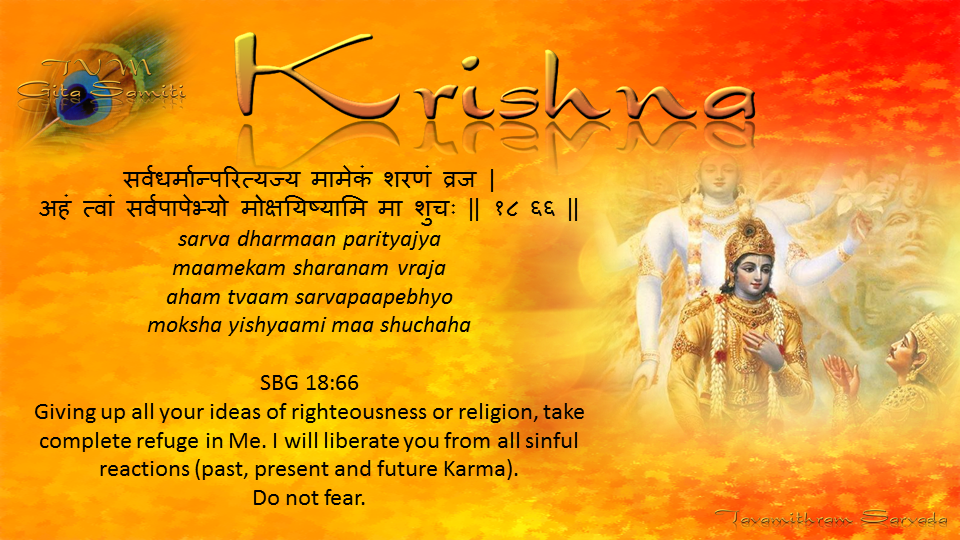
Shloka 18:66 of the Srimad Bhagavad Gita does not mean that one should have blind belief in Krishna.

Krishna says in SBG 18:66, “Giving up all your ideas of righteousness or religion, take complete refuge in Me. I will liberate you from all sinful reactions. Do not fear.”

It means, “Give up all the nonsensical ideas you might have in the name of religion, and by adopting the logical analysis and reasoning provided throughout until the 18th chapter, become one with Krishna.”

The entire purpose of the Srimad Bhagavad Gita is to guide people to shed their false beliefs and take to a rational study of truth. The process is very simple with three stages:

  1. Sidhaanta – A Question, Idea, Concept, or Theory
  2. Saadhana – The means to study, including reading, listening, researching, analysing, debating, etc.
  3. Siddhi – Final understanding, internalisation, and experience, known as Anubhava in Sanskrit.

Scientists don’t believe anything without evidence, do they? Remember that Vedanta is the science of all sciences.

Reason and Logic in the Srimad Bhagavad Gita

The Srimad Bhagavad Gita talks about reason and logic and NEVER about belief.

SBG 13:4 states, “Great sages have sung about the absolute truth in various ways. They have stated the truth in Vedic hymns and have described it in the Brahma Sutras through reason and logic with unambiguous evidence.”

Shloka SBG 4:34 says, “Acquire knowledge through reverence to teachers who have known the Truth, serve them and ask them questions until all of them are answered. The wise who know the Truth will teach it to you.”

Definition of Religion

Religion is a system of beliefs, practices, and values often centred around the worship of a higher power or divine beings. It typically involves rituals, moral guidelines, and a community of followers who share the same belief and faith.

Did you find anything related to reason, rationality, science, inquiry, or logic in this definition?

Vedanta: The Pinnacle of Vedic Studies

Vedanta is the highest point of Vedic studies – right from the basic Karma Kaanda, Upaasana Kaanda to the Gnyaana Kaanda of the Upanishads.

If you are interested in changing your life COMPLETELY and are willing to clear your mind of all the unfounded beliefs you have been trained by your elders to blindly believe, please feel free to contact me.

I do not talk about miracles performed by some man in a cave, one with a long beard, or another with fuzzy hair. Out here, it is pure Advaita Vedanta – Nondual Vedanta, and the compact and best manual for attaining the highest understanding of the nondual, all-pervading SELF is the Srimad Bhagavad Gita.

A real shift to Vedanta is a complete change with no traces of illogical or irrational ideas sticking in the mind in the name of belief, ‘aastha’, religion, or whatever.

“Before you heal someone, ask him if he’s willing to give up the things that make him sick,” said Hippocrates. Just as baseless beliefs can be likened to mental diseases, one must be willing to abandon them to achieve true healing and enlightenment. Therefore, start with a clean slate.

SBG 4:38 Shri Krishna says: “There is certainly nothing more purifying than knowledge. He who is perfect in Yoga finds it in the Self in due course of time.”

From Frustration to Fulfilment

The Essential Guide to Overcoming Life’s Unfavourable Situations

*SUBSCRIBE TO MY SUBSTACK – IT’S FREE*

Breaking Free from the Cycle

Many of us find ourselves stuck in a cycle of complaining, brooding, and feeling generally dissatisfied with our circumstances. Whether it’s our job, relationships, or personal achievements, the tendency to ruminate on what’s wrong can be overwhelming. And yet, despite the temporary relief we might find in venting to a friend or relative, we often wake up the next day only to repeat the same routine, with nothing having changed. The question then arises: how can we expect change when we continue to do the same thing?

The Unproductive Cycle of Complaints

Complaining and brooding are natural human responses to dissatisfaction. It’s almost instinctual to express our frustrations when things don’t go as planned. However, these actions rarely lead to meaningful change. Instead, they often serve as a temporary release, a way to momentarily ease the pressure without addressing the underlying issues. As a result, we remain stuck in the same unfavourable situation, repeating the cycle day after day.

To break free from this cycle, it’s crucial to take a different approach—one rooted in clarity and action. The key lies in defining your problems and goals with precision. Let me take you back to my childhood to illustrate this point.

As a young boy, I was naturally curious and had a mechanical aptitude that drove me to understand how things worked. I was always eager to get to the bottom of things, refusing to accept anything at face value without clear evidence. When I was reprimanded by elders or teachers for my behaviour, I didn’t just accept the scolding. Instead, I wanted to know what I had done wrong and, more importantly, what I should do right. However, my requests for guidance were often met with silence or a cold stare, leaving me with unanswered questions.

This experience taught me a vital lesson: in any situation, if something is wrong, it’s essential to ask, “What is right?” This principle can be applied to any area of life:

  1. If you’re dissatisfied with your job, ask: What is my ideal job?
  2. If you don’t like your life, ask yourself: What would my ideal life look like?
  3. If you’re unhappy in a relationship, ask: What is the ideal relationship I want?

The Three-Step Approach to Change

Once you’ve asked these questions, the next step is to define your situation clearly. Here’s a practical approach:

  1. Identify What You Don’t Like and Why: Be specific about what bothers you. Is it the long hours at work, the lack of appreciation, or perhaps a feeling of being stuck? Understand the root cause of your dissatisfaction.

  2. Create a Clear Vision of What You Want: Visualise your ideal situation in detail. What does your perfect job look like? What qualities define your ideal relationship? Be as specific as possible, down to the finest details.

  3. Develop a Plan to Achieve Your Vision: Identify the steps you need to take to move from your current situation to your ideal one. This might involve learning new skills, making lifestyle changes, or even having difficult conversations. The key is to take actionable steps that lead you closer to your goal.

The Danger of Temporary Fixes

Many people, when faced with an unfavourable situation, seek quick fixes to ease their minds temporarily. Whether it’s pouring out your woes to a friend, closing your eyes and sitting under a tree or in a religious place, or even turning to substances, these methods offer only momentary relief. They don’t address the core issues and often lead to more frustration when the problem inevitably resurfaces.

Please always remember that if someone truly wants something, they will find a way to get it. Consider alcohol and substance addicts or those addicted to gambling—they always manage to obtain what they crave. If you feel you’ve been working hard with no improvement in your life, instead of adopting a victim or ‘poor me’ attitude, try to view it from another perspective. Perhaps your efforts are insufficient, misdirected, or lack proper direction.

Summing up and Learning to Take Control of Your Life

If you’re unhappy with your current situation, don’t waste time complaining or seeking temporary distractions. Instead, follow the steps I’ve outlined:

  1. Define your issue clearly.
  2. Visualise your ideal situation.
  3. Take actionable steps to achieve your vision.

By doing so, you’ll find that you have the power to transform your life into something truly fulfilling. These steps may seem simple, but they are profoundly effective—I speak from experience.

Never forget that many people don’t know exactly what they want. Complaining and feeling depressed require less effort than reflecting and strategising, which is why slipping into self-pity is so easy. For anything good and positive to materialise, there must first be a clear image in the mind. So, the next time you feel the urge to complain or brood, make sure you know exactly what you want.

Real change begins with a clear definition of your goals and a commitment to taking action.

A Mind-Bending Voyage

Experience the Vastness and Awesomeness of Existence

Reality, Perception, and the Awakening of Consciousness

*SUBSCRIBE TO MY SUBSTACK – IT’S FREE*

*Please listen to the audio or read the post before watching the video.

After a decade away, I found myself standing once more in front of the house where I had lived until I was 11. This was the place where my sister and I used to walk to school, hand in hand, through green fields, joyfully crossing a small brook along the way. But as I stood there, I was struck by how different everything seemed. The street that once seemed so long and wide now appeared short and narrow. The house, which I remembered as spacious, looked small. The distance to my school, which had once felt like a great journey, now seemed trivial.

What had happened? When I left Poona, I was 11 years old. Now, I was 21. I had grown taller, and my perspective had shifted. The distances and proportions I held in my mind were relative to my height and understanding as a child.

This experience confirmed a profound truth: what we call reality is shaped entirely by our perception. When I was a child, my world seemed vast. As an adult, returning to that same world, it appeared small and contained. The reality I perceived at 11 was not an absolute truth—it was a reflection of my limited perception at that time.

This realisation extends far beyond childhood memories. It speaks to the very nature of our existence and the limitations we impose upon ourselves. Those who are deluded into believing they are merely their bodies, confined by irrational religious beliefs and paralysed by the fear of defying some ‘heavenly figure’, are trapped in a narrow reality. Their consciousness is limited, their minds blocked by layers of fear, dogma, and superstition.

But imagine if they could step out of these mental prisons—if they could free themselves from the beliefs that restrict their consciousness and their ability to think freely. They would rise above these illusions and delusions, and experience the ultimate truth of their existence: the realisation of their true SELF as subjective awareness, which is formless and, once not mentally limited to the body, is all-pervading.

This is the essence of the awakening journey—transcending the childish beliefs, religions, cults, and sects that confine us, and attaining the highest state of understanding. It is a journey from the narrow confines of perception to the boundless expanses of consciousness.

Take this fascinating virtual flight through space to the end of the observable universe and back. As you do, realise the vastness and awesomeness of existence. Let it inspire you to rise above the illusions that bind you and to reach for that highest state of awareness where the ultimate truth resides, far beyond the constructs of human beliefs.

Amritabindu Upanishad on Substack

The MIND – Man’s Greatest Tool

*SUBSCRIBE TO MY SUBSTACK – IT’S FREE*

Learning to use the MIND as a Churning Stick to realise your TRUE DIVINE SELF!

The Amritabindu Upanishad, part of the Krishna Yajur Veda, is a concise and powerful text for true seekers of spiritual wisdom. CONTINUE ON SUBSTACK


Treat Insults and Setbacks as ‘ROCKET FUEL’

Shatter the Cycle: BURN and RESET your Karma!


The Ever-Relevant Gita: A Present-Day Rendering’

FREE PROMO CODES: LIMITED OFFER

The Greatest Gift to Yourself for 2024 and the Future

Nonduality #Vedanta #SelfDiscovery #Consciousness #Spirituality #TruthSeeker”

Anger – your greatest ally?

Harness Your Rage and Redefine Your Reality

TheTriple ‘Z’ 

What if I told you that anger isn’t something to be feared or suppressed, but rather a powerful force that, when harnessed wisely, can drive incredible change in your life?

Well, some people are happy with their lives, not so happy, sad, or even sick of their lives. If everything is going well, and you are happy, just continue doing what you are doing and living the way you are. I don’t propagate the ideas of ‘good and bad’ or ‘right and wrong,’ which I consider dogmatic. Common sense alone tells us that something is good and right if it makes us happy and in no way harms our health, surroundings, nature, or others.

However, many are unhappy, dissatisfied, depressed, weak, or scared and would like to change their lives for the better. For those who genuinely want to make changes, however big or small, here are some steps you might want to follow:

  1. Identifying the Problems

Write down what you don’t like about your current situation, whether it’s your appearance, living circumstances, work, mindset, or any other area of your life. Be as specific as possible. I have given some easy and practical hacks in my video titled ‘Shatter the Cycle: BURN and RESET your Karma!’

  1. Setting Clear Goals

Next, think about what you want to achieve. What does your ideal self look like? How do you want to feel or think differently? Write down these goals so that you have a clear target to aim for. Be absolutely specific and describe your ideal self in detail.

  1. Execution

Once you’ve identified your problems and set your goals, begin outlining the steps or strategies needed to achieve them. This might involve altering your habits, seeking guidance, or acquiring new skills. Concentrate on taking small, manageable actions that will steadily progress you towards your objectives.

By breaking it down into these steps, you’ll have a clearer path to follow, making it easier to track your progress and stay motivated along the way.

Sitting alone, fretting, fuming, or complaining will only lead to self-pity, and that will ensure that your life stays exactly the way it is now, if not worse.

A Personal Story of Transformation

Thirty years ago, during a 48-hour self-imposed retreat, I conceived and meticulously crafted ‘Project KR’, where I defined and redefined exactly how I wanted my life to unfold.

Almost everything I described in Project KR has been happening so far. This includes the realisation of far-fetched aims, such as meeting with Queen Elizabeth II, and many other things that would have seemed impossible at that time.

I must emphasise that the goals and strategies I outlined in my playbook, which I boldly committed to nearly 30 years ago – defying all conventional thought processes and career planning – have not only materialised but have done so with astonishing precision, even in the finer details. Keep in mind, Rhonda Byrne’s ‘The Secret’ hadn’t even been written back then!

Likely Source of My Determination

My determination likely stemmed from the intense anger I harboured due to the wrongs inflicted upon me by others, which I now recognise as a result of my own naïveté or even foolishness. It’s often said that necessity is the mother of invention, and my ‘necessity,’ or rather my overwhelming drive to transform my life, was so powerful that I was able to create possibilities out of seemingly nothing.

The Triple ‘Z’: Zeal, Zest, and Zing

Around the time I embarked on my 48-hour self-reflection, I was teaching French at several management colleges. I closely observed the mindsets of my students, aged 18 to 20. Among them, only a few exhibited a profound, intense drive to set ambitious goals, achieve them, and pursue a more fulfilling life. This further reinforced my belief that not everyone possesses a high level of drive. While this isn’t inherently wrong, it can result in either a lacklustre future or a life devoid of Zeal, Zest, and Zing – qualities I was highly driven to attain and live my life to the fullest, which I had almost lost in some major accidents earlier.

In the biographies of many great individuals I’ve read, one common thread stands out: they never blamed others for their circumstances. Instead, they took full responsibility, charted their own paths, and forged ahead with determination.

Final Thoughts:

Some people write to me saying that they want to improve their lives, looks, happiness, relationships, etc., but are unable to achieve them.

My question to them is, “Who is stopping you?”

Treat Insults and Setbacks as ‘ROCKET FUEL’

Shatter the Cycle: BURN and RESET your Karma!


The Ever-Relevant Gita: A Present-Day Rendering’

Nonduality #Vedanta #SelfDiscovery #Consciousness #Spirituality #TruthSeeker”

Shatter the Cycle: BURN and RESET your Karma!

Break Free from Fate and Change Your Life Instantly

Karma Hacks

The concept of karma, often misunderstood or shrouded in superstition, is essentially about the patterns and outcomes in our lives that are heavily influenced by our own attitudes, actions, and reactions. Here’s a simplified breakdown of how Karma functions and impacts our lives and even those of our descendants:


The Ever-Relevant Gita: A Present-Day Rendering’

FREE PROMO CODES: LIMITED OFFER

The Greatest Gift to Yourself for 2024 and the Future

Nonduality #Vedanta #SelfDiscovery #Consciousness #Spirituality #TruthSeeker”

The Journey Within: Exploring Vedanta and Self-Realisation

From Illusion to Insight

Click HERE to go to my Substack. Join it. It’s FREE!

Exploring the Depths of Vedanta

Ever since I began my blog and YouTube channel in 2014, my mission has been to inspire individuals to delve deeper into the profound teachings of the Srimad Bhagavad Gita and Vedanta. These ancient philosophies offer timeless wisdom that can guide us towards self-realisation and inner peace.

In our modern world, it’s easy to get lost in the noise and distractions of daily life. However, the teachings of Vedanta provide a path to clarity and understanding. By focusing on the principles of unity and non-duality, we can transcend superficial differences and connect with our true selves.

One of the most powerful aspects of Vedanta is its emphasis on inquiry and the pursuit of knowledge. This philosophy encourages us to ask questions and seek deeper truths, fostering personal growth and mental clarity.

In my next video, I will be discussing these themes in greater detail, exploring how Vedanta can help us lead more meaningful and fulfilling lives. Stay tuned for insights and practical applications that can transform your perspective and approach to life.

Join me as we embark on this journey of self-discovery and enlightenment. Let’s explore the depths of Vedanta together!