As we traverse the path of knowledge and self-discovery, I extend a warm welcome to both our cherished followers and those who have recently arrived in our virtual sanctuary. At the heart of this blog lies a profound mission: to illuminate the transformative brilliance of Advaita Vedanta, the pinnacle of intellectual and spiritual evolution.
In a world often clouded by superstitions, myths, and dogmatic beliefs, my purpose is to guide you towards a higher understanding. Together, we will journey away from arcane rituals and practices that bind, and instead, embrace the liberating wisdom of Advaita Vedanta. This ancient philosophy offers a gateway to boundless liberation and pure bliss, free from the confines of misguided practices.
Through the timeless teachings of the Srimad Bhagavad Gita, the Upanishads, and the Brahma Sutras, I strive to empower you. My aim is not mere recitation, but a deep internalisation of these teachings, leading to fearlessness, self-confidence, excellent health, and prosperity. Together, we’ll cultivate a positive mindset that radiates throughout all aspects of life.
Excitingly, I am delighted to introduce a new chapter in our journey – the launch of our Newsletter series. This venture is for those who seek truth beyond the realm of dualistic beliefs and rituals. If you are ready to immerse yourself in the rational philosophy passed down through millennia, I invite you to join us.
Please read this post and/or watch the video in it before continuing. It is because you will understand the direction in which the new newsletter series will be going. It will be purely Advaita Vedanta and will never discuss rites, rituals, or any other such factor that creates the ‘my god and your god’ or them and us’ issues.
Now, if you are a serious seeker, and after reading the post ‘Beyond Belief and Ideology: Vedanta’s Perspective on Human Understanding‘, and if you would like to join, please express your interest by signing up for the newsletter. Simply enter your name and email ID in the box below. Please note that even if you are already subscribed to my main blog but have not signed up for the new newsletter series, you will not be added to the new mailing list. I will once again announce when the first Newsletter is ready, but for now, whoever expresses their interest in joining it will be demonstrating their participation in the journey, and that will truly add to my motivation.
Thank you for being part of this enlightening voyage. Let us continue to explore, learn, and evolve, as we uncover the profound truths that lead to a life of liberation, purpose, and unending bliss.
This chapter of the Srimad Bhagavad Gita has only 20 Shlokas which teach devotees how to worship Bhagavan Krishna and meditate upon His teachings. Bhagavan Krishna explains to Arjuna the things one could do in order to become dear to Him. He says that no one is repulsive or dear to Him. It is left to the seeker to interpret this and follow the steps taught in this chapter and get closer to the Supreme Bhagavan Krishna.
Bhagavan said: SBG 9:29 I am the same to all living beings. There is no one who is repulsive or dear to Me. But those who worship Me with devotion are in Me and I too am in them.
Bhagavan Krishna is not affected by anyone or anything. However, the truth is that people who are sincerely devoted to Him, offer complete Sharanaagati before Him and follow His teachings, are always confident about themselves. This makes them stronger and more efficient in whatever they do. It’s like in the case of children who have doting parents. Children who receive a lot of love, attention, protection and guidance from their father, mother or both, usually excel in everything.
In the pursuit of leading a purposeful and fulfilling life, we often encounter the obstacle of laziness that hampers our progress. The teachings of the Srimad Bhagavad Gita provide profound insights on how to combat this inertia and embrace a life of action and purpose. As per the Srimad Bhagavad Gita, it is essential to treat pleasure and pain, gain and loss, victory and defeat alike when engaging in life’s battles.
The verses guide us to recognise the importance of action over inaction, and emphasise the significance of selfless dedication to our duties. By performing our tasks as offerings to the Supreme Bhagavan Krishna and releasing all attachment to outcomes, we become untouched by sin, just like a lotus leaf remains unaffected by water.
Through these teachings, we learn to rise above the dualities of the material world and work for the welfare of all living beings, leading us towards liberation and absorption in the Divine. So, let us embark on a journey of self-discovery, drawing inspiration from the Srimad Bhagavad Gita, and conquering laziness to attain true glory and purpose in life.
Fear is an unpleasant, often strong emotion caused by anticipation or awareness of danger. It is a primordial emotion that exists in all sentient beings. Fear is an emotion that everyone has experienced at some point or the other in life. Most of us have experienced the fear of either losing someone, our honour, money, property, happiness, position or also that of being attacked by someone. Whatever it is, fear basically is imagining something that has not happened yet! Even if it is fearing the repetition of some unpleasant incident in the past, it is still the fear of something that has not happened until that point in time.
The root cause of fear is attachment. Those who fear losing someone or something, do so because of their attachment to the object they feel they would lose. The fear of losing one’s reputation stems from one’s ego. People who dread physical attacks fear damage to their bodies, which is sure to perish at the end of a Janma or lifetime. A person who understands the impermanence of everything physical or materialistic and realises that he or she has nothing to lose; fears absolutely no one and nothing.
In order to reach a higher level of understanding, it would be necessary to comprehend that a person’s body, mind, intelligence, senses and the Atman are separate from each other. Studying the Srimad Bhagavad Gita helps clear misunderstandings that cause faulty thinking, which is one of the prime causes of all misery.
Reading and imbibing the truths in the selected life-changing Shlokas, from the Srimad Bhagavad Gita, given in the collection above can aid in removing fear out of the mind.
Remember that a disturbed mind can achieve nothing and that a calm mind is the first requirement in preparing oneself to receive Divine Blessings.
Sorry for being blunt, but if you hold beliefs in a separate being up there, who is constantly watching and controlling your life—granting your wishes upon prayer and punishing you for not doing so with misfortunes—you might not have attained sufficient mental maturity, are unwilling to employ your innate power of reason, or have been influenced by a cult or religion that prevents you from understanding the true essence of the Srimad Bhagavad Gita.
For the past nine years, I have tirelessly worked to empower everyone, irrespective of gender or social status, with the ability to read, study, and internalise the RATIONAL PHILOSOPHY present in the Srimad Bhagavad Gita. It is knowledge that can be easily grasped if only one remained mentally free.
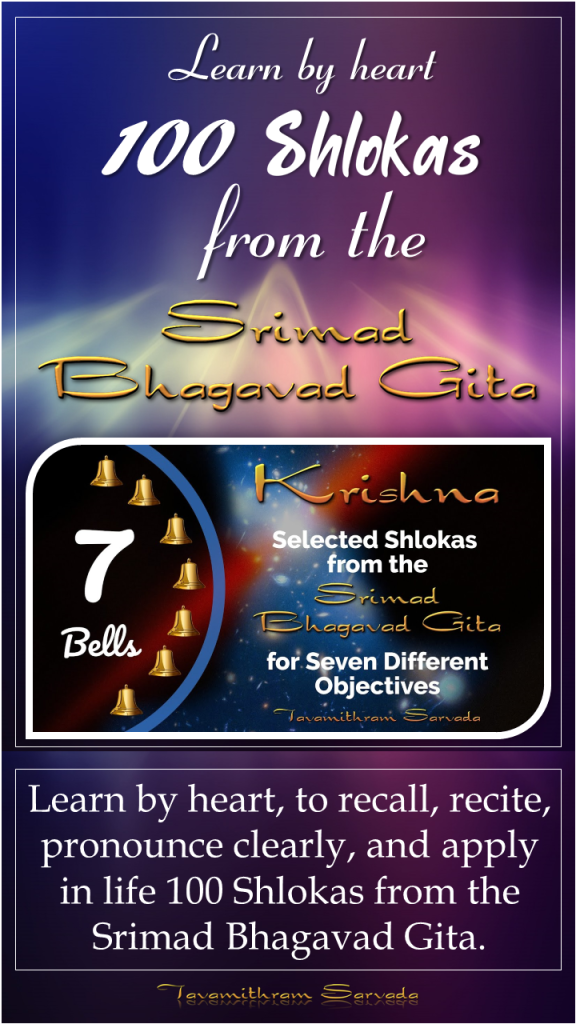
I won’t elaborate further, but I encourage you to watch this video, which is basically some bonus content added to the 100 selected SBG Shlokas course.
Why would anyone want to be a mental slave to someone or something?
Before you proceed, consider these questions: 1. If Krishna was omnipresent, wouldn’t that mean He resides within me as well? So, why should I search for Him outside myself?
2. If I believe in the existence of beings other than the All-pervading Divine principle, also known as Krishna, does that not negate the existence of Krishna within those beings?
3. Tavamithram taught his son Vedanta from a young age, ensuring the boy’s mind was completely free from irrational dualistic beliefs. Why am I still bound by baseless belief systems forced upon me?
Meditation is a powerful practice that holds immense importance in our fast-paced and often chaotic lives. It provides a sanctuary for the mind, allowing us to step away from the constant stream of thoughts and emotions that can overwhelm us. By dedicating time to meditation, we cultivate a sense of inner peace and clarity. A calm mind becomes more receptive to intelligent and rational thinking. It enables us to make better decisions, respond to challenges with composure, and approach life with a deeper understanding.
One of the initial steps towards achieving a peaceful mind is learning to disconnect from our emotions. Emotions can cloud our judgment and lead to impulsive reactions. Through meditation, we learn to observe our thoughts and feelings without getting entangled in them. By creating this mental distance, we become better equipped to navigate life’s complexities with a level-headed approach.
Mantras are invaluable tools in the journey of calming the mind. These ancient, sacred sounds or words have a profound impact on our consciousness. Repetition of mantras during meditation can help quieten the mental chatter and instil a sense of tranquillity. The vibration and rhythm of mantras empower the mind, making it more resilient and focused. As we delve deeper into meditation with mantras, we unlock the potential to access higher states of awareness and find our true selves amidst the noise of the world.
Take the help of meditation and Mantras to calm your mind and invoke Divine Power and Energy into you to start your journey to Inner Peace, Bliss, and Self-Realisation.
Below are some of my meditation videos which you watch or play, and to help you in your meditation.
Please use headphones for a more personal experience.
Today, I want to share an interesting incident that occurred yesterday after I posted about “Ma ka doodh.” I have been counselling a good old friend of mine for some time, and he has been experiencing positive changes in his life.
My friend, who happens to be a meat consumer, wasn’t particularly pleased with my post, and he promptly sent me a message expressing his feelings. Now, I must admit, our viewpoints on this topic have always been divergent, and this post seemed to strike a sensitive chord for him. Nevertheless, since he is someone who values detailed explanations and wants to reread them, I took the time to compose a thoughtful reply.
Today, I decided to share my response publicly, albeit while protecting his real identity. I am doing it because I think it might be beneficial to others who face similar challenges when discussing contrasting beliefs. It’s a story of emotional reactions versus intelligent discussions, and I hope it provides valuable insights to those who find themselves in similar situations.
In my response, I reflect on a past incident where my friend’s reaction to one of my earlier posts was emotion-based. However, after we engaged in a conversation, he grasped the essence of my message. Similarly, in his recent message, I noticed that he reacted without fully comprehending what I wrote and without watching the film ‘Ma ka doodh,’ which I had recommended in the post.
Throughout my life, I have always been passionate about learning, and I have passed on this attitude to my son as well. Learning, for me, is an exciting journey, and I embrace any opportunity to expand my knowledge. Consequently, when someone points out my mistakes and proves them, I am genuinely grateful because it means I have gained new insights. To be honest, I am eternally grateful to all those who might have ridiculed, insulted, or even publicly belittled me because what they did worked as great causes of reflection in me and also functioned as booster rockets in my life and career. Do you remember my post ‘Treat Insults and Setbacks as ‘ROCKET FUEL?
To be honest, I am eternally grateful to all those who might have ridiculed, insulted, or even publicly belittled me because what they did worked as great causes of reflection in me and also functioned as booster rockets in my life and career. Do you remember my post ‘Treat Insults and Setbacks as ‘ROCKET FUEL?
In this message, I delve into the idea of human evolution and how embracing change and growth is essential. I stress the importance of questioning beliefs, conducting thorough research, and making informed decisions rather than blindly accepting ideas. As I often say, there’s no absolute right or wrong; there are only causes and effects. It is always the outcomes that determine whether an action is right or wrong.
I highlight the significance of living the life of a responsible soul, thinking about the consequences of our actions, and aligning them with our desired results. It’s about being conscious of what we consume, both physically and mentally, and making responsible choices.
In conclusion, I urge my friend to ponder upon these ideas and consider looking beyond traditional beliefs. I believe that embracing knowledge and critical thinking can lead to a deeper understanding of oneself and the world around us. Blind faith may foster divisive ideologies, but open-mindedness can pave the way for harmony and growth. Unlike in many organised religions, nowhere in the Srimad Bhagavad Gita does Krishna ask Arjuna to BELIEVE in Him. In Shloka SBG 18:63, Krishna says: “I have taught you the secret wisdom, which is deeper than all that is confidential and profound. Reflect fully on what I have declared to you, and do what you wish to do.”
I present my response to my friend to all of you with the hope that it inspires meaningful conversations and encourages self-discovery. As I share my thoughts, I offer my sincere gratitude to the teachings of the Srimad Bhagavad Gita, which have enriched my perspective and whole life.
Thank you for taking the time to read this. Let us all embark on a journey of continuous learning and evolution.
Stay Blessed.
————————————-
My message to my friend:
Dear friend,
do you remember that one time when I wrote something about Tamil and your response was based on emotion? Later, when we spoke, you understood what I meant. Similarly, in yesterday’s post, you read it and reacted immediately. In fact, I had already addressed all your questions in my post, even before you asked them. However, you reacted without fully comprehending what I wrote, and also without watching the two-hour film I promoted through my post.
I’m sorry to say that yours was an emotional reaction and not an intelligent one. It was the result of a typical human tendency to defend or attack when one is told that what they have been doing or what they believe in is wrong.
In my case, I must say that learning is my passion, and I have instilled the same attitude in my son. He is doing very well because he’s thrilled to learn anything and everything. If someone points out my mistakes and proves them to me, I’m only too happy because it means I’ve learned something new.
That’s why I have great respect for people who have insulted or degraded me in the past. They taught me things about myself that I didn’t know.
You asked me in your message if what people have been doing since time immemorial is wrong, I say, “Yes, they are incorrect, at least in today’s scenario!” Asking questions and learning is what I call human evolution. We all evolve, don’t we? Your daughter and grandchildren being smarter than you is a sign of progress, and you should be proud of it. If they’re not, it indicates something might be wrong with your parenting or their growth.
In my post, I have clearly said that I’m not an expert, but all I stress is that before you do something or believe something, do your research, study, figure things out for yourself, and then take action. There’s no absolute right or wrong; there are only causes and effects. It’s only up to the effects to determine whether something was right or wrong.
Therefore, before taking any action, consider the consequences. If you want a specific result, make sure your actions align with that goal. Yesterday, I was surprised by your impulsive reply; I thought you had become calmer and more peaceful. Your reaction might indicate that there was some misunderstanding because I had already provided answers to your questions in the post.
Have you thought about what the cow, whose milk you drink, was fed and injected with yesterday? Or what was injected into the chicken you ate last week? Do you know what the fish you consume, ingested from the ocean? Did you ever care to find out how poultry farms are run and the hazardous measures they take to make the chicken weigh more and appear fat to its consumers? It’s essential to be aware of these things, at least for the sake of your health and that of your loved ones.
I aim not to preach or enforce my beliefs upon you; rather, I am merely sharing my ideas. I urge you to engage in independent thinking and conduct thorough research on your own. It is crucial for everyone to safeguard themselves against blind belief systems, as they have been responsible for the proliferation of violent religions, cults, and sects, and the emergence of fraudulent figures like fake babas such as some bearded beef-eating ones, and self-proclaimed ‘divine ammas.’
Furthermore, I suggest that you ask questions and discover on your own. Haven’t I supported my arguments with relevant Shlokas from the Srimad Bhagavad Gita?
The Kenopanishad is one of the principal Upanishads of the Vedanta philosophy. It explores the nature of ultimate reality and the means of attaining self-realisation. The Upanishad delves into profound questions, such as the source of our senses, the limitations of perception, and the essence of Brahman, the supreme reality.
In this ancient text, it is revealed that the true essence of Brahman cannot be known through the ordinary faculties of the mind, speech, or senses. It highlights that Brahman is distinct from both the known and the unknown, beyond the grasp of conventional knowledge. The Upanishad emphasises the importance of seeking knowledge from enlightened masters who have directly experienced the transcendent truth.
Through poetic metaphors and philosophical insights, the Kenopanishad teaches that Brahman is the underlying reality behind all our faculties. It is described as the ear of the ear, the mind of the mind, and the eye of the eye. By transcending our identification with the senses and renouncing worldly attachments, one can realise their true nature and attain immortality.
This presentation explores the profound wisdom contained within the Kenopanishad, offering insights into the nature of reality, the limitations of perception, and the path to self-realisation. It invites viewers on a journey of self-discovery and spiritual awakening, shedding light on the timeless teachings of the Upanishads and their relevance in the modern world.
Study Vedanta and clear your mind of all kinds of fears, doubts, superstitions, and all pseudo-belief systems.
Kenopanishad (Ninth Chapter Talavakkara BrahmaNa, Sama Veda)
I-1. By whom is the mind directed to focus on its objects? By whom does the foremost vital air move? By whom is this speech desired, which the people utter? Who is the radiant being that brings together the eye and the ear with their objects?
I-2. Because He is the ear of the ear, the mind of the mind, the speech of speech, the vital air of the vital air, and the eye of the eye, the wise attain immortality by freeing themselves from identification with the senses and renouncing the world.
I-3. The eye does not reach there, nor does speech or mind. We do not fully understand it, and therefore, we are unable to provide instruction about it. It is distinct from the known and distinct from the unknown. We have learned this from the ancient sages who explained it to us.
I-4. That which is not expressed by speech, but by which the word is expressed, recognise that alone to be Brahman, and not this non-Brahman that is being worshipped.
I-5. That which cannot be thought by the mind, but by which, they say, the mind is capable of thinking, recognise that alone to be Brahman, and not this non-Brahman that is being worshipped.
I-6. That which cannot be seen with the eye, but by which one sees the activities of the eye, recognise that alone to be Brahman, and not this non-Brahman that is being worshipped.
I-7. That which cannot be heard with the ear, but by which one hears the ear’s hearing, recognise that alone to be Brahman, and not this non-Brahman that is being worshipped.
I-8. That which cannot be smelled with the sense of smell, but by which the sense of smell is attracted to its objects, recognise that alone to be Brahman, and not this non-Brahman that is being worshipped.
II-1. If you think, ‘I know Brahman correctly,’ you have only a limited understanding of Brahman’s true nature. Your knowledge of His form and the forms of the gods is also limited. Therefore, Brahman is still to be explored by you. I believe I know Brahman.
II-2. I do not claim to know Brahman correctly, nor do I claim it is completely unknown. I both know and do not know. Among us, those who truly know, know Brahman; it is neither completely unknown nor fully known.
II-3. To those who do not know, it is known; to those who think they know, it remains unknown. Those who truly know recognise that it is unknown, and those who think they know do not truly know.
II-4. When Brahman is realised as the inner essence of cognition in every state of consciousness, it is truly known, for in that realisation, one attains immortality. Through one’s own Self, strength is gained, and through knowledge, immortality is attained.
II-5. If one has realised this, there is fulfillment. If one has not realised it, there is a complete loss. By realising Brahman in all beings and withdrawing from this world, the wise attain immortality.
III-1. It is widely known that Brahman indeed achieved victory for the gods. In that victory, the gods experienced great joy.
III-2. They thought, “This victory is exclusively ours, this glory is exclusively ours.” Brahman recognised their arrogance and appeared before them, but they did not recognise the worshipful Being that appeared.
III-3. They said to Agni, “O Jataveda, please find out who this worshipful Being is.” Agni agreed.
III-4. Agni approached the Being, who asked, “Who are you?” Agni replied, “I am Agni, also known as Jataveda.”
III-5. The Being asked, “What power do you possess?” Agni responded, “I can burn all that is upon the earth.”
III-6. The Being placed a blade of grass and said, “Burn this.” Agni hurried towards it but could not burn it. He returned and said, “I am unable to understand who that Being is.”
III-7. Then they said to Vayu, “O Vayu, please find out who this Being is.” Vayu agreed.
III-8. Vayu approached the Being, who asked, “Who are you?” Vayu replied, “I am Vayu, also known as Matarishva.”
III-9. The Being asked, “What power do you possess?” Vayu responded, “I can grasp all that is upon the earth.”
III-10. The Yaksha placed a blade of grass and said, “Pick this up.” Vayu hurried towards it but could not pick it up. He returned and said, “I am unable to understand who that Being is.”
III-11. Then they said to Indra, “O Maghava, please find out who this Being is.” Indra agreed. He approached the Being, but It disappeared from his sight.
III-12. In that very place, Indra encountered an exceedingly charming woman. To Uma, adorned with gold (or to the daughter of the Himalayas), he asked, “Who is this Being?”
IV-1. She replied, “It was Brahman. In the victory that belonged to Brahman, you revelled in joy.” At that moment, Indra knew for certain that It was Brahman.
IV-2. Therefore, these gods, Agni, Vayu, and Indra, surpassed other gods because they came into contact with Brahman, who stood so close, and they were the first to recognise It as Brahman.
IV-3. Hence, Indra excels over other gods, for he touched Brahman, who stood so close, and he was the first to recognise It as Brahman.
IV-4. The instruction regarding meditation is as follows. It is comparable to a flash of lightning or the blink of an eye. This analogy represents the divine aspect of Brahman.
IV-5. Then follows the instruction through analogy concerning the individual self. It is widely understood that the mind seems to attain It, that the mind constantly remembers It, and that the mind possesses thoughts about It.
IV-6. That Brahman is known as Tadvana (adorable to all beings). That is to be worshipped as Tadvana. Those who know It in this manner are revered by all beings.
IV-7. The disciple said, “Respected sir, please teach me the Upanishad.” The teacher replied, “I have taught you the Upanishad. It is indeed about Brahman that I have spoken.”
IV-8. In this knowledge, austerity, self-restraint, and action serve as the foundation, the Vedas represent all the limbs, and truth is its abode.
IV-9. One who comprehends this, with their sins eradicated, becomes firmly established in the infinite, blissful, and supreme Brahman. They become firmly established in Brahman.
The ‘thread’ of existence – The one who comprehends this attains instantaneous spiritual, intellectual and emotional freedom, and above all peace.
Irrespective of the difficulties or obstacles you encounter in life, the foremost task you might want to undertake prior to seeking solutions would be to overcome the CURSE OF DUALITY by PURGING YOUR MIND of all baseless fears, beliefs and assumptions that may be currently dictating your thoughts.
Those who propagate the concept of duality lack an understanding of both Vedanta and the principles of science and rationality. Their influence on society has been immeasurable and harmful. The naive and intellectual notion of unquestioningly believing in the existence of a separate divine being is a leading cause of major conflicts, wars, genocides, and other atrocious events throughout human history. Individual beliefs often clash, leading to deep-rooted conflicts that can endure for centuries. Nowhere in the Srimad Bhagavad Gita does Krishna instruct Arjuna to blindly believe in anything or seek His favour through prayer. Nowhere does Krishna advocate for performing absurd goal-oriented rituals. Such actions carried out in the name of religion, Bhakti, or tradition contradict one of the core teachings of KarmaYoga in the Srimad Bhagavad Gita.
SBG 2:47 कर्मण्येवाधिकारस्ते मा फलेषु कदाचन | मा कर्मफलहेतुर्भूर्मा ते सङ्गोऽस्त्वकर्मणि || २ ४७ || You only have the right to work, but never to claim its results. The results of your actions should never be your motive but at the same time, you should not be attached to inaction.
Watch the Advaitaanubhava video given below to gain more clarity on this matter.
Consider this: Just as a wave emerges from the ocean and temporarily assumes its own form and identity, it always remains connected to and inseparable from the ocean.
Likewise, all living beings and inanimate objects are similar to waves, as they too arise from the vast ocean of existence and adopt transient names and forms, only to return to their original state of oneness with the entirety of existence or Brahman.
Physical beings are mere assemblages of cells organised in various ways that determine their structure and function. However, the true Self is the same omnipresent Paramatma, Brahman, or the entity known as Krishna, without whom nothing can either exist or not exist.
The false belief of separation from the whole is the root cause of mental distress and unease in life. These deeply ingrained beliefs, though difficult to uproot, can be overcome within a short span of time if one truly opens their inner eye of reason.
SBG 6:29 सर्वभूतस्थमात्मानं सर्वभूतानि चात्मनि | ईक्षते योगयुक्तात्मा सर्वत्र समदर्शनः || ६ २९ || A yogi whose Self is united with Divine Consciousness sees the Self abiding in all beings and all beings in the Self. Such a person sees the same everywhere.
SBG 10:20 अहमात्मा गुडाकेश सर्वभूताशयस्थितः | अहमादिश्च मध्यं च भूतानामन्त एव च || १० २० || I am the Self, O Gudakesha (Arjuna), situated within all living entities. I am the origin, the middle and also the end of all beings.
SBG 13:27 (or 28 in some editions) समं सर्वेषु भूतेषु तिष्ठन्तं परमेश्वरम् | विनश्यत्स्वविनश्यन्तं यः पश्यति स पश्यति || १३ २७ || The person who truly sees is the one who sees the Supreme Atman or Supreme Bhagavan, existing equally in all beings – the unperishing within the perishing.
SBG 13:28 (or 29 in some editions) समं पश्यन्हि सर्वत्र समवस्थितमीश्वरम् | न हिनस्त्यात्मनात्मानं ततो याति परां गतिम् || १३ २८ || Such a person perceives the same Supreme Divinity or Bhagavan dwelling equally everywhere, and he does not degrade his own spiritual well-being by mistaking his ego to be the Self like the way ignorant people do. He, therefore, reaches the highest goal.
Clean up your mind. START WORKING on gaining Advaitaanubhava and find peace in 30 minutes – Learning to Experience nonduality or Universal Oneness. The moment you realise that there is nothing outside your own mind, the result will be nothing but fearlessness and absolute peace.












 Tavamithram Sarvada