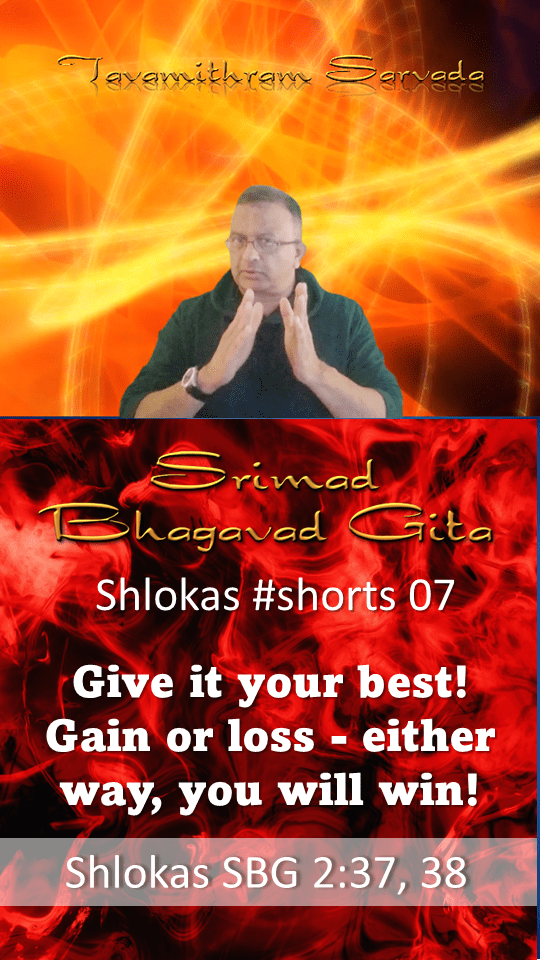
SBG 2:37 हतो वा प्राप्स्यसि स्वर्गं जित्वा वा भोक्ष्यसे महीम् | तस्मादुत्तिष्ठ कौन्तेय युद्धाय कृतनिश्चयः || २ ३७ || hatho va praapsyasi svargam jitvaa vaa bhokshyase mahim tasmaa-duttist-ha kaunteya yuddhaaya krta nischayaha (SBG 2:37) Either you will be killed in the battle, and you will attain the celestial abodes or, you will win this battle and enjoy the kingdom on earth. Therefore, arise and fight with resolution. ———————————————————————— SBG 2:38 सुखदुःखे समे कृत्वा लाभालाभौ जयाजयौ | ततो युद्धाय युज्यस्व नैवं पापमवाप्स्यसि || २ ३८ || sukhaduh-khe same krtvaa laabhaa-laabhau jayaa-jayau thatho yuddhaaya yujyasva naivam paapam-avaapsyasi (SBG 2:38) Fight the battle treating alike pleasure and pain, gain and loss as well as victory and defeat. By doing so, you will not sin.
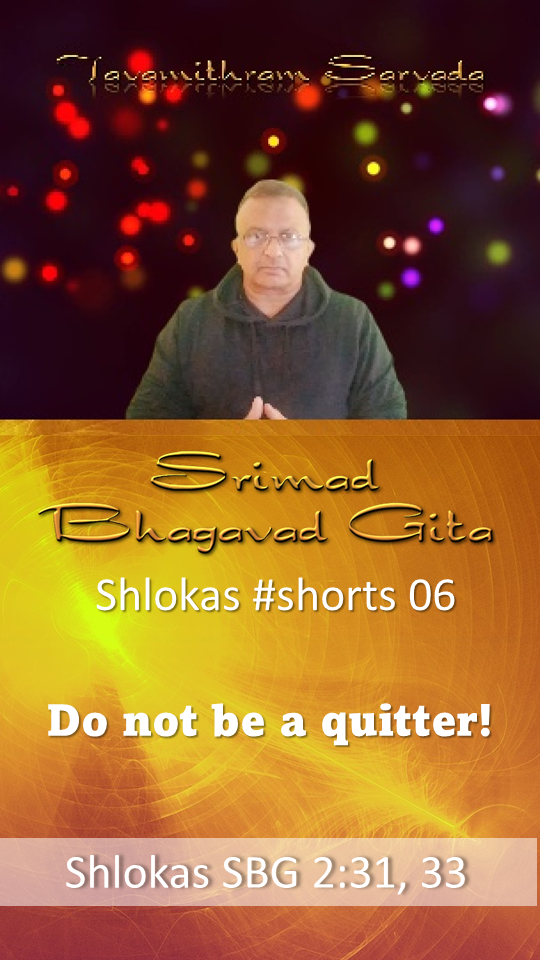
धर्म्याद्धि युद्धाच्छ्रेयोऽन्यत्क्षत्रियस्य न विद्यते || २ ३१ ||
svadharma-mapi chaavekshya
na vikampitu-marhasi
dharmyaaddhi yuddhaach reyo ‘nyat-
kshatriyasya na vidhyate (SBG 2:31)
Considering your duty as a Kshatriya, you should not falter, as there is no greater work for you than a battle which protects Dharma (righteousness).
SBG 2:33
अथ चेत्त्वमिमं धर्म्यं संग्रामं न करिष्यसि |
ततः स्वधर्मं कीर्तिं च हित्वा पापमवाप्स्यसि || २ ३३ ||
atha chettva-mimam dharmyam
sangraamam na karishyasi
tatah svadharmam kiirtim cha
hitvaa paapam-avaapsyasi (SBG 2:33)
If you don’t fight this battle of Dharma (righteousness), you will be a sinner by failing in your duty, and it will cause the loss of your standing as a warrior.
धर्म्याद्धि युद्धाच्छ्रेयोऽन्यत्क्षत्रियस्य न विद्यते || २ ३१ ||
svadharma-mapi chaavekshya
na vikampitu-marhasi
dharmyaaddhi yuddhaach reyo ‘nyat-
kshatriyasya na vidhyate (SBG 2:31)
Considering your duty as a Kshatriya, you should not falter, as there is no greater work for you than a battle which protects Dharma (righteousness).
SBG 2:33
अथ चेत्त्वमिमं धर्म्यं संग्रामं न करिष्यसि |
ततः स्वधर्मं कीर्तिं च हित्वा पापमवाप्स्यसि || २ ३३ ||
atha chettva-mimam dharmyam
sangraamam na karishyasi
tatah svadharmam kiirtim cha
hitvaa paapa-mavaapsyasi (SBG 2:33)
If you don’t fight this battle of Dharma (righteousness), you will be a sinner by failing in your duty, and it will cause the loss of your standing as a warrior.
SBG 2:23 नैनं छिन्दन्ति शस्त्राणि नैनं दहति पावकः | न चैनं क्लेदयन्त्यापो न शोषयति मारुतः || २ २३ || nainam chindanti shastraaNi nainam dahati paavakaha na chainam kledayanty-aapo na shoshayati maarutaha (SBG 2:23) The soul cannot be cut by weapons, it can’t be burned by fire, water cannot wet it nor can wind dry it. ———————————————————————— SBG 2:24 अच्छेद्योऽयमदाह्योऽयमक्लेद्योऽशोष्य एव च | नित्यः सर्वगतः स्थाणुरचलोऽयं सनातनः || २ २४ || acchedyo ‘yama daahyo ‘yam akledyo ‘shoshya eva cha nityaha sarva gatah sthaaNur- achalo ‘yam sanaatanaha (SBG 2:24) The soul or the Self is indeed incombustible, it cannot be cut, nor moistened nor dried. It is eternal and it has been there forever.
SBG 2:17 अविनाशि तु तद्विद्धि येन सर्वमिदं ततम् | विनाशमव्ययस्यास्य न कश्चित्कर्तुमर्हति || २ १७ || avinaashi tu tadviddhi yena sarva midam tatam vinaasham-avyayas-yaasya na kash-chit kartu marhati (SBG 2:17)
You must know that, that which pervades the body can never be destroyed. The soul is indestructible and imperishable.
SBG 2:20 न जायते म्रियते वा कदाचिन् नायं भूत्वा भविता वा न भूयः | अजो नित्यः शाश्वतोऽयं पुराणो न हन्यते हन्यमाने शरीरे || २ २० || na jaayate mriyate vaa kadaachin naayam bhutva bhavitaa vaa na bhuuyaha ajo nityaha shaashvato ‘yam puraaNo na hanyate hanyamaane shariire (SBG 2:20)
The Self is never born, nor does it die at any time. It does not come into existence by being born. The Self is constant. It is not killed when the body dies.
2:12 नत्वेवाहं जातु नासं न त्वं नेमे जनाधिपाः | न चैव न भविष्यामः सर्वे वयमतः परम् || २ १२ || na tvevaaham jaatu naasam na tvam neme janaadhi-paaha na chaiva na bhavishyaa-maha sarve vayam-ataha param (SBG 2:12) There was never a time when I did not exist, nor you, nor all these kings. We will also never cease to exist. —————————————————————————- 2:14 मात्रास्पर्शास्तु कौन्तेय शीतोष्णसुखदुःखदाः | आगमापायिनोऽनित्यास्तांस्तितिक्षस्व भारत || २ १४ || maatra-sparshaas-tu kaunteya sheetoshNa-sukhad-duhkhadaaha aagamaa-paayino -‘nityaas- taam-sthithikshasva-bhaarata (SBG 2:14) O son of Kunti, transitory perceptions such as happiness and sadness arise from the contact of the senses with sense objects. Like the heat and cold in summer and winter, they too come and go. They are temporary, so learn to endure them.
*In order for the video to make the best of this video, please go through the following post before watching the video.
*You could choose to listen to this audio, or if you wish, you could also play the audio and simultaneously read the introductionto the video given below:
Around thirty trillion cells that are stuck together form the human body in which you reside. In fact, YOU, or rather your SELF, exist in each of these trillions of cells.
Now, how is your SELF different from the SELF that exists in others and in all other living beings? Is each SELF known by some people as ‘Jivatma’ separate from one another? After a person is dead and gone, and when neither face, body, nor DNA exist, how can you tell one ‘Jivatma’ from another?`Do they have ‘Jivatma fingerprints?’ And if ‘Jivatmas’ were truly separate from one another, then they should be made of matter in one of the three states of solid, liquid or gas. What are they made of? Are they some kind of gas? If that were to be the case, they should be made of molecules. So what kind of molecules are they made of?
The lack of general knowledge, common sense, and an overall foundation of rationality are the ones that cause people to believe without questioning whatever ‘yarns’ are spun for them by ‘religious’ people.
Have you read the Srimad Bhagavad Gita? Did Arjuna ever ‘pray to Krishna’ to help him win the war? NO! Arjuna only requested Krishna to accept him as His pupil and impart knowledge to him.
The Srimad Bhagavad Gita is a perfect allegory for your life. The Mahabharata war is not something that takes place between you and others, but it is a perpetual battle between the ‘Pandavas’ and ‘Kauravas’ that represent the positive and negative thoughts in your mind. Remember that both are equally powerful, and therefore, the only way for the good guys or the Pandavas to win over the badies of the Kauravas would be THROUGH KNOWLEDGE. Every sane person has their own intellect or KRISHNA in them, but how many actually choose to be like Arjuna who questions, discusses, contemplates, reflects, and is always eager to learn, is an important question.
The last Shloka SBG 18:78 of the Srimad Bhagavad Gita sums it all up:
SBG 18:78 (Sanjaya says) Wherever there is Krishna, the Master of Yoga; and wherever there is Arjuna, the supreme archer; you will find there, prosperity, happiness, victory and righteousness. Of this fact, I am certain.
What is the moral of Shloka 18:78? A true seeker is one who is eager to learn, is socially responsible, is fearless, and is aware that he is the same All-pervading Supreme Paramatma, temporarily limited by his false belief that he is restricted to the boundaries of his skin on his body. Such a person consults his intellect before performing action, which he does as a sacrifice unto Krishna or his own Higher Self, and by doing so, he can be free from Karmic reactions and comfortably evolve towards the final goal of Ultimate Self-Realisation.
Please read the following translated SBG Shlokas and then watch the video:
SBG 2:18 The material body is perishable but not the eternal, indestructible and immeasurable Self, which has no end.
SBG 2:20 The Self is never born, nor does it die at any time. It does not come into existence by being born. The Self is constant. It is not killed when the body dies.
SBG 2:25 The Self is said to be formless, inconceivable, immutable and unchangeable. Hence, knowing this, you should not grieve.
SBG 6:29 A yogi, whose Self is united with Divine Consciousness, sees the Self abiding in all beings and all beings in the Self. Such a person sees the same everywhere.
SBG 13:02 (13.3 in some editions) You should know that the Kshetrajna or the embodied Self in all bodies or Kshetras is Me, O Arjuna. Knowing about the Kshetra and the Kshetrajnas is called knowledge.
SBG 13:22 (13.23 in some editions) Yet, within the body resides The Supreme Bhagavan who is also called the Spectator, the One who permits, the Supporter and the Transcendental Enjoyer. He is the Paramatma, the Supreme Self.
SBG 13:31 (13:32 in some editions) The imperishable Supreme Self is without any beginning and is devoid of the Gunas or material qualities, O Arjuna. Although it dwells in the body, it neither acts nor is tainted.
SBG 13:32 (13:33 in some editions) Just as the all-pervading ether is not tainted because of its subtlety, the Self that is seated everywhere in the body, does not mix with it nor is affected by it.
SBG 13:33 (13:34 in some editions) Like the sun that illuminates the whole world, the Self or the Soul, which is the Bhagavan of the Kshetram or body, illuminates the whole field, O Arjuna.
SBG 14:19 The one who recognises the Gunas alone as the agent in all actions and treats the Self to be above the Gunas, achieves My (Krishna’s) Divine Nature.
SBG 18:63 I have taught you the secret wisdom, which is deeper than all that is confidential and profound. Reflect fully on what I have declared to you, and do what you wish to do.
I can understand the lives of people, whose forefathers had converted to foreign religions either due to fear, greed, or whatever reason. But what about those whose forefathers faced it all, stood tall, protected the Vedic Sanatana Dharma, and passed it on so that the present generation could benefit from the highest knowledge of Vedanta?
How pathetic can such a huge number of people be, to not put in at least minimal efforts to study the Srimad Bhagavad Gita, which is called the nectar of all the Upanishads, instead of becoming mental slaves of non-existent imaginary deities and of beef-eating men and women claiming to be special divine people; join cults, sects, groups and subgroups; and actually choose to suffer all through their lives! How pathetic!
Now, get this straight: If you do something, no matter how ‘religious’ or ‘pious’ you might think it is, but expect something in return, including simply ‘wanting to please ‘god”; you would only be going against the main principle of KarmaYoga:
कर्मण्येवाधिकारस्ते मा फलेषु कदाचन | मा कर्मफलहेतुर्भूर्मा ते सङ्गोऽस्त्वकर्मणि || २ ४७ || karmaNye vaadhikaras te maa phaleshu kadaachana maa-karma-phala-hetur-bhuur- maa te sango ‘stva karmaNi (SBG 2:47) You only have the right to work, but never to claim its results. The results of your actions should never be your motive but at the same time, you should not be attached to inaction.
How miserable can people be, particularly those who consider themselves to be educated and knowledgeable, to ‘pray’ for special favours to something that does not even exist?
Please, remember that The Srimad Bhagavad Gita is a grand allegory. The Pandavas and the Kauravas are the positive and negative forces that continuously battle within one’s mind. Arjuna had Krishna as his own driver all through the war, but did he ever ask Krishna to ‘perform miracles’ and solve his problems? NO! Arjuna placed himself as a pupil of Krishna. See Shloka SBG 2:07. The moment any person, no matter m or f, positions himself or herself as an ‘Arjuna’, their ‘Krishna’ will appear and guide them through life. What I mean by ‘their ‘Krishna’ will appear’ is that their natural intellect, which has been, until then, shrouded by ignorance, ego, selfishness, and stupidity in the name of religion, misunderstood ‘shraddha’, ‘aasthaa’ or whatever, will start functioning well and help the person be open to true knowledge.
Krishna says:
अव्यक्तं व्यक्तिमापन्नं मन्यन्ते मामबुद्धयः | परं भावमजानन्तो ममाव्ययमनुत्तमम् || ७ २४ || avyaktam vyakti-maapannam manyante maam-abuddhayaha param bhaava-majaa-nanto mamaa-vyayaman-uttamam (SBG 7:24) Foolish people who do not know My formless, exalted, imperishable, and supreme nature think I assume a manifest human form.
अवजानन्ति मां मूढा मानुषीं तनुमाश्रितम् | परं भावमजानन्तो मम भूतमहेश्वरम् || ९ ११ || avajaananti maam mood-haa maanu-sheem tanum-aashritam param bhaavam-ajaananto mama bhoota-maheshvaram (SBG 9:11) Foolish people, due to their lack of understanding of My higher nature as the Supreme Bhagavan of everything that exists, disregard Me when I descend in the human form.
What do the above Shlokas mean? It simply means that FOOLISH PEOPLE do not understand HIS Universal Nature because of silly beliefs that were injected into their heads through generations and generations of people who either had no idea of what they were saying or doing, or did such things deliberately in order to keep people in a state of intellectual and spiritual stupor. Puranas, which are meant to enable seekers better internalise the Supreme Truth of Vedanta are being taken literally and whole new cults are being created out of them!
Stop all the nonsensical rites and rituals you perform with your poor understanding of Vedanta believing they would ‘make ‘god’ happy’ and be helpful or useful to you; and study the Srimad Bhagavad Gita. There cannot be anything more important for you in life than something that can set your whole life straight.
Click here to look for suitable Gita resources and swear never to be pathetic or lead a pathetic life filled with fear, greed, anger, hatred, laziness, and the lack of true Vedantic Knowledge, simply because you do not care to study the Srimad Bhagavad Gita and are willing to spread the disease of pseudo-spirituality to others and to future generations.
7. The Quintessence – Internalising Krishna’s Gitopadesha
THE FINAL SHLOKA OF THE SBG – THE ULTIMATE PRINCIPLE FOR IDEAL LIVING
100.
यत्र योगेश्वरः कृष्णो यत्र पार्थो धनुर्धरः | तत्र श्रीर्विजयो भूतिर्ध्रुवा नीतिर्मतिर्मम || १८ ७८ || yatra yogesh-varaha krishNo yatra paartho dhanur-dharaha tatra shreer-vijayo bhootir- dhruvaa neetir-matir-mama (SBG 18:78) Wherever there is Krishna, the Master of Yoga; wherever there is Arjuna, the supreme archer; there is bound to be prosperity, happiness, victory and righteousness. This is my opinion. (SBG 18:78)
PLEASE FOLLOW THIS SITE AND SUBSCRIBE TO THE YOUTUBE CHANNEL
THE FOLLOW BUTTON IS ON THE TOP OF THE SIDEBAR ON THE RIGHT







 Tavamithram Sarvada