The Essence of Karma: Insights from the Srimad Bhagavad Gita

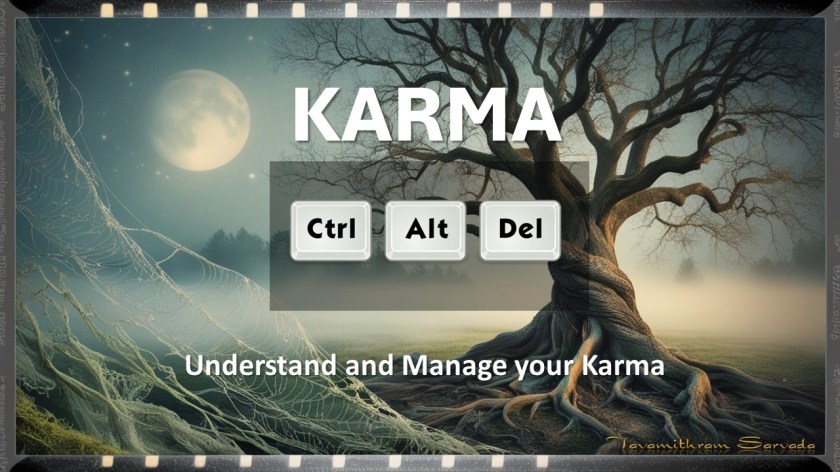
After six years, I am revisiting this post to shed more light on the principles of Karma, Karmayoga, Doership, and methods to manage one’s Karma.

Realisation is the crucial first step in managing and transforming your own Karma. Recognising that nothing is happening to you personally, but rather that all events in your life are the result of your Karma, which is shaped by your genetic inheritance, upbringing, education, and experiences—can open a new path for you. This awareness allows you to take corrective measures and actively alter the course of your life.

Blaming others for your circumstances and failing to take action to change them is a futile use of your time and energy.

Those who delve into the Srimad Bhagavad Gita recognise that attachment is the root of negative emotions such as sadness, dejection, anger, jealousy, and hatred. Attachment to the outcomes of one’s actions can diminish concentration and efficiency, causing immense pain when goals are not achieved.

One effective approach to reaching the ultimate goal is through Karma Marga—the path of righteous action performed without attachment to results. This practice ensures mental equilibrium, even in challenging circumstances.

Bhagavan Krishna imparted to Arjuna the significance of being a Karmayogi and provided guidance on adopting this path.

A common question from those unfamiliar with Karmayoga is, “How can one work without considering the outcome or aiming for a result?” This question arises from a misunderstanding of Krishna’s teachings, which emphasise that a doer should be entirely focused on their objective: SBG 2:41 “In this path, O Arjuna, there is a single point of focus and determination. The thoughts of the undecided are branched and are infinite.”

Attachment to results can lead to a loss of focus, as individuals may become preoccupied with the rewards of success or the fears of failure—scenarios that are purely speculative. This mental diversion compromises the quality of their work, steering them towards mediocrity.

My Top 7 Life Strategies

Grasping life’s fundamental truths often takes years, causing many to look back with regret, wishing they had learned these lessons sooner. By adopting these seven Life Strategies, you can navigate your journey with greater confidence and fulfilment, avoiding the pitfalls that others have encountered. Embrace these principles now to set yourself on a path toward a more successful and enriching life.

If you’re in your early twenties and take the time to study and internalise these strategies, you’ll save yourself a great deal of time and effort in your pursuit of a fulfilling life.

1. Take Responsibility for Your Actions

Stop blaming others and start taking full responsibility for your actions. You alone are accountable for your decisions. Owning up to your actions empowers you to make positive changes and steer your life in the direction you want.

Example: If a project at work doesn’t succeed, instead of blaming your team, reflect on what you could have done differently and use that knowledge to improve future projects.

2. Select Your Life Partner with Thoughtful Consideration

Choosing your spouse is one of the most crucial decisions you’ll ever make. A good partner brings joy and support, while a poor choice can lead to unhappiness. Never decide in a hurry or when under pressure. Friedrich Nietzsche wisely advised, “When marrying, ask yourself this question: ‘Do you believe that you will be able to converse well with this person into your old age? Everything else in marriage is transitory.'”

Example: Imagine spending your life with someone who shares your interests and values, and with whom you can have deep, meaningful conversations. This is the foundation of a lasting and fulfilling marriage.

3. Embrace Lifelong Learning

Don’t let financial constraints hold you back from investing in your career development. The internet is full of resources offering vast opportunities for learning and growth. While degrees can be valuable, they don’t solely define your knowledge, wisdom, or capabilities.

Example: Many successful entrepreneurs have used online resources to learn new skills like coding, digital marketing, or design, and have built thriving businesses without formal education in those fields.

4. Adopt Gradual and Consistent Learning for Deeper Understanding and Full Internalisation.

Take your time to learn slowly, carefully, and steadily. By doing so, you’ll realise that you have the ability to achieve anything. Don’t let others discourage you. Give things a go and be prepared to fail before conceding defeat prematurely.

Example: Consider training for a marathon. At first, the goal may seem overwhelming, but by committing to a steady, incremental training plan, you build endurance and confidence over time. Each small, consistent effort contributes to your overall progress, transforming a seemingly insurmountable challenge into an achievable accomplishment. Similarly, learning a new skill or mastering a subject takes persistent, gradual effort, leading to profound understanding and success.

5. Develop the Habit of Investing and Understand the Power of Money

Start investing as early as possible. The earlier you begin, the more time your investments have to grow, providing you with financial security and freedom. Many of life’s problems can be alleviated with money. Financial stability provides the means to address challenges and seize opportunities. While money doesn’t buy happiness, it reduces stress and grants you the freedom to pursue your passions and goals.

Example: Starting an investment account with a small monthly contribution in your 20s can lead to significant savings by the time you reach retirement age, thanks to compound interest. Having a financial safety net can help you handle unexpected expenses like medical bills or car repairs without falling into debt or significant stress.

6. Don’t Let Regrets Hold You Back

Regrets are unproductive. Instead of dwelling on what could have been, focus on making the most of the present. Every moment spent regretting is a moment lost that could be used for positive action and growth.

Even if you’ve faced deep pain or significant losses, ask yourself, “So what?” followed by “What next?” and focus on your next steps. The past is gone and will never return, but it can sabotage your future if you allow it.

Example: Imagine you regret not taking a chance on a business idea years ago. Instead of ruminating on missed opportunities, redirect that energy into launching a new venture now. Research your market, develop a solid plan, and connect with potential mentors or investors. By focusing on actionable steps, you turn regret into motivation and create new possibilities for yourself.

7. Sleep on Important Decisions

Before making an important decision, take a pause and avoid deciding immediately. Instead, let it sit overnight. This brief delay allows you to gain clarity, giving you time to weigh the pros and cons thoughtfully, rather than being driven solely by emotions or excitement.

Example: If you receive a job offer, take a night to think it over. This allows you to assess the offer with a clear mind and make a well-considered decision.

By internalising and practising these seven strategies, you can navigate life with greater confidence, resilience, and fulfilment. Remember, the journey is just as important as the destination, so embrace each step with an open mind and a determined heart.

Amritabindu Upanishad on Substack

The MIND – Man’s Greatest Tool

*SUBSCRIBE TO MY SUBSTACK – IT’S FREE*

Learning to use the MIND as a Churning Stick to realise your TRUE DIVINE SELF!

The Amritabindu Upanishad, part of the Krishna Yajur Veda, is a concise and powerful text for true seekers of spiritual wisdom. CONTINUE ON SUBSTACK


Treat Insults and Setbacks as ‘ROCKET FUEL’

Shatter the Cycle: BURN and RESET your Karma!


The Ever-Relevant Gita: A Present-Day Rendering’

FREE PROMO CODES: LIMITED OFFER

The Greatest Gift to Yourself for 2024 and the Future

Nonduality #Vedanta #SelfDiscovery #Consciousness #Spirituality #TruthSeeker”

Anger – your greatest ally?

Harness Your Rage and Redefine Your Reality

TheTriple ‘Z’ 

What if I told you that anger isn’t something to be feared or suppressed, but rather a powerful force that, when harnessed wisely, can drive incredible change in your life?

Well, some people are happy with their lives, not so happy, sad, or even sick of their lives. If everything is going well, and you are happy, just continue doing what you are doing and living the way you are. I don’t propagate the ideas of ‘good and bad’ or ‘right and wrong,’ which I consider dogmatic. Common sense alone tells us that something is good and right if it makes us happy and in no way harms our health, surroundings, nature, or others.

However, many are unhappy, dissatisfied, depressed, weak, or scared and would like to change their lives for the better. For those who genuinely want to make changes, however big or small, here are some steps you might want to follow:

  1. Identifying the Problems

Write down what you don’t like about your current situation, whether it’s your appearance, living circumstances, work, mindset, or any other area of your life. Be as specific as possible. I have given some easy and practical hacks in my video titled ‘Shatter the Cycle: BURN and RESET your Karma!’

  1. Setting Clear Goals

Next, think about what you want to achieve. What does your ideal self look like? How do you want to feel or think differently? Write down these goals so that you have a clear target to aim for. Be absolutely specific and describe your ideal self in detail.

  1. Execution

Once you’ve identified your problems and set your goals, begin outlining the steps or strategies needed to achieve them. This might involve altering your habits, seeking guidance, or acquiring new skills. Concentrate on taking small, manageable actions that will steadily progress you towards your objectives.

By breaking it down into these steps, you’ll have a clearer path to follow, making it easier to track your progress and stay motivated along the way.

Sitting alone, fretting, fuming, or complaining will only lead to self-pity, and that will ensure that your life stays exactly the way it is now, if not worse.

A Personal Story of Transformation

Thirty years ago, during a 48-hour self-imposed retreat, I conceived and meticulously crafted ‘Project KR’, where I defined and redefined exactly how I wanted my life to unfold.

Almost everything I described in Project KR has been happening so far. This includes the realisation of far-fetched aims, such as meeting with Queen Elizabeth II, and many other things that would have seemed impossible at that time.

I must emphasise that the goals and strategies I outlined in my playbook, which I boldly committed to nearly 30 years ago – defying all conventional thought processes and career planning – have not only materialised but have done so with astonishing precision, even in the finer details. Keep in mind, Rhonda Byrne’s ‘The Secret’ hadn’t even been written back then!

Likely Source of My Determination

My determination likely stemmed from the intense anger I harboured due to the wrongs inflicted upon me by others, which I now recognise as a result of my own naïveté or even foolishness. It’s often said that necessity is the mother of invention, and my ‘necessity,’ or rather my overwhelming drive to transform my life, was so powerful that I was able to create possibilities out of seemingly nothing.

The Triple ‘Z’: Zeal, Zest, and Zing

Around the time I embarked on my 48-hour self-reflection, I was teaching French at several management colleges. I closely observed the mindsets of my students, aged 18 to 20. Among them, only a few exhibited a profound, intense drive to set ambitious goals, achieve them, and pursue a more fulfilling life. This further reinforced my belief that not everyone possesses a high level of drive. While this isn’t inherently wrong, it can result in either a lacklustre future or a life devoid of Zeal, Zest, and Zing – qualities I was highly driven to attain and live my life to the fullest, which I had almost lost in some major accidents earlier.

In the biographies of many great individuals I’ve read, one common thread stands out: they never blamed others for their circumstances. Instead, they took full responsibility, charted their own paths, and forged ahead with determination.

Final Thoughts:

Some people write to me saying that they want to improve their lives, looks, happiness, relationships, etc., but are unable to achieve them.

My question to them is, “Who is stopping you?”

Treat Insults and Setbacks as ‘ROCKET FUEL’

Shatter the Cycle: BURN and RESET your Karma!


The Ever-Relevant Gita: A Present-Day Rendering’

Nonduality #Vedanta #SelfDiscovery #Consciousness #Spirituality #TruthSeeker”