Stuck? Escape Regret. Get the Life You Deserve

Break Free from Emotional Baggage with This Transformative Two-Word Mantra

Are you tired of being stuck in repetitive emotional patterns, haunted by your past, and overwhelmed by regret? This powerful new video dives into a life-changing concept that blends spiritual clarity, emotional resilience, and mental discipline through the use of two deceptively simple yet profound mantras: “So what?” and “What next?”.

Rooted in Vedanta, and enriched by a personal journey of spiritual transformation, this message is a wake-up call for those ready to reclaim their power. Whether you’re on the path of self-inquiry, seeking personal development, or aiming to cultivate a growth mindset, this video offers direct and practical tools to help you move forward.

Let go of self-pity, stop dwelling on the past, and embrace conscious living. The time to transform your inner world is now.

The Ever-Relevant Gita: A Present-Day Rendering

Embracing the Blissful Journey: The Ever-Relevant Gita – A Present-Day Rendering by Tavamithram Sarvada

Now available in various online store fronts, such as: Amazon InternationalINDEUKAUNLCAFRESPLITBRMX

*The paperback version is not available on Amazon India.

Part 1: Preface and Introduction + Chapters 1-6

The preface and introduction lay the foundation for your exploration. Don't be tempted to skip these initial chapters; they are the compass guiding you through the intricate terrain of the Gita's philosophy. Understand the core teachings, and you'll find yourself motivated to delve deeper, perhaps into the rich Bhashyams or commentaries of Shri Adi Shankara and other great teachers.

Part 2: Chapters 7-12

As you progress through these chapters, absorb the profound insights that unfold. The clarity of understanding achieved in the earlier sections becomes the stepping stone for an even more profound comprehension of Krishna's teachings.

Part 3: Chapters 13-18 + Outro

The culmination of your journey awaits in the final chapters. The outro ties the threads together, offering a comprehensive view of the Gita's timeless wisdom. This concluding section is not to be missed; it holds the key to empowerment and self-confidence.

Namaste Seekers,

Embark on a profound journey into the timeless wisdom of the Srimad Bhagavad Gita with ‘The Ever-Relevant Gita: A Present-day Rendering by Tavamithram Sarvada.’ Below, I’ll elucidate the profound significance of this work and its potential to illuminate the path to self-realisation.

In a fast-paced world fraught with complexities, the solace found in ancient wisdom often remains unexplored. 'The Ever-Relevant Gita – A Present-day Rendering by Tavamithram Sarvada’ endeavours to bridge this gap, bringing forth the profound teachings of the Srimad Bhagavad Gita to everyone, irrespective of age, background, or familiarity with ancient scriptures.

Dispelling Myths and Misconceptions

The main challenge involves dispelling misconceptions that surround the Srimad Bhagavad Gita—misconceptions about its perceived depth, religious connotations, and its relevance limited to the elderly or devout individuals. In this modern interpretation, we untangle myths and present timeless wisdom in a manner that aligns with the sensibilities of the contemporary mind.

A Unique Approach: Audio, Video, and E-book Formats

Understanding the daunting nature of lengthy translations, a unique approach has been taken by creating easily digestible audio recordings of each chapter. These recordings allow listeners to absorb the essence of the Gita at their own pace, breaking down barriers that often deter individuals from exploring this ageless scripture.

Beyond presentation, this initiative is a call to embark on a blissful journey of self-discovery. In my life, which has been shaped by numerous challenges and life-altering situations, the importance of a well-trained instinct and a balanced mindset has become crystal clear to me. A clear understanding of the fundamental principles of the teachings in the Srimad Bhagavad Gita certainly plays a pivotal role in shaping attitudes, cultivating fearlessness, and fostering rational thinking during critical moments.

Practical Insights for Daily Application

The true power of the Srimad Bhagavad Gita lies in its application in everyday life. The focus is not merely on delivering a rendition or chanting Shlokas, but on providing practical insights that enable individuals to apply these teachings in their daily lives, leading to a more fulfilling and blissful existence.

In essence, the mission is to make the teachings of the Srimad Bhagavad Gita easily accessible, relatable, and applicable to everyone, fostering a deeper understanding of life's intricacies. Join me on this enlightening journey, and let's journey through the supreme scripture together.

Those who would like a promo code for a free download of the Audiobook version of the ‘The Ever-Relevant Gita – A Present-Day Rendering by Tavamithram Sarvada’ may email their request to tavamithramoffice@gmail.com

Jai Shri Krishna

Forget the Heart, First Heal the Mind!

Beyond Prayers and Miracles – The Rational Path to Self-Realisation

Transform Your Life with Vedanta, The Science of all Sciences

WATCH THIS AND CLEAR YOUR HEAD OF ALL UNWANTED STUFF:

When ignorance becomes the norm, entire masses of people can be easily swayed to firmly believe the unreal to be real. The crucial factor in society that enables a select few to manipulate their minds is the ignorance of the masses, which basically stems from blind beliefs that numb their brains, and sheer laziness to make a move to get out of ignorance.

People come to my blog, watch some of my videos, and ask me what they should do to change their lives. Almost everyone wants instant solutions, and they are even willing to pay for shortcuts! One should not overlook the fact that even the act of going to a religious place and praying for what one wants is a form of seeking shortcuts.

But the truth is that everything has a price, and everything is part of the never-ending cause-and-effect chain. Asking someone or ‘god’ to give them what they want could only mean that the so-called ‘god’ changes his plans to suit the needs of the one praying. So, what about the others? Do their lives get destroyed because someone else prayed and got things done by ‘god’ to do things their way? Really? So, what happens when two entities at war with each other pray to the same ‘god’? Who do you think ‘god’ will bless with special favours?!

How many people really dare to make massive changes in their lives, have the courage to travel around, experience and learn more, and evolve? Krishna says in Shloka SBG 7:19, “Therefore, after innumerable births, the one who has perfected his or her wisdom, understanding fully My universal reality, surrenders to Me and such an individual is very rare.”

So, with a default state of mind of wanting to maintain the status quo, people tend to look for easy ways out, shortcuts, middlemen, and women who can help them achieve success through the short path, which is a form of corruption or fraud. It is because people want something without really working for it.

When did Krishna say in the Srimad Bhagavad Gita to go to his temples, perform meaningless rites and rituals with the mammary milk of poor voiceless animals, sing songs in His praise, chant Mantras the whole day, and do nothing else? The clear instruction in the second chapter is that you only have the right to work, but never to claim its results. The results of your actions should never be your motive, but at the same time, you should not be attached to inaction.

Then why do people perform religious rites to fulfill personal desires?

Vedanta and the Srimad Bhagavad Gita

Shloka 18:66 of the Srimad Bhagavad Gita does not mean that one should have blind belief in Krishna.

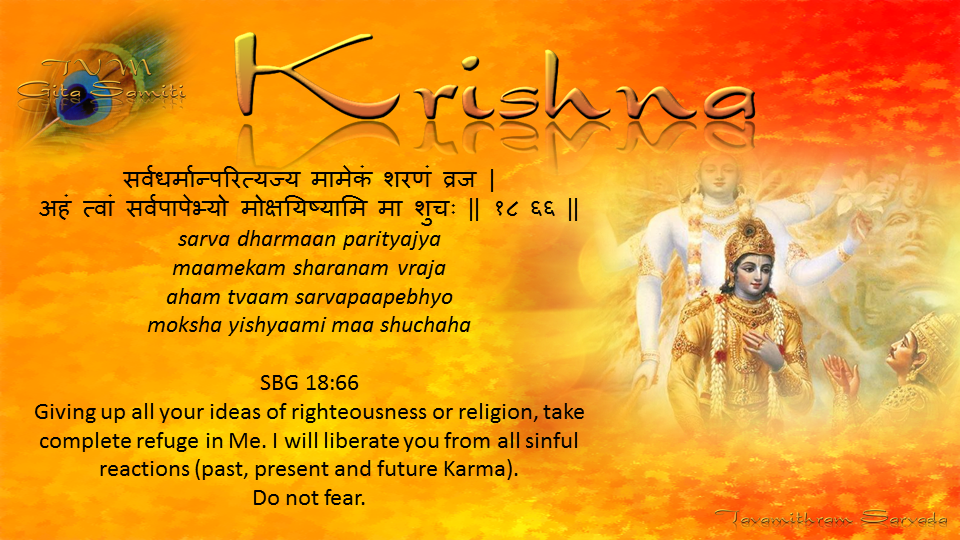
Krishna says in SBG 18:66, “Giving up all your ideas of righteousness or religion, take complete refuge in Me. I will liberate you from all sinful reactions. Do not fear.”

It means, “Give up all the nonsensical ideas you might have in the name of religion, and by adopting the logical analysis and reasoning provided throughout until the 18th chapter, become one with Krishna.”

The entire purpose of the Srimad Bhagavad Gita is to guide people to shed their false beliefs and take to a rational study of truth. The process is very simple with three stages:

  1. Sidhaanta – A Question, Idea, Concept, or Theory
  2. Saadhana – The means to study, including reading, listening, researching, analysing, debating, etc.
  3. Siddhi – Final understanding, internalisation, and experience, known as Anubhava in Sanskrit.

Scientists don’t believe anything without evidence, do they? Remember that Vedanta is the science of all sciences.

Reason and Logic in the Srimad Bhagavad Gita

The Srimad Bhagavad Gita talks about reason and logic and NEVER about belief.

SBG 13:4 states, “Great sages have sung about the absolute truth in various ways. They have stated the truth in Vedic hymns and have described it in the Brahma Sutras through reason and logic with unambiguous evidence.”

Shloka SBG 4:34 says, “Acquire knowledge through reverence to teachers who have known the Truth, serve them and ask them questions until all of them are answered. The wise who know the Truth will teach it to you.”

Definition of Religion

Religion is a system of beliefs, practices, and values often centred around the worship of a higher power or divine beings. It typically involves rituals, moral guidelines, and a community of followers who share the same belief and faith.

Did you find anything related to reason, rationality, science, inquiry, or logic in this definition?

Vedanta: The Pinnacle of Vedic Studies

Vedanta is the highest point of Vedic studies – right from the basic Karma Kaanda, Upaasana Kaanda to the Gnyaana Kaanda of the Upanishads.

If you are interested in changing your life COMPLETELY and are willing to clear your mind of all the unfounded beliefs you have been trained by your elders to blindly believe, please feel free to contact me.

I do not talk about miracles performed by some man in a cave, one with a long beard, or another with fuzzy hair. Out here, it is pure Advaita Vedanta – Nondual Vedanta, and the compact and best manual for attaining the highest understanding of the nondual, all-pervading SELF is the Srimad Bhagavad Gita.

A real shift to Vedanta is a complete change with no traces of illogical or irrational ideas sticking in the mind in the name of belief, ‘aastha’, religion, or whatever.

“Before you heal someone, ask him if he’s willing to give up the things that make him sick,” said Hippocrates. Just as baseless beliefs can be likened to mental diseases, one must be willing to abandon them to achieve true healing and enlightenment. Therefore, start with a clean slate.

SBG 4:38 Shri Krishna says: “There is certainly nothing more purifying than knowledge. He who is perfect in Yoga finds it in the Self in due course of time.”

Beyond the Herd: Unmasking the Myths of Group Belonging

Why Tavamithram is Never Aligned to Any Particular Group, Ashram, Agama, Paddhathi, Sects, Subsects, Guru, Swamy, Dress Code, Traditions, Religion etc.

Please read the post before listening to the podcast discussing the post

Throughout my life, I have observed a significant connection between beliefs, the desire to belong to groups, and the thirst for knowledge and self-confidence. My personal attitude has always been to stand alone. It’s crucial to clarify that my reluctance to belong to groups should not be mistaken for hubris. I simply prefer solitude, as my strong ideas often diverge from the majority, who are frequently swept away by traditions—something Krishna himself admonishes even before the conclusion of Chapter 2 in the Srimad Bhagavad Gita.

To illustrate the extent to which I go to avoid belonging to a group, let me share anLeonardo_Phoenix_a_dramatic_highcontrast_cinematic_photograph_3 example from my past. Many years ago, I was a motorcycle stuntman in Indian films, doubling for lead stars and performing death-defying stunts. In the film industry, numerous unions exist for various trades, including actors, directors, make-up artists, dancers, photographers, and others. Naturally, there was also a union for stuntmen, and I was expected to join. However, I refused to be tied down by group membership, choosing instead to remain independent. Consequently, I willingly accepted a penalty of twenty-five per cent of my earnings for not being a member. Despite this, I chose to pay the penalty each time I earned money performing stunts.

I’ve observed that individuals who are rather low on self-confidence or a sense of personal substance usually seek strength in numbers by joining groups. Being part of a group provides reassurance and a sense of belonging. Within these groups, members usually share common beliefs or philosophies, forming the basis of their unity. However, I think that belonging to a group compels individuals to adopt the group’s ideology, limiting their ability to think and act independently. I prefer the freedom to think for myself and analyse matters in my own way. Groups typically consist of like-minded individuals, which signifies a lack of diverse thought. This, in turn, stifles intellectual development and curtails opportunities for new ideas to emerge.

As an ardent learner, I find great fascination in encountering people whose ideas challenge my own, compelling me to think outside the box. This is the essence of personal evolution.

It’s essential to clarify that I do not hold beliefs in the conventional sense; instead, I possess perspectives. I have unwavering trust in my intelligence, intellect, and experiences, considering myself a keen learner in every situation I encounter.

While belonging to a group can provide a sense of security, it can also hinder personal growth and self-discovery. True self-confidence emerges from understanding and standing firm in one’s perspectives, even when they diverge from the prevailing norms of a group. By cultivating self-awareness and introspection, individuals can develop a stronger, more authentic sense of self. I am not suggesting anything against groups; rather, I strongly advocate for retaining one’s freedom to question, think, and express oneself.

Among the most detrimental effects groups can have on intellectual development is the deification of central figures, often referred to as Gurus or Babas. The story of the 24 Gurus of Sage Dattatreya aims to dismantle the false notion of being tethered to a single guru, suggesting that anything and everything that helps dispel ignorance can be considered a guru. To quote Shri Ramana Maharshi: “Your own Self-Realisation is the greatest service you can render the world.”

In Shloka SBG 2:45, Krishna instructs Arjuna: “Vedic literature deals with subjects that fall under the three Gunas. O Arjuna, you should rise above the three, be free from dualities, always remain in Sattva or goodness, and be established in the Self.”

A true teacher should guide individuals to clear their ignorance and advance towards the ultimate goal of Atma-gnyaana, or knowledge of the Self. However, how many truly do this? Many, adorned in flowing robes and sporting long beards, strut about like proud peacocks, claiming to possess all knowledge.

It is indeed disheartening to witness children and youth from families not converted to foreign religions being lured into the illusory world of meaningless beliefs, rites, and rituals.

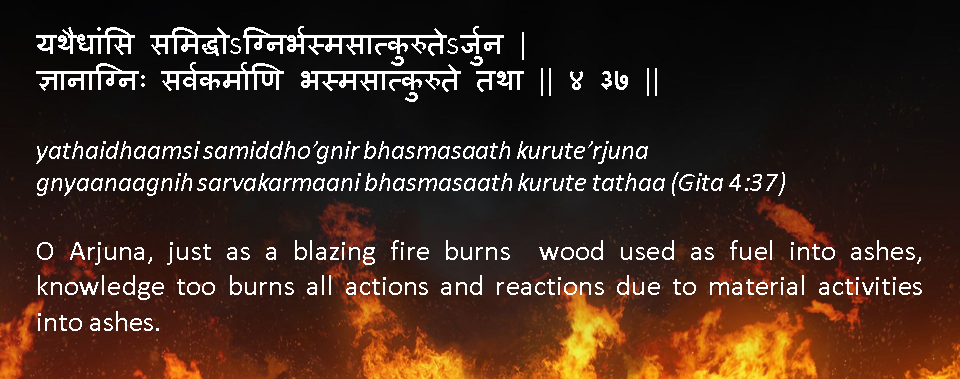
I conclude this post with Shlokas SBG 4:37 and 38

37: “Just as a blazing fire burns firewood into ashes, O Arjuna, knowledge burns all actions and reactions into ashes.” 

38: “There is certainly nothing more purifying than knowledge. He who is perfect in Yoga finds it in the Self in due course of time.”

May you stay abundantly blessed.


Jai Shri Krishna

My Top 7 Life Strategies

Grasping life’s fundamental truths often takes years, causing many to look back with regret, wishing they had learned these lessons sooner. By adopting these seven Life Strategies, you can navigate your journey with greater confidence and fulfilment, avoiding the pitfalls that others have encountered. Embrace these principles now to set yourself on a path toward a more successful and enriching life.

If you’re in your early twenties and take the time to study and internalise these strategies, you’ll save yourself a great deal of time and effort in your pursuit of a fulfilling life.

1. Take Responsibility for Your Actions

Stop blaming others and start taking full responsibility for your actions. You alone are accountable for your decisions. Owning up to your actions empowers you to make positive changes and steer your life in the direction you want.

Example: If a project at work doesn’t succeed, instead of blaming your team, reflect on what you could have done differently and use that knowledge to improve future projects.

2. Select Your Life Partner with Thoughtful Consideration

Choosing your spouse is one of the most crucial decisions you’ll ever make. A good partner brings joy and support, while a poor choice can lead to unhappiness. Never decide in a hurry or when under pressure. Friedrich Nietzsche wisely advised, “When marrying, ask yourself this question: ‘Do you believe that you will be able to converse well with this person into your old age? Everything else in marriage is transitory.'”

Example: Imagine spending your life with someone who shares your interests and values, and with whom you can have deep, meaningful conversations. This is the foundation of a lasting and fulfilling marriage.

3. Embrace Lifelong Learning

Don’t let financial constraints hold you back from investing in your career development. The internet is full of resources offering vast opportunities for learning and growth. While degrees can be valuable, they don’t solely define your knowledge, wisdom, or capabilities.

Example: Many successful entrepreneurs have used online resources to learn new skills like coding, digital marketing, or design, and have built thriving businesses without formal education in those fields.

4. Adopt Gradual and Consistent Learning for Deeper Understanding and Full Internalisation.

Take your time to learn slowly, carefully, and steadily. By doing so, you’ll realise that you have the ability to achieve anything. Don’t let others discourage you. Give things a go and be prepared to fail before conceding defeat prematurely.

Example: Consider training for a marathon. At first, the goal may seem overwhelming, but by committing to a steady, incremental training plan, you build endurance and confidence over time. Each small, consistent effort contributes to your overall progress, transforming a seemingly insurmountable challenge into an achievable accomplishment. Similarly, learning a new skill or mastering a subject takes persistent, gradual effort, leading to profound understanding and success.

5. Develop the Habit of Investing and Understand the Power of Money

Start investing as early as possible. The earlier you begin, the more time your investments have to grow, providing you with financial security and freedom. Many of life’s problems can be alleviated with money. Financial stability provides the means to address challenges and seize opportunities. While money doesn’t buy happiness, it reduces stress and grants you the freedom to pursue your passions and goals.

Example: Starting an investment account with a small monthly contribution in your 20s can lead to significant savings by the time you reach retirement age, thanks to compound interest. Having a financial safety net can help you handle unexpected expenses like medical bills or car repairs without falling into debt or significant stress.

6. Don’t Let Regrets Hold You Back

Regrets are unproductive. Instead of dwelling on what could have been, focus on making the most of the present. Every moment spent regretting is a moment lost that could be used for positive action and growth.

Even if you’ve faced deep pain or significant losses, ask yourself, “So what?” followed by “What next?” and focus on your next steps. The past is gone and will never return, but it can sabotage your future if you allow it.

Example: Imagine you regret not taking a chance on a business idea years ago. Instead of ruminating on missed opportunities, redirect that energy into launching a new venture now. Research your market, develop a solid plan, and connect with potential mentors or investors. By focusing on actionable steps, you turn regret into motivation and create new possibilities for yourself.

7. Sleep on Important Decisions

Before making an important decision, take a pause and avoid deciding immediately. Instead, let it sit overnight. This brief delay allows you to gain clarity, giving you time to weigh the pros and cons thoughtfully, rather than being driven solely by emotions or excitement.

Example: If you receive a job offer, take a night to think it over. This allows you to assess the offer with a clear mind and make a well-considered decision.

By internalising and practising these seven strategies, you can navigate life with greater confidence, resilience, and fulfilment. Remember, the journey is just as important as the destination, so embrace each step with an open mind and a determined heart.

Fate and Time: The Tragic Story of Mike Lynch

In my latest video, I delve into the poignant and impactful story of Mike Lynch, a man whose life and career were marked by remarkable achievements and profound challenges. Despite his success, Lynch’s life took a tragic turn with his untimely death while on his yacht—a stark reminder of how swiftly fate can alter our course.

In this video, I offer an introspective look at Lynch’s journey, touching on the themes of fate, the passage of time, and the importance of living fully in the present. I explore how Lynch’s story serves as a powerful lesson about the unpredictable nature of life and the significance of embracing each moment with gratitude and responsibility.

Join me as I unravel the elements of Lynch’s life and legacy, and reflect on the crucial lessons we can learn from his experiences. Don’t miss this opportunity to gain insight into how to navigate life’s uncertainties with grace and mindfulness.

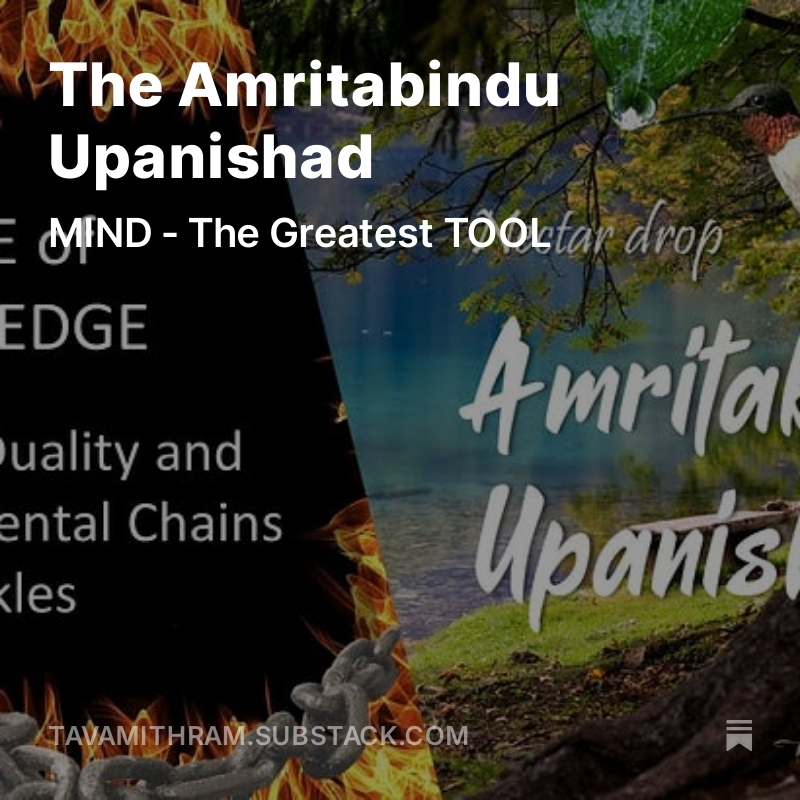
Amritabindu Upanishad on Substack

The MIND – Man’s Greatest Tool

*SUBSCRIBE TO MY SUBSTACK – IT’S FREE*

Learning to use the MIND as a Churning Stick to realise your TRUE DIVINE SELF!

The Amritabindu Upanishad, part of the Krishna Yajur Veda, is a concise and powerful text for true seekers of spiritual wisdom. CONTINUE ON SUBSTACK


Treat Insults and Setbacks as ‘ROCKET FUEL’

Shatter the Cycle: BURN and RESET your Karma!


The Ever-Relevant Gita: A Present-Day Rendering’

FREE PROMO CODES: LIMITED OFFER

The Greatest Gift to Yourself for 2024 and the Future

Nonduality #Vedanta #SelfDiscovery #Consciousness #Spirituality #TruthSeeker”

Anger – your greatest ally?

Harness Your Rage and Redefine Your Reality

TheTriple ‘Z’ 

What if I told you that anger isn’t something to be feared or suppressed, but rather a powerful force that, when harnessed wisely, can drive incredible change in your life?

Well, some people are happy with their lives, not so happy, sad, or even sick of their lives. If everything is going well, and you are happy, just continue doing what you are doing and living the way you are. I don’t propagate the ideas of ‘good and bad’ or ‘right and wrong,’ which I consider dogmatic. Common sense alone tells us that something is good and right if it makes us happy and in no way harms our health, surroundings, nature, or others.

However, many are unhappy, dissatisfied, depressed, weak, or scared and would like to change their lives for the better. For those who genuinely want to make changes, however big or small, here are some steps you might want to follow:

  1. Identifying the Problems

Write down what you don’t like about your current situation, whether it’s your appearance, living circumstances, work, mindset, or any other area of your life. Be as specific as possible. I have given some easy and practical hacks in my video titled ‘Shatter the Cycle: BURN and RESET your Karma!’

  1. Setting Clear Goals

Next, think about what you want to achieve. What does your ideal self look like? How do you want to feel or think differently? Write down these goals so that you have a clear target to aim for. Be absolutely specific and describe your ideal self in detail.

  1. Execution

Once you’ve identified your problems and set your goals, begin outlining the steps or strategies needed to achieve them. This might involve altering your habits, seeking guidance, or acquiring new skills. Concentrate on taking small, manageable actions that will steadily progress you towards your objectives.

By breaking it down into these steps, you’ll have a clearer path to follow, making it easier to track your progress and stay motivated along the way.

Sitting alone, fretting, fuming, or complaining will only lead to self-pity, and that will ensure that your life stays exactly the way it is now, if not worse.

A Personal Story of Transformation

Thirty years ago, during a 48-hour self-imposed retreat, I conceived and meticulously crafted ‘Project KR’, where I defined and redefined exactly how I wanted my life to unfold.

Almost everything I described in Project KR has been happening so far. This includes the realisation of far-fetched aims, such as meeting with Queen Elizabeth II, and many other things that would have seemed impossible at that time.

I must emphasise that the goals and strategies I outlined in my playbook, which I boldly committed to nearly 30 years ago – defying all conventional thought processes and career planning – have not only materialised but have done so with astonishing precision, even in the finer details. Keep in mind, Rhonda Byrne’s ‘The Secret’ hadn’t even been written back then!

Likely Source of My Determination

My determination likely stemmed from the intense anger I harboured due to the wrongs inflicted upon me by others, which I now recognise as a result of my own naïveté or even foolishness. It’s often said that necessity is the mother of invention, and my ‘necessity,’ or rather my overwhelming drive to transform my life, was so powerful that I was able to create possibilities out of seemingly nothing.

The Triple ‘Z’: Zeal, Zest, and Zing

Around the time I embarked on my 48-hour self-reflection, I was teaching French at several management colleges. I closely observed the mindsets of my students, aged 18 to 20. Among them, only a few exhibited a profound, intense drive to set ambitious goals, achieve them, and pursue a more fulfilling life. This further reinforced my belief that not everyone possesses a high level of drive. While this isn’t inherently wrong, it can result in either a lacklustre future or a life devoid of Zeal, Zest, and Zing – qualities I was highly driven to attain and live my life to the fullest, which I had almost lost in some major accidents earlier.

In the biographies of many great individuals I’ve read, one common thread stands out: they never blamed others for their circumstances. Instead, they took full responsibility, charted their own paths, and forged ahead with determination.

Final Thoughts:

Some people write to me saying that they want to improve their lives, looks, happiness, relationships, etc., but are unable to achieve them.

My question to them is, “Who is stopping you?”

Treat Insults and Setbacks as ‘ROCKET FUEL’

Shatter the Cycle: BURN and RESET your Karma!


The Ever-Relevant Gita: A Present-Day Rendering’

Nonduality #Vedanta #SelfDiscovery #Consciousness #Spirituality #TruthSeeker”

Shatter the Cycle: BURN and RESET your Karma!

Break Free from Fate and Change Your Life Instantly

Karma Hacks

The concept of karma, often misunderstood or shrouded in superstition, is essentially about the patterns and outcomes in our lives that are heavily influenced by our own attitudes, actions, and reactions. Here’s a simplified breakdown of how Karma functions and impacts our lives and even those of our descendants:


The Ever-Relevant Gita: A Present-Day Rendering’

FREE PROMO CODES: LIMITED OFFER

The Greatest Gift to Yourself for 2024 and the Future

Nonduality #Vedanta #SelfDiscovery #Consciousness #Spirituality #TruthSeeker”