Every human being uses the word “I” countless times a day.
I am happy. I am tired. I am thinking. I am worried.
But a very strange thing happens when we pause for a moment and ask a simple question:
What exactly is this “I”?
Is it the body?
Is it the mind?
Is it something inside the body?
Or is it something entirely different from what we normally assume?
Most people never examine this question seriously. They simply inherit an idea of who they are and carry it throughout their lives without investigation.
Vedanta does something very different.
It asks us to look carefully, logically, and honestly at the one thing we take for granted more than anything else.
The word “I.”
Instead of giving explanations here, let us examine the question directly through a rapid-fire enquiry.
Watch carefully how one assumption after another begins to dissolve.
If the reasoning is followed honestly, the result is not a belief or a mystical claim.
Visit Amazon and click on the country of your residence
In moments of confusion, stress, fear, indecision, or emotional disturbance, most people do not need long explanations or philosophical debates. They need immediate clarity. They need a direct pointer that helps the mind settle and the intellect take charge.
Now, imagine being like Arjuna and having Bhagavan Krishna always close to you, so that you can consult Him whenever you want.
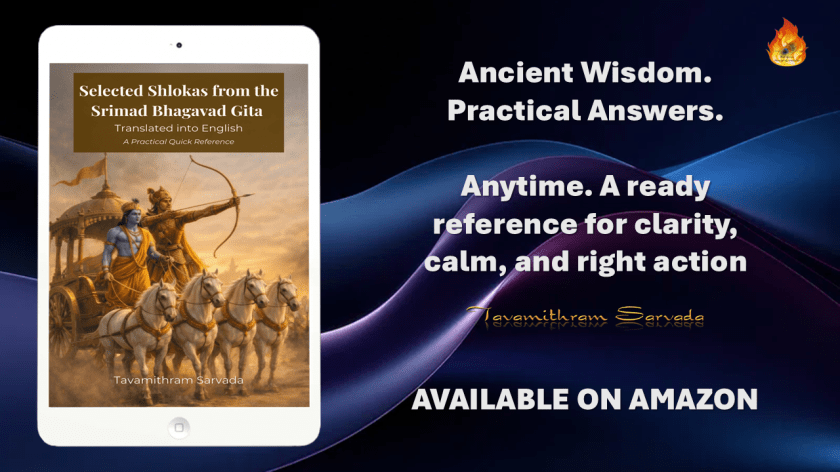
That is precisely the purpose of the newly released eBook, Selected Shlokas from the Srimad Bhagavad Gita : A Practical Quick Reference, now available on Amazon.
This is not another commentary, nor a ritualistic presentation of scripture.
This eBook is designed as a ready reference, something you keep on your phone, tablet, or Kindle and return towhenever life presents a challenge.
Each Shloka has been carefully selected and translated into clear, direct English, focusing on practical understanding rather than blind belief. The intent is simple: help you respond to life with clarity instead of emotional turbulence.
Just as people carry emergency numbers or reference guides, this book is meant to be mentally accessible at all times.
Use It As a Mental First Aid Kit
Life does not wait until we are calm or prepared. Problems appear suddenly, and reactions often follow faster than understanding.
This eBook allows you to:
Pause before reacting
Reflect instead of panicking
Shift from emotion to understanding
Re-centre the mind during pressure, loss, fear, or confusion
It is especially useful during moments when the mind feels:
Restless
Overwhelmed
Angry
Fearful
Directionless
Emotionally entangled
Categories Covered in the eBook
The Shlokas in this eBook are organised under the following specific categories and topics, allowing the reader to turn directly to the guidance most relevant to their present situation:
Krishna – The Divine Father and Mother
Overcoming Fear, Anger, and Mental Disturbance
Understanding Action, Duty, and Responsibility
Detachment, Clarity, and Inner Freedom
Knowledge, Devotion, and Self-Mastery
Becoming Dear to Bhagavan Krishna
This structure allows you to open the book at the exact point of need, rather than reading sequentially.
A Companion for Everyday Living
The Srimad Bhagavad Gita is not meant to be confined to temples, ceremonies, or academic study. It is a manual for living intelligently.
This eBook serves as:
A daily reflection tool
A companion during difficult decisions
A grounding reference during emotional storms
A reminder of clarity when the mind slips into confusion
You do not need prior knowledge, belief, or background to use it. You only need the willingness to pause and reflect.
This video presents the entire message of the Gita in clear, contemporary English, without ritualism, mysticism, or unnecessary abstraction. It is ideal for those who want a structured, start-to-finish understanding of Krishna’s teaching as a philosophy of life, responsibility, clarity, and self-mastery. While the eBook functions as a quick-access reference for daily situations, this video serves as a comprehensive foundation for sustained reflection and deeper understanding.
No Mantras, No Prayers, No Fasting – Just 3 Hours to Smash Illusion and Gain the Supreme Truth!
I am not saying this. KRISHNA SAYS IT IN THE SRIMAD BHAGAVAD GITA.
All worries, fears, stress, anger, envy, and every negative force that can block, weaken, or destroy your chance of living a truly beautiful and fulfilling life will be crushed to smithereens and pulverised to dust.
With soothing sound, captivating visuals, and clear English text to follow along.
Please let me be honest, my dear brothers and sisters, I find it utterly saddening that so many people have been convinced that the Srimad Bhagavad Gita is “too difficult to comprehend” and that without a “good guru” they can never learn it.
In Shloka SBG 9:02, Bhagavan Krishna clearly says that this knowledge is not only VERY EASY, but also it is also VERY EASY TO PRACTISE and it is EVERLASTING. All it takes is the small effort of sitting down and reading a simple translation of the 700 Shlokas. In fact, I must have read this supreme scripture over a thousand times, and I never tire of it. The same applies to every genuine seeker. You cannot read it once and expect to fully grasp it. But at the very least, read it, listen to it, or go through it ONCE BEFORE YOU DIE!
As part of my SBG for ALL Mission, here is my humble offering: a three-hour guided study of this life-changing scripture, a true gift to humanity.
Experience this once, and the weight of your illusions will collapse into nothing.
Please, take this opportunity. Whatever you think it is worth, COMPLETE IT. Do it at least for your brother’s sake. You can thank me later 🙂
Why Tavamithram is Never Aligned to Any Particular Group, Ashram, Agama, Paddhathi, Sects, Subsects, Guru, Swamy, Dress Code, Traditions, Religion etc.
Please read the post before listening to the podcast discussing the post
Throughout my life, I have observed a significant connection between beliefs, the desire to belong to groups, and the thirst for knowledge and self-confidence. My personal attitude has always been to stand alone. It’s crucial to clarify that my reluctance to belong to groups should not be mistaken for hubris. I simply prefer solitude, as my strong ideas often diverge from the majority, who are frequently swept away by traditions—something Krishna himself admonishes even before the conclusion of Chapter 2 in the Srimad Bhagavad Gita.
To illustrate the extent to which I go to avoid belonging to a group, let me share an example from my past. Many years ago, I was a motorcycle stuntman in Indian films, doubling for lead stars and performing death-defying stunts. In the film industry, numerous unions exist for various trades, including actors, directors, make-up artists, dancers, photographers, and others. Naturally, there was also a union for stuntmen, and I was expected to join. However, I refused to be tied down by group membership, choosing instead to remain independent. Consequently, I willingly accepted a penalty of twenty-five per cent of my earnings for not being a member. Despite this, I chose to pay the penalty each time I earned money performing stunts.
I’ve observed that individuals who are rather low on self-confidence or a sense of personal substance usually seek strength in numbers by joining groups. Being part of a group provides reassurance and a sense of belonging. Within these groups, members usually share common beliefs or philosophies, forming the basis of their unity. However, I think that belonging to a group compels individuals to adopt the group’s ideology, limiting their ability to think and act independently. I prefer the freedom to think for myself and analyse matters in my own way. Groups typically consist of like-minded individuals, which signifies a lack of diverse thought. This, in turn, stifles intellectual development and curtails opportunities for new ideas to emerge.
As an ardent learner, I find great fascination in encountering people whose ideas challenge my own, compelling me to think outside the box. This is the essence of personal evolution.
It’s essential to clarify that I do not hold beliefs in the conventional sense; instead, I possess perspectives. I have unwavering trust in my intelligence, intellect, and experiences, considering myself a keen learner in every situation I encounter.
While belonging to a group can provide a sense of security, it can also hinder personal growth and self-discovery. True self-confidence emerges from understanding and standing firm in one’s perspectives, even when they diverge from the prevailing norms of a group. By cultivating self-awareness and introspection, individuals can develop a stronger, more authentic sense of self. I am not suggesting anything against groups; rather, I strongly advocate for retaining one’s freedom to question, think, and express oneself.
Among the most detrimental effects groups can have on intellectual development is the deification of central figures, often referred to as Gurus or Babas. The story of the 24 Gurus of Sage Dattatreya aims to dismantle the false notion of being tethered to a single guru, suggesting that anything and everything that helps dispel ignorance can be considered a guru. To quote Shri Ramana Maharshi: “Your own Self-Realisation is the greatest service you can render the world.”
In Shloka SBG 2:45, Krishna instructs Arjuna: “Vedic literature deals with subjects that fall under the three Gunas. O Arjuna, you should rise above the three, be free from dualities, always remain in Sattva or goodness, and be established in the Self.”
A true teacher should guide individuals to clear their ignorance and advance towards the ultimate goal of Atma-gnyaana, or knowledge of the Self. However, how many truly do this? Many, adorned in flowing robes and sporting long beards, strut about like proud peacocks, claiming to possess all knowledge.
It is indeed disheartening to witness children and youth from families not converted to foreign religions being lured into the illusory world of meaningless beliefs, rites, and rituals.



 example from my past. Many years ago, I was a motorcycle stuntman in Indian films, doubling for lead stars and performing death-defying stunts. In the film industry, numerous unions exist for various trades, including actors, directors, make-up artists, dancers, photographers, and others. Naturally, there was also a union for stuntmen, and I was expected to join. However, I refused to be tied down by group membership, choosing instead to remain independent. Consequently, I willingly accepted a penalty of twenty-five per cent of my earnings for not being a member. Despite this, I chose to pay the penalty each time I earned money performing stunts.
 Tavamithram Sarvada