Four Crucial KarmaYoga Shlokas – Printable

Apply these principles in your daily life, and witness your life transforming into utter bliss.


BE A KARMAYOGI

The True Essence of a KarmaYogi

Namaste,

You may have encountered the term KarmaYogi in your spiritual journey, but perhaps you find it challenging to fully grasp and internalise its profound meaning. It’s a common experience for many individuals to attend lengthy sermons by revered gurus and spiritual leaders, only to leave without gaining valuable insights or practical steps for personal transformation. Mechanical rituals and mere recitation of Shlokas and Mantras often fall short of fostering a deeper understanding. To truly embrace the path of KarmaYogi, one must first delve into the profound concept of devotion, known as ‘Bhakti’ in Sanskrit, and work towards attaining Atmagnyana or the supreme Knowledge of the SELF.

However, the misinterpretation of the term ‘Bhakti’ has led to misguided religious practices and the formation of belief systems and bizarre cults, resulting in spiritual immaturity. At its core, the practice of devotion should lead to self-realisation and profound transformation.

A Path to Transformation for All

I have made various resources available to you, including paperbacks, e-books, videos, Udemy courses, and informative posts. My sincere intention is to make the invaluable wisdom of the Srimad Bhagavad Gita accessible to individuals from all walks of life, regardless of societal status, gender, or religious background. This commitment arises from my deep desire to share the philosophy that has profoundly transformed my life, ushering in a state of complete freedom, inner peace, and unceasing bliss.

Krishna’s Teachings on Action and Detachment

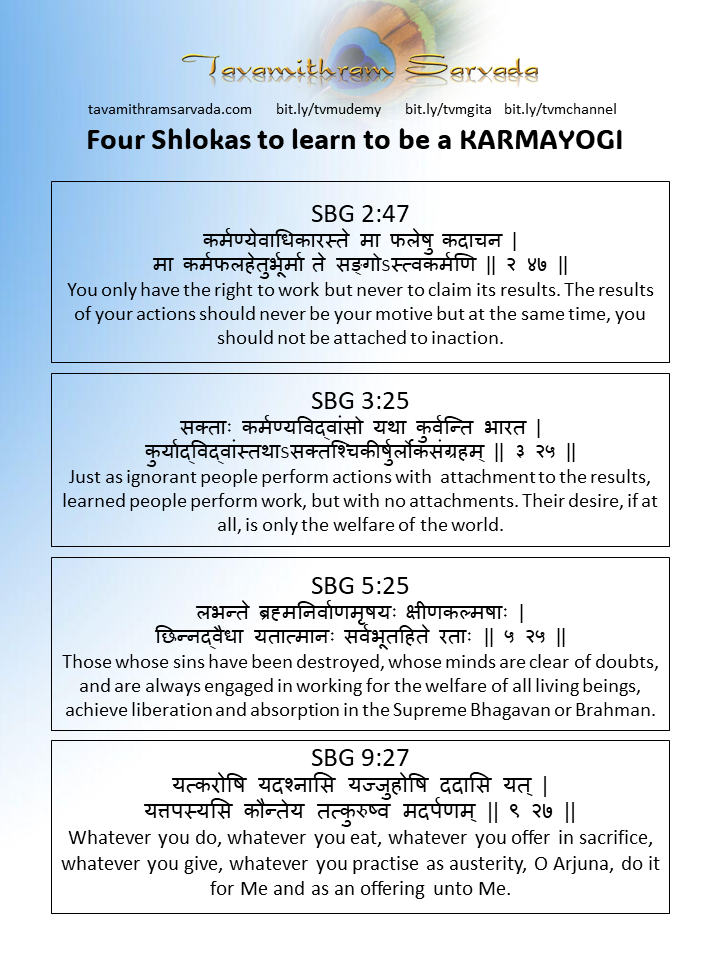
In Shloka SBG 2:47, the Srimad Bhagavad Gita explicitly conveys, “You only possess the right to perform your actions, but you should never lay claim to their outcomes. The results of your actions should not be your primary motivation, and yet, you must not be inert or uninvolved.” This teaching encapsulates the essence of the Karma Marga as elucidated by Bhagavan Shri Krishna. It emphasises the importance of performing one’s duties without attachment to the results. Nowhere in the entire Srimad Bhagavad Gita does Krishna instruct Arjuna to visit a temple of His and engage in meaningless rites and rituals in exchange for desires. A careful reading of Shlokas SBG 2:41-47 reveals Krishna’s instructions on desire-driven rituals conducted in the name of religion. These seven Shlokas shed light on activities that people believe please ‘god’ but, in reality, go against the true teachings of the Srimad Bhagavad Gita

A Gift of Wisdom: The Srimad Bhagavad Gita in Narration

Shortly, I will be releasing a new product that I believe will be of great value to seekers. While I understand that some may not know to fully appreciate offerings that come at no cost, I am pleased to announce that I will be offering it for free on YouTube and Spotify. This special project is my rendition of the entire Srimad Bhagavad Gita in the form of a story-telling narration. I have designed it to provide you with a seamless and uninterrupted experience, free from the distractions of Shloka numbers. My goal is to help you gain a deep understanding of what the Srimad Bhagavad Gita truly represents, without the need to rely on misleading WhatsApp forwards claiming to be from the Gita.

Embark on Your Journey with Four Key Shlokas

Here are four essential Shlokas from the Srimad Bhagavad Gita that can set you on the path of Karma Marga as elucidated by Shri Krishna. You have the option to download these Shlokas as an image or in PDF format. I encourage you to start by applying these teachings in your daily life, whether at home, at work, or anywhere else. Embracing these principles can lead to profound personal transformation and a deeper connection with the wisdom of the Srimad Bhagavad Gita.

4 x Karmayoga Shlokas

You may use the download button below to save it as an image, or you could click here to open a new tab and download it as a PDF.

Stay tuned for more enlightening content and resources to support your spiritual journey. Together, let’s unlock the true essence of KarmaYogi and embark on a path of self-discovery and inner transformation.

Jai Shri Krishna


Below are some of my videos that can help you steer your way out of fears, worries, mental slavery, mental weakness, superstitions, and pseudoreligion and progress towards Self-Realisation.

The Symphony of Life – Exploring Cosmic and Microcosmic Connections

From Galaxies to Individual Cells

PLEASE READ THE POST BEFORE WATCHING THE VIDEO!

Introduction
Discover the captivating beauty of existence in the video, “The Symphony of Life.” This remarkable journey takes us from the vastness of galaxies to the intricacies of cells, exploring the profound connections that link the universe and the microcosm. Dive into the mysteries of life at every scale and be prepared to be amazed.

The Microcosm and Macrocosm Connection
Explore the profound relationship between the microcosm (the world within) and the macrocosm (the vast universe) in “The Symphony of Life.”

Srimad Bhagavad Gita SBG 8:9

कविं पुराणमनुशासितारं
अणोरणीयंसमनुस्मरेद्यः |
सर्वस्य धातारमचिन्त्यरूपं
आदित्यवर्णं तमसः परस्तात् || ८ ९ ||
kavim puraaNam-anushaa-sitaaram
aNora-Neeyam-samanu-smared-yaha
sarvasya dhaataaram-achintyaroopam
aaditya-varNam tamasah parastaat (SBG 8:09)
“The Parampurush is the Omniscient and Most Ancient Ruler, who is more minute than an atom, has an inconceivable Divine form, and is beyond the brightness of the sun and the darkness of ignorance.”

Ishavasya Upanishad IU05

तदेजति तन्नैजति
तद् दूरे तद्वन्तिके ।
तदन्तरस्य सर्वस्य
तदु सर्वस्यास्य बाह्यतः ॥ ५॥
tade-jati tannai-jati tadduure tadvantike
“tadan tarasya sarvasya
tadu-sarvasyaa-sya baahyataha (IU 05)
“It moves, and it does not move. It is far, yet so near. It exists within and also outside all this.”

Srimad Bhagavad Gita SBG 7:19

बहूनां जन्मनामन्ते ज्ञानवान्मां प्रपद्यते |
वासुदेवः सर्वमिति स महात्मा सुदुर्लभः || ७ १९ ||
bahoonaam janma naamante
jnaana-vaan-maam prapadyate
vaasudevah sarvamiti
sa mahaatmaa sudur-labhaha (SBG 7:19)
“Therefore, after innumerable births, the one who has perfected his or her wisdom, understanding fully My universal reality, surrenders to Me and such a soul is very rare.”

Aim to be that rare one, not a sycophantic follower of some cult or individual. Anyone who helps in removing ignorance, which exists due to the mind being shrouded by meaningless beliefs and illogical concepts, is a GURU, which means remover of darkness. I must admit that I have learned quite a few things from my son, and therefore, he too is my GURU.

ॐ ब्रह्मानन्दं परमसुखदं केवलं ज्ञानमूर्तिं
द्वन्द्वातीतं गगनसदृशं तत्त्वमस्यादिलक्ष्यम् ।
एकं नित्यं विमलमचलं सर्वधीसाक्षिभूतं
भावातीतं त्रिगुणरहितं सद्गुरुं तं नमामि ॥
Brahmaanandam parama sukhadam Kevalam gnyaana moortim
Dvandva teetam gagana sadrusham Tatvam asyaadi lakshyam
Ekam nityam vimalam achalam Sarvadhi saakshibhootam
Bhava teetam triguNa rahitam Sadhgurum tam namaami
“My obeisance to the Guru, the Bliss of Brahman, the One who bestows Supreme Happiness and is Knowledge personified.
To the One who transcends the pairs of opposites, is vast as the sky and who is known as “That you are”.
To the One who is eternal, pure, unchanging and is the witness of the functions of the intellect.
To the One who is above all mental states and the three Gunas.
My salutations to that Divine Guru.”

Remember that everything you come across in scriptures such as the Puranas is nothing but 100% allegory. The author of the Bhagavata PuraNa has given such a clear and precise disclaimer in the scripture.
कथा इमास्ते कथिता महीयसां विताय लोकेषु यशः परेयुषाम् ।
विज्ञानवैराग्यविवक्षया विभो वचोविभूतीर्न तु पारमार्थ्यम् ॥ १२.३.१४॥
kathaa imaaste kathita mahiiyasaam vitaaya lokeshu yashah pareyushaam
vignyaana-vairaagya-vivakshayaa vibho vachovibhootiirna tu paaramaartham

It was Shloka 12:3:14 of the Srimad Bhagavata PuraNa.

The son of sage VedaVyasa, Shukadeva Goswami, who is the main narrator of the Bhagavata Purana says to king Parikshith: “O mighty, king, I have told you tales of illustrious kings whose reputations have extended far and wide before their eventual passing. However, my primary objective has always been to impart the wisdom of transcendental knowledge and the importance of renunciation. Although these stories of great kings add grandeur and splendour to my narrations, they, on their own, do not constitute the ultimate knowledge.”

You are Divine. All beings are Divine. Divinity is all-pervading.
Vedanta has nothing to do with religion. It is the science of all sciences.

Stay blessed with great health, happiness, prosperity, and, above all, freedom.

Jai Shri Krishna.


Embrace Your Uniqueness – Don’t Let Labels Define You

Embrace Resilience: Rise Above Complaints, Victimhood, and Self-Pity

PLEASE READ THE POST BEFORE WATCHING THE VIDEO!


Denzel Washington, one of my favourite Hollywood actors, exudes brilliance in his style. His wisdom transcends all barriers, especially the common narrative of people feeling oppressed due to their ethnicity or skin colour.

When he declares, “I’m very proud to be black, but black is not all I am. That’s my cultural historical background, my genetic makeup, but it’s not all of who I am, nor is it the basis from which I answer every question,” he delivers a profound message that surpasses cultural, racial, and background constraints.

Breaking Free from Labels

Often, society encourages us to wear labels—to categorise ourselves based on culture, race, or social status. While these aspects are undeniably a part of our identity, they should not dominate or confine us. Denzel’s message is clear: embracing your individuality and understanding that labels do not define you are vital for personal growth and liberation.

The Pitfalls of Labelling

The act of labelling oneself comes with a set of risks. It can lead to a victim mentality, where one believes their background grants them certain entitlements or absolves them of accountability. Such an outlook constrains personal growth and hinders societal progress.

Equality and Unity

In a world that aspires to equality and unity, it’s crucial to acknowledge that our backgrounds, whether cultural, racial, or social, do not determine our worth. We are all equal members of the human race, and our actions, character, and integrity are the true measures of our essence. It’s our individual contributions and the values we uphold that leave an enduring imprint on the world.

Denzel Washington’s Wisdom

Denzel’s words echo the idea that while we should take pride in our backgrounds, they should not confine us. Let us celebrate our uniqueness and recognise that our character is the true basis from which we answer life’s questions. By shedding limiting labels, we open ourselves up to infinite opportunities and the chance to connect with others based on shared values and aspirations.

As Denzel Washington underscores, it is crucial to recognise that we are more than our cultural, racial, or social backgrounds. Our individuality is a cause for celebration, and it is through our shared humanity that we can work together to improve the world. So, let’s break free from labels, embrace our unique qualities, and stand together in unity and equality.

The Cantankerous Tenant – A parable to learn to Shift to Self Realisation

Study Vedanta – BE FREE

PLEASE READ THE POST BEFORE WATCHING THE VIDEO!


Learn to make the SHIFT from fears and worries to Total Freedom

Dear Seekers of Truth,

Prepare for this brief video that has the potential to reshape your perception of life and the world. It introduces you to the bliss and freedom that await you by studying Advaita Vedanta.

The Essence of Advaita Vedanta

This video will lead you to break free from the shackles of dualistic thinking in the name of religion and misunderstood ‘bhakti’, thereby awakening your inner strength and SELF-realisation

A Path to Self-Realisation

Advaita Vedanta, the pinnacle of Upanishads, empowers you to script your own destiny. It’s a journey that guides you towards SELF-realisation, fostering a sense of responsibility and inner strength.

Unveiling the Teachings

In the video, we dive into the core teachings of the Srimad Bhagavad Gita, a sacred scripture that embodies the essence of Vedanta. Discover how this wisdom can help you navigate life’s challenges with a fresh perspective and awaken to the power of oneness within.

Your Personal Transformation Awaits

Are you ready to redefine your life, free from fear and uncertainty? Join me on this short but captivating trip towards learning to attain SELF-realisation through Advaita Vedanta. Let the teachings guide you towards a path of empowerment and responsibility.

Don’t miss the opportunity to watch “The Cantankerous Tenant” and embark on this enlightening journey towards SELF-discovery and personal freedom.

Remember, in Advaita Vedanta, you hold the key to your own destiny.

Stay Blessed.

Jai Shri Krishna.


Rituals vs. Self-Realisation

Find out what Shri KRISHNA and the Upanishads say, and learn to be FREE.

PLEASE READ THE BRIEF POST BEFORE WATCHING THE VIDEO!


Unmasking the Veil: Rites and Rituals

In a world steeped in tradition, superstitions, and belief, have you ever wondered about the true essence behind the rituals we perform? Are these ceremonies mere customs, or do they hold a deeper, more profound meaning?

Join me on a journey where I peel back the layers of tradition to reveal the hidden truths beneath. In the video titled ‘Rituals vs. Self-Realisation’, we embark on an exploration of rites and rituals, but this isn’t your typical discourse. Instead, it’s an invitation to challenge your perspectives, to question what you’ve been told and what you thought you always knew, and to peep into the depths of spiritual understanding.

I won’t tell you everything, for the beauty of this journey lies in the discoveries you’ll make in the video, in which I draw upon the wisdom of ancient scriptures like the Srimad Bhagavad Gita to shed light on the often-misunderstood world of rituals. It is a voyage into the heart of spirituality, where you are encouraged to seek your truth.

But here is something important for you before you watch the video: It is about the two kinds of knowledge spoken about in the Mundaka Upanishad. They are Apara Vidya and Para Vidya.

Mundaka Upanishad 1:1:5

तत्रापरा ऋग्वेदो यजुर्वेदः सामवेदोऽथर्ववेदः
शिक्षा कल्पो व्याकरणं निरुक्तं छन्दो ज्योतिषमिति ।
अथ परा यया तदक्षरमधिगम्यते ॥ ५॥
tatraaparaa rigvedo yajurvedah saamavedo’tharvavedah
shikshaa kalpo vyaakaraNam niruktam cchando jyotishamiti |
atha paraa yayaa tadaksharamadhigamyate || 5 ||

Among these, the Apara includes the Rig Veda, the Yajur Veda, the Sama Veda, and the Atharva Veda, as well as subjects like language and phonetics, grammar, etymology, prosody, and astrology. On the other hand, the Para Vidya refers to the knowledge through which one attains the imperishable Brahman

Watch the video to find out whether age-old customs that have shaped cultures and civilisations and have given birth to numerous rituals are a path to enlightenment or are a shroud that obscures the real journey. The answers might surprise you.

Are you ready to unmask the veil? Watch the video and embark on a quest to uncover the profound truths hidden within the world of rites and rituals.

The Coronavirus – a social meliorist?

When there is a fear of death, people generally suspend all the conditions and reservations they might have in life and do everything possible to stay alive. This fear is so strong that in the event that the risk of dying is high, even powerful people ignore masking it before others. Western people, for example, who are so proud of their social traditions of expressing love through physical contact either by hugging or kissing, are now experiencing major changes in their social practices.

Important people of the world such as President Trump, Prime Minister Netanyahu, Chancellor Merkel, President Macron, Prince Phillip, the king of Spain and others have taken to greeting people with folded hands and a ‘Namaste’. No one wants to die  – at least for now. In fact, almost everyone suffers from varying degrees of thanatophobia, which is the fear of dying or being dead. It fundamentally stems from one’s attachment to their impermanent physical being and the lack of ample understanding that the body is temporary and short-lived but the SELF, that occupies a body during a lifetime, is indestructible and permanent.

The health and the duration of the existence of the short-lived perishable body, which is the temporary abode of the SELF, completely depends on how well it is cared for. According to Dharmic culture, the body is called a temple of Divinity. The Oxford English Dictionary defines the term ‘temple’, which basically means a place of worship, as ‘a building used for the worship of a god or gods, especially in religions other than Christianity.’ However, the term ‘temple’ can be translated in a couple of Indian languages as follows:

  • Devalaaya and Devaalayam (house of God) ದೇವಾಲಯ and దేవాలయం
  • Devasthaana and Devasthaanam (place of God) ದೇವಸ್ಥಾನ  and దేవస్థానం 
  • Koil (House of the king – ko – il) கோயில் 

Although most of the followers of the Sanatana Dharma are aware that Brahman is omnipresent, a place which has been consecrated as a temple of God is highly venerated and kept clean at all times.

In Shloka 13:02 of the Srimad Bhagavad Gita, Krishna says, 

क्षेत्रज्ञं चापि मां विद्धि सर्वक्षेत्रेषु भारत |
क्षेत्रक्षेत्रज्ञयोर्ज्ञानं यत्तज्ज्ञानं मतं मम || १३ २ ||
SBG 13:02 You should know that the Kshetrajna or THE EMBODIED SELF IN ALL BODIES OR KSHETRAS IS ME, O Arjuna. Knowing about the Kshetra and the Kshetrajnas is called knowledge.

This is a clear statement of Krishna indicating that the SELF in all beings is none other than Him. Therefore, from the definition of the term ‘temple’ given above and based on Krishna’s statement that the SELF in all beings is Brahman or Krishna, it can be concluded that the body is His temple. Such being the case, the body deserves the respect and treatment that one would give a temple that is in the form of a stone edifice. Since Dharmic traditions accord utmost importance to maintaining personal hygiene and respecting the personal space of people, followers of the Sanatana Dharma, greet each other with folded hands saying ‘Namaste’, ‘Namaskar’, or ‘Vanakkam’, respecting their divinity and sanctity. 

Cleanliness and purity are values that have been referred to in the Srimad Bhagavad Gita. The Sanskrit term used in the Srimad Bhagavad Gita to denote cleanliness is शौच – SHAUCHA. It is a rather interesting term because it has many meanings such as cleanliness, purity, purity of the mind, honesty and even integrity. Oxymoronic that it may sound, the Sanskrit term for toilet, which is ‘Shauchalaya’, literally means a place of cleanliness and purity. The emphasis on cleanliness and hygiene has always been extremely high in Dharmic traditions. The term ‘Shaucha’ has been used multiple times in the Srimad Bhagavad Gita which indicates how intrinsically the concepts of cleanliness and purity are intertwined in the fabric of Dharmic culture. The term ‘Shaucha’ can be found in the Shlokas 13:07, 16:03, 16:07, 17:14 and 18:42.  

Demographic and political influences cause massive cultural syncretisation in human societies, which force people to drift far away from their own time tested traditions that were created by their forefathers over generations. In the case of Indians, particularly young ones, it is the lack of the proper passing down of Dharmic family traditions as well as pseudo-westernisation that have greatly contributed towards such cultural decadence. Krishna said in the Srimad Bhagavad Gita that whenever there is an imbalance in the society, He would manifest Himself. Relating what he said to the current Coronavirus situation, His words may be interpreted as acts of nature that happen from time to time only in order to set things right. SBG 4:07-08

Since many millennia, Indian people, who belong to the oldest, most ancient yet constantly evolving civilisation of the world, have been subjected to brutal attempts of barbaric foreign forces that conquered large masses of people and ruled over them using their pernicious religions as mass mind control systems. One of the elements of their modus operandi has been to get indigenous people to detest their own culture in order to prepare them mentally to accept the new dogma taught by those marauders and soul vultures. Another social disease that joined the list of agents provocateurs that caused Dharmic Indians to look down upon their own philosophy, culture and traditions is what is known as ‘Macaulayism’. This formed the foundation of the dreaded social malady of pseudo-westernisation with which many young Indians have been affected.

The Coronavirus crisis, which seems to be a balancing act of nature, is an event that not only reminds people how vulnerable, impermanent and inconsequential their physical existence in this world is, no matter how rich, educated or good looking they might be, but also teaches them the need to prioritise paying topmost attention to the health and hygiene of themselves and of others. It validates the philosophy behind general Dharmic social customs. Before the arrival of plunderers, mass murderers, conquerors and colonisers, India or Bharat Varsha, was known to be the Vishvaguru or Teacher of the world. It is high time for India to regain the status that is rightfully hers. As the Coronavirus has already triggered the process by inducing important people of the world to take the lead and follow Indian traditions, others should soon follow suit.

Many countries are under lockdown at least for the next few weeks. Just as an optimist sees opportunity in every difficulty as against a pessimist who sees the difficulty in every opportunity, we too can decide to make use of this time to reset our lives as if there were a reset button that we could press and turn everything back to how it was in the beginning. 

Although it is a time of protecting ourselves from infection and avoiding playing a part in spreading the virus, it is, thanks to the fact that most of us are indoors, a curative period of time for mending things and invigorating ourselves. The mending and restoration can be of physical health, of disturbances in the mind or of troubles in relationships with others.

Below is an adumbration of ideas and suggestions for people who would like to treat their precious time during the current situation as a boon contrary to dreading it or calling it a bane.

Making optimal use of time

  • Make use of this time to interact more with your family members.
  • Increase the amount of reading you do.
  • Find videos on YouTube that teach you home workouts and use them to stay fit.
  • Search the Internet for vegan culinary ideas, recipes and diets and should you be an omnivorous person, consider using this time to comfortably evolve towards a life of plant-based eating and living.
  • Work on your hobbies or develop new ones.
  • Those of you who have children in the family, spend more time with them, shower them with love and attention, help them with their schoolwork and teach them values that will guide them through their future.
  • If you have pets, show them too how much you love them and make them feel safe and secure.
  • Introspect and do a thorough self-analysis by making two separate lists of all your qualities that you feel are good and of those you feel are undesirable.

Focus on personal as well as social habits

  • Maintain personal hygiene. Shower at least twice a day and clean yourselves well.
  • Always wear clean clothes.
  • Pay attention to what you send down your oesophagus. All known seven Coronaviruses are zoonotic, meaning they are transmitted between animals and people. Make sure that you do not ingest carcasses, bones, blood or other fluids from animals. I personally find it disgusting to consume meat, eggs or even dairy products which are basically made from pus containing mammary secretions of animals.
  • Respect the personal space of people, avoid shaking unsanitised hands with strangers or touching them unnecessarily. A polite and respectful ‘Namaste’ should do.
  • Whether you already have or have not read the Srimad Bhagavad Gita, do it now. You may make use of our TVM Gita site and my audiobook, EBooks or paperback books.
  • Respect life, Respect nature. Remember that a plant-based diet is a result of evolution in human dietary habits.

Let us take a resolution to respect the values that our great forefathers gave us. It was they who faced it all, stood tall, developed the great Sanatana Dharma and left it for us so that we may live a healthy, peaceful, happy, rewarding, fulfilling and Karmically beneficial life.   

Stay safe, healthy, peaceful, thankful and abundantly blessed.

#coronavirus #namaste #healthandhygiene