Stop Distorting the Srimad Bhagavad Gita

KRISHNA IS THE SUBSTRATUM OF ALL THAT EXISTS AND DOES NOT EXIST! Someone made a video and called Him the ‘backbone of India!’ What? And What about the rest of the universe??

Eisegesis is the practice of reading one’s own ideas into a text instead of drawing out the meaning that is actually there. That is exactly what the speaker in a video I recently watched did.

The ideas promoted in the video, reduce the universal philosophy of the Srimad Bhagavad Gita to shallow slogans, and that needs to be corrected. The speaker takes ‘Jana Gana Mana’ and forces his own narrow view into it, capitalising on the fact that most people have neither read nor understood the Srimad Bhagavad Gita.

There are confusions and distortions that get repeated again and again. Let us set them straight.

Was it written for George V?
Many people have said that Tagore composed the song in praise of George V in 1911. The timing made the suspicion stronger, since it was sung at the Indian National Congress session just when the King arrived in India. Tagore denied this charge later and said he had written it for the “Eternal Charioteer.” The truth is that the words are veiled in such a way that they can be read in more than one way. That ambiguity itself should alert us to be cautious and not jump to easy conclusions.

It is also worth remembering that when this song was written, the modern political entity called India did not yet exist. To confine Krishna, the all-pervading Self, within the limits of a political boundary on Earth is to miss the essence of the Srimad Bhagavad Gita. The Gita reveals the cosmic Krishna, whose presence transcends nations and even this planet, which itself is but a speck in the vast universe.

Krishna is not a human deity
In SBG 7:24, Krishna says: “Foolish people who do not know My formless, exalted, imperishable, and supreme nature think I assume a manifest human form.”

And in SBG 10:20, He states: “I am the Self, O Gudakesha (Arjuna), situated within all living entities. I am the origin, the middle and also the end of all beings.”

This makes it clear that Krishna is the universal Self, not a political or sectarian figure limited to India! To call Him the “backbone of India” is to completely misrepresent the entire Krishna Tattva or Krishna Principle.

Contradicting Chapters 10 and 11

  • Chapter 10 shows Krishna as the essence behind every greatness, not as the ‘backbone’ of a single land.
  • Chapter 11 shows Arjuna the universal form, containing all beings, all worlds, and all time. Reducing Bhagavan Shri Krishna to a mascot of a country is to rubbish these chapters.

Tagore’s wording
Tagore’s phrase “Eternal Charioteer” was a universal metaphor. To twist it into a sectarian slogan is dishonest and disrespectful to his intent. Tagore was a poet and philosopher who could have deliberately used metaphors broad enough to be interpreted universally.

Exploiting ignorance
Since most people mistake the personification of Krishna in the Bhagavad Gita for an anthropomorphic deity, speakers like this exploit that gap. They impose their own ideas and turn Vedanta into shallow propaganda.

One word twisted into nonsense
The speaker picks up a single word “chira-sarathi” and cooks up an entire narrative out of it. In the Srimad Bhagavad Gita, Krishna’s role as Arjuna’s charioteer serves as a metaphor for the intellect guiding the mind. As per the chariot analogy, the chariot is the body, Arjuna is the owner of the body, Krishna is the intellect, the reins are the mind, the horses are the senses, and the path is the world in which one lives. To literalise it and claim that Tagore’s “Eternal Charioteer” must mean a historical Krishna who is the backbone of India is pure invention. Worse, it reduces the Bhagavad Gita’s universal truth to a narrow slogan.

The truth is simple. Krishna is the eternal, formless Self. The Srimad Bhagavad Gita is a universal scripture that points us to clarity and self-realisation. Do not allow your ignorance of the great life-altering scripture to make you fall for shallow interpretations that limit the boundless truth of Vedanta.

Have you completed reading or listening to the Srimad Bhagavad Gita? Whether your answer is yes or no, here is your chance to spend just three hours and internalise the most supreme philosophy of nondual universal oneness.

Below is my harmonica rendition of the Indian National Anthem

Experience the Bhagavad Gita: A Dynamic Approach

Now Is the Time. Experience the Srimad Bhagavad Gita Like Never Before!

It is rather ironic that in India, people solemnly place their hand on the Srimad Bhagavad Gita in a court of law and swear to speak the truth, yet many of them have never read it, let alone truly understood its message. How strange it is that a civilisation that produced the world’s most brilliant text on life, ethics, detachment, work, and clarity, treats it like a prop or a ritual object, rather than the supreme manual for life that it truly is.

This is why I, Tavamithram Sarvada, have taken it upon myself to make the Srimad Bhagavad Gita easily available, accessible, and comprehensible to all, not by mystifying it, but by bringing it to life.
And here is a rendition like no other.

🎙️ Each Shloka Delivered Powerfully, Not Sung Dully

Most recitations of the Gita are delivered in a monotonous and emotionless chant, often with all 700 Shlokas sung in a single flat tune. But remember that the scenario is that of war, and to ensure the energy and power apart from the wisdom the Bhagavad Gita imparts, I came to the conclusion that it needs to be delivered dramatically and powerfully.

With a background in acting and a deep grounding in Vedanta, I have delivered each Shloka with the tone, expression, and intensity its meaning calls for. This is not a performance – it is a sacred transmission, infused with clarity, emotion, and strength.

Each Shloka appears on-screen in Sanskrit, accompanied by its romanised transliteration, English transliteration, and meaning. Whether or not you understand Sanskrit, this immersive experience will draw you into the battlefield of Kurukshetra and place you right beside Arjuna and at the feet of Bhagavan Shri Krishna, both mentally and spiritually.

📽️ Why This Matters Now

In an age of confusion, disconnection, and identity crisis, the Srimad Bhagavad Gita remains the most powerful antidote to fear, sorrow, and indecision. But you must listen to it, not once, not just as a ritual, but as if your life depended on it.

Because in many ways, it does.

💡 Don’t Believe. Know!

This is the spirit of Timeless Vedanta, and this is your invitation to listen to the Srimad Bhagavad Gita as never before. There is no concept of belief in Vedanta as it is in organised religions. It is purely about realisation. Don’t leave this life without having at least heard the full message of Bhagavan Krishna.

If you haven’t yet read or heard the Srimad Bhagavad Gita even once in your life, start today. You owe it to yourself.

🎧 Now is the time. Experience the Srimad Bhagavad Gita, like never before!

👇🏼 Watch the full video here:

The Srimad Bhagavad Gita Explained Simply In English

SrimadBhagavadGita #BhagavadGitaRecitation #GitaWithMeaning #TimelessVedanta #Don’tBelieveKnow #SanskritGita #GitaForEveryone #PowerfulRecitation #ArjunaKrishna #SpiritualAwakening

Men in Crisis: The Hidden Struggles No One Talks About

READ ON SUBSTACK

India is witnessing an alarming rise in suicides among young men, many of whom feel trapped in toxic relationships, crushed by societal pressures, and ignored by the legal system. They suffer in silence, battling emotional turmoil with no real support. But what if they knew that strength is a choice, and weakness is not a compulsion?

In this video, we will look at the real reason behind emotional suffering—how unchecked emotions shroud intelligence, making it impossible to perceive situations clearly. We will see why men must reclaim their inner strength, break free from despair, and learn to master their minds instead of succumbing to hopelessness.

The primary cause of mental suffering was the inability to perceive situations with detachment, instead of viewing them through the distorting lens of emotion. This emotional entanglement prevented individuals from coming to terms with reality, trapping them in cycles of distress and confusion. When emotions took control, they completely obscured intelligence, making rational thought and objective decision-making nearly impossible.

What You’ll Learn in This Video:
-Why young men are struggling and what’s fueling the crisis
-How toxic relationships and emotional weakness lead to mental destruction
-The powerful wisdom from the Srimad Bhagavad Gita that can save lives
-Real-life examples of resilience that prove strength is a choice, not an accident

If you are a young man feeling lost, disrespected, or emotionally broken—this message is for you. If you know someone who is suffering, share this with them. There is a way forward, and it starts with mastering your emotions and taking control of your life.

💪 Watch Now & Take the First Step Towards Strength! 💪

DON’T DELAY. LISTEN TO THIS TODAY!

The Complete Srimad Bhagavad Gita – Explained Simply | No Confusion, Only Clarity!

Kenopanishad – The Path Beyond Perception

CLICK HERE TO READ THE POST ON SUBSTACK

What if everything you worship, think, and perceive is not the ultimate truth?

The Kenopanishad shakes the very foundation of our understanding by revealing that Brahman—the ultimate reality—is not what the senses perceive, nor what the mind can grasp. It is that by which all perception happens, yet remains beyond perception itself.

I am pleased to share my English explanation of the Kenopanishad, now available on the new Vedanta channel, Timeless Vedanta. This Upanishad is a profound text that explores the nature of ultimate reality, the limitations of perception, and the essence of Brahman—the supreme truth that is beyond the grasp of the senses and intellect.

This video presents a clear and insightful analysis of the Kenopanishad, encouraging deeper reflection and self-inquiry. Watch, learn, and break free from blind beliefs to embrace the wisdom of Vedanta.

Your engagement helps spread the knowledge of Advaita Vedanta and enables more seekers to benefit from these ancient yet ever-relevant teachings.

Summary of the Kenopanishad

The Kenopanishad from the Sama Veda’s Talavakara Brahmana is a profound exploration of Brahman, the ultimate reality that transcends sensory perception and intellectual comprehension. It is structured into four sections, addressing the nature of consciousness, the limitations of the mind and senses, and the necessity of realisation beyond mere knowledge.

I. The Nature of Brahman

The text begins with fundamental inquiries: What is the force behind the mind, speech, and senses? What enables perception and cognition? The answer given is that Brahman is the unseen power that enables all faculties yet remains beyond their grasp.

  • Brahman is the “ear of the ear, the mind of the mind, the speech of speech, the life of life, and the eye of the eye.”
  • The wise attain immortality by renouncing identification with the senses and realising this truth.
  • Brahman is beyond thought, speech, and sight, yet it is that by which the mind thinks, speech expresses, and the eyes see.
  • “Nedam-yadidam-upaasate” – That which is worshipped as an object is not Brahman; the real Brahman is that which enables perception itself.

II. The Paradox of Knowing Brahman

The Upanishad asserts that Brahman is not fully knowable, nor is it completely unknown. It is beyond dualistic comprehension:

  • If one thinks, “I know Brahman,” they have only a partial understanding.
  • Brahman is known by those who realise they do not fully know and remains unknown to those who think they know it completely.
  • True knowledge of Brahman leads to immortality, strength, and ultimate fulfilment.

III. The Parable of the Gods and Brahman’s Revelation

The Upanishad illustrates the ignorance of the gods through a symbolic story:

  • After a great victory, the gods (Agni, Vayu, and Indra) assume their triumph is solely their own.
  • Brahman appears as an unknown Yaksha (divine being) to humble them.
  • Agni, the fire god, fails to burn a blade of grass; Vayu, the wind god, fails to lift it—revealing their limited power.
  • Indra, seeking answers, meets Uma (Parvati), the embodiment of wisdom, who reveals that their victory was due to Brahman alone.
  • Indra, being the first to realise this, is praised above the other gods.

IV. The Flash of Realisation

  • Brahman is realised like a lightning flash or a blink of an eye—sudden and beyond conceptualisation.
  • The seeker must meditate on Brahman as “Tadvana” (the most desirable).
  • Austerity, self-restraint, and righteous action serve as the foundation for realisation.
  • One who attains this knowledge becomes established in Brahman, free from ignorance, confusion, suffering, and Karma

The Kenopanishad asserts that Brahman is the essence of all experience but cannot be objectified. It must be known intuitively, not intellectually. The Upanishad leads the seeker away from external worship to direct self-inquiry, revealing that the ultimate truth is not in what is perceived but in that which enables perception itself.

Click here for the complete text of the Kenopanishad in English

📌 Watch, like, and share the video.
📌 Subscribe to the channel, Timeless Vedanta, for more timeless teachings.

11 Years of Vedantic Wisdom: A Special Gift of the Srimad Bhagavad Gita Audiobook

11th Anniversary of tavamithramsarvada.com

It was after one of the many miracles in my life that I started this blog back in 2014. My intention was not only to share my knowledge of Vedanta, but also to walk alongside fellow seekers on the path of self-inquiry and truth. I created a website dedicated to the Srimad Bhagavad Gita, featuring Sanskrit Shlokas, transliterations, and my own English translations. Over the years, thousands have visited my blogs, and I have published accessible translations of the Srimad Bhagavad Gita along with hundreds of videos.

Today, as we begin the 12th year of this blog, and as a gesture of friendship and affection, I am releasing my latest audiobook as a YouTube video. The video is as long as a typical feature film, but the difference is profound—the three hours you invest in this audiobook can transform your entire outlook on yourself, others, and life itself.

All you have to do is press play and listen to it. I have explained the entire text in an easily relatable manner.

As someone deeply devoted to sharing the wisdom of the Srimad Bhagavad Gita and the Upanishads, I have never promoted rites and rituals in my work. Anything or anyone that obstructs one’s realisation of truth or delays their pursuit of true knowledge is best avoided. All dualistic beliefs and attachments inevitably lead to suffering. The only path to liberation is the pursuit of the ultimate non-dual truth—beyond which nothing more remains to be attained.

Despite offering free copies of this audiobook through promo codes, many still do not complete the book. It is this widespread ignorance that religious figures exploit, building their own cults and keeping followers perpetually ‘drugged’ on beliefs, myths, and rituals.

The Srimad Bhagavad Gita itself states that the supreme truth is easy to attain. What is required is ‘Jignyaasa’—curiosity, inquisitiveness, and a sincere desire for knowledge.

Since this audiobook is now available on YouTube, all that is required is to start the video and listen.

With affection and best wishes, I urge you to watch the entire video without skipping or missing any parts.

Stay blessed

Jai Shri Krishna

Mandukya Upanishad on TimeLess Vedanta

Discover the Mandukya Upanishad: The Essence of AUM and the Four States of Consciousness

Welcome to TimeLess Vedanta, where ancient wisdom meets modern seekers. In this    video, we will dive into one of the most profound texts in the Vedanta philosophy—the Mandukya Upanishad.

The Mandukya Upanishad, though the shortest of the 108 Upanishads, holds the key to understanding the essence of AUM and the four states of consciousness: waking, dreaming, deep sleep, and the transcendent state of Turiya. This Upanishad is a gateway to self-realisation, offering timeless insights into the nature of reality and your true Self.

In this video, we explore:

  • The significance of AUM and its connection to the three states of consciousness.
  • The fourth state, Turiya, which underlies and transcends all other states.
  • How the Mandukya Upanishad can guide you to realise your divine nature and break free from the illusions of the mind.

Whether you’re new to Vedanta or a seasoned seeker, this video will inspire you to look within and discover the divinity that resides in you.

Free PDF Included: To deepen your understanding, I’ve also prepared a beautifully formatted guide to the Mandukya Upanishad. Download it now and embark on your journey to self-realisation.

Join me on this transformative exploration of the Mandukya Upanishad. Watch the video below, download the PDF, and let the wisdom of the ancients illuminate your path.

ॐ शान्तिः शान्तिः शान्तिः

Subscribe to TimeLess Vedanta for more insights into Vedanta, the Upanishads, and the timeless truths that can transform your life.

The Three Secrets to Vitality, Strength, and a Clear Mind

What if I told you that transforming your life doesn’t require monumental effort, drastic sacrifices, or years of trial and error? What if the key to living with strength, vitality, and an unshakable sense of peace lies in three simple but life-changing choices?

These aren’t steps or stages, nor are they tied to any belief system or ritual. They are timeless principles, practical, and accessible to anyone willing to take charge of their life.

In an age where distractions, stress, and unhealthy habits dominate, it’s easy to feel overwhelmed. But imagine waking up each day with energy coursing through your body, clarity in your mind, and a conscience free of weight. That’s not just a possibility; it’s within your reach.

Curious to know more? Explore how three essential pillars can lead you to a healthier, stronger, and more peaceful you. The path is simpler than you think—and the destination is life-changing.

Watch the videos below.

Tree of Abundance

A Message of Reflection and Clarity

As we take a moment to reflect on our lives, let’s remind ourselves that a new year, whether it’s the Gregorian year or any other marker of time, by itself cannot do anything. It is our perception of things and our attitude towards life that truly influence our lives.

In my opinion, what we need to first strive for is clarity—clarity in the way we think, perceive, and judge. For this, some fundamental understanding of oneself and universal oneness is essential.

In our world, filled with numerous cults, groups, spiritual leaders and gurus, it is crucial to recognise the true qualities of divinity, which are honesty, sincerity, compassion, modesty, and gratitude. These virtues surpass any specific doctrine or tradition.

TThe Vedas, Upanishads, and the Srimad Bhagavad Gita are invaluable tools designed to guide individuals towards selflessness. However, although they make things easier for a seeker, they are not the only path to achieving a divine state. Many remarkable people who have never encountered these texts exhibit profound divinity, suggesting that true spirituality transcends any specific set of teachings.

In the Srimad Bhagavad Gita, Shloka 2:46, Krishna says that one who has attained SELF-realisation needs the Vedas as much as one would need a well when it is flooded everywhere. This illustrates that attaining supreme knowledge is the highest goal.

Everyone’s spiritual journey is unique. The purpose of Karma Yoga, or performing one’s duty without expecting results, is to maintain a balanced state of mind. Emotions such as happiness, sadness, anger, hatred, and envy are born from our perceptions. These emotions are merely waves in the otherwise tranquil ocean of awareness.

When we learn to perceive things differently, we can face and handle challenges better. However, the root causes of mental pain, sadness, and suffering are often attachments and our expectations.

The greatest lesson I have learned from life’s ups and downs is to never expect anything from anyone or life itself. Instead, relish every moment, knowing that anything can happen at any time. Being alive, healthy, sane, and conscious is a gift to be celebrated.

I think that feeling upset about things can also be seen as a form of arrogance or entitlement. It is because it overlooks the miracle of life happening with every heartbeat, which, by the way, can stop at any time.

BBy cultivating a profound understanding of this, we can achieve peace in any circumstance. Introspecting and recognising our fundamentally innate honest and sincere nature reveals the misguided notions arising from a lack of clarity, which obscure our divine true self. Challenging situations refine and polish us, leading to the highest clarity and the ultimate state of Krishna.

Please reflect on the following Shlokas from the Srimad Bhagavad Gita:

SBG 14:23
Krishna says: “He remains unattached and is not moved by sense objects. He knows that it is the senses and the mind born of the Gunas that act while his real Self remains unwavering in all situations.”

SBG 14:24
“He is the same in pleasure as well as in pain; is established in the Self; he is one to whom a lump of earth, a stone and gold are no different from each other; he treats equally the friendly and the unfriendly, and accepts praise or criticism with equanimity.”

SBG 14:25
“He who remains unmoved in honour and dishonour; is the same to friend and foe, and has renounced all actions by giving up claims of being the ‘Doer’, is said to have transcended the three Gunas.”

SBG 14:26
“He who serves Me with unflinching devotion and transcends the Gunas, is fit for becoming Brahman.”

SBG 14:27
“For I am the abode of the formless Brahman, the imperishable and the immutable, of eternal Dharma and of absolute bliss.”

Reflect on these teachings to find peace and equanimity in your spiritual journey. Once such clarity has been achieved, every new day can be celebrated as the first day of the rest of your life, without waiting for any calendar to announce and validate it.

As we embark on our own journeys, let us seek the fruits of the Tree of Abundance. This metaphorical tree, rooted in the fertile soil of knowledge and wisdom, offers us an endless bounty. From its branches hang the fruits of health, prosperity, and happiness, each one a result of the nurturing power of understanding and insight. When we cultivate our minds with learning and awareness, we gain the true wealth that life has to offer. May the Tree of Abundance bless you with its riches, nourishing every aspect of your life and guiding you towards a future filled with endless possibilities.

Please remember that if you continue to be what you have always been and do what you have always done, your life will continue to be how it has always been. Different results need different inputs. It all starts with knowledge. It is usually through the transformative power of knowledge that one can plant the seeds of change and harvest a future abundant with new possibilities.

Thank you.

Have a great life ahead.

Stay blessed.

Jai Shri Krishna.

Advaita Vedanta Video Collection: A Resource for Serious Seekers

I am pleased to share a comprehensive resource for those dedicated to the pursuit of self-realisation through Advaita Vedanta. This collection of 45 videos, hosted on YouTube, serves as a guided journey to help you internalise the profound teachings of non-dual Vedanta, the pinnacle of all Vedic studies. Each video is thoughtfully designed to facilitate a smoother path towards the realisation of Atma-Gnyaana — the knowledge of your own true, all-pervading, and attributeless SELF, known as Brahman or Krishna.

For your convenience, I have compiled these videos into a single PDF index with clickable links, allowing you to easily access each video at your own pace.

Download the PDF Index here: Understanding Vedanta with Tavamithram 03 (50 videos)

May this resource inspire and aid you in your quest for self-awareness and enlightenment, freeing you from all fears and negative emotions. These emotions can only rob you of your most precious asset — time on this planet — without offering true happiness in return.

The Path of Knowledge has been accorded the highest status among all paths towards Self-Realisation: Shloka SBG 4:38

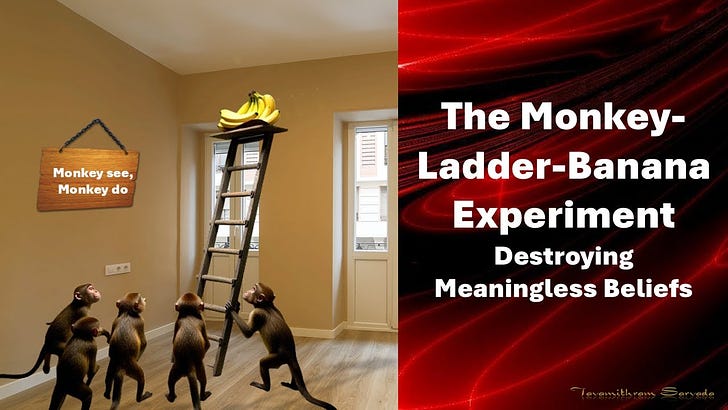
Trapped by Tradition: What Monkeys Teach Us About Blind Conformity

JOIN MY SUBSTACK – IT IS FREE

This video sheds light on an intriguing experiment that reveals deep insights into human behaviour and the importance of questioning established norms. The story serves as a powerful metaphor for how traditions and social customs can become…READ ON SUBSTACK AND WATCH THE VIDEO