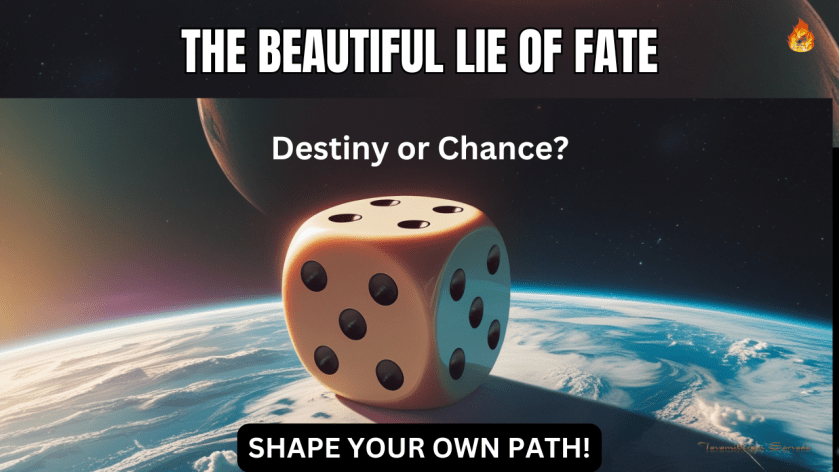
Born by Chance, Fooled by Belief

READ AND WATCH THE VIDEO ON SUBSTACK.

JOIN MY SUBSTACK – IT IS FREE.

Unravelling the Illusion of Fate in a Stochastic Universe

Many people believe there’s a ‘grand plan’ behind everything—a higher power or force shaping events through fate, destiny, or divine will. This belief often leads us to surrender a significant portion of our mental capacity and autonomy to things we cannot fully prove: unseen beings, sacred books, religious intermediaries, and abstract concepts. But what if this comforting story is merely a creation we’ve been telling ourselves for centuries? Even more troubling is that such beliefs breed a sense of entitlement, creating divisions among individuals, fostering inequality, envy, jealousy, and belligerence—forces that ultimately damage lives, relationships, and our natural world.

In this short presentation, I confront the illusion of fate head-on. Let us examine the stochastic nature of existence—not through superstition or sentiment, but through reason, science, and Vedanta. From the genetic lottery you were born into, to the subtle conditioning shaped by environment and epigenetics, you’ll see how much of your life has just happened. No blueprint. No cosmic purpose. No invisible puppeteer.

Let us question why religions and mythologies have always tried to impose order upon chaos, and why fatalism is just another form of resignation. I present Karma not as divine justice, but simply as cause and effect. Actions and consequences, not punishments and rewards.

And yet, this isn’t a descent into nihilism. Far from it.

To embrace randomness is to reject the passive comfort of fate and to step into clarity. Life doesn’t need a script to have meaning. Meaning arises not from predestination, but from conscious living in an unpredictable world.

This presentation is for the quietly curious, the disillusioned believer, the sceptic, the philosopher—and anyone ready to ask: What if chance isn’t your enemy, but your liberation?

Haven’t you completed the Srimad Bhagavad Gita yet? Here is your solution:
The Complete Srimad Bhagavad Gita – Explained Simply | No Confusion, Only Clarity!

Religion Failed You – Vedanta Won’t

VEDANTA DOESN’T NEGATE ‘GOD’, IT ….. (READ ON AND WATCH THE VIDEO)

Vedanta gets you out of DELUSION.

READ ON SUBSTACK. JOIN MY SUBSTACK. HURRY UP! THIS SITE WILL SOON MOVE TO SUBSTACK!

What if everything you’ve been taught about ‘god’, worship, and salvation is just the kindergarten of the path of the rational philosophy of Vedanta?

The ancient Rishis (wise, selfless sages) spoke in metaphors and extensive analogies—not to hide the truth, but because ultimate reality must be directly experienced. It cannot be handed to you as dogma or belief.

Yet what do the ignorant masses do? They take the allegories literally and spin them into entire new cults, sects, and traditions! Haven’t you seen all those ‘I-know-it-all’ bearded men in flowing robes strutting around like proud peacocks who spin yarns about being reincarnations of some old sages who existed 50,000 years ago and so on? Where does all that come from? How do those people even get there? One reason: The IGNORANCE of the masses strengthened by the disease of DUALITY infused into them – or rather, the lack of knowledge of NONDUALITY or universal oneness in them.

Watch the video presentation below to understand why such profound analogies exist in the Puranas, Itihasas, and Vedantic scriptures at all.

It is indeed comforting to believe in a ‘divine father’ watching over us—listening to our prayers, changing all his plans only because we were ‘good children’ or fasted sincerely, rewarding good, punishing evil. Temples and prayers sustain this. A necessary beginning, maybe, but it is like ‘spiritual kindergarten’. True awakening requires quitting kindergarten and progressing toward Vedanta’s university.

Below are a few points why Vedanta stands apart:
• It rejects all blind belief in any supernatural being or other such unintelligent stuff in favour of direct knowledge
• It transcends ritual worship through Self-inquiry
• Through studying the master-disciple dialogues, seekers systematically remove ignorance to recognise their true nature – which the Srimad Bhagavad Gita reveals as the highest state of consciousness – SBG 2:72

What we call “spiritual seeking” often becomes mental chasing. Vedanta ends this by revealing:
✓ The illusion of separation between seeker and sought
✓ That rituals cannot give what you already are
✓ How to recognise the eternal presence beyond birth and death
✓ That the ultimate goal isn’t conceptual – it’s a transformed state of mind (what the Gita calls “sthita-pragnyaa”) SBG 2:55

This isn’t about new beliefs – it’s about realising the truth that:
• Liberates from all mental conditioning
• Establishes one in natural peace
• Reveals consciousness as your fundamental state

This is not about adopting new beliefs—it’s about transcending belief itself, to know truth directly.

📽️ Watch “Vedanta vs Religion: The Truth Will Set You Free”
(For those ready to move from concepts to direct realisation)

The wave need not believe it is the ocean—it need only look and realise that it is the ocean.

Aum Tat Sat.

This knowledge isn’t “enlightenment” — it’s what remains when all illusions fall away.

🔄 I know few will read this or watch the myth-shattering video – truth tends to terrify the comfortable. But if these words stir even the faintest doubt in some corner of your conditioned mind, share it with someone still trapped in ‘spiritual kindergarten’. They might just deserve their first taste of freedom.

Monk Mindset, Modern Life

The myth of needing perfect conditions for peace

READ ON SUBSTACK

What does true peace look like?

Is it a secluded beach at sunset? A mountaintop retreat? The moment after you achieve a long-sought goal?

A photography contest once asked this same question—and the winning answer stunned everyone.

It wasn’t the most beautiful image. It wasn’t the most dramatic. But when the judges saw it, they immediately knew: This is it. This is real peace.

What did they see that moved them so deeply?

And more importantly – how can you access that same unshakeable calm, no matter your circumstances?

I explore this in my new video, “The Essence of Peace: A Journey Beyond Fear and Attachment.” It’s not what you might expect.

You’ll discover:

  • The hidden trap in how we chase peace (and why it keeps slipping away)
  • The 2-word mental shift that dissolves worry instantly
  • What predators, bouncing cups, and your deepest fears all have in common
  • Why “preparing for the worst” is actually the key to fearless living

This isn’t theory. It’s a revelation hiding in plain sight—in a poor village, in life-threatening crises in my life, and in the quiet space between your thoughts.

Peace isn’t something you find. It’s something you stop losing.

Watch here:

“The battle was never with the world. It was always in the mind—and the mind was never really you.”

P.S. The most extraordinary truths often wear the disguise of ordinary moments. This one might catch you by surprise.

Nirvana Shatakam: The Bold Truth That Shatters Every Illusion You Hold Dear

“When you KNOW, you don’t need to BELIEVE.” – Tavamithram Sarvada

What if everything you believe about yourself—your identity, your desires, your fears—is nothing but an illusion? What if the very essence of who you are lies beyond the mind, the ego, and even the concept of “I”?

Enter the Nirvana Shatakam, a profound composition by the 8-year-old spiritual prodigy, Adi Shankaracharya. In just six verses, this masterpiece dismantles every label, every belief, and every ritual you’ve ever clung to. It doesn’t just challenge your worldview—it obliterates it.

Imagine a young boy, wandering the Himalayas, confronted by a sage who asks, “Who are you?” His response? A declaration so radical, so fearless, that it strips away every falsehood and points directly to the ultimate truth: “I am Shiva. I am pure consciousness.”

This isn’t just philosophy. This isn’t just spirituality. This is a call to awaken—to see beyond the illusions of identity, religion, and dogma. It’s a challenge to let go of everything you think you know and embrace the infinite truth of your being.

Are you ready to question everything? Are you ready to discover who you truly are? Watch the video now and let the Nirvana Shatakam guide you to the ultimate liberation.

Main Tavamithram Channel

Timeless Vedanta Channel

Truth Doesn’t Care About Your Beliefs: Uncover the Ultimate Reality

READ AND WATCH THROUGH MY SUBSTACK

You’ve been told what to think. You’ve been conditioned to accept, obey, and conform. But what if everything you believe—everything you rely on—has been carefully placed there to keep you from seeing the truth?

What if the world around you isn’t what it seems?

This isn’t just another talk. It’s an experience—one that might shake the very foundation of what you think is real. But be warned: once you step through this door, there is no going back.

Are you ready to challenge everything? Watch now.

Kenopanishad – The Path Beyond Perception

CLICK HERE TO READ THE POST ON SUBSTACK

What if everything you worship, think, and perceive is not the ultimate truth?

The Kenopanishad shakes the very foundation of our understanding by revealing that Brahman—the ultimate reality—is not what the senses perceive, nor what the mind can grasp. It is that by which all perception happens, yet remains beyond perception itself.

I am pleased to share my English explanation of the Kenopanishad, now available on the new Vedanta channel, Timeless Vedanta. This Upanishad is a profound text that explores the nature of ultimate reality, the limitations of perception, and the essence of Brahman—the supreme truth that is beyond the grasp of the senses and intellect.

This video presents a clear and insightful analysis of the Kenopanishad, encouraging deeper reflection and self-inquiry. Watch, learn, and break free from blind beliefs to embrace the wisdom of Vedanta.

Your engagement helps spread the knowledge of Advaita Vedanta and enables more seekers to benefit from these ancient yet ever-relevant teachings.

Summary of the Kenopanishad

The Kenopanishad from the Sama Veda’s Talavakara Brahmana is a profound exploration of Brahman, the ultimate reality that transcends sensory perception and intellectual comprehension. It is structured into four sections, addressing the nature of consciousness, the limitations of the mind and senses, and the necessity of realisation beyond mere knowledge.

I. The Nature of Brahman

The text begins with fundamental inquiries: What is the force behind the mind, speech, and senses? What enables perception and cognition? The answer given is that Brahman is the unseen power that enables all faculties yet remains beyond their grasp.

  • Brahman is the “ear of the ear, the mind of the mind, the speech of speech, the life of life, and the eye of the eye.”
  • The wise attain immortality by renouncing identification with the senses and realising this truth.
  • Brahman is beyond thought, speech, and sight, yet it is that by which the mind thinks, speech expresses, and the eyes see.
  • “Nedam-yadidam-upaasate” – That which is worshipped as an object is not Brahman; the real Brahman is that which enables perception itself.

II. The Paradox of Knowing Brahman

The Upanishad asserts that Brahman is not fully knowable, nor is it completely unknown. It is beyond dualistic comprehension:

  • If one thinks, “I know Brahman,” they have only a partial understanding.
  • Brahman is known by those who realise they do not fully know and remains unknown to those who think they know it completely.
  • True knowledge of Brahman leads to immortality, strength, and ultimate fulfilment.

III. The Parable of the Gods and Brahman’s Revelation

The Upanishad illustrates the ignorance of the gods through a symbolic story:

  • After a great victory, the gods (Agni, Vayu, and Indra) assume their triumph is solely their own.
  • Brahman appears as an unknown Yaksha (divine being) to humble them.
  • Agni, the fire god, fails to burn a blade of grass; Vayu, the wind god, fails to lift it—revealing their limited power.
  • Indra, seeking answers, meets Uma (Parvati), the embodiment of wisdom, who reveals that their victory was due to Brahman alone.
  • Indra, being the first to realise this, is praised above the other gods.

IV. The Flash of Realisation

  • Brahman is realised like a lightning flash or a blink of an eye—sudden and beyond conceptualisation.
  • The seeker must meditate on Brahman as “Tadvana” (the most desirable).
  • Austerity, self-restraint, and righteous action serve as the foundation for realisation.
  • One who attains this knowledge becomes established in Brahman, free from ignorance, confusion, suffering, and Karma

The Kenopanishad asserts that Brahman is the essence of all experience but cannot be objectified. It must be known intuitively, not intellectually. The Upanishad leads the seeker away from external worship to direct self-inquiry, revealing that the ultimate truth is not in what is perceived but in that which enables perception itself.

Click here for the complete text of the Kenopanishad in English

📌 Watch, like, and share the video.
📌 Subscribe to the channel, Timeless Vedanta, for more timeless teachings.

How to Destroy the Illusion of False EGO in 5 Minutes?

Subscribe to my Substack. It is FREE.

Can an Eye See Itself? Understanding the Nature of the Self

[This is a continuation of the post “Not Your Body? Quick Tips to Discover Your True Self!”]

Many seekers struggle with the concept of the Self, often expressing confusion and frustration over their inability to “connect” with it. I’ve heard people saying things like, “I feel the disconnect with my own self,” and so forth. The fact is that such statements are logically flawed. Why? Because the Self is not something to be seen or grasped—it can only be realised. CONTINUE READING AND WATCHING THE VIDEO ON SUBSTACK.

Not Your Body? Quick Tips to Discover Your True Self!

Join my SUBSTACK. It is FREE.

The Illusion of ‘Me’: Why You’re Not Your Body

In some major religions, creation is described as a divine act—’god’ creating humans in ‘his’ own image and forming the universe in six days, resting on the seventh. But what does it mean to be made in ‘god’s’ image? Is it about the physical form, or something deeper? From the largest of stars to the tiniest creatures on Earth, everything is a conglomeration of atoms—physical objects perceived through names and forms. Yet, identifying solely with these forms traps us in illusion, much like the prisoners in Socrates’ ‘Allegory of the Cave’, who mistook shadows for reality. READ AND WATCH THE SHORT VIDEO ON SUBSTACK

Bhaja Govindam on the Timeless Vedanta Channel

Bhaja Govindam: The Song That Will Transform Your Life

Most people listen to or recite Bhaja Govindam without grasping its true essence—but this profound composition by Shri Adi Shankara is far profound than what most people might think. It is a bold call to awaken from ignorance, starting with the striking words, “O Fool,” and leading to a life of wisdom and responsibility.

In this video, The Bhaja Govindam Song on the new Timeless Vedanta YouTube Channel, I unravel the deeper meaning of each Shloka, providing an English translation alongside a downloadable PDF with the original Sanskrit, transliteration, and translation.

Bhaja Govindam is not about blind beliefs or meaningless rituals but about attaining SELF-knowledge (Atmagnyaana), freeing the mind from delusions, and embracing Vedantic clarity. This understanding is vital in today’s world, where distractions pull us away from truth.

Watch the video, explore this timeless wisdom, and pair it with The Ever-Relevant Gita: A Present-Day Rendering—together, they will bring you clarity, peace, and a truly fulfilling life.

Mandukya Upanishad on TimeLess Vedanta

Discover the Mandukya Upanishad: The Essence of AUM and the Four States of Consciousness

Welcome to TimeLess Vedanta, where ancient wisdom meets modern seekers. In this    video, we will dive into one of the most profound texts in the Vedanta philosophy—the Mandukya Upanishad.

The Mandukya Upanishad, though the shortest of the 108 Upanishads, holds the key to understanding the essence of AUM and the four states of consciousness: waking, dreaming, deep sleep, and the transcendent state of Turiya. This Upanishad is a gateway to self-realisation, offering timeless insights into the nature of reality and your true Self.

In this video, we explore:

  • The significance of AUM and its connection to the three states of consciousness.
  • The fourth state, Turiya, which underlies and transcends all other states.
  • How the Mandukya Upanishad can guide you to realise your divine nature and break free from the illusions of the mind.

Whether you’re new to Vedanta or a seasoned seeker, this video will inspire you to look within and discover the divinity that resides in you.

Free PDF Included: To deepen your understanding, I’ve also prepared a beautifully formatted guide to the Mandukya Upanishad. Download it now and embark on your journey to self-realisation.

Join me on this transformative exploration of the Mandukya Upanishad. Watch the video below, download the PDF, and let the wisdom of the ancients illuminate your path.

ॐ शान्तिः शान्तिः शान्तिः

Subscribe to TimeLess Vedanta for more insights into Vedanta, the Upanishads, and the timeless truths that can transform your life.