Gratitude and the salt metaphor
Recently, a person known to me who used to stay and eat at my home at least two to three days a week, suddenly turned hostile towards me and considered me his enemy. I am sure that he would never have experienced in is entire life, the kind of respect and love that he received from us. Then what went wrong? The only possible reason could have been that he did not get enough attention from other people when I was around. He could not stand the fact that a younger person like me could be better than him at so many things. It made him jealous and the evil feeling of envy blinded him and wiped the spirit of Dharma from his mind. It is this recent painful experience with this elderly man that has inspired me to narrate the following story that my father told me when I was a young boy. May God forgive the poor ignorant man and all others like him.
The ‘noble’ thief
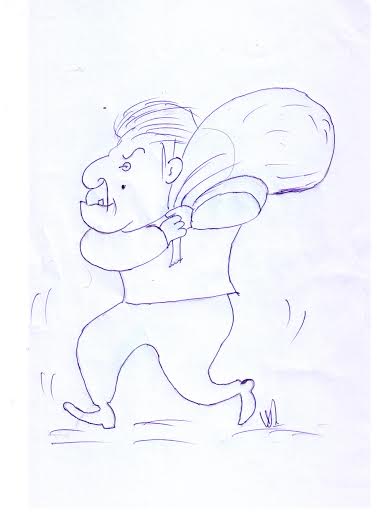
That was the time, many centuries ago when Dharma was practised by everyone in Bharat Varsh, no matter what profession one was engaged in. Strangely enough, even robbers of that age followed Dharma just as hunters and butchers too did. A few centuries ago, there lived a professional thief in a South Indian town. One evening, he left for work usual. He had already narrowed down on the house that he wished to burgle that night. He was a seasoned and a well experienced thief who had never been caught until then.
It was pitch dark and he walked towards the target house. It was a mansion in which lived a wealthy businessman with his family. He stealthily moved around the mansion to find a way to sneak into it. The cook who worked in the mansion had forgotten to shut one of the kitchen windows that night and the thief spotted it. He deftly slipped past the guards and made his way into the house through the open kitchen window. An expert thief that he was, he could open the iron safe without much difficulty and he filled his bag with the booty consisting of gold jewellery and coins, diamonds and other precious stones.
He tiptoed back to the kitchen in order to escape though the window there. He entered the kitchen which was not all that dark thanks to the moonlight through the window. He saw a jar close to the window.
 It looked like a jar to store sugar. As he was a bit stressed out, he felt like having some sugar to get some instantaneous energy. So he climbed up the window and as he was about to exit, he put his hand into the jar and collected from the contents whatever he could and he jumped out. As he landed on the ground he put into his mouth whatever he had taken from the jar. To his utter dismay, he realised that it was not sugar, but it was salt. He spat it out and looked around to see if there was a well in order to find some water to clear is mouth and throat.
 Once he felt fine, he looked at his booty bag and looked at the mansion. His conscience told him that his Dharma did not permit him to steal from a family of which he had consumed salt. So the thief went to main door where the guards saw him and pounced upon him. The rich businessman was woken due to the melee and went out to find out what was happening. He was appalled to see the huge booty bag containing the wealth stolen from him, which was snatched away from the thief by the guards. The thief fell at the feet of the businessman and asked for pardon. He told him that as he consumed salt in the mansion, his Dharma prevented him from stealing and hence he, instead of running away, would like to return the loot to the owner. The businessman was not at all surprised, because what the thief said was totally in accordance with the high moral values that prevailed during the classical age in Bharat Varsh (India) much before it was invaded, conquered, looted and its true essence diluted.
Even until this day, there are many who have an inborn sense of gratitude to those who help them or to those in whose houses, they have eaten or rather, consumed salt. Consuming salt (Namak in Hindi or Uppu in Tamil) from someone amounted to making a commitment of loyalty towards that person or family. A person would never go against someone whose salt one has consumed. Even ancient Hebrews believed that they were bound to God by a covenant of salt. Salt has been used as a metaphor because of its great importance in food. Of what use is the most exotic dish and how could one relish it without that humble pinch of pure white salt?
Many animals particularly dogs, have a deep sense of gratitude. Unfortunately some humans disregard this divine quality which forms the basis of any relationship. People need to be grateful to each other. Gratitude need not be limited only to people whose salt one has consumed but it also needs to be shown to people who love us, or those who have been kind to us, have lent us an ear, have given us a piece of advice or even have given us a few minutes of their time on the planet. Gratitude towards one’s parents, teachers, siblings, cousins, spouses, colleagues, friends, employers, employees and others gives us a wonderful feeling of being modest and this alone is sufficient to help us reap positive Karma.
I express my sincere gratitude to my family, friends, teachers, to all those who love me, teach me, are kind to me, to those who have helped me and above all, to Bhagavan Krishna for protecting me and for magnanimously allowing me to continue to exist on the planet.






 Tavamithram Sarvada