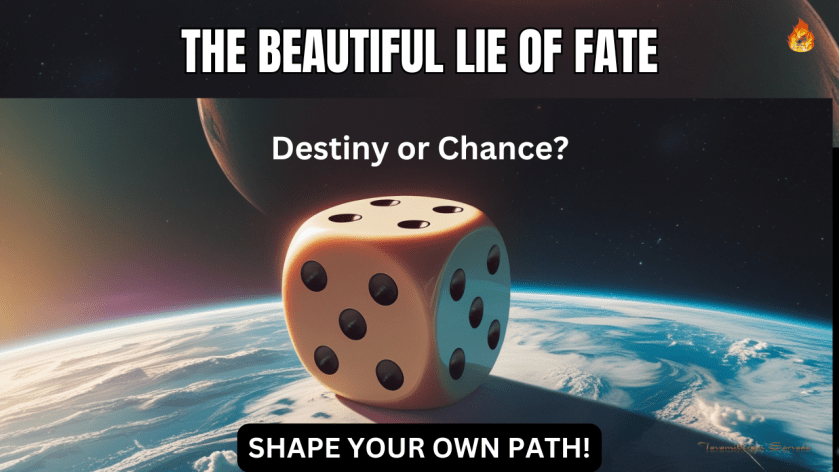
Unravelling the Illusion of Fate in a Stochastic Universe
Many people believe there’s a ‘grand plan’ behind everything—a higher power or force shaping events through fate, destiny, or divine will. This belief often leads us to surrender a significant portion of our mental capacity and autonomy to things we cannot fully prove: unseen beings, sacred books, religious intermediaries, and abstract concepts. But what if this comforting story is merely a creation we’ve been telling ourselves for centuries? Even more troubling is that such beliefs breed a sense of entitlement, creating divisions among individuals, fostering inequality, envy, jealousy, and belligerence—forces that ultimately damage lives, relationships, and our natural world.
In this short presentation, I confront the illusion of fate head-on. Let us examine the stochastic nature of existence—not through superstition or sentiment, but through reason, science, and Vedanta. From the genetic lottery you were born into, to the subtle conditioning shaped by environment and epigenetics, you’ll see how much of your life has just happened. No blueprint. No cosmic purpose. No invisible puppeteer.
Let us question why religions and mythologies have always tried to impose order upon chaos, and why fatalism is just another form of resignation. I present Karma not as divine justice, but simply as cause and effect. Actions and consequences, not punishments and rewards.
And yet, this isn’t a descent into nihilism. Far from it.
To embrace randomness is to reject the passive comfort of fate and to step into clarity. Life doesn’t need a script to have meaning. Meaning arises not from predestination, but from conscious living in an unpredictable world.
This presentation is for the quietly curious, the disillusioned believer, the sceptic, the philosopher—and anyone ready to ask: What if chance isn’t your enemy, but your liberation?
Haven’t you completed the Srimad Bhagavad Gita yet? Here is your solution:
The other day, I was speaking with an old friend when the conversation turned to the tragic stampede at the Kumbh Mela in February 2025 and the official reports highlighting severe faecal contamination in the very waters where thousands had taken ‘holy’ dips. My friend took offence at my remarks and became almost aggressive and confrontational. He insisted that people have the right to their beliefs and that I had no business questioning them.
I want to highlight two important points here:
My friend, like many others, fails to recognise that while he demands respect for people’s beliefs, there are also those who do not subscribe to such beliefs—and they, too, have a right to their views.
My argument was never about belief itself, but about the reckless endangerment of thousands of lives and the pollution of a river they themselves deem ‘holy’ with faecal contamination!
The issue with my friend remains unresolved! So, my old friend is willing to risk our friendship over this thing called belief! Christopher Hitchens rightly said that religion poisons everything.
The most crucial point, however, is that in Advaita Vedanta, the highest attainment on the Vedic path known as Sanatana Dharma, there is no concept of belief. It is a path of knowledge, direct experience, and realisation, not blind faith.
Yet, many continue to follow irrational beliefs and rituals without questioning their origins or validity. These inherited practices are often carried out simply because they are part of tradition, with little thought given to their purpose. How often do people stop to ask: “Why am I doing this?” “Does it make sense?”
To encourage critical thinking and deeper reflection, I am reposting two videos that examine the absurdity of beliefs and rituals. These videos challenge the notion that faith alone is enough, exposing how unquestioned traditions shape societies and hinder individuals from seeking true knowledge.
Vedanta emphasises reason and self-inquiry. Instead of surrendering to superstition, one must strive to understand reality as it is, not as it is imagined or dictated by blind faith. True wisdom lies in breaking free from irrational dogmas and seeing the world with clarity.
Unfortunately, as laziness is easier and more comfortable than using our brains and thinking critically, most people prefer the easier route of blindly believing things rather than questioning, studying, and researching.
I invite you to watch these videos with an open mind and reflect on the impact of unquestioned beliefs in your own life.
Newspaper article regarding the pollution of the river Ganga: “High levels of faecal coliform (microbes from human and animal excreta) were found in river water in which people took holy dip during Maha Kumbh in Prayagraj of Uttar Pradesh, according to a report submitted to the National Green Tribunal by the Central Pollution Control Board.”
Why Tavamithram is Never Aligned to Any Particular Group, Ashram, Agama, Paddhathi, Sects, Subsects, Guru, Swamy, Dress Code, Traditions, Religion etc.
Please read the post before listening to the podcast discussing the post
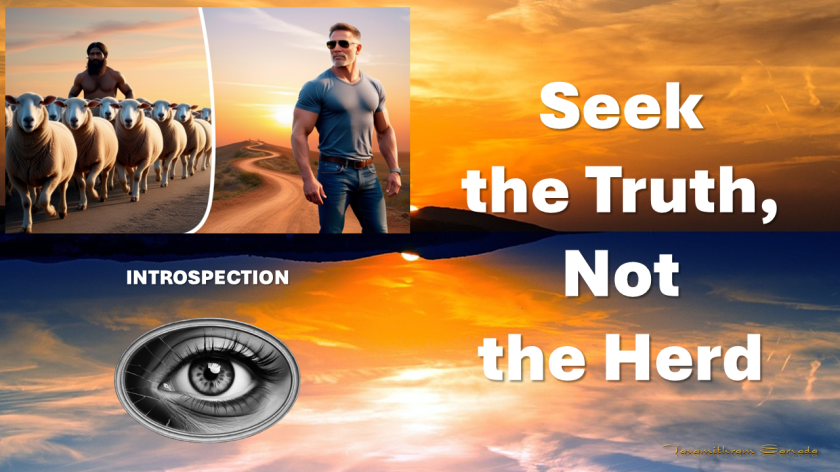
Throughout my life, I have observed a significant connection between beliefs, the desire to belong to groups, and the thirst for knowledge and self-confidence. My personal attitude has always been to stand alone. It’s crucial to clarify that my reluctance to belong to groups should not be mistaken for hubris. I simply prefer solitude, as my strong ideas often diverge from the majority, who are frequently swept away by traditions—something Krishna himself admonishes even before the conclusion of Chapter 2 in the Srimad Bhagavad Gita.
To illustrate the extent to which I go to avoid belonging to a group, let me share an example from my past. Many years ago, I was a motorcycle stuntman in Indian films, doubling for lead stars and performing death-defying stunts. In the film industry, numerous unions exist for various trades, including actors, directors, make-up artists, dancers, photographers, and others. Naturally, there was also a union for stuntmen, and I was expected to join. However, I refused to be tied down by group membership, choosing instead to remain independent. Consequently, I willingly accepted a penalty of twenty-five per cent of my earnings for not being a member. Despite this, I chose to pay the penalty each time I earned money performing stunts.
I’ve observed that individuals who are rather low on self-confidence or a sense of personal substance usually seek strength in numbers by joining groups. Being part of a group provides reassurance and a sense of belonging. Within these groups, members usually share common beliefs or philosophies, forming the basis of their unity. However, I think that belonging to a group compels individuals to adopt the group’s ideology, limiting their ability to think and act independently. I prefer the freedom to think for myself and analyse matters in my own way. Groups typically consist of like-minded individuals, which signifies a lack of diverse thought. This, in turn, stifles intellectual development and curtails opportunities for new ideas to emerge.
As an ardent learner, I find great fascination in encountering people whose ideas challenge my own, compelling me to think outside the box. This is the essence of personal evolution.
It’s essential to clarify that I do not hold beliefs in the conventional sense; instead, I possess perspectives. I have unwavering trust in my intelligence, intellect, and experiences, considering myself a keen learner in every situation I encounter.
While belonging to a group can provide a sense of security, it can also hinder personal growth and self-discovery. True self-confidence emerges from understanding and standing firm in one’s perspectives, even when they diverge from the prevailing norms of a group. By cultivating self-awareness and introspection, individuals can develop a stronger, more authentic sense of self. I am not suggesting anything against groups; rather, I strongly advocate for retaining one’s freedom to question, think, and express oneself.
Among the most detrimental effects groups can have on intellectual development is the deification of central figures, often referred to as Gurus or Babas. The story of the 24 Gurus of Sage Dattatreya aims to dismantle the false notion of being tethered to a single guru, suggesting that anything and everything that helps dispel ignorance can be considered a guru. To quote Shri Ramana Maharshi: “Your own Self-Realisation is the greatest service you can render the world.”
In Shloka SBG 2:45, Krishna instructs Arjuna: “Vedic literature deals with subjects that fall under the three Gunas. O Arjuna, you should rise above the three, be free from dualities, always remain in Sattva or goodness, and be established in the Self.”
A true teacher should guide individuals to clear their ignorance and advance towards the ultimate goal of Atma-gnyaana, or knowledge of the Self. However, how many truly do this? Many, adorned in flowing robes and sporting long beards, strut about like proud peacocks, claiming to possess all knowledge.
It is indeed disheartening to witness children and youth from families not converted to foreign religions being lured into the illusory world of meaningless beliefs, rites, and rituals.
Find out the birthplace of all disagreements, conflicts, riots, social upheavals, violence, and even genocides, and learn how Vedanta is the perfect solution.


 example from my past. Many years ago, I was a motorcycle stuntman in Indian films, doubling for lead stars and performing death-defying stunts. In the film industry, numerous unions exist for various trades, including actors, directors, make-up artists, dancers, photographers, and others. Naturally, there was also a union for stuntmen, and I was expected to join. However, I refused to be tied down by group membership, choosing instead to remain independent. Consequently, I willingly accepted a penalty of twenty-five per cent of my earnings for not being a member. Despite this, I chose to pay the penalty each time I earned money performing stunts.
 Tavamithram Sarvada