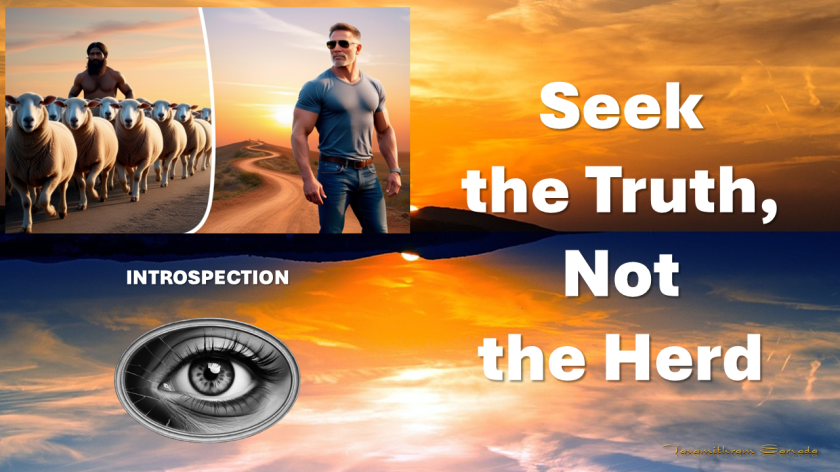
Beyond the Herd: Unmasking the Myths of Group Belonging

Why Tavamithram is Never Aligned to Any Particular Group, Ashram, Agama, Paddhathi, Sects, Subsects, Guru, Swamy, Dress Code, Traditions, Religion etc.

Please read the post before listening to the podcast discussing the post

Throughout my life, I have observed a significant connection between beliefs, the desire to belong to groups, and the thirst for knowledge and self-confidence. My personal attitude has always been to stand alone. It’s crucial to clarify that my reluctance to belong to groups should not be mistaken for hubris. I simply prefer solitude, as my strong ideas often diverge from the majority, who are frequently swept away by traditions—something Krishna himself admonishes even before the conclusion of Chapter 2 in the Srimad Bhagavad Gita.

To illustrate the extent to which I go to avoid belonging to a group, let me share anLeonardo_Phoenix_a_dramatic_highcontrast_cinematic_photograph_3 example from my past. Many years ago, I was a motorcycle stuntman in Indian films, doubling for lead stars and performing death-defying stunts. In the film industry, numerous unions exist for various trades, including actors, directors, make-up artists, dancers, photographers, and others. Naturally, there was also a union for stuntmen, and I was expected to join. However, I refused to be tied down by group membership, choosing instead to remain independent. Consequently, I willingly accepted a penalty of twenty-five per cent of my earnings for not being a member. Despite this, I chose to pay the penalty each time I earned money performing stunts.

I’ve observed that individuals who are rather low on self-confidence or a sense of personal substance usually seek strength in numbers by joining groups. Being part of a group provides reassurance and a sense of belonging. Within these groups, members usually share common beliefs or philosophies, forming the basis of their unity. However, I think that belonging to a group compels individuals to adopt the group’s ideology, limiting their ability to think and act independently. I prefer the freedom to think for myself and analyse matters in my own way. Groups typically consist of like-minded individuals, which signifies a lack of diverse thought. This, in turn, stifles intellectual development and curtails opportunities for new ideas to emerge.

As an ardent learner, I find great fascination in encountering people whose ideas challenge my own, compelling me to think outside the box. This is the essence of personal evolution.

It’s essential to clarify that I do not hold beliefs in the conventional sense; instead, I possess perspectives. I have unwavering trust in my intelligence, intellect, and experiences, considering myself a keen learner in every situation I encounter.

While belonging to a group can provide a sense of security, it can also hinder personal growth and self-discovery. True self-confidence emerges from understanding and standing firm in one’s perspectives, even when they diverge from the prevailing norms of a group. By cultivating self-awareness and introspection, individuals can develop a stronger, more authentic sense of self. I am not suggesting anything against groups; rather, I strongly advocate for retaining one’s freedom to question, think, and express oneself.

Among the most detrimental effects groups can have on intellectual development is the deification of central figures, often referred to as Gurus or Babas. The story of the 24 Gurus of Sage Dattatreya aims to dismantle the false notion of being tethered to a single guru, suggesting that anything and everything that helps dispel ignorance can be considered a guru. To quote Shri Ramana Maharshi: “Your own Self-Realisation is the greatest service you can render the world.”

In Shloka SBG 2:45, Krishna instructs Arjuna: “Vedic literature deals with subjects that fall under the three Gunas. O Arjuna, you should rise above the three, be free from dualities, always remain in Sattva or goodness, and be established in the Self.”

A true teacher should guide individuals to clear their ignorance and advance towards the ultimate goal of Atma-gnyaana, or knowledge of the Self. However, how many truly do this? Many, adorned in flowing robes and sporting long beards, strut about like proud peacocks, claiming to possess all knowledge.

It is indeed disheartening to witness children and youth from families not converted to foreign religions being lured into the illusory world of meaningless beliefs, rites, and rituals.

I conclude this post with Shlokas SBG 4:37 and 38

37: “Just as a blazing fire burns firewood into ashes, O Arjuna, knowledge burns all actions and reactions into ashes.” 

38: “There is certainly nothing more purifying than knowledge. He who is perfect in Yoga finds it in the Self in due course of time.”

May you stay abundantly blessed.


Jai Shri Krishna

Why me – मैं ही क्यों – நான் ஏன்?

Understanding Destiny through the Srimad Bhagavad Gita

Every morning can be treated as a new Janma (birth), carrying forward the thoughts and mindset from the previous day, thus continuing life patterns. Changing one’s life for the better is not difficult if one understands the natural principle of cause and effect and works towards acquiring the knowledge of the all-pervading Self, Brahman, or Krishna. As long as one thinks of Krishna as a separate entity, they will have expectations, which naturally lead to disappointments. Krishna is everywhere, in all beings, and is existence itself. Rise above dualitym accept responsibility and make the necessary course corrections in life. The Srimad Bhagavad Gita clearly states that the path of knowledge is the highest. Check out Shloka SBG 4:37-38.

To illustrate these concepts, I created three videos in three different languages using easy-to-understand analogies. When I made the Hindi video, one of our family members, Mr. Anupam Agarwal helped me in reviewing the Hindi script. Special thanks to him.

Additionally, I offer my latest book, ‘The Ever-Relevant Gita: A Present-Day Rendering’. This book can answer almost all possible questions one might have about destiny, karma, dharma, Krishna, birth, life, and death.

Embracing the Path of Knowledge

It is an irrefutable fact that everyone possesses some degree of a personality trait called narcissism. The degree of narcissism in a person separates a normal individual from someone who needs professional help. Even a small amount of narcissism can push a person towards feelings of entitlement, selfishness, and the typical ‘Why me?’ question. One’s own answer to this question is usually based on self-pity and a sense of being a victim of others, external forces, or misfortune.

People who care to set aside their narcissistic traits, however small and insignificant, and their feelings of victimhood, can find not just an answer to the ‘Why me?’ question but a permanent solution to it.

The following presentation analyses the ‘Why me?’ question, the principle of cause and effect, and ways to carve out a clearer, better, enjoyable, and enriching destiny with the help of teachings from the Srimad Bhagavad Gita.

May peace reign in your heart, mind, and soul, and may your life be blessed with an abundance of Divine Grace.

Jai Shri Krishna

Watch the video in the language of your choice, reflect, and take action.

WHITE BLOOD -Milk, Tradition, and Compassion: Rethinking Our Choices

The Hypocrisy of Animal Fat in Tirupati Laddus

HYPOCRISY TO THE CORE!

Podcast (Please read and play the Podcast for a better understanding of the topic)

I was appalled and, at the same time, amused by the news of animal fat being found in the laddus sold in Tirupati!

Animal fats can be categorised as milk fats, rendered fats, and fish oils (marine oils). The main representative of milk fats is the fat from cow’s milk (milk fat, butter fat, butter oil). All other milks are of almost no importance as far as their fats are concerned.

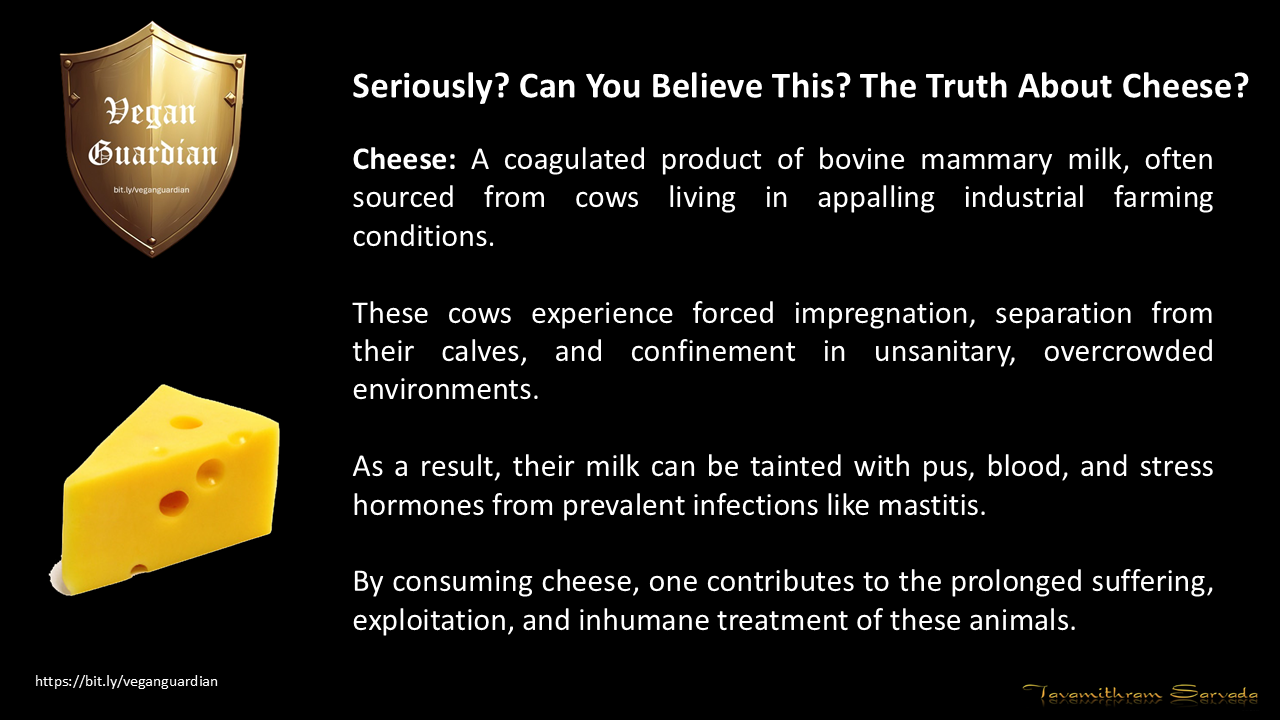
As a pure vegan, I can say that this is another case of typical Indian hypocrisy. Many people, blinded by traditions, complain about animal fat but consume ghee. Where do they think that fat comes from? From plants? Ghee comes from the secretion, often containing pus, of bovine animals, which secrete it for their own young ones and not for fully grown adults of a different species!

Is there any other species that drinks mammary secretions in adulthood? Not even bulls do. And more so from another species! Indians are accustomed to a lot of nonsense in the name of ridiculous traditions. This stems from a lack of knowledge.

People don’t have time to spend three hours reading a copy of the Srimad Bhagavad Gita and reflecting on the supreme knowledge it offers, but when it comes to following family traditions blindly, they do so without asking a single question!

In Chapter 1, Arjuna talks about family traditions being lost, and Krishna does not even consider it something worth discussing. In Chapter 4, Krishna tells Arjuna in so many words to ask questions and get answers. He never advocated blindly following meaningless traditions.

Krishna, in Shloka SBG 9:26 says:
पत्रं पुष्पं फलं तोयं यो मे भक्त्या प्रयच्छति |
तदहं भक्त्युपहृतमश्नामि प्रयतात्मनः || ९ २६ ||
patram pushpam phalam toyam
yo me bhaktyaa prayacchati
tadaham bhaktyu-pahritam-
ashnaami praya-taat-manaha (SBG 9:26)
“I accept whatever is offered to Me with devotion and a pure heart. It could be a leaf, a flower, a fruit or a little water.” HE DID NOT SAY: STEAL A CALF’S BABY FOOD AND POUR IT ON ME!

Have you ever considered the plight of the poor cows kept in horrifying conditions, their milk taken from them? When they deliver male calves, the poor little chaps are sent straight to the slaughterhouse to be killed and their tender meat used for something else, all because they will not give milk! And these vegetarians think they are absolved of all the brutal murders done to these animals just because their meaningless traditions tell them they should consume animal milk?

IF YOU STAY SILENT ABOUT A CRIME BEING COMMITTED, YOU ARE COMPLICIT IN IT.

Watch the videos below that I published some time ago, and help your conscience come out after being shrouded for so long under ignorance. That’s called evolution.

Ten things you should know about dairy…

All confused or pseudo-devotees of Krishna, please remember that YOU ARE THAT, and so is everything and every being!

No! No creature was created for you to steal its baby food or kill and eat it!

SBG 13:27 (or 28 in some editions)
समं सर्वेषु भूतेषु तिष्ठन्तं परमेश्वरम् |
विनश्यत्स्वविनश्यन्तं यः पश्यति स पश्यति || १३ २७ ||
samam sarveshu bhooteshu
tisht-hantam parameshvaram
vinashyatsva-vinashyantam
yah pashyati sa pashyati
(SBG 13:27)
The person who truly sees is the one who sees the Paramatma or Supreme Self, existing equally in all beings – the unperishing within the perishing.

The All-pervading SELF – YOU!

There was a man called ‘Agyani’, who ‘lost himself’ and set out to ‘find himself’!

Don’t waste your time looking for yourself outside your subjective awareness! That is impossible! Contemplate yourself! Because that is the path towards Atmagnyaana – the Highest Achievement possible!

Sadesati Review

I have been receiving emails from individuals with Vrischika (Scorpio) and Dhanu (Sagittarius) Rashi or moon signs about their post-SadeSati experiences.

To facilitate the sharing of information among those who have completed their SadeSati period—whether they have returned to normal lives or are still facing challenges—I am opening this page.

“Why on Earth” – Full Movie

“Why on Earth” is a powerful documentary available on Amazon Prime that takes viewers on a global journey to explore the profound connection between humans, animals, and our planet.

Featuring stunning and rarely seen footage, the film highlights the impact of deforestation and the illegal trade of threatened and endangered species. It focuses on the plight of iconic animals such as elephants, lions, sharks, and orangutans, revealing how these environmental issues affect their survival.

The documentary underscores the importance of caring for these magnificent creatures as a step towards healing our planet and fostering a better future for all living beings.

Through its eye-opening content, “Why on Earth” aims to inspire action and awareness about the urgent need for conservation efforts.

The film is directed by Katie Cleary and features Katie Cleary, Clint Eastwood, and others.

Watch the full film

Clint Eastwood, 94-year-old vegan actor legend, formulated one of the most important lessons of his life so far for the young generation:

“Don’t look for luxury in watches or bracelets, don’t look for luxury in villas or sailboats!

Luxury is laughter and friends, luxury is rain on your face, luxury is hugs and kisses.

Don’t look for luxury in shops, don’t look for it in gifts, don’t look for it in parties, don’t look for it in events!

Luxury is being loved by people, luxury is being respected, luxury is having your parents alive, luxury is being able to play with your grandchildren.

Luxury is what money can’t buy.”
(2024)

Faith vs. Reason – Christianity vs. Vedanta

Unveiling the Shocking Truth: Christianity vs. Vedanta – Faith or Reason?

We live in a world filled with diverse beliefs and philosophies, in which, the quest for truth remains a constant journey. This video, “The Shocking Truth: Christianity vs. Vedanta – Faith or Reason?” takes you on an enlightening exploration of two profound world-views that have shaped human thought and spirituality for centuries.

The Clash of Faith and Reason

Christianity and Vedanta offer distinct paths to understanding the nature of existence, the divine, and our place in the cosmos. While Christianity is rooted in faith and belief in a personal God, Vedanta emphasises knowledge and SELF-realisation, guiding seekers towards the ultimate truth of oneness with Brahman.

What to Expect in the Video

This thought-provoking video, is a discussion on the core principles of both Christianity and Vedanta, comparing and contrasting their teachings. We discuss the concept of duality versus non-duality, the role of reason and logic in spiritual pursuit, and the historical context that has shaped these traditions.

The Mahavakya or grand statement “Aham Brahmasmi” (“I am Brahman”) from the Brihadaryanaka Upanishad is a powerful representation of the Vedantic experience of unity and self-realisation. This Mahavakya can be used as a gateway to begin understanding the profound insights of Vedanta.

Stay Connected

Don’t forget to like, share, and subscribe to the Tavamithram Sarvada blog and YouTube channel for more posts and videos on philosophy, spirituality, and self-discovery. Follow this blog for updates and more enlightening content.

Embark on this journey with me and uncover the shocking truth that lies at the intersection of faith and reason.

Two Golden ‘Mantras’ to Destroy Negative Karma and Start Afresh

Have you ever felt trapped in a cycle of negativity, brooding over past traumas, and struggling to find a way out? You’re not alone. Many people fall into the habit of self-pity, which can be a powerful and destructive force.

In my latest video, I share the two simple yet profound mantras that have helped me break free from the shadows of my past and step confidently into a brighter future. These mantras have been my guiding light, empowering me to overcome challenges and embrace a life full of possibilities.

Curious to learn more? Watch the video to discover how “So What?” and “What Next?” can transform your life too.

Reset your Karma

Self-Pity is a DRUG

Google Translate

Hindi

Tamil

Marathi

Kannada

Telugu

Malayalam

Shattering Beliefs: The Ultimate Truth of Atman and Brahman

Unveiling the Truth: Why You Should Question Everything

This video presentation delves into profound philosophical questions through an engaging Q&A discussion. This session is designed to ignite your curiosity and challenge your understanding of reality, consciousness, and the nature of the self. This video is a must-watch if you’ve ever wondered about the deeper meanings behind ancient scriptures or the true essence of existence.

Learning Through Analogies

We explore various analogies to shed light on complex concepts. Imagine understanding the nature of consciousness through the metaphor of a wave in the ocean, a fire igniting under the right conditions, or the space within a pot. These simple yet powerful illustrations can transform your perception and deepen your insight into non-duality and the oneness of all existence.

The Importance of Inquiry

In the pursuit of knowledge, it is crucial to study, observe, analyse, and experience rather than simply accept interpretations handed down by others. The masses often prefer to listen passively rather than actively engage with the material. This passive acceptance can lead to misunderstandings and superficial knowledge. True understanding comes from questioning, probing, and seeking clarity.

As Krishna states in Shloka 4:38 of the Srimad Bhagavad Gita, “There is certainly nothing more purifying than knowledge. He who is perfect in Yoga finds it in the Self in due course of time.” This Shloka highlights the transformative power of true knowledge and its role in achieving a peaceful state of mind.

The Path to Clarity

Clarity is essential for inner peace and spiritual growth. By challenging assumptions and seeking to understand the fundamental truths, we can attain a deeper level of clarity. This journey requires patience, dedication, and a willingness to go beyond surface-level interpretations.

Why This Video is Essential

This video is not just another lecture; it’s an invitation to embark on a journey of discovery. The discussion is designed to make you think critically and inspire you to seek your own answers. I present ideas that can change the way you view the world and your place within it.

Don’t Miss Out

Join this enlightening discussion and take the first step towards true knowledge. Watch the video now and start questioning everything you thought you knew.

Stay curious, stay engaged, and remember: the journey to knowledge and clarity is the path to true peace and enlightenment.

ALSO READ THIS AND WATCH THE VIDEO
What is Atma?

The Essence of Karma: Insights from the Srimad Bhagavad Gita

After six years, I am revisiting this post to shed more light on the principles of Karma, Karmayoga, Doership, and methods to manage one’s Karma.

Realisation is the crucial first step in managing and transforming your own Karma. Recognising that nothing is happening to you personally, but rather that all events in your life are the result of your Karma, which is shaped by your genetic inheritance, upbringing, education, and experiences—can open a new path for you. This awareness allows you to take corrective measures and actively alter the course of your life.

Blaming others for your circumstances and failing to take action to change them is a futile use of your time and energy.

Those who delve into the Srimad Bhagavad Gita recognise that attachment is the root of negative emotions such as sadness, dejection, anger, jealousy, and hatred. Attachment to the outcomes of one’s actions can diminish concentration and efficiency, causing immense pain when goals are not achieved.

One effective approach to reaching the ultimate goal is through Karma Marga—the path of righteous action performed without attachment to results. This practice ensures mental equilibrium, even in challenging circumstances.

Bhagavan Krishna imparted to Arjuna the significance of being a Karmayogi and provided guidance on adopting this path.

A common question from those unfamiliar with Karmayoga is, “How can one work without considering the outcome or aiming for a result?” This question arises from a misunderstanding of Krishna’s teachings, which emphasise that a doer should be entirely focused on their objective: SBG 2:41 “In this path, O Arjuna, there is a single point of focus and determination. The thoughts of the undecided are branched and are infinite.”

Attachment to results can lead to a loss of focus, as individuals may become preoccupied with the rewards of success or the fears of failure—scenarios that are purely speculative. This mental diversion compromises the quality of their work, steering them towards mediocrity.

The Day I Nearly Died: My Journey of Survival, Gratitude, and Realisation

(This post is a sequel to an earlier post of mine, titled “The Two Truths of Life.”)

Life is a series of unpredictable events, but nothing could have prepared me for the day I nearly died. In my latest video, I delve into the harrowing moments of a life-threatening ordeal that forever changed my perspective on existence. It’s a story of blood, pain, and sheer willpower, where my presence of mind and unwavering attitude were the only things standing between me and the end.

As I lay there, soaked in blood and teetering on the edge of oblivion, a powerful mantra my father had taught me echoed in my mind: “What next?” This simple yet profound question became my lifeline, guiding me to take the crucial steps that ultimately saved my life.

Through this experience, I have come to deeply appreciate every breath and heartbeat, celebrating life in every moment. My brush with death has instilled in me an immense gratitude for the simple act of living, and I want to share this journey with you.

Join me in my video as I recount this incredible story of survival and gratitude. Discover how facing the unthinkable can transform one’s outlook on life, and perhaps, find inspiration to cherish every moment you have.

In this video, I share my experience and my approach towards life and managing situations. It will greatly help people who are currently in challenging situations by helping them create a shift in the way they think and perceive life.

Watch the full video to experience my journey of survival and learn the invaluable lessons that came with it.

Nirvana Shatakam – Shri Adi Shankaracharya