The monthly programme called “Mann ki Baat” or the “Words from the heart” by Shri Narendra Modiji is a programme that I never miss. The honourable Indian Prime Minister’s monthly talk to Indians is broadcast through this wonderful programme in which he informs Indians of the work he did during that period and also fills it with great pearls of wisdom that he has amassed during his lifetime.
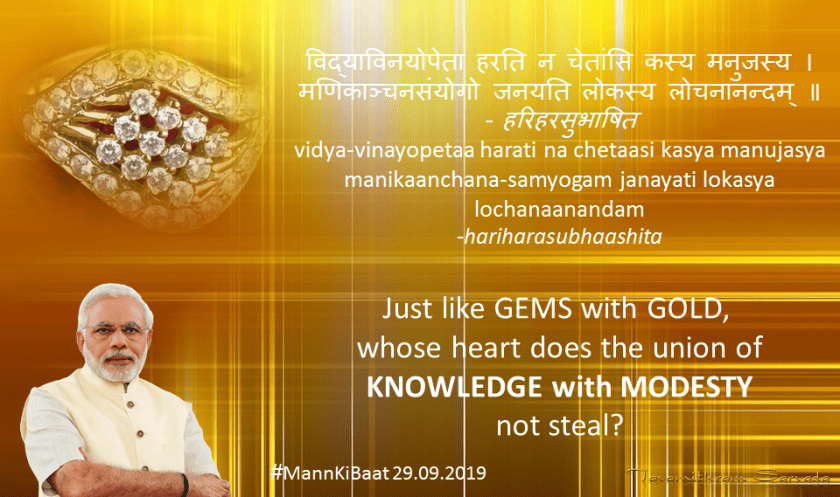
Among the different topics he spoke about in “Mann ki Baat” dated 29.09.2019, he touched upon the topic of modesty. Shri Modiji called the legendary singer Lata Mangeshkar on the telephone and greeted her for birthday. The telephone conversation was broadcast in the programme. When Shri Modiji admired her for all her achievements, the great singer humbly said that she owed everything to her parents and of course to her listeners. This modesty of hers despite her being a great star, earned her another round of lavish appreciation from Shri Modiji.
Shri Modiji quoted the above poem from the Hariharasubhaashita of Harihara, which likens the union of knowledge and modesty with that of gems and gold.
An expensive decorative earthen vase ceases to be one the moment it falls from a height of two feet or when it is struck by someone using a hard object. However, the fact that it is earth, never changes. The broken pieces of an earthen vase can be crushed, kneaded using water, be put on a potter’s wheel and formed into a new vase, jug or pot again.
Likewise, people are nothing but pure consciousness in different physical forms which are not permanent. All external forms undergo changes, but the true Self can neither be changed nor destroyed.
SBG 2:20 The Self is never born, nor does it die at any time. It does not come into existence by being born. The Self is constant. It is not killed when the body dies.
SBG 13:32 Just as the all-pervading ether is not tainted because of its subtlety, the Self that is seated everywhere in the body, does not mix with it nor is affected by it.
Those who are aware of the above truth are not affected by states of mind such as vanity, arrogance, narcissism, fear, greed, jealousy and hatred.
Shri Bhagavan Krishna taught Arjuna the importance of knowledge without any arrogance.
SBG 3:27 All actions are done by the three kinds of material nature called ‘Gunas’, but he, whose mind is deluded by false ego and arrogance, thinks “I am the doer.”
SBG 3:30 Renounce all your works completely in me, with your mind with full knowledge of the Self and without expecting any benefits. Be clear of arrogance and laziness and fight.
SBG 3:28 But O mighty-armed Arjuna, the one who knows the absolute Truth that the Gunas and the actions springing from them are different from the Self, is not attached. They understand that it is not the Self, but it is the Gunas that go for the respective objects, which are also products of the same Gunas.
SBG 4:19 A person, whose every action is devoid of selfish desires and whose actions are burned by the fire of knowledge is known to be a wise and highly learned person.
SBG 4:34 Acquire knowledge through reverence to teachers who have known the Truth, serve them and ask them questions until all of them are answered. The wise who know the Truth will teach it to you.
SBG 4:35 After acquiring that knowledge, O Arjuna, you will not be deluded like this anymore and by that knowledge, you will see all creatures in you and them in Me.
SBG 4:37 Just as a blazing fire burns wood used as fuel into ashes, O Arjuna, knowledge burns all actions and reactions due to material activities, into ashes.
“A great man is always willing to be little.” – Ralph Waldo Emerson
One of the main problems with many Sanatana Dharmic people aka Hindus is their sheer laziness to spend 3 hours of their time to read a simple translation of the Srimad Bhagavad Gita in a language of their choice. They would gladly spend that time to watch some film but would find it extremely difficult to invest it to acquire the knowledge taught in the Srimad Bhagavad Gita. In reality, one or two thorough reads of the great scripture can clear their mind and make them a hundred times smarter and more knowledgeable about life, death, Krishna, Brahman, Karma, Dharma and Advaita Vedanta in general than many of the bearded charlatans masquerading as great spiritual gurus and roll in the wealth created from their gullible and sycophantic followers who are plain lackadaisical to read the Srimad Bhagavad Gita.
Not reading the Srimad Bhagavad Gita which is the nectar of all the Vedas, and not learning at least the basics of organised cults that arrived into India through marauders, usurpers and colonisers, are two of the prime causes for what is known as ‘Hindu-bashing’ which is increasing and also the conversion of Dharmic people into ridiculous desert cults based on bizarre ideas of God.
Reading the Srimad Bhagavad Gita or going through it at least once is a simple yet most important step that everyone could take in order to protect and preserve the Sanatana Dharma apart from glorifying it and presenting it to future generations in a rational, logical and scientific manner.
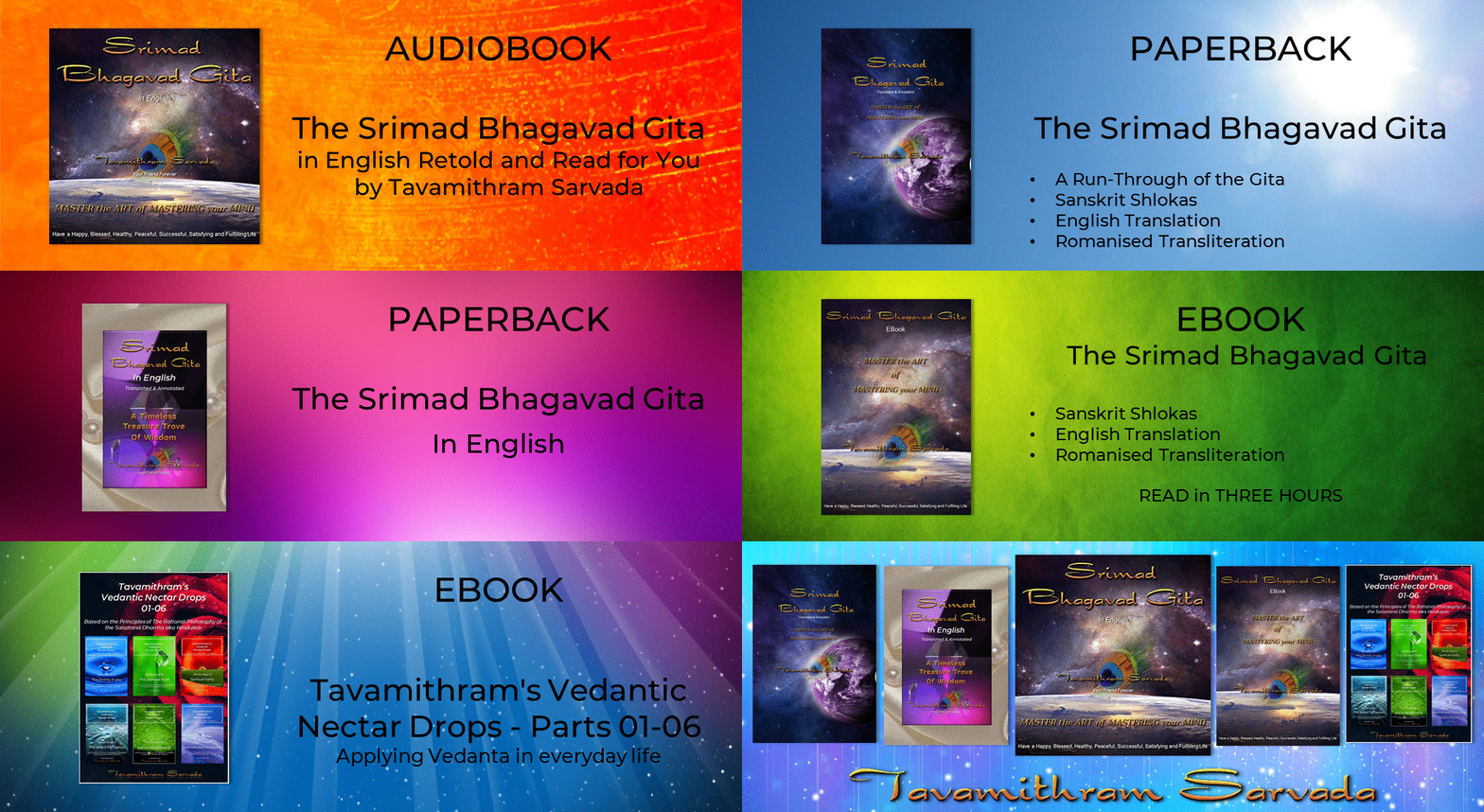
The new audiobook “The Srimad Bhagavad Gita in English retold and read for you by Tavamithram Sarvada,” has been made in order to make it easier for people who either do not have the time, the patience or the inclination to take the grand step of reading the book and receiving great enlightenment in their life.
Please click on the links given below to the different stores from where the Audiobook can be downloaded.
May you all be blessed with the Divine knowledge of the Srimad Bhagavad Gita imparted by Bhagavan Shri Krishna and may you and your loved ones live a healthy, peaceful, prosperous and fulfilling life.
Jai Shri Krishna
———————————————–
It is your personal Audiobook that you can hear anytime – while you are at home, while driving, while travelling, when you are taking a walk or simply when you feel like taking off from your routine and calming your mind and empowering yourself with Divine Knowledge, Blessings and Energy.
20 minute sample of the audiobook: “The Srimad Bhagavad Gita in English retold and read for you by Tavamithram Sarvada”
Listen (Use headphones)
CLICK ON ANY STORE ICON BELOW TO BUY THE AUDIOBOOK
The musk deer is, in fact, the perfect example of the tendency of most people to spend their whole life looking for God when the Self in them is that God that they are looking for. The ultimate goal of the study of Advaita Vedanta for a seeker, is to learn to realise their true Self which is pure Divinity.
SBG 6:31 He who is in union with Me and worships Me residing in all beings, becomes a Yogi and, whatever circumstances he may be in, resides in Me.
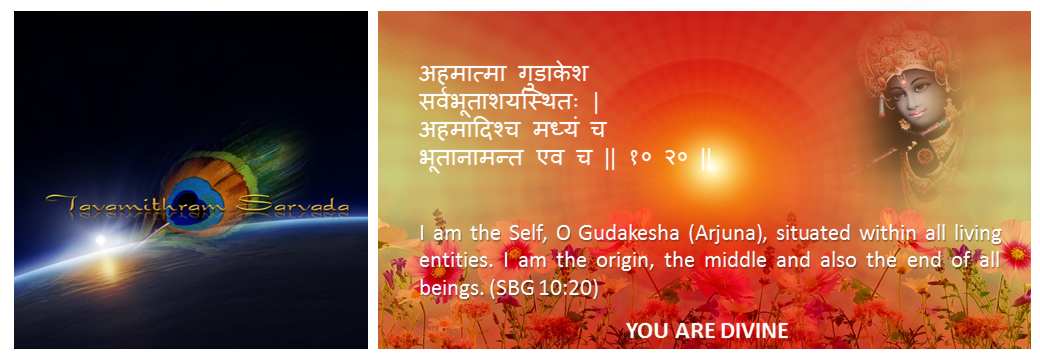
SBG 10:20 I am the Self, O Arjuna, situated within all living entities. I am the origin, the middle and also the end of all beings.
SBG 13:02 You should know that the Kshetrajna or the embodied Self in all bodies or Kshetras is Me, O Arjuna. Knowing about the Kshetra and the Kshetrajnas is called knowledge.
SBG13:27 The person who truly sees is the one who sees the Supreme Bhagavan, existing equally, the unperishing within the perishing.
The Mandukya Upanishad, which is the shortest Upanishad with merely 12 verses, analyses the syllable ‘AUM’ and explains through it the four states of consciousness. Watch the video on the Mandukya Upanishad below.
May you realise the divinity in you and understand that as in organised cults, the Advaita Vedanta does not propound the concept of a god being a separate being living somewhere up above. It is unfortunate that the lack of this vital knowledge drives people into confusion, mental delusion, mental slavery of soul merchants and kicks them out of the right course towards the Supreme Goal of creating great positive Karma and attaining Superconsciousness.
The Advaita Vedanta is the ultimate philosophy, understanding which, can straightaway lead you to eternal bliss.
Your personal Audiobook that you can hear anytime – while you are at home, while driving, while travelling, when you are taking a walk or simply when you feel like taking off from your routine and calming your mind and empowering yourself with Divine Knowledge, Blessings and Energy.
CLICK ON ANY STORE ICON BELOW TO BUY THE AUDIOBOOK
Click below to go to our Srimad Bhagavad Gita site where each Shloka is given in Sanskrit along with the corresponding transliteration using the Roman script and translation of all the verses in simple English.
It is almost time for Vrischikans (people with the lunar sign of Scorpio) to say ‘PHEW! What a ride!’ That is because their life-changing period of Sadé Sati, which began on the 14th of November 2011, is due to end a couple of hours after the 24th sunrise of January 2020. Although the period is known as Sadé Sati or ‘seven and a half’, it has already been, as of today, seven years and ten months since that ‘fateful’ day that ushered in a tumultuous, challenging and metamorphic stint in the lives of Vrischikans.
On the one hand, we have Vrischikans who lost their positions, jobs, businesses, wealth, property and even loved ones, but on the other, there are Vrischikans whose lives were either not much affected during the Sadé Sati period or those who rose to great heights in life during this time. Our beloved Prime Minister Shri Modiji is one great example of a Vrishikan who rose to the position of being the leader of the world’s largest democracy within merely three years after his Sadé Sati started.
Ever since I started this blog/site on the 7th of February 2014, I have been sharing what I have learned as well as my positive thoughts in order to help people maintain composure, increase mental strength, develop patience, refine their virtues, shed ego and arrogance, and above all, to the learn The Srimad Bhagavad Gita. I have also explained clearly about Advaita Vedanta; Karma, Dharma; about certain Upanishads; that Vedic Astrology is a ‘Karma diagnosis tool’; that planets do not control people’s lives but all that happens in one’s life is due to their own Karma; and that the best way to alter one’s life is to work on one’s Gunas taking the help of the Divine Knowledge imparted by Shri Bhagavan Krishna in The Srimad Bhagavad Gita.
However, it needs to be said that for a lot of people, the subject of astrology is like dope. Whatever and how much ever they are taught about Advaita Vedanta and Karma being the cause of all events, inequalities, troubles, challenges as well as their moments of crowning glory, they will still continue to look for someone or some website that makes astrological predictions that their stars augur a good future for them. They flatly refuse to use their basic intelligence and common sense to figure out that the possibility of the ringed planet called Saturn, which is seven hundred times the size of the earth, ruining the lives of a human being born under a particular zodiac sign is far-fetched.
Nevertheless, for the benefit of those who continue to be obstinate in not wanting to learn and imbibe the Divine Knowledge taught in The Bhagavad Gita but continue to believe that planets are the ones that are responsible for all good and unpleasant events in their lives, I would like to state the following encouraging predictions based on the rules as per Vedic astrology.
The Good News On January 24 2020, Saturn will enter Makara Rashi or Capricorn, which is the 3rd house for Vrischikans. Ancient Rishis have written that the transits of Saturn into the third, sixth and eleventh houses are exceptionally favourable ones. This means that this transit is going to be extraordinarily amazing for three Rashis or lunar signs namely, Vrischika (Scorpio), Simha (Leo) and Meena (Pisces). Saturn will remain in the house of Makara for a period of 36 months except for short durations of retrograde movements.
Now here comes the catch. The position will be an extremely favourable one provided people maintain discipline and have noble virtues in them. Qualities such as laziness, vanity, rudeness, dishonesty and disloyalty can completely block all the luck that is at the moment almost on the doorsteps of people born under the three signs and waiting to shower them with an abundance of all good things in life.
In order to have a clearer mind or rather a less foggy one after having undergone a major transformation during the chastening Sadé Sati period and before commencing a new inning in life, Vrischikans who have been affected during the seven and a half year period might want to take a look at some important tasks that they could consider completing on time. Performing these tasks and empowering yourselves with a better understanding of the SELF, Krishna, Sadé Sati, Karma, Gunas, the 60 20 20 equation of settling Karma, and of making the best use of the remaining months in Sadé Sati are what you should now be looking into.
3. Make sure that you have completely done away with your ego.
4. Check your levels of modesty and humility that you have reached during your Sadé Sati and be sure that you do not have even an iota of arrogance left in you.
5. In case you have not been smart enough to make good use of your down years to work on improving your physical health, start doing it right away. How about starting a new habit to walk at least 1.5 hours every day or joining a gym?
6. Take your time to think and confirm that there are not even the smallest traces of hate in your heart, be it for someone or for something.
7. 60% of your destiny was created by you in your past Janmas and you can do nothing to change it. 20% of your destiny has been created by your actions caused by your Gunas in your current Janma and this too is unalterable. The remaining 20%, however, is still open for you and the choice to add either positive or negative Karma to the equation, is purely yours. Please do get one thing straight – No god, No planet or No other entity is either doing you good nor is destroying you. It is your own Gunas that are solely responsible for all that happens in your life. (See SBG 3:27-28)
The forthcoming 36-month stay of planet Saturn in Makara, that begins in January 2020, contains three important celestial events, namely, one Rahu transit and two Guru transits which can indicate quite remarkable developments in your life. However, benefitting from them or inviting new troubles in the periods indicated by these planetary transits totally depends on how well prepared a Vrischikan you are.
Vrischikans, please start organising yourselves for a brand new part of your life which, if you have fulfilled your Sadé Sati training period well, will be so awesome that the force with which it will stun you positively will be much greater than the force with which the onset of your Sadé Sati shocked you in 2011.
Take a deep breath, be proud of yourselves for the patience you have had during your Sadé Sati and be thankful for all the divine protection that you have been receiving all along. Remember that things could have been worse! Start visualising the chequered flag at the end of the gruelling rally that you have been through. Bear in mind that when your time comes and when you achieve great success, it would be necessary for you to be kind and generous. Please be careful so as to not rush into things only because you are in a great hurry to get back all that you lost and do not forget that the massive amounts of pain you endured since eight years might cause a proclivity in you to develop a vengeful attitude which can only ruin the loads of Karma credits you have earned through your kind gestures to others, and through facing defeat, insults, joblessness, financial crunches, troubles in the family and other painful as well as heart-breaking situations.
The most important rule to be remembered is that the end of Sadé Sati does not guarantee the end of all troubles. It is only a proper understanding of Karma and of righteous living as per Dharma that will greatly contribute towards putting unpleasant things behind you and creating a new blessed life and world for you as well as for your loved ones. A balanced mind is the key to such a life.
SBG 2:55 Shree Bhagavan Krishna said: The one who has given up all desires of the heart and has a purified mind which finds joy in itself and not in external factors is called a ‘Stithapragnya’ who is a person of steady consciousness.
SBG 2:56 He who is not agitated or disturbed despite by the threefold miseries, or is also not euphoric when he has comforts, and is free from attachment, fear and anger, is called a sage with a steady mind.
Note- The threefold miseries are: Miseries that arise from the mind and the body. Miseries caused by other living beings. Miseries caused by natural disasters over which we have no control.
May the priceless knowledge and experience that you have gained during your Sadé Sati help you in living the rest of your current Janma as a Karmayogi and ‘Stithapragnya’, and may you be showered upon with the Divine Blessings of the Supreme Bhagavan Krishna.
Best wishes.
Jai Shri Krishna
Audiobook
The Srimad Bhagavad Gita in English retold and read for you by Tavamithram Sarvada
Being a person who has been through life-threatening situations in which the chances of my surviving looked quite bleak, and after having discussed in the last couple of decades with many others like me, who had been to the edge of life, I can confidently state some of the thoughts that ran in our minds during those moments which could have been our last ones.
They were: 1. “What have I done in my life?” and NOT “How comfortably did I live my life?”! 2. “What all did I experience and not experience in life” and NOT “How much money did I make or how much real estate I possessed?”! 3. “Who were the people I hurt but did not apologise to for hurting them?” and NOT “How many people did I miss hurting?”! 4. “I should have taken that opportunity instead of missing it due to silly reasons.” 5. “How interesting has my life been?” and NOT “How comfortable has my life been?”!
In my post “The Cup of Life“ dated 13.08.2019, I had written, “People who have celebrated life and have lived it to the fullest, relish the crescendo of life as well as its climax moment, while those who have been sad, discontent, selfish, egoistic, angry or bitter all through their time on earth, don’t.”
The very purpose of life is learning – Learning to learn; to get up from a fall; to experience good and bad as well as pleasure and pain; to love; to share; to endure; to survive, and conclude a lifetime feeling one with the system. At the time of departure, it is a life full of surprises, different people and great experiences that one usually wishes they had. Those who have had such a life, are the ones that are the happiest during the final seconds of earthly existence. Having lived a plush, comfortable and trouble-free life at someone else’s cost is certainly not what makes people happy at that highest moment. The happiest are those who loved; were kind; kept their word; loved children; loved animals; admired flowers and butterflies; enjoyed gardening; cooked with passion; dreamt; strived; struggled; worked hard; shared; burned and fell but rose again from the ashes; built their world on their own from nothing; helped others and made them happy; contributed towards protecting nature, and left a legacy behind that generations of people could benefit from.
During the years when I was much younger, many of my friends disapproved my decision to choose an adventurous life instead of a peaceful one that a person enjoys by doing a comfortable ‘9 to 5’ job. Well, the result of my decision has been my highly eventful, extremely thrilling, enormously rewarding and greatly educative life that is filled with such a large number of stories that even after my son has turned 15, I have still not managed to recount to him beyond 15-18% of all that has happened in my life so far.
It would definitely be great to possess a lot of wealth, but what about those who are not affluent? Why should they feel sad for not possessing something that does not guarantee great health, peace and happiness? The truth is that, a truly rich life is one which is rich with various kinds of experiences, one in which you met many people, and one that teaches you stuff that no university can ever teach. If one had Moksha or salvation as the ultimate goal, learning through experience would be the only way to get there.
Therefore, experiences, both good and bad, are amazing divine blessings that one needs to be thankful for. But for them, one neither grows nor evolves. However, during troubling times in life, reading the following Shloka should help one get some solace :
मात्रास्पर्शास्तु कौन्तेय शीतोष्णसुखदुःखदाः |
आगमापायिनोऽनित्यास्तांस्तितिक्षस्व भारत || २ १४ ||
maatra-sparshaas-tu kaunteya sheetoshna-sukhad-duhkhadaaha
aagamaa-paayino-‘nityaas- taam-sthithikshasva-bhaarata SBG 2:14 O son of Kunti (Arjuna), impermanent things like happiness and sadness, heat and cold in summer and winter, come and go. They are temporary so learn to endure them.
Be a free thinking and modest seeker.
May Divine Blessings continue to shower upon you, giving you a rich and fulfilling life.
Almost everyone has undergone heartaches caused by someone who hurt them or left them for someone else. It could have been among school friends, colleagues, relatives or romantic couples who had sworn earlier they would never leave. From a psychological point of view, such a heartache can be said to be a result of ego, attachment and the will to possess the loved person.
Love, attachment and being possessive about a person or object you love are in fact often confused with one another. When you truly love someone, you wish them well and do not try to possess them.
True love is truly loving, wishing the loved one well and expecting nothing in return.
In reality, all relationships except the one with the Supreme Brahman or Krishna, are bound to end in pain and separation, at least through the death of either of the two in the relationship. Excessive attachment to a person or object also gives rise to the fear of losing who or what one is attached to and this damages trust, causes suspicion and ruins one’s peace of mind.
Attachment to a person usually stems from the state of mind that one achieves through the relationship. The relationship satisfies one or more desires of the person. Bhagavan Krishna has explained the repercussions of being attached to a person or object as follows:
SBG 2:63 A person who thinks of sense objects develops an attachment for them. From this attachment desires are born and from desires, anger is born.
SBG 2:63 Anger gives birth to delusion and this delusion results in confusion of memory. When memory is confused, intelligence is destroyed and from the destruction of intelligence, the person perishes.
Bhagavan Krishna also says that the way to achieve a calm state of mind is not through suppressing the senses but by controlling them.
SBG 3:33 The learned act according to their own nature. All beings follow their own nature. What can suppression do?
SBG 3:34 It is natural to be attracted to or to be repelled by sense objects pertaining to each sense. However, one should not come under their control because they are obstacles in one’s path towards self-realisation.
Bhagavan Krishna explains in Chapter Two of the Srimad Bhagavad Gita who a ‘Sthithapragnya’ or a steady minded person is. A ‘Sthithapragnya’ is one who has perfect control over the senses. A Yogi who is a Stithapragnya has a stable mind and is steady even when sense objects come to him. He remains unmoved and enjoys eternal peace.
SBG 2:55 Shree Bhagavan Krishna says: One who has given up all desires of the heart and has a purified mind, which finds joy in itself and not in external factors, is called a ‘Stithapragnya’ or a person of steady consciousness.
SBG 2:56 He who is not agitated or disturbed despite by the threefold miseries, or is also not euphoric when he has comforts; and is free from attachment, fear and anger, is called a sage with a steady mind.
Note: The threefold miseries are:
Miseries that arise from the mind and the body,
Miseries caused by other living beings
Miseries caused by natural disasters over which we have no control.
SBG 2:57 He who is free from attachment and neither rejoices when he achieves good nor hates evil, has steady wisdom and perfect knowledge.
Reaching such a state of mind free from delusion and being in it even during the time of death, unites one with the Supreme Being.
The sources of happiness and sorrow are explained in Shloka 160 of the 4th Chapter of the Manu Smriti:
सर्वं परवशं दुःखं सर्वं आत्मवशं सुखम् ।
एतद्विद्यात्समासेन लक्षणं सुखदुःखयोः ।।
sarvam paravasham duhkham sarvam aatmavasham sukham
etad-viddhyaat-samaasena lakshanam sukha-duhkhayo (MS 4:160) Everything becomes a cause for sorrow if one is dependent on it for happiness, whereas, everything turns into happiness when one is dependent on oneself.
SBG 14:16It is said that the fruits of righteous actions performed in Sattva are pure; those performed in Rajas, result in pain; and the fruit of work done in Tamas, is darkness.
SBG 5:03 A person who neither hates nor desires the results of his actions is known to be a Sanyasi or one who has renounced everything. Such a person is free from dualities and is therefore liberated from material bondage.
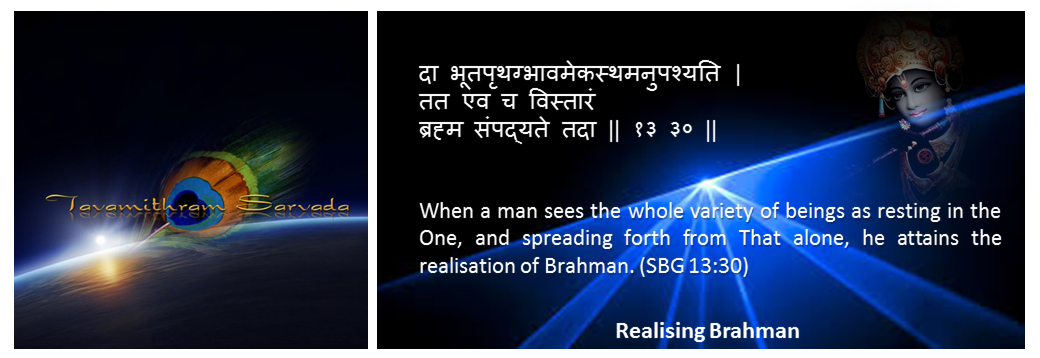
SBG 13:30 When a man sees the whole variety of beings as resting in the One and spreading forth from That alone, he attains the realisation of Brahman.
Note:
A man becomes one with the Supreme Brahman when he realises that all these various forms are rooted in the One.
Shri Ramana Maharishi was once asked, how to pray for other people. The Maharishi answered, “If you are abiding within the Self, there are no other people. You and I are the same. When I pray for you I pray for myself and when I pray for myself I pray for you. Real prayer is to abide within the Self. This is the meaning of ‘Tat Tvam Asi’ – ‘That Thou Art.’ There can be no separation in the Self. There is no need for prayer for yourself or any person other than to abide within the Self.”
Those who comprehend the message given above will be free from heartaches.
Going through the Ishavasya Upanishad should also help:
Your personal Audiobook that you can hear anytime – while you are at home, while driving, while travelling, when you are taking a walk or simply when you feel like taking off from your routine and calming your mind and empowering yourself with Divine Knowledge, Blessings and Energy.
Go to one of the stores given below
A 20 sample of the audiobook.
Namaste.
The ‘Who am I’ question has always intrigued people of almost all civilisations. There have been numerous renowned philosophers who came out with their own answers to the question. The French philosopher René Descartes, who is known as the father of modern philosophy, gave a conclusive statement, saying, “I think, and therefore I am.” He meant that it is only through our mind that we know that we exist and therefore if we can think, we exist. On the other hand, according to the teachings of the Srimad Bhagavad Gita, it is “I am, and therefore I think!”
Feelings such as happiness, sadness, fear, anger, desperation, hatred, etc are states of mind. You are happy or sad only when you think of whatever it is that gives you those feelings. It is the way you perceive different situations that cause to the different states of mind. One one hand, being attached to people, to objects, to one’s work or accomplishments apart from their feeling of ownership of what they believe they possess, can give rise to the fear of the risk of losing them. This fear of losing leads people to take the wrong decisions, which can have serious repercussions and cause irreversible damages in one’s life. When the fear of losing has taken control over one’s mind, they not only give up, but they also give themselves lame excuses and baseless reasons in order to justify to themselves their decision to quit. This decision to quit, however, does not solve their problem or make them feel better! It only makes them even more despondent.
The Bhagavad Gita begins with the chapter that talks about the feelings of despondency, weakness and confusion that took over Arjuna’s intellect. His despondent state of mind was about to turn him, who was known as a valiant, intelligent and knowledgeable warrior king, into a coward, destroy his perspicacity and drive him towards delusion, failure, defeat and ignominy.
However, Arjuna took an extremely important step that people in a despondent state of mind need to take in order to improve their situation and achieve their goals. What he did was to concede that he had an unclear mind, and asked Krishna to accept him as His pupil and teach him the way to counter the problem that he was facing. The knowledge and advice that Arjuna received from Krishna, changed his way of thinking and perceiving things, as a result of which, Arjuna attained grand success.
The two hours and fifty minutes that you spend on this audiobook of the complete Srimad Bhagavad Gita in English presented by Tavamithram Sarvada will help you:
Correct flaws in your thinking as well as in your perception of reality,
Understand the natural ‘Cause and Effect’ principle,
Become fearless, self-confident, generous and socially responsible
Reset your life by learning to override all your negative past Karma through Divine Knowledge, and,
Most importantly, learn to recognise your TRUE SELF and Master the Art of Mastering your Mind
‘Corporate Social Responsibility’ or CSR, is the modern term for a company’s responsibility to people, society and the environment. Large conglomerates learned that in order to achieve sustainability in their businesses, they had to ensure that the welfare of all the participants in the entire business process was of utmost importance.
Many great kings and queens who ruled in the past, passed ordinances and carried out projects that ensured the upliftment of the people.
A lot of people carry noble intentions in their heart. Intentions such as being of use to the society by helping the needy in whichever way possible. However, the self-doubt that clouds the minds of most people, due to their feelings of inadequacy or ignorance of ways to perform such noble acts, prevents them from doing charitable works.
The fact of the matter is that the more one sincerely thinks of the welfare of the world, the higher will be the chances of their becoming instruments in the Divine Hands of Krishna (SBG 11:33). As many of you might have understood from the SBG, it is not us but it is our Gunas that are the ‘doers’ of actions. Unfortunately, many people erroneously think that they are doing things (SBG 3:27).
As a matter of fact, something as simple as merely thinking sincerely about the welfare of others and requesting the Supreme Being to be considered for the job of being an instrument in His Divine Hands, would mean that our Gunas are tuned to be more Sattvik and this, in turn, would mean that we are on the right path towards perfection. Many large charity organisations were started by people who were in the lowest ebbs of their lives. What they did during the times they struggled was that they empathised with all others like them who were going through challenges in life, and with the sincere wish to help them, took their first small step in that direction by sharing whatever they had with those who did not.
SBG 2:39 O Arjuna, I have declared to you the Truth according to the Sankhya or the path of knowledge. Now listen to the teaching of Yoga, which is the path of selfless action combined with devotion. By practising this, you will free yourself from the bondage of actions.
SBG 2:40 There is no loss in taking up such a task in this world. Even a little bit of progress in Dharma will free you from grave danger.
SBG 3:20 Even Janaka and other kings attained perfection through action. You should perform action with the view of being of benefit to the people of the world.
SBG 3:25 Just as ignorant people perform actions with attachment to the results, learned people perform work, but with no attachments. Their desire, if at all, is only the welfare of the world.
SBG 14:06 Of these, Sattva, which due to its purity is luminous and healthy, frees a person of all Karmic reactions. Those of this Guna are attached to knowledge and to happiness, O sinless one.
No one can know everything. Not even an expert in a particular field knows everything about it. All of us are continuously evolving. Therefore, the lack of experience or knowledge in something should never stop us from thinking in that direction. Once we enter an area with focus and dedication, all the knowledge that we gained in our previous Janmas, that is stored in our Karmic memory, will come back to the forefront and guide us on our journey (6:43-44).
When I started this site in February 2014, I too did not have much knowledge of blogging. In fact, I still don’t think I qualify to be included even under the category of mediocre bloggers. However, I gather from people that whatever small work I am doing through this site is helping them and this greatly humbles me apart from making me feel that I should be doing even more as service to others and to the Supreme Bhagavan Krishna.
SBG 9:27 Whatever you do, whatever you eat, whatever you offer in sacrifice, whatever you give, whatever you practise as austerity, O Arjuna, do it for Me and as an offering unto Me.
SBG 6:40 Bhagavan Shri Krishna said (to Arjuna): O Arjuna, neither in this world nor in the next world, is there destruction for him; because the one who does good, O My dear friend, never comes to evil.
Think of the famous starfish story in which the young boy said to the elderly man with great joy, as he threw back one starfish into the sea, that although he could not save the lives all the thousands of starfish washed ashore, he could save that one creature. You do not have to be able to help the entire society. You could consider yourself highly lucky and blessed so much if, through your acts, you are able to be of use to a few people or even one single living being.
The Sanatana Dharma is a path for seekers, which means it is a path which helps its followers EVOLVE CONTINUOUSLY. Another important truth is that the Sanatana Dharma is not an organised religion with dos, don’ts, rewards and punishments.
It is purely based on the natural principle of ‘Cause and Effect’. With every action of ours, we create Karma. I am sure you will agree with me if I said that stealing and drinking the milk that a cow produces for its babies is certainly not a noble act. Females among mammals produce milk that contains all the nutrition required to help the little one of their respective species grow into a healthy adult. Bovine milk, for example, contains hormones that can make a little calf grow into a 270 to 300 Kg animal in a period of a year.
The different cultures practised by people always started with someone doing it for the first time. When powerful or famous people practise something, whatever they practise is usually emulated by the people below them. SBG 3:21 Whatever or whichever action an important person does, others follow him and emulate him. What he does becomes a standard for the others.
People who follow blindly what others do cannot be considered to be particularly intelligent. Sheep do the same thing too by following their shepherd.
Unlike the way it is in organised religions that enslave their followers with commandments or divine rules, Bhagavan Krishna, towards the end of His discourse to Arjuna, says, (SBG 18:63) I have taught you THE SECRET WISDOM which is deeper than all that is confidential and profound. REFLECT FULLY on what I have declared to you, and DO WHAT YOU WISH TO DO.
Instead of trying to find out why Krishna is depicted to be One who drank bovine milk and consumed butter made from it, it would be better to REFLECT upon and RESEARCH the matter, and ask yourself if it would be right in any way to snatch the milk meant for babies of another species or to kill animals and consume them. Cows and other animals do not queue up before dairy farms or slaughterhouses, offering their milk or flesh! As if it were their right, humans TAKE what they want from innocent voiceless animals. Apart from the ethical or moral angle in consuming animal products, one needs to look at what drives today’s gargantuan food industry. The only factor that the food industry works for is PROFITS. In order to create more profits, they need to produce more, and in order to produce more, they resort to unnatural methods such as injecting poor female mammals with various drugs which include Oxytocin, Bovine somatotrophin, etc. Do not forget that food created by tampering with nature, leads to an imbalance in its basic chemical structure and that makes it carcinogenic.
One of the first instructions that doctors give patients of serious diseases such as cancer is to STOP CONSUMING ALL ANIMAL PRODUCTS INCLUDING DAIRY. They are asked to go for a diet of RAW VEGETABLES. Another example is that of people with Autism Spectrum Disorders who are usually prescribed a casein-free diet, which means removing all dairy products from the diet.
A very long time ago, our ancestors used to live in caves, but we don’t, do we? They did a lot of things which we don’t. That is called human evolution.
I can say from my experience that since the time I changed from being a pure vegetarian to a vegan and have gone back to regular exercise, I have been experiencing everything that people above the age of about thirty-five would dream of – Excellent Fitness; Increased Physical Strength and Stamina; Lesser wrinkles due to tighter skin; Cheerfulness; and an Overall Age-Reversal. The most important benefits of going 100 % plant-based are, the crystal clear conscience as well as the feeling of relief and peace that it gives caused by shutting a prime source of excessive amounts of negative Karma which I will have to balance through many lifetimes.
Karma Yoga can be defined as the ‘Yoga of action’ or ‘Yoga of active action.’ It means action without attachment to one’s actions. Karma Yoga should not be confused with selfless service.
Karma Yoga or the path of rightful action is one in which a person strives to surrender all of their human activity to the sublime will. It begins with the renunciation of all egoistic purposes of their works, of all undertakings of action out of egoistic interest or for the sake of a worldly result.
As per Karma Yoga taught in the Srimad Bhagavad Gita; serenity, renunciation of all desire for the fruit of our action, and action offered as a sacrifice to the sublime Lord of our nature and of all nature; are the three basic approaches to the Supreme Bhagavan. It is one of the three recommended Margas of paths to attain Moksha or salvation.
Swami Vivekananda said, “When you have trained your mind and your nerves to realise this idea of the world’s non-dependence on you or on anybody, there will then be no reaction in the form of pain resulting from work.” – Karma Yoga: The Yoga of action
Below are some selected Shlokas from the Srimad Bhagavad Gita, that can help a seeker understand Karma Yoga better. PLEASE DO READ THEM CAREFULLY AND PATIENTLY!
SBG 2:37 Either you will be killed in the battle and you will enter heaven or, you will win this battle and enjoy the kingdom on earth. Therefore arise and fight with resolution.
SBG 2:47 You have the right only to work but never to claim its results. The results of your actions should never be your motive but at the same time, let this not make you attached to inaction.
SBG 2:48 You have to be established in Yoga, O Arjuna. You have to do your duty without any attachment to its success or to its failure. This kind of equanimity is known as Yoga.
SBG 3.19 Therefore, always perform your duty or work unattached because the one performing work without attachment will certainly attain the Supreme.
SBG 3:20 Even Janaka and other kings attained perfection through action. You should perform action with the view of being of benefit to the people of the world.
SBG 3:30 Renounce all your works completely in me, with your mind with full knowledge of the Self and without expecting any benefits. Be clear of arrogance and laziness and fight.
SBG 4:15 Ancient people who sought liberation, performed actions based on this truth. Hence, you too should perform your duty in Supreme Consciousness.
SBG 5:02 Bhagavan Shri Krishna said: Renunciation and the Yoga of performing selfless action both lead to liberation. However, among the two, the Yoga of performing selfless action is superior to the Yoga of renunciation of action.
SBG 5:07 A person who is devoted to the path of selfless action, has a pure mind and a purified soul, has his body and senses under control, is compassionate to all living beings and sees his Self in them, although engaged in work, is never in bondage.
SBG 5:10 One, who dedicates all his actions to the Supreme Bhagavan and gives up all attachment to his works, is untouched by sin, just as a lotus leaf is by water.
SBG 5:19 Even here in this life, those who have their minds situated in equality and in equanimity, have conquered dualities, are flawless and are situated in the Ultimate truth.
SBG 5:25 Those whose sins have been destroyed, whose minds are clear of doubts, and are always engaged in working for the welfare of all living beings, achieve liberation and absorption in the Supreme Bhagavan or Brahman.
SBG 6:01 He who performs his obligatory duty unattached to the fruit of his work, is a Sannyasi and Yogi following the way to attain Ultimate Consciousness. He is not just someone who has merely renounced action.
SBG 6:07 The one who has conquered the mind has already reached Superconsciousness. Such a person has crossed all dualities such as cold and heat; pleasure and pain; honour and dishonour; and is always balanced, peaceful and steadfast in devotion.
SBG 8:07 Therefore, think of me at all times and do your duty of fighting the battle. With your mind and intellect offered to Me, you will certainly attain Me.
SBG 9:27 Whatever you do, whatever you eat, whatever you offer in sacrifice, whatever you give, whatever you practise as austerity, O Arjuna, do it for Me and as an offering unto Me.
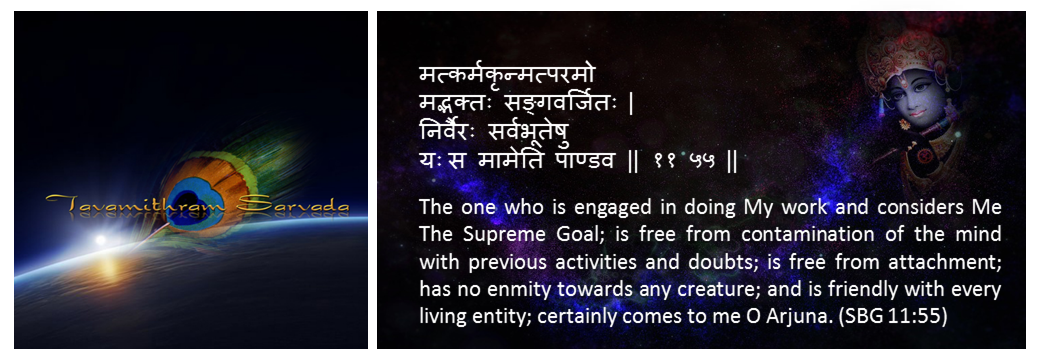
SBG 11:55 The one who is engaged in doing My work and considers Me The Supreme Goal; is free from contamination of the mind with previous activities and doubts; is free from attachment; has no enmity towards any creature, and is friendly with every living entity; certainly comes to me O Arjuna.
SBG 17:11 The sacrifice which is offered by people as taught in the Scriptures, without expecting any reward but with the faith to do it as a duty, is considered to be Sattvic or pure.
SBG 18:09 O Arjuna, an action that is done as a duty, giving up all attachment to the fruit of the action or desire for reward, is considered Sattvic.
SBG 18:66 Giving up all your ideas of righteousness or religion, take complete refuge in Me. I will liberate you from all sinful reactions. Do not fear.
There are countless Karma Yogis in the world who do their duty with utmost sincerity and dedication. However, the most popular and beloved one among them happens to be Shri Narendra Damodardas Modiji. He is truly who one of the greatest Karma Yogis, whose contemporary I am fortunate to be.
Jai Shri Krishna
Audiobook – The Srimad Bhagavad Gita in English, presented by Tavamithram
THE KARMA YOGI LEADER SHRI NARENDRA DAMODARDAS MODIJI







 It is almost time for Vrischikans (people with the lunar sign of Scorpio) to say ‘PHEW! What a ride!’ That is because their life-changing period of Sadé Sati, which began on the 14th of November 2011, is due to end a couple of hours after the 24th sunrise of January 2020. Although the period is known as Sadé Sati or ‘seven and a half’, it has already been, as of today, seven years and ten months since that ‘fateful’ day that ushered in a tumultuous, challenging and metamorphic stint in the lives of Vrischikans.






 SBG 6:40 Bhagavan Shri Krishna said (to Arjuna):
 One of the first instructions that doctors give patients of serious diseases such as cancer is to STOP CONSUMING ALL ANIMAL PRODUCTS INCLUDING DAIRY. They are asked to go for a diet of RAW VEGETABLES. Another example is that of people with Autism Spectrum Disorders who are usually prescribed a casein-free diet, which means removing all dairy products from the diet.
 Tavamithram Sarvada
