Q: What is the real message of the Bhagavad Gita? The Srimad Bhagavad Gita teaches systematically the understanding of the true Self, the mastery of perception, and the power of clarity and responsibility.
Q: Is the Gita a religious book? No. It is a philosophical text explaining the nature of the mind, awareness, clarity, and action.
Headphones are recommended for better focus, concentration, and effect.
ENGLISH The Srimad Bhagavad Gita – Explained Simply in English–No Confusion, Only Clarity!
SANSKRIT Narration in Sanskrit Text +Roman transliteration + English translation
Please turn off the auto subtitles generated by YouTube
When you watch it for the first time, go through the English translation of the Shlokas as you hear them in Sanskrit
The second time you watch it, you will find it easier to immerse yourself in the narration of the life-changing scripture, which is called the nectar of the Upanishads.
4. All the Upanishads are like the cows; the one who milks them is Krishna, the cowherd boy; Arjuna is the calf; and men who are wise and pure drink the milk, which is the supreme, immortal nectar of the Gita.
Feelings such as happiness, sadness, fear, anger, desperation, hatred, etc., are states of mind. You are happy or sad only when you think of whatever it is that gives you those feelings. It is the way you perceive different situations that causes the different states of mind. The fear of losing what or whom one is attached to leads people to take the wrong decisions, which can have serious repercussions and cause irreversible damages in one’s life. Attachment and the fear of losing can make people losers.
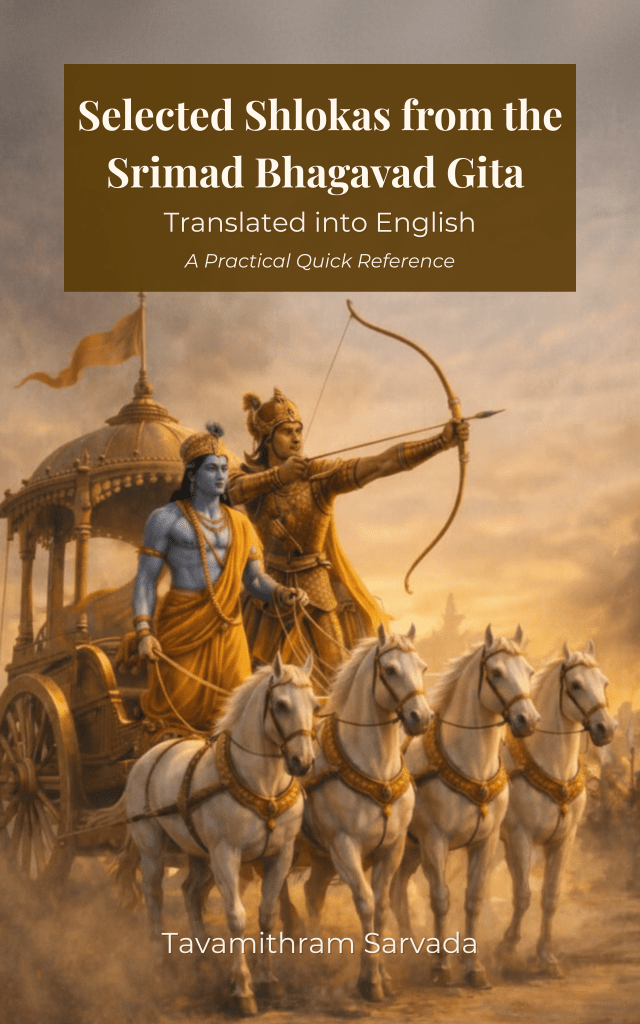
The Srimad Bhagavad Gita, one of the most important scriptures revered by the followers of the Sanatana Dharma aka Hinduism, is a transcript of the dialogue between Shri Bhagavan Krishna and Arjuna on the battlefield of Kurukshetra, as reported to King Dhritarashtra by his charioteer Sanjaya. The scripture begins with the chapter that talks about the feelings of despondency, weakness, and confusion that took over Arjuna’s intellect. The despondent state of mind of the valiant, intelligent, and knowledgeable warrior king Arjuna was about to turn him into a coward, destroy his perspicacity and drive him towards delusion, failure, defeat, and ignominy. However, Arjuna took a wise decision and that was to ask Krishna for guidance.
The time you spend on this video of the complete Srimad Bhagavad Gita in Sanskrit presented by Tavamithram Sarvada will help you:
i. Correct flaws in your thinking as well as in your perception of reality,
ii. Understand the natural “Cause and Effect” principle,
iii. Become fearless, self-confident, generous, and socially responsible,
iv. Reset your life by learning to override all your negative past Karma through Divine Knowledge, and,
v. Most importantly, recognise your TRUE SELF and Master the Art of Mastering your Mind
————————————————————–
The COMPLETE SRIMAD BHAGAVAD GITA in Sanskrit and English on UDEMY
If Krishna is the Self in everyone, why do people commit sinful deeds and suffer thereafter?
Why should He even allow such sins to take place?
How can we stay away from committing wrongful deeds?
Please explain in detail:
In order to answer the questions, it would be necessary, at the outset, to understand the ‘God’ concept as per Vedanta and make it clear that according to Vedanta, Krishna is not some theistic being separate from nature residing elsewhere, but He is the personification of the eternal, timeless, beginningless, and All-pervading God principle known as Brahman. This is an extremely important point to be borne in mind so that the seeker comprehends the metaphor in the Shlokas while studying the Srimad Bhagavad Gita.
Now, the main natural law on which all other laws stand is that of Cause and Effect, or simply Karma. There are no beginnings or ends, but a cyclical continuum of existence with different points or stages, of which one point or stage is the effect of the previous one and, at the same time, the cause of the next one.
Understanding and internalising the teaching of Krishna that it is your own Karma, your own inherent nature and your attitude that cause everything in your life, can straight away free you from the feeling of victimhood that could make you think that it is an unkind God, bad planets, curses or black magic by those who do not like you, or simply bad luck, that could be the cause of the challenges you face in your life. Just remember Cause and Effect, and you will come out of the non-productive and highly destructive mental feeling of being a victim. Take responsibility, and you will feel empowered because you will realise that it is you and only you who could change things in your life.
How Karma is ‘transported’ between different Janmas or lifetimes has been briefly explained in Shloka SBG 15:08. I also have a separate video on this topic titled, “Transmigration of the Atman and the Transport of KARMA between Janmas”.
Shloka SBG 15:08.
शरीरं यदवाप्नोति यच्चाप्युत्क्रामतीश्वरः |
गृहीत्वैतानि संयाति वायुर्गंधानिवाशयात् || १५ ८ ||
shareeram yada-vaapnoti
yacchaa-pyut-kraama-teesh-varaha
gruhee-tvaitaani samyaati
vaayur-gandhaa-nivaa-shayaat (SBG 15:08)
When the soul, which is the master, acquires a body, it takes the mind and the five senses from the body it has left, just as the wind takes different odours along with it.
Pain and pleasure are not the results of ‘punishments’ or rewards, respectively, given by a totalitarian, tyrannical, and egotistical theistic being called God, but they are components in the process of learning and self-development.
Just as the number of processes that gold undergoes right from the time of its extraction from goldmines, to refinement, and finally to being created as fine jewellery, it can be said that a Jivatma also goes through thousands and thousands of Janmas in its process of Karmic evolution in order to become fit for attaining Brahman and ending the cycle of its manifestations in countless perishable bodies that go through births and deaths.
I suggest that you pay close attention to the Shlokas that I quote because they not only back whatever I am saying, but they are in fact the prime source of the Vedanta philosophy that I so passionately teach.
In Shloka SBG 3:36 Arjuna asks Krishna
अर्जुन उवाच |
अथ केन प्रयुक्तोऽयं पापं चरति पूरुषः |
अनिच्छन्नपि वार्ष्णेय बलादिव नियोजितः || ३ ३६ ||
arjuna uvaacha
atha kena prayuktho ‘yam
paapam charathi puurushaha
anicchannapi vaarshNeya
balaadiva niyojitaha (SBG 3:36)
Arjuna said:
What prompts a man to perform sinful deeds, O descendant of Vrshni? Why does he commit such acts even without desiring to do them, as if he were forced?
Krishna answers as follows in SBG 3:37
श्रीभगवानुवाच |
काम एष क्रोध एष रजोगुणसमुद्भवः |
महाशनो महापाप्मा विद्ध्येनमिह वैरिणम् || ३ ३७ ||
sri bhagavaan uvaacha
kaama esha krodha esha
rajo-guNa-samud-bhavaha
mahaashano mahaa paapmaa
viddhyena-miha vairiNam (SBG 3:37)
Shri Bhagavan Krishna said:
Lust and anger are born out of the material nature called Rajoguna, which is insatiable and prompts man to commit sin. You must know that this is the greatest enemy in a man’s spiritual life.
SBG 3:38
धूमेनाव्रियते वह्निर्यथादर्शो मलेन च |
यथोल्बेनावृतो गर्भस्तथा तेनेदमावृतम् || ३ ३८ ||
dhuumenaa-vriyate vahnir-
yathaadarsho malena cha
yathol-benaavrto garbhas-
thathaa thenedha-maavrtham (SBG 3:38)
Just as a fire is covered by smoke, a mirror by dust and the foetus by the womb, the living being is covered by lust.
SBG 3:39
आवृतं ज्ञानमेतेन ज्ञानिनो नित्यवैरिणा |
कामरूपेण कौन्तेय दुष्पूरेणानलेन च || ३ ३९ ||
aavrtham gnyaana-metena
gnyaanino nitya-vairiNaa
kaama-ruupeNa kaunteya
dushpureNaa-nalena cha (SBG 3:39)
Man’s wisdom is covered by this permanent enemy which is in the form of lust, and it is like a fire which cannot be satisfied.
Now comes the Shloka in which it has been explained how past Karma shapes the attitude and actions in a new Janma
In Shloka SBG 18:61 Krishna says:
ईश्वरः सर्वभूतानां हृद्देशेऽर्जुन तिष्ठति |
भ्रामयन्सर्वभूतानि यन्त्रारूढानि मायया || १८ ६१ ||
eeshvarah sarva-bhootaanaam
hriddeshe’rjuna tisht-hati
bhraamayan-sarvabhootaani
yantraa-rood-haani maayayaa
(SBG 18:61)
The Supreme Bhagavan dwells in the hearts of all beings, O Arjuna, and in accordance to their respective Karma, He directs the wanderings of all beings by His Maya or illusive power, as if they were mounted on a machine.
The most important point to be noted and remembered here is that a person always has the choice of either performing a particular action or saying something, or not doing it.
You have the choice.
Think, speak, and act wisely.
SBG 18:51-53
The one with a pure intellect; who controls his mind with determination; relinquishes sense-objects beginning with sound; gives up attachment and hatred;
…takes to solitude, reduces food to just what is necessary; has his speech, body and mind completely under control; has his mind always engaged in concentration and meditation; takes refuge in dispassion;
…abandons egoism, false pride, violence, lust, anger and possessiveness; and becomes peaceful; is a person who is fit to attain Brahman or Super-Consciousness.
In Shloka 18:63 Krishna says:
इति ते ज्ञानमाख्यातं गुह्याद्गुह्यतरं मया |
विमृश्यैतदशेषेण यथेच्छसि तथा कुरु || १८ ६३ ||
iti te jnaana-maakhyaatam
guhyaad-guhyataram mayaa
vim-rushyaita-dashesheNa
yathe-cchasi tathaa kuru
(SBG 18:63)
I have taught you the secret wisdom which is deeper than all that is confidential and profound. Reflect fully on what I have declared to you, and do what you wish to do.
I could suggest a simple step, which one could take before saying something or performing any action. It can greatly help in preventing the collection of unnecessary Karma, and in also settling past Karma:
The step consists of two questions that you ask yourself:
What would happen if I said or did such and such a thing?
What would happen if I did not say or do such and such a thing?
By asking yourself the two questions above, although your nature, which is based on your past Karmic impressions or Samskaaras, might push you to say or do things, sense will surely prevail upon you, and you will make the right choice which would be most beneficial to you in your life as well as in the process of your Karmic evolution.
Krishna says in Shloka SBG 3:27 that it is the Gunas that cause action.
SBG 3:27
प्रकृतेः क्रियमाणानि गुणैः कर्माणि सर्वशः |
अहङ्कारविमूढात्मा कर्ताहमिति मन्यते || ३ २७ |
prakrtehe kriyamaanaaNi
gunaihi karmaaNi sarvashaha
ahankaara-vimuud-haathmaa
karthaa-hamithi manyate (SBG 3:27)
All actions are done by the three Gunas or the qualities of nature. But he, whose mind is deluded by false ego and arrogance, thinks “I am the doer”.
It means that the basic nature of a person is the one that leads them to say things or perform action. That being the case, if a person works on improving their own fundamental nature and infuse it with noble thoughts, it would be immensely helpful in preventing them from committing Karma-attracting unrighteous acts.
Therefore, it can be concluded that despite the Karmic tendencies a person might have that could seem to compel him or her to commit an inappropriate act, the choice of acting, of refraining from acting, or of performing righteous action, always rests with that person, the appropriateness of which, would depend on how calm, composed, balanced, free from emotions, and virtuous their mind is.
SBG 2:64
रागद्वेषविमुक्तैस्तु विषयानिन्द्रियैश्चरन् |
आत्मवश्यैर्विधेयात्मा प्रसादमधिगच्छति || २ ६४ ||
raaga-dvesha-vimuktaistu
vishayaa-nindriyaish-charan
aatma-vashyair-vidhe-yaatmaa
prasaada-madhigacchati (SBG 2:64)
But the person who controls his senses in spite of being with sense objects is free from both attachment and aversion. Such a person attains serenity of the mind and of the intellect.
MASTER THE ART OF MIND MANAGEMENT AND THE WORLD WILL BE YOURS.
In case you haven’t done it until now, please read and study the Srimad Bhagavad Gita. Please feel free to contact me should you need any help with the studying of the life-changing scripture.
It was a time when I worked for a company in Trivandrum. Something happened in that company which almost ended my life. It was after that incident and hospital treatment that I left the job and returned to Bangalore.
Anyway, I was single then and used to stay alone in the company guest house.
Almost every evening after work, I would go to the Padmanabhaswamy temple in the city, and spend at least an hour there. This became so blissful that I was actually addicted to this practice.
In my Krishna meditation sessions, I have the habit of imagining myself to be Arjuna either sitting at the feet of Krishna and listening to His words, or going for a walk with Him in the forest, asking Him questions about life, and receiving answers from Him.
One day during the meditation, I had a strong urge to go to the Guruvayurappan temple which is about 7 hours from Trivandrum by train.
It is a temple that I had first visited when I was a teenager and had gone along with my father on a pilgrimage to Sabarimala and other temples in Kerala.
I then fixed a day and took a good friend along with me who is also a committed devotee of Krishna.
The moment we arrived at Guruvayur, I started feeling as if I was in a different plane of consciousness.
We took a room at a simple hotel near the station, had a shower, and started walking towards the temple which is about a kilometre away.
I told my friend that I was going to ‘switch off my conscious mind’, and that although we were together, she could communicate with me only after we returned from the temple because I would be in a state of trance.
We entered the temple. The sounds of the bells, the smell of camphor, the beautifully and gracefully dressed ladies who looked like Divine mothers, all men and women with chandan or sandalwood paste on their foreheads, and so on, transported me deeper and deeper into my trance like state.
As we entered the main building and neared the Garbhagriha, I had to take off my shirt as per the requirement for all male devotees in the temple.
We went into the sanctum sanctorum, had an amazing Darshan. I actually felt I was standing before Krishna just as Arjuna would have felt before Him. Those Divine moments simply flew at jet speed and we had to move on because of the crowd of devotees in the queue we were in.
We came out to the open space outside, sat on the floor in a corner, and we both entered into meditation. The feeling we had was so great that we were oblivious to all the sounds around. I, in my usual style, visualised myself as Arjuna walking beside Krishna. In that day’s meditation, I had one of the most important life-changing discussions with Krishna, which, I must say, led to various developments that have culminated into the life I lead today.
SBG 9:29 I am the same to all living beings. There is no one I am partial to. However, those who worship Me with love and devotion, are in Me and I too am in them.
My simple suggestion to everyone, both men and women – When you mentally commune with Krishna, simply become Arjuna. It means, have the kind of love and reverence for Krishna that Arjuna had. Try to build a teacher-student relationship with Krishna.
Krishna is certainly the most Supreme Teacher. The SBG has such a systematic analysis of the Self, the mind, action, social responsibility, etc., studying which in depth, can make a seeker highly knowledgeable, absolutely powerful, victorious, and totally invincible before all kinds of negative forces, just the way Arjuna was.
Remember, the ultimate goal is attaining Self-Realisation, which means realising that the Self is Brahman or Krishna Himself. In order to attain this, we need knowledge – “There is nothing more purifying than knowledge” -SBG 4:38
Revering Krishna as one’s Supreme Teacher can keep a check on a devotee so that he or she is not tempted to ask Him for out-of-turn favours, and later on get upset with Him if things do not go the way they want!
The reason I also treat Him as my best friend is because by doing so, I can discuss with Him all my ideas, without feeling silly or crazy. In my meditation sessions, I have very deep conversations with Him. I usually visualise us sitting before each other in my office.
I feel that the greatest prayer as such in the Srimad Bhagavad Gita is Shloka 2:07 in which Arjuna asks Krishna to teach Him what would be good for him, as compared to prayers in organised religions in which people ask their personal God for bread and other material benefits.
SBG 2:07 With my mind in a state of confusion regarding my duty and the feeling of helplessness because of weakness, I ask You to tell me what is good for me. I am Your disciple and I have surrendered my soul to You. Please teach me.
Whenever I am trying hard to find a solution to some problem that I face, I sit in meditation, imagine myself at the feet of Krishna, and chant SBG 2:07 at least nine times. I usually get an answer in some form or the other, either in a few hours that follow, or sometimes in a matter of a few days.
Although the open-ended spanner, which is called wrench in American English, is, as it name says, open. It usually has two sets of open jaws on either ends. However, a double-sided open end spanner can open two different sizes of bolts or nuts.
On the other hand, a monkey wrench is adjustable and can be used to open nuts and bolts of a wide range of sizes.
Imagine an automobile workshop in which, a mechanic is busy working on a car. Right beside him is a tool box with a number of tools of different types and sizes. They include a large set of open-ended spanners and a couple of monkey wrenches. While each spanner can be used only to open two sixes of bolts and nuts, the monkey wrench, due to its adaptive nature, can be used for multiple purposes.
A person who has completely surrendered himself or herself before Krishna and has learned to experience being one with the WHOLE, is forever ready to whole-heartedly perform any duty that comes their way, treating it to be an opportunity to be a simple and modest ‘monkey wrench’ in the Divine Hands of Krishna.
SBG 11:33 “…nimitta maatram bhava savya saachin.”
“…you are merely an instrument, O Arjuna, the ambidextrous one.”
Once a person achieves this state of being a ‘monkey wrench’ in the Hands of Krishna, the unexplainable way Karma and Destiny work become even more exciting, thrilling, educating, awe-inspiring, and fascinating.
Destiny gives people chances to be ‘monkey wrenches’ but unfortunately, many people, due to their stubbornness, are closed to change and prefer to be ‘open end spanners’ with a limited use, and not allow flexibility in their own lives.
Destiny can cause enormous changes in people’s lives. It can take a person from the deepest levels of misery to the highest levels of achievements, from great pain to extreme bliss, from obscurity to great fame, from the depths of penury to the heights of opulence, ad so on.
I have been trained by my beloved father to live the life of a humble ‘monkey wrench’ in the Divine Hands of Krishna and be grateful every time He uses me for something, however big or small the task might be. My father’s advice to me has been to make sure that whatever I do is useful to others, and to always strive towards earning a good reputation for our motherland.
Practising KarmaYoga is in fact, not all that complicated, but is rather simple – Whatever you do, do it for Krishna.
Whatever I do is always as per what He teaches me during my meditation sessions with Him.
My simple steps are:
-Go into my own mind in a meditative state
-Define and visualise my goal
-Make visual representations of the success of my goal, using tools such as PPT, videos, and capture my passion in voice memos, etc
-Define and explain to my self how achieving my goal would benefit others, my nation, and the world
-Go into deeper meditation and converse with Krishna
-Promise Him as per Srimad Bhagavad Gita 9:27 that, “Whatever I do, whatever I eat, whatever I offer in sacrifice, whatever I give, and whatever I practise as austerity, I do them for Krishna and as an offering unto Him with zero attachment to the results of whatever I do.”
-Come out of my meditative state and ACT.
Some Shlokas that guide a KarmaYogi:
SBG 2:47 You only have the right to work but never to claim its results. The results of your actions should never be your motive but at the same time, you should not be attached to inaction.
SBG 3:20 Even Janaka and other kings attained perfection through action. Your actions should be for the benefit of the world.
SBG 3:25 Just as ignorant people perform actions with attachment to the results, learned people perform work, but with no attachments. Their desire, if at all, is only the welfare of the world.
SBG 4:23 The actions of a person who has neither attachments nor the feeling of ‘doership’, and has his mind completely established in Divine knowledge, when performed as a sacrifice unto Bhagavan Krishna, are freed from all Karmic reactions.
SBG 5:25 Those whose sins have been destroyed, whose minds are clear of doubts, and are always engaged in working for the welfare of all living beings, achieve liberation and absorption in the Supreme Bhagavan or Brahman.
SBG 18:47 It is better to perform one’s own Dharma or duty imperfectly than do that of another perfectly well. People who perform their duty as per their own innate nature are not affected by sinful reactions.
Being merely an instrument in His hands, it is up to Him as to what He would like to do with me, and for how long.
No, Karma does not fail, however, people who have studied the Srimad Bhagavad Gita, learn how to manage their Karma.
Some tell-tale signs of a person who has studied the Srimad Bhagavad Gita:
a. They are fearless and composed.
b. Negative feelings such as hate and anger do not take over their intelligence so easily any more.
c. They realise that they, or rather their nature that is based on their Gunas, is directly responsible for everything they have and do not have in life.
d. They understand the futility of merely ‘praying for what they want’ without performing any action, and realise the need to ‘work with devotion for what they want.’
e. They are confident that they can achieve whatever they wished for if they developed a clear mental image of what they wanted, had a perfect focus on their goal, worked with social responsibility as a guiding principle, and gave their best but with no attachment to the results. Doing so can make even the impossible happen.
f. They treat everyone and all beings with equal respect.
g. They work with the natural law of Cause and Effect as the fundamental principle behind everything that exists and does not exist. Every action has an equal and opposite reaction, so says science too.
h. They do not fear fate or destiny any more, but since they have a fair idea on how Karma works, they are selflessly and more enthusiastically involved in works that are good for the welfare of society.
i. Since they realise that their Self is Krishna Himself, they push their mind to a side, and meditate upon Krishna, who is the personification of the Formless and All-pervading Supreme Brahman, Paramaartha Tattvam, or God Principle, visualise what they want, invoke Divine energy, create plans – always with the benefit of others in mind, and go for performing their Karma as a Yagnya or sacrifice, giving their best in whatever they do.
The Sanatana Dharma
The reason why the Supreme, All-pervading, and formless Brahman, Paramaarttha Tattvam or God Principle is worshipped as Bhagavan Krishna with a form has been clearly explained in one single Shloka SBG 12:05 and yet, people who do not see the truth behind the explanation, treat God as some separate being. This prevents them from respecting the natural law of cause and effect, taking responsibility for their words and actions, and also creates the need for them to go to people who function as ‘agents’ such as babas and ammas, who would ‘recommend’ their case to a personal God.
Certain organised religions order their followers to visit the grave of a person important in those religions. But why is it that people of the ancient nondualistic way of life, which, for that matter, does not lay any commandments whatsoever, have the need for ‘agents’ such as god men and god women, who the ignorant people think are ‘elevated souls’ that can ‘help them with impressing God’?
Krishna said: SBG 9:32 Anyone can come unto Me, O Paartha, whatever be their race, gender or social status. Even those shunned by society can approach Me the Supreme Destination and attain the Highest Goal.
On the one hand, people do respect great wise people such as Swami Vivekananda and Ramana Maharshi, but on the other, they go to god men and god women and do exactly the things the two wise men named above, advised people not to waste time on!
The SBG is a treatise that can save a person a hell of a lot of time which they would otherwise waste on reinventing the wheel in their worldly as well as spiritual pursuits.
Krishna, did not ask people to give up family and friends and walk like mendicants, but He asked people to do their duty in a selfless manner, with no attachment to the results, and as a sacrifice unto Him.
A simple definition of the term ‘Sanyasi’ is given in Shloka 5:03 “A person who neither hates nor desires the results of his actions is known to be a Sanyasi or one who has renounced everything. Such a person is free from dualities and is therefore liberated from material bondage.”
Is it so difficult to understand this simple teaching of the Srimad Bhagavad Gita?
In one of my posts or videos, I described Karma as ‘the never-failing and absolutely unforgiving natural law of Cause and Effect.’ Those who have truly experienced the way Karma works will surely agree with me. Well, let me end this post on a pleasing and encouraging note by quoting a Shloka from the 6th chapter of the SBG.
श्रीभगवानुवाच |
पार्थ नैवेह नामुत्र विनाशस्तस्य विद्यते |
न हि कल्याणकृत्कश्चिद् दुर्गतिं तात गच्छति || ६ ४० ||
Sri Bhagavaan uvaacha:
paartha naiveha naamutra vinaashas tasya vidyate
na hi kalyaaNakrut-kash-chid-durgatim taata gacchati (SBG 6:40)
Bhagavan Krishna said: O Arjuna, neither in this world nor in the next world is there destruction for him; because the one who does good, O My dear, never comes to evil.
My personal task in this Janma of mine is to do my small bit in order to re-establish the timeless Sanatana Dharma as a rational, scientific, and cool way of life as against the regressive impression that a lot of ignorant people who are followers of some grandiose, self-centred god men and god women have made it to look like.
Righteous action, which is true Yagnya, could be called the most sensible way to manage Karma, even if one were to look at things from an agnostic point of view but with the natural law of cause and effect as the main scientific principle of all existence.
Life, which is not as complicated as many people make it out to be, needs to be treated and respected as a great voyage that can enrich a person with unbelievably amazing learning experiences.
Organised religion is a structured system of faith or worship, especially one followed by a large number of people, such as Christianity, Islam, or Judaism. Similarly, a cult can be defined as a system of religious veneration and devotion directed towards a particular figure or object.
The timeless Vedic Sanatana Dharma is neither of them. However, care needs to be taken lest one be talked into organised religions or cults, or even inadvertently slip into such systems which stand and thrive on conditioning the minds of its followers who cease to ask questions but blindly obey what they are told even if they happen to be absolutely bizarre, far-fetched, and illogical stories.
A brief self-test:
Ask yourself:
1. Do I feel greatly offended when someone makes a negative remark about my religious group?
2. Do I blindly believe whatever my religious group or my religious leader tells me even if it has no rational explanation?
3. Do I believe that whatever my religious leader says overrides even the truths taught in scriptures such as the Srimad Bhagavad Gita, and all the Upanishads?
4. Do I get upset when someone, whom I personally know, does not agree with what my religious leader, whom I do not know personally, says or does?
5. Would I be ready to go to the extent of breaking ties with someone I have known for a long time only because they found fault with my religious group and religious leader, or criticised it?
6. Would I dump those who have always stood by me only because they do not like my religious leader?
7. Do I feel that in my religious group or with my religious leader, I have found my ultimate place, and that I do not feel there is anything beyond it?
8. Do I cherry-pick verses from various scriptures to validate and justify my state of being mentally conditioned?
9. Do I believe that my religious leader is so elevated that through my devotion to him or her and to my religious group, I can actually overcome the never-failing and absolutely unforgiving natural law of Cause and Effect aka Karma?
10. Am I convinced that my leader is holier than me and that his touch or even his or her glance either personally or from their picture, can wipe my past Karma, give me a clean slate, and a comfortable life that is trouble-free?
11. Do I feel that my religious leader ‘knows’ what I want and would make my life wonderful simply through my devotion to him or her even if I do not perform Karma or do what is rightful to achieve my goal?
12. Am I convinced that praying to my religious leader, either deceased or alive, can remove my ‘sufferings’ which are, as a matter of fact, a part of my Karma-balancing process as also of my Karmic evolution?
13. Would I be prepared to sacrifice my family, friends, and wealth for the sake of my religious leader?
Well, should your answer be ‘yes’ to any one of the above questions, some of them, or all of them, you can be sure that you are part of a brain-numbing cult. It also means that it is time for some introspection or to seek professional help in order to check the level of brainwashing that you have been subjected to and to find ways to free your mind from slavery so that you can get back to rational thinking and to the attitude of asking questions that ancient scriptures of the Vedic Sanatana Dharma advocate.
Remember, Freedom, both physical and mental, is the greatest blessing after one’s own life and good health. Guard it with all your might because it is the only factor that will help you be a true seeker and guide you on the path of your own spiritual advancement.
May you stay abundantly blessed with excellent health, peace, love, prosperity, and above all, freedom.
Some of the prime objectives of the network would be to help and enable people:
1. study the Srimad Bhagavad Gita, and to learn to apply the teachings in everyday life;
2. build a clear ‘God concept’, understand the idea of Universal Oneness, and unite under Krishna, the personification of the Eternal. Formless, Intangible, Unimaginable, and All-Pervading Supreme Truth called Brahman;
3. stand with and for each other as well as contribute towards the spiritual and moral upliftment of one another;
4. instantaneously find someone to talk to during times of feeling low and demotivated or when simply looking for a pep talk from someone;
5. fully internalise Vedantic teachings; learn to master their own mind; remove all negative qualities such as fear, hate, jealousy, anger, self-doubt, and an inferiority complex;
6. take complete responsibility for their actions, be constantly aware of the Natural Law of Cause and Effect which is the reason behind everything that happens in a person’s life and beyond; and learn to live life as Responsible Souls thereby achieving, great health, peace, happiness, bliss, success, spiritual enrichment, and overall fulfillment;
7. share knowledge, talents and achievements with other members;
A long time ago, there lived an old farmer and his two sons in a small village.
The older son, like his father, was always calm and composed and followed whatever he was told, while the younger one was the personification of pessimism who was not only always skeptical whenever the father or anyone else said something, but also had the habit of inventing reasons to worry about things.
One night, the only horse that they had, ran away.
The pessimistic son and the neighbours of the farmer said, “What a stroke of bad luck! What a terrible loss!” The old farmer simply said, “We’ll see what happens.”
However, the pessimistic over-thinking son continued with his grumbling. He said, “Now that bad luck has struck us so badly, our crops will fail, we won’t be able to earn the money we need to see us through the year. This bad luck will also make us all sick and we will perish!”
The father looked at his gloom-ridden son and said, “Stop your nonsensical brooding and learn to be patient. We’ll see what happens.”
A few days later, the horse returned home. However, he did not return alone but brought along with him a herd of fine wild horses.
The pessimistic son and the farmer’s neighbours now said, “What a stroke of good luck!,” The old farmer simply said, “We’ll see what happens.”
The following morning, the pessimistic son threw a saddle on the back of one of the horses and climbed over the animal to take a ride. The horse neighed, reared, which means it stood on its hind legs with its forelegs off the ground, and threw the young man on the terrain breaking his leg.
Now, the injured pessimistic son and the neighbours of the farmer said, “What a stroke of bad luck! What a terrible loss!”
The son said, “I will have to walk with crutches for some more time which means I will not be able to work. We won’t have enough money and so we are all going to struggle for a living.” The old farmer simply said, “Be patient. We’ll see what happens.”
A few days later, the king of the land announced a state of emergency and passed an order that all young men would be drafted into the army since a powerful evil enemy was at the outskirts of their nation and was just about to invade. All the young men obeyed the king’s order, stopped whatever they were doing and rushed to take their positions to fight the invincible attacker.
The older brother and the farmer’s neighbours were overjoyed when they were informed by a soldier, who had come to collect the young men, that the pessimistic son of the farmer did not need to go to join the army. It was because he was injured and hence he was allowed to rest at home while the others marched into certain death at the hands of the mighty and brutal enemy.
The pessimistic son and the farmer’s neighbours now said, “What a stroke of good luck! The wild horse has in fact saved my life! Let us celebrate!”
The old farmer simply said, “Stay calm. We’ll see what happens.”
Both the times the pessimistic son had feared the worst, but whatever happened turned out to be in his favour.
His over-thinking did not help him in any way. Over-thinking clearly means thinking more than what is necessary. One might ask, ‘What then is necessary?”
Whatever the answer to the question is, it can be said that over-thinking always has a negative connotation to it. Over-thinking usually does not have a creative element to it but it most often has a pessimistic flavour.
Two common questions that ‘over-thinkers’ usually ask themselves are:
A. ‘What if things do not go the way I want?’
B. ‘What if I failed?’
The person soon goes deep into imagining all the negative things that they fear could happen should their project fail or not take place at all. Doing so, in fact, amounts to sowing seeds for a future containing all the undesirable elements that the person feared would happen! It could also mean suspecting close people or at least beginning to lose trust in them.
On the other hand, dreaming is much better than worrying because dreaming leads to creating new ideas and creations. Almost all human inventions are results of dreaming. Now try naming one positive advantage of over-thinking!
Over-thinking can lead to rifts in relationships or hinder people from executing their duties well because of wasting time on thinking unwanted things. Over-thinking usually comes from fear, which in turn stems from ego, and attachment to objects that they fear they might lose.
The simple story of the old farmer shows that life is a grand act that goes on all by itself anyway, but it is people, who with their expectations as well as interpretations of different events, complicate it and unnecessarily experience disturbing feelings such as fear, pain, anguish, jealousy, frustration and depression. This, however, is a rather tricky theory. One could ask, “So if things are happening all by themselves, why should I do anything at all? Won’t my monthly salary reach me even without me going to work?”
Now, let us take a look at what Krishna teaches about work in the Srimad Bhagavad Gita.
Srimad Bhagavad Gita Shloka SBG 3:04.
न कर्मणामनारम्भान्नैष्कर्म्यं पुरुषोऽश्नुते |
न च संन्यसनादेव सिद्धिं समधिगच्छति || ३ ४ ||
na karmaNaa-manaa-rambhaan- naishkarmyam purusho ‘shnute
na cha sannya-sanaa-deva siddhim samadhi-gacchati (SBG 3:04)
One cannot achieve freedom from reaction simply by not doing work and one cannot attain perfection merely by renouncing.
Srimad Bhagavad Gita 3:05
न हि कश्चित्क्षणमपि जातु तिष्ठत्यकर्मकृत् |
कार्यते ह्यवशः कर्म सर्वः प्रकृतिजैर्गुणैः || ३ ५ ||
na hi kash-chit-kshaNa-mapi jaatu thist-ha-thya-karma-krt
No one can remain inactive even for a single moment because of the qualities born of material nature (Prakriti).
Srimad Bhagavad Gita 3:08
नियतं कुरु कर्म त्वं कर्म ज्यायो ह्यकर्मणः |
शरीरयात्रापि च ते न प्रसिद्ध्येदकर्मणः || ३ ८ ||
niyatham kuru karma thvam karma jyaayo hya karmaNaha
shariira yaathraapi cha the na prasiddhye dakarmaNaha (SBG 3:08)
Do the duties prescribed for you because action is better than inaction. Even the maintenance of the body cannot be done without doing work.
Work should not and cannot be avoided. All kinds of work create Karma. KARMA is in fact, the EFFECT CAUSING ACTION done by people and also the EFFECT of the action. Well, everything that happens in life can be said to be a result of past Karma and whatever will happen in the future, either a continuation of remaining PAST KARMA or the result of new PRESENT KARMA.
Shloka SBG SBG 4:17 talks about the nature of action as described in the Vedas. They are Karma, Vikarma and Akarma, which mean Action, Forbidden Action and Inaction, respectively. Karma stands for all action and for work that is prescribed or rather, the duties of a person.
2. Vikarma is work that does not agree with that which has been prescribed.
3. Akarma is work or action done which has no reactions either because of renouncing all attachment to its fruit or because of doing it sincerely as a prescribed duty.
Krishna says that all actions done by people are actually done by their Gunas. Gunas cause action. Srimad Bhagavad Gita 3:27.
There is neither on earth nor in celestial abodes, not even among deities, a being that is free from these three Gunas or qualities which are born of Nature.
How can Gunas cause action? The three Gunas, namely Sattvika, Rajasika, and Tamasika, and their different combinations create propensities in people and form their mental disposition.
The mental disposition of people created by the Gunas and their combinations creates the general attitude of people which determines the kind of action they perform and the Karma they collect.
Gunas, form the general nature and attitude of people according to which they act.
Gunas lead to Attitude which in turn leads to Action and Karma.
Everyone knows that a person’s attitude usually shows on their face and shapes their general appearance. A person’s countenance either attracts, does not attract, or repels people as well opportunities. Those who worry usually cannot hide the worried look on their face.
Those who are angry look angry.
People are normally not attracted to or impressed by those who are angry, sad, or do not look energetic, happy, and friendly.
If truth be told, worrying and complaining amount to being ungrateful for the blessings one has already been receiving.
What is most important to comprehend is that worrying, which is nothing but creating images of unpleasant and undesirable negative events that have not happened, changes nothing but only causes unwanted mental sufferings that mercilessly eat away the ever depleting wealth called ‘time on the planet.’ There is nothing creative about worrying, whereas, on the other hand, dreaming is highly creative. It is about creating images of positive, pleasing, and useful matters in the mind. Dreaming has certainly been a prime factor in human evolution and development. The positive images that are dreamt by a person have high chances of becoming reality.
But in the event they do not become reality, they at least make the dreaming person feel good and not miserable like the way the process of worrying so efficiently does. Complicating life is not at all necessary. Some simple Mind Management Steps that one could follow to dream constructively and set clear goals in life are:
1. With social responsibility as the chief guiding factor, dream and create images of the life you desire – starting with the ‘macro level’ or the overall picture from a broad perspective. When you think of the welfare of others, the entire natural system will surely support you.
2. Figure out a route to get to the situation in the ‘macro’ images.
3. Work on the means of travelling on the chosen route to get to the goal.
4. Start visualising details in the ‘micro-level’, or in other words, create mental images with finer details of the goal.
5. Tell yourself “It would be awesome if I could succeed, but if for some reason or the other I do not succeed, this would make me wiser and intellectually richer by adding one more great experience to my ever-growing treasure trove of personal learning experiences.”
6. Let go of all your attachments to whatever you wish to do, execute your work to the best of your ability, and do not bother or worry about what the outcome of your work might be.
Finally, always bear in mind that Life is happening NOW.
Your past is creating your present over which you have no control, but you can certainly ‘design’ your future through noble actions that are not selfish in nature but benefit society.
Worrying is of absolutely no use simply because doing so will not improve anything but only make you sad and scared apart from damaging your chances of a better future.
Over-thinking, Brooding, and Complaining use up the time that could be spent on visualisation and in investing for a bright future.
Whatever is happening now is a result of past Karma which cannot be changed but you can be careful in the present and create as well as control the future because your future depends on your present Karma.
Krishna says in SBG 18:57, “Using the Yoga of your intellect, dedicate all your actions to Me, have Me as your highest goal, devote yourself intensely to Me and you will always be under My protection. Be fully conscious of Me all the time.”
You will take no one or nothing with you when you leave, not even your own body but your Karma will surely go along with you. Strive to be a Karma Yogi by performing work with the welfare of society in mind and renouncing all attachment to the results of your work.
Be a Responsible Soul.
Whenever a negative thought creeps into your mind, simply look at it sarcastically through your mind’s eye, laugh at it and tell it, “Nice try,” and also that you have stopped worrying because doing so is nothing but sheer waste of your precious time.
When the soul, which is the master, acquires a body, it takes the mind and the five senses from the body it has left, just as the wind takes different odours along with it.
——————————
15:09 श्रोत्रं चक्षुः स्पर्शनं च रसनं घ्राणमेव च |
अधिष्ठाय मनश्चायं विषयानुपसेवते || १५ ९ ||
shrotram chakshuh sparshanam cha rasanam ghraaNa-meva cha
Making use of the ear, the eye, touch, taste and smell, as well as the mind, the soul in the body, enjoys the objects of the senses.
It is said that God is within you, He is omnipresent, and all you need to do to find Him is to look within yourself. Remember that in Shloka 10:20, Krishna declared that the Self in all beings is Krishna Himself. In Shloka 15:07, Krishna says that souls in living beings are an eternal portion of Himself. In the Vedic culture, people worship cows, elephants, other beings and even children. It is not which species a being belongs to or how chronologically old a person is, but it is the same Divinity that exists in all beings that is respected.
When all souls are an eternal portion of Krishna, why are people and their lives so different from one another? Why are some siblings who have had identical upbringings, sometimes so diametrically opposite in nature from one another? Why are some babies born into affluent families and others born into families which suffer from extreme penury? Who is recording the Karma of people? Is it Chitragupta?
Well, the answers to those questions are rather straight and simple. Imagine you are going for a long walk in the countryside and all of a sudden, the air begins to smell of fragrant flowers. You stop and look around to find out where the smell is coming from and walk in that direction. After walking some distance, you find yourself before a garden of sweet-smelling beautiful flowers. How did you get the smell of the flowers even before you could know where the garden was?
It was the wind that carried along with it the lovely fragrance of the flowers. Krishna explains in one Shloka, which is SBG 15:08, the process of the transmigration of souls in which, Karma is literally transported from one Janma to another. He uses the wind and the fragrance analogy that anyone can easily comprehend. Bhagavan says that just as the wind carries different odours along with it, the Atman, too, carries along with it the mind and the five senses from the body it has left. That explains why even little babies and children have strong qualities and sometimes, as is the case of child prodigies, they even possess unbelievable talents such as those in music and drawing. Each child, when conceived, just as the diploid is formed, contains a certain combination of genetic factors from different ancestors.
The Atman or the SELF does nothing. It does not perform Karma or action. However, in Shloka 15:09, Krishna says that the soul in the body uses the ear, the eye, touch, taste and smell, to enjoy objects of the senses. The question that arises is that when the Atman or the soul is an eternal portion of Krishna, then how and why does it enjoy sense objects perceived through the five senses?
The answer to this question can be answered as follows:
a. The mind and the senses, which are fundamentally lifeless, are activated by the Atman. The mind is nothing but a certain pattern of the flow of thoughts. This pattern depends on genetic factors, upbringing, education, and experiences in life.
b. Once they come alive, they are affected by the abstract phenomenon called the ego or the assumed ‘I’, which is based on one’s mental projection of what one wishes to be.
c. The ego comes into being and thrives due to one’s Gunas that form the mind, which is carried by the Atman from one body to another. This, scientifically seen, are the genetic traits that babies are born with.
The ego causes attachment to the senses, which, in turn, creates all the wants in a person that turn out to be the root cause of all suffering and misery.
Therefore, making it a practice to carry noble thoughts all the time and realising that material pleasures are temporary can greatly help people in their Karmic voyage towards Supreme Consciousness. When you fall asleep, you literally hand over your entire system to your subconscious mind, which runs all your essential systems for you even when you are asleep.
You must have observed that the state of mind you are in when you fall asleep, usually continues the following morning.
It usually takes a lot of experience in life to grasp the truth that material pleasures are impermanent and that they can never satisfy the soul, which is eternal. However, people who are blessed with the knowledge of the Srimad Bhagavad Gita, easily acquire the realisation of this crucial factor in one’s Karmic voyage. There can be no event which is not a continuation or reaction of a past event.
If a person could strive to experience the Divinity within them with the same amount of passion that they would have for material, as well as abstract objects of the senses, achieving the Highest Goal of realising Krishna and attaining Self Realisation, is most certainly possible.
AUDIOBOOK: ‘A Gita Experience with Tavamithram Sarvada – The Complete Srimad Bhagavad Gita narrated in Sanskrit and retold to you in English by Tavamithram Sarvada’
Ideal for Beginners, Children and Young People
Almost eight hours of content. Chapters 2-18 begin with a Recap of the previous chapter.
Shlokas in Sanskrit along with their translation in English.
Click on the Amazon Links below for their Online Stores








 The pessimistic son and the neighbours of the farmer said, “What a stroke of bad luck! What a terrible loss!” The old farmer simply said, “We’ll see what happens.”
 undesirable negative events that have not happened, changes nothing but only causes unwanted mental sufferings that mercilessly eat away the ever depleting wealth called ‘time on the planet.’ There is nothing creative about worrying, whereas, on the other hand, dreaming is highly creative. It is about creating images of positive, pleasing, and useful matters in the mind. Dreaming has certainly been a prime factor in human evolution and development. The positive images that are dreamt by a person have high chances of becoming reality.
 Whatever is happening now is a result of past Karma which cannot be changed but you can be careful in the present and create as well as control the future because your future depends on your present Karma.
 Whenever a negative thought creeps into your mind, simply look at it sarcastically through your mind’s eye, laugh at it and tell it, “Nice try,” and also that you have stopped worrying because doing so is nothing but sheer waste of your precious time.

 Tavamithram Sarvada