The ‘noble’ thief – Gratitude and the salt metaphor

Gratitude and the salt metaphor

Recently, a person known to me who used to stay and eat at my home at least two to three days a week, suddenly turned hostile towards me and considered me his enemy. I am sure that he would never have experienced in is entire life,  the kind of respect and love that he received from us. Then what went wrong? The only possible reason could have been that he did not get enough attention from other people when I was around. He could not stand the fact that a younger person like me could be better than him at so many things. It made him jealous and the evil feeling of envy blinded him and wiped the spirit of Dharma from his mind. It is this recent painful experience with this elderly man that has inspired me to narrate the following story that my father told me when I was a young boy. May God forgive the poor ignorant man and all others like him.

The ‘noble’ thief

That was the time, many centuries ago when Dharma was practised by everyone in Bharat Varsh, no matter what profession one was engaged in. Strangely enough, even robbers of that age followed Dharma just as hunters and butchers too did. A few centuries ago, there lived a professional thief in a South Indian town. One evening, he left for work usual. He had already narrowed down on the house that he wished to burgle that night. He was a seasoned and a well experienced thief who had never been caught until then.

It was pitch dark and he walked towards the target house. It was a mansion inDieb1 which lived a wealthy businessman with his family. He stealthily moved around the mansion to find a way to sneak into it.  The cook who worked in the mansion had forgotten to shut one of the kitchen windows that night and the thief spotted it. He deftly slipped past the guards and made his way into the house through the open kitchen window.  An expert thief that he was, he could open the iron safe without much difficulty and he filled his bag with the booty consisting of gold jewellery and coins, diamonds and other precious stones.

He tiptoed back to the kitchen in order to escape though the window there. He entered the kitchen which was not all that dark thanks to the moonlight through the window. He saw a jar close to the window.
Jar02 It looked like a jar  to store sugar. As he was a bit stressed out, he felt like having some sugar to get some instantaneous energy. So he climbed up the window and as he was about to exit, he put his hand into the jar and collected from the contents whatever he could and he jumped out. As he landed on the ground he put into his mouth whatever he had taken from the jar. To his utter dismay, he realised that it was not sugar, but it was salt. He spat it out and looked around to see if there was a well in order to find some water to clear is mouth and throat.

Once he felt fine, he looked at his booty bag and looked at the mansion. His conscience told him that his Dharma did not permit him to steal from a family of which he had consumed salt. So the thief went to main door where the guards saw him and pounced upon him. The rich businessman was woken due to the melee and went out to find out what was happening. He was appalled to see the huge booty bag containing the wealth stolen from him, which was snatched away from the thief by the guards. The thief fell at the feet of the businessman and asked for pardon. He told him that as he consumed  salt in the mansion, his Dharma prevented him from stealing and hence he, instead of running away, would like to return the loot to the owner. The businessman was not at all surprised, because what the thief said was totally in accordance with the high moral values that prevailed during the classical age in Bharat Varsh (India) much before it was invaded, conquered, looted and its true essence diluted.

Even until this day, there are many who have an inborn sense of gratitude to those who help them or to those in whose houses, they have eaten or rather, consumed salt. Consuming salt (Namak in Hindi or Uppu in Tamil) from someone amounted to  making a commitment of loyalty towards that person or family. A person would never go against someone whose salt one has consumed. Even ancient Hebrews believed that they were bound to God by a covenant of salt.  Salt has been used as a metaphor because of its great importance in food. Of what use is  the most exotic dish and how could one relish it without that humble pinch of pure white salt?

Many animals particularly dogs, have a deep sense of gratitude. Unfortunately some humans disregard this divine quality which forms the basis of any relationship. People need to be grateful to each other. Gratitude need not be limited only to people whose salt one has consumed but it also needs to be shown to people who love us, or those who have been kind to us, have lent us an ear, have given us a piece of advice or even have given us a few minutes of their time on the planet. Gratitude towards one’s parents, teachers, siblings, cousins, spouses, colleagues, friends, employers, employees and others gives us a wonderful feeling of being modest and this alone is sufficient to help us reap positive Karma.

I express my sincere gratitude to my family, friends, teachers, to all those who love me, teach me, are kind to me, to those who have helped me and above all, to Bhagavan Krishna for protecting me and for magnanimously allowing me to continue to exist on the planet.

The power of Mantras

The significance of Sanskrit Mantras AUM or OM and other important Mantras

ॐ  AUM or OM from Space

Mantras came into existence during the Vedic period between 6000 and 10000 BC through great Rishis who had reached the highest levels of spiritual awareness. The most powerful and common Mantra is ॐ transliterated as ‘Aum’ also written as ‘Om’.

It is said that Aum is a primordial Mantra and is the sound which originated during the time of creation of the Universe. Western astronomy calls this creation of the Universe ‘The Big Bang’.
The Sanaatana Dharma is based on Nature and on Peace.
Below are two Shanti (Peace) Mantras from The Krishna Yajurveda Taittiriya Upanishad

ॐ सह नाववतु ।
सह नौ भुनक्तु ।
सह वीर्यं करवावहै ।
तेजस्वि नावधीतमस्तु मा विद्विषावहै ।
ॐ शान्तिः शान्तिः शान्तिः ॥

Transliteration:
Om saha nau-avatu |
Saha nau bhunaktu |
Saha veeryam karavaavahai |
Tejasvi naavadheetamastu maa vidvishaavahai |
Om Shaantih Shaantih Shaantih ||

Meaning:
Om, may we all be protected
May we all be nourished/ energised
May we all work together with energy
May we all be enlightened and rise to a higher degree of intellect and may there be no hostility (or animosity)
Om, Peace, Peace, Peace.

ॐ सर्वे भवन्तु सुखिनः
सर्वे सन्तु निरामयाः ।
सर्वे भद्राणि पश्यन्तु
मा कश्चिद्दुःखभाग्भवेत् ।
ॐ शान्तिः शान्तिः शान्तिः ॥

Transliteration:
Om sarve bhavantu sukhinah
Sarve santu niraamayaah |
Sarve bhadraanni pashyantu
Maa kashcidduhkha-bhaag-bhavet |
Om Shaantih Shaantih Shaantih ||

Meaning:
May all be prosperous and be happy
May all be free from illness.
May all experience upliftment
May no one Suffer.
Om Peace, Peace, Peace.

‘Ahimsa paramo Dharma’ अहिंसा परमो धर्मः। Non-violence is the highest way of life. Sanaatana Dharma is based on vibrating or rather, being in tune with Nature. There is no place for violence, killing, war or anything destructive as per the principles of the Dharma, except for the purpose of upholding Dharma. 

planets

Indian classical music is  based on the tenets of the Sanaatana Dharma or the ‘Eternal way of life’. The Vedas are composed on the ‘Saptasvara’ or seven musical notes.

Aum or Om is the universal Mantra and the original sound of the universe. ‘Aum’ is set to 136.1 Hz (Hz = Hertz is the number of oscillations per second) based on the A432 scale.  Modern Western Music is set to A440. This means that the ‘A’ note after Middle ‘C’ has a frequency of 440 Hz.

The four parts of the AUM Mantra, namely, the A, U, M, and silence, denote the three states of consciousness, which are the wakeful state, dream state, and deep sleep state. That which exists in all three states is known as ‘Turiya’ and it has been explained in the Mandukya Upanishad.

The early 1930s was a time when the science of Psychology was being used to inject narcissism, aggression, mass hysteria, hatred, etc. into the common man’s mind. Sigmund Freud’s theories were being experimented and practiced by the Nazis with the aim of  developing new mind control techniques.

In the year 1939, under the instructions of Joseph Goebbels, the Nazi Propoganda Minister, the A1 was changed from 432 Hz to 440 Hz.

The natural pitch 432 Hz is the tone frequency that resonates with people, nature and the universe in harmony.  Music in 432 Hz has a highly  relaxing and healing effect on humans which is easily noticeable. As it resonates with the sound of the earth’s frequency, it awakens our ‘Heart Chakra’ or the ‘Anahata Chakra’ and connects the heart with the universe.

The time taken by the earth to travel once around the sun  is 365.25243600 days. Therefore 365.25243600 days x 86400 seconds per day = 31,557,810 seconds per year. The frequency of the year measured in cycles per second would be 1 year/ 31,557,810 which is an extremely low frequency. We double that extremely low frequency 32 times or rather increase 32 octaves and we arrive at 136.10 Hz. This is the frequency of the ‘Aum’ tuning fork and is the same as Shadjama, Shadja or Sa in Indian classical music.  Shadjama is the first key of the octave.

The earth vibrates in one Earth Year in the 32nd octave to C #  (C sharp of modern Western Music based on A440) at 136.1 Hz.The frequency of the Earth Year results from the Earth’s vibration caused by the time the Earth takes to go once aroud the Sun. Indian classical music structured on the belief that the ‘Aum’ is the everlasting sound. The C# (C sharp) corresponds to the natural pitch in India and it is to this frequency that a Sitar for example, is tuned. Indian classical music is based on 136.1 Hz as Shadjama or the first key of the octave. Following this basic tone in its natural tone sequence, we arrive at the note A1 which equals 432 Hz.

Mantras

“मननात् त्रायते इति मन्त्रः॥ “Mananaat trayate iti mantraḥ”. This means “A Mantra is something which protects us from thinking”. Sounds strange? Protects us from thinking?

Here is the explanation:

मनन ‘Manan’ means ‘thinking’. The suffix ‘aat’ means indicates ’from’.  दूरात् ‘dooraat’ means ‘from a distance’.

Well, a Mantra does ‘protect’ us from thinking because, while reciting it, we have total focus and do NOT think about anything else! So there is nothing strange about it. A Mantra does protect us from thinking unnecessary things while trying to concentrate.

त्रायते ‘traayate’ – save, protect or defend.

Here is an example of another usage of the word  ‘iti’  – इति आदित्यहृदयम् मन्त्रस्य॥  ‘Iti Aaditya Hrudayam Mantrasya’ ‘This IS Aditya Hrudayam Mantra’.

We can deduce from the above explanation that a Mantra is something that helps us focus.

A Mantra can be a syllable, a word, a phrase, a quatrain, etc. Mantras are recited, sung, repeated aloud or even said in the mind. The Sanskrit term ‘Mantra’ can also be interpreted as ‘what the mind does’ or also ‘a method of regulating the mind’.  When we utter words they cause physical vibrations. Each and every word we say carries energy. While reciting Mantras,  the frequency of our mental vibration increases to such an extent that it coincides with that of Mother Nature’s. Different aspects added to the recitation of Mantras, such as rhythm and music, add more depth and multiply the effects of reciting them. Even thoughts vibrate at a very high frequency. For thousands of years, great sages who had mastered Mantras, chanted them in order to enter higher mental and spiritual planes.

The sounds made by sea waves or the ripple sounds created by the water in a stream or in a rivulet have a soothing effect even on the most depressed and sad person’s mind. It takes the person to a different state of mind. Listening to the chirping of birds or the cooing of cuckoos makes people happy. The sound of a roaring thunder or that of the wind in very stormy weather can scare people. Sounds have a great effect on the way people think and on their mental state. Reciting Mantras in Sanskrit and repeating them takes people into a trancelike state and to a much higher level of spiritual awareness.

Understanding what Mantras mean and pronouncing them correctly are very important.   They have a direct effect on the mind and on the central nervous system. This causes either a soothing feeling or a powerful one, depending on the Mantra, tone and speed at which it is recited. There are Mantras that can relieve people of physical pain almost instantaneously. The faith in Mantras add to the power  that we can derive out of them.

Sanskrit Mantras are not just random or whimsically written verses; they are stunningly amazing. Mantras are composed of different types of  Chandas or metres and metrical units.

Gayatri    : 3 paadas of 8 syllables containing 24 syllables in each stanza.

Ushnuk   : 4 paadas of 7 syllables containing 28 syllables in each stanza.

Anustup  : 4 paadas of 8 syllables containing 32 syllables in each stanza.

Brihati    : 4 paadas (8 + 8 + 12 + 8) containing 36 syllables in each stanza.

Pankti     : 4 paadas (sometimes 5 padas) containing 40 syllables in each stanza.

Tristubh  : 4 paadas of 11 syllables containing 44 syllabes in each stanza

Jagati       : 4 paadas of 12 syllables containing 48 syllables in each stanza

The Gayatri Mantra is composed in the Gayatri metre which has three verses with 8 syllables each. The first line actually has 7 syllables but to achieve metrical balance, the word ‘varenyam’ which has  three syllables is pronounced as ‘varen-I-yam’ which has four syllables thus giving the line  8 syllables.

ॐ भूर्भुवः॒ स्वः ।
ॐ तत्स॑वितुर्वरे॑णियं(तत्सवितुर्वरेण्यं) ।
भ॒र्गो॑ दे॒वस्य॑ धीमहि ।
धियो॒ यो नः॑ प्रचो॒दया॑त्

Transliteration:
Oṃ bhoor bhuvaḥ svaḥ
Om tat savitur vareṇ(I)yaṃ
bhargo devasya dheemahi
dhiyo yo naḥ prachodayaat

The Gayatri Mantra finds a mention even in the Vibhuti Yoga of the Bhagavad Gita – Chapter 10:35

बृहत्साम तथा साम्नां गायत्री छन्दसामहम्‌ ।
मासानां मार्गशीर्षोऽहमृतूनां कुसुमाकरः॥35॥

Transliteration:
brhat-saama tathaa saamnaam
gaayatri chandasaamaham
maasaanaam maarga sheershoh ‘ham
mrtunaam kusumaakarah

Meaning:
Of the Vedic hymns I am the Brihat Saama, of the metres, I am the Gaayatri, of months I am Maargashirsha (The 9th lunar month corresponding to November and December), of seasons I am spring.

The most common metre is the ‘Anushtup Chanda’ अनुष्टुप्छन्दः . Verses composed in the Anushtup Chanda are quatrains. Each stanza has four lines consisting of 8 syllables each. Every quatrain in Anushtup Chanda has 32 syllables. The entire Valmiki Ramayana  and the Mahabharata are  composed in Anusthup Chanda.

The birth of Anushtup Chanda is said to have occured as follows:

Krauncha was one of the five birds featuring in Ramayana. The five birds were Kakabhushundi (the sage-crow), Sampati (the vulture – brother of Jatayu), Krauncha (the crane), Garuda (the eagle) and Jataayu (the vulture)

A hunter shot dead Krauncha the male crane who was courting his female. The Sage Valmiki seeing the female crane crying and going around her dead mate, was enraged and he screamed out at the hunter a curse in verse. Just after he uttered it, Sage Valmiki realised that the curse that he had uttered had an organised metre. It was the sad death of Krauncha the crane that inspired Sage Valmiki to compose the over 24000 verses of Valmiki Ramayana in Anushtup Chanda. space

Examples of verses in Anushtup Chanda:

Shreemad Bhagavad Gita 1:1

धर्मक्षेत्रे कुरुक्षेत्रे
समवेता युयुत्सवः |
मामकाः पाण्डवाश्चैव
किमकुर्वत सञ्जय ||१-१||

Transliteration:
dharma-kshetre kuru-kshetre
samavetaa yuyutsavaha
maamakah paandavas chaiva
kim akurvata sanjayaa

Aditya Hridayam (Valmiki Ramayana – Yuddha Kaanda, Chapter 106)

आदित्यहृदयं पुण्यं सर्वशत्रुविनाशनम्।
जयावहं जपेन्नित्यम् अक्षय्यं परमं शिवम्॥ ४॥

Transliteration:
aadityahrudayam punnyam sarvashatruvinaashanam
jayaavaham japennityam akshayyam paramam shivam .. 4 ..

Chanting of Mantras regularly brings about great clarity in the mind. It makes us feel stronger and more confident and gives us the feeling of being in tune with Nature.  Our subconscious mind controls all involuntary actions in our body, such as our heartbeat, breathing rate, digestive system, etc. The chanting of powerful Mantras energises our subconscious mind. This ensures that all systems function well and good health is maintained.  It also systematically realises one by one,  the dreams and aspirations of the person, chanting them with devotion and total faith. Regular chanting of Mantras ensures peace of mind and the unexplainably amazing feeling of being one with Nature.

The easiest way to learn Mantras are by studying the metre of the Mantra, by first learning to pronounce each syllable separately and then connecting them in groups of three, four or even six syllables. These groups of three to six syllables can be treated as individual long words and memorised.  However, it is important to learn Mantras under the guidance of a knowledgeable teacher.  When beginning the Mantra course, it would be advisable to begin with the following Guru Mantra:

गुरुर ब्रह्मा गुरुर विष्णु गुरु देवो महेश्वरः
गुरु साक्षात परब्रह्म तस्मै श्री गुरवे नमः

Transliteration:
Gurur Brahma Gurur Vishnuhu
Guru Devo Maheswaraha
Guru Saakshaat Parabhrahma
Tasmai Sri Gurave Namaha

Translation:
Guru is Brahma, Guru is Vishnu,
Guru is Maheshwara (Shiva),
Guru is the Supreme Self Itself
Prostration unto the Guru

The Sanaatana Dharma is the only philosophy in which the Guru is accorded the status of the Supreme Self. This is because all that we ‘know’ comes from a Guru. The Guru could be the Atma Guru or the Guru within or anyone like a school teacher, a college professor, a neighbour, the spouse, a child who tells us something we don’t know or even someone we meet on the street who guides us to our destination.  All that we claim to know came from some external source, which is Guru. Some ask, how one could treat a human being as ‘God’. Why not? This problem arises when people consider ‘God’ to be a separate entity or individual. God is the entire system and our knowledge is Consciousness. Even a Nobel laureate’s mind is of no use when he or she is asleep! He or she is ‘intelligent’ only when awake or rather, conscious. Is there a difference in the ways an intelligent and unintelligent person sleeps? While asleep, both of them are the same as far as being useless to others is concerned! No difference! Therefore, it is consciousness or knowledge and this knowledge comes from a Guru and not from some voice we hear from the skies. But for my wonderful primary school teachers, I wouldn’t have been able to write this article at all. I humbly bow before my Teachers or Gurus and express my deepest gratitude to them.

I sincerely thank Bhagawan Krishna for His Divine Grace.

वसुदेव-सुतं देवं कंस-चाणूर-मर्दनम् |
देवकी-परमानन्दं कृष्णं वन्दे जगद्गुरुम् ||

Transliteration:
vasudeva-sutam devam kamsa-chaanNoora-mardanam |
devakee-paramaanandam krshnam vande jagad-gurum ||

To the son of Vasudeva, to the God, to the destroyer of Kamsa and ChaaNoora (representing evil) |
To the utter bliss of DevakI, to Krshna, praise, to the Universal Guru ||
One of the simplest yet most powerful Mantra which also has other uses such as that of a form of greeting, taking leave, expressing gratitude or a sigh of relief is Jai Shri Krishna जय श्री कृष्ण or जय श्री कृष्णा | However, some people are lazy to utter these four syllables contained in three words and simply say ‘JSK’! It’s like saying ‘ADHM’ ‘ADHM’ ‘ADHM’ when asked to chant the Aditya Hridayam Mantra three times! How senseless it is to shorten one of the most amazing Mantras!

Lokah Samastha Sukhino Bhavanthu

May the world (Lokah also means people) be happy

Jai Shree Krishna

Tavamithram

Gnyaana Vignyaana Yoga – The 7th Chapter of the Gita

A study of the 7th Chapter of the Srimad  Bhagavad Gita.

 lord-krishna.

Knowing and realising oneself and Knowledge of the ultimate truth

The following are words of Bhagavan Shree Krishna

1. Bhagavan Krishna said, “ Hear about how you with your consciousness deeply attached to me and your taking total shelter under me constantly trying to unite your individual consciousness with the ultimate consciousness, will be able to know Me completely and free of doubt.

2. I will now clearly explain to you this phenomenal knowledge and also its realisation after which there will be nothing further remaining to be known in the world.

3. Out of thousands of men, hardly one tries to achieve perfection in self-realisation and among those trying so hard to do so, there is hardly one who achieves perfection in self-realisation and among those who do achieve self-realisation, hardly one knows Me in truth.

4. Earth, water, fire, air, ether, mind, intelligence and certainly false ego together are My eight external energies.

5. Apart from this lower energy of Mine, you should know My Jiva Shakti which is another energy of Mine. It is superior to this, is the principle of life and sustains all living beings in the material world.

6. You must know that all living things are manifested in these two energies of Mine. I am the source of its manifestation, I sustain, and I am also the Destroyer.

7. Beyond Me, there is nothing superior. Everything is connected to me like pearls on a thread.

8. I am the sweet flavour in water, the radiant light of the moon and the sun, the primordial root syllable OM in the Vedas, the subsonic element of the sound of the ether and the manhood in man.

9. I am also the fragrance of the earth as well as the heat of the fire and the vitality of all living beings, and also the tolerance in people who practise austerities.

10.  Arjuna, you need to try to understand that I am the origin of all living beings, the intelligence of the intelligent and the power of the powerful.

11. I am the strength of the strong who are devoid of desire and attachment, and I am the energy of procreation in all living beings, which is not against righteousness.

12. And try to understand that of all which is surely in the state of goodness, passion and ignorance and all that is manifested by Me alone, you should not know Me as being in them, but that they are in Me.

13. The entire universe is deluded by the three Gunas of Prakriti, not knowing Me as being situated above them and as the immutable Supreme.

14. My Divine Maya with the three Gunas of Prakriti, is definitely very difficult to overcome without knowing Me as being situated above them as the immutable Supreme. But only those who take refuge in Me will be able to overcome this illusory energy or Maya.

15. Those who are depraved commit evil, are foolish and are not devoted to Me. Their minds are controlled by this illusory energy Maya and their discrimination is degraded by this.

16. Among the pious, there are four kinds who are devoted to me. They are the distressed, those seeking knowledge, people desiring material gain and people of wisdom.

17. Of these the one who is engaged in devotional service is superior to the one who seeks knowledge, I am dear and he or she is dear to me.

18. All these are certainly noble, but in my opinion, the one of wisdom whose soul is connected to Me is with Me because he or she is solely engaged in realising Me as the highest attainment.

19. Therefore, after innumerable births, the one who has perfected his or her wisdom, understanding fully My universal reality, surrenders to Me and such a soul is very rare.

20. Due to various desires, those deprived of knowledge, driven by their own particular natures, surrender themselves to the deities, and they adapt themselves to their corresponding rites and rituals.

21. Whoever is faithfully devoted to whatever form of a deity in worship as desired, I surely sustain that faith in him or her.

22. Endowed with firm faith of that deity and sanctioned only by Me, a devotee obtains all that he desires from that deity.

23. The results of insufficient understanding are always temporary. A devotee of a deity obtains the deity, but my devotee obtains Me.

24. Foolish people who do not know My formless, exalted, imperishable, and supreme nature think I assume a manifest human form.

25. I am not manifest to everyone, being veiled by My illusory potency in the external energy. The foolish and ignorant cannot understand Me – the unborn and imperishable.

26. O Arjuna, I know all the past, the present and the future and all living beings, but nobody really knows me.

27. By the illusion of duality that arose from desire and aversion, all forms of life from the beginning are in delusion.

28. But those whose sins are completely eradicated by performing virtuous deeds are free from the delusion of duality, and they dedicatedly engage in devotional service unto Me.

29. Those who strive to be freed from old age and death, take shelter in Me. Such people learn the ultimate truth, the embodied self and the law of action or reaction.

30. Those who know Me the ultimate principle of phenomenal existence, as the underlying foundation of all deities and sustainer of the performance of all sacrifices, with their minds absorbed in Me can know Me even at the moment of death.

Fearlessness – achieving it by understanding the ‘God’ Concept

The concept of ‘god’ – Krishna Consciousness or ‘god-consciousness’

Achieving absolute fearlessness 

Fear is a natural instinct, and it is a state of mind.  Physical and psychological dangers that people sense cause fear in their minds. It is a natural instinct which even animals, reptiles, birds, etc have. Instinct has nothing to do with intelligence but training and controlling it, do.

Loewe1

Fearing something or someone is also a kind of negative auto-suggestion. Confusions and illusions augment fear and the lack of faith worsens things. Out of the 86400 seconds every day, even 10 seconds spent fearing something is an absolute waste of time.

Some of the disadvantages of fearing :

i.    Causes unpleasant feelings
ii.   Is of no benefit
iii.  Makes people look scared and unattractive
iv.  Weakens intelligence, memory and intellect
v.   Causes anger and unfriendly behaviour
vi.  Plants negative seeds in the mind
vii.  Is a total waste of time

Some of the advantages of thinking positively:

i.    Causes Happiness
ii.   Greatly increases self-confidence
iii.  Makes people look radiant and good-looking
iv.  Strengthens the mind, stimulates memory and the intellect
v.   Makes people think in a magnanimous way thereby making them appear confident and benevolent
vi.  Plants positive seeds in the mind that will grow into large fruit-bearing trees
vii. Makes the mind more healthy paving the way for a great future

The strong belief in being under the protection of the personified Supreme Power makes people mentally very strong and it totally removes fear. When people fear, they visualise unpleasant situations which actually may not have been destined to happen at all.  Instead, people who have total faith in the Supreme Power, are absolutely confident and certain that no harm would ever befall upon them.  The easiest would be to personify the Supreme Power in such a way that people can relate to it. People are free to attribute whatever qualities or powers to the Supreme god they have personified. In the 11th chapter of the Gita, which is also called the Vishwaroopa Darshana Yoga,  Bhagavan Krishna has been described as follows:

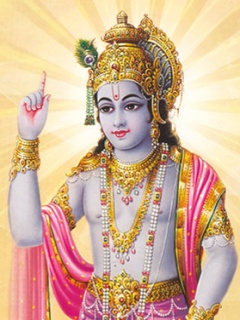
krishna

किरीटिनं गदिनं चक्रहस्तमिच्छामि त्वां द्रष्टुमहं तथैव।
तेनैव रूपेण चतुर्भुजेनसहस्रबाहो भव विश्वमूर्ते॥

kiritinam gadinam chakra hastam
icchaami tvaam drashtum aham tathaiva
tenaiva rupena chatur bhujena
sahasra baaho bhava vishva murte

Oh universal Bhagavan, I wish to see You in Your four-armed form, with helmeted head and with club, wheel, conch and lotus flower in Your hands. I long to see You in that form.

In modern times, it would make sense to visualise Bhagavan Krishna to be an omnipotent and omnipresent muscular, handsome, powerful, extremely intelligent and loving god who stays with us each and every single second of the day. Depending on people’s perception of him, He could be a friend, a guide, a teacher, a brother or can be loved in the way one would love his or her own father. Believing that He is always there for people for an instant boost of energy and courage makes people totally confident, courageous and at the same time virtuous or  Dharma abiding.

An employee of a large organisation, who is very dear to the CEO, would never fear anyone or anything within the organisation because he or she has the direct support and protection of the CEO. The entire system in which we live is an extremely huge corporate organisation and the CEO is Bhagavan Krishna. When one is dear to him, has blind faith in Him and follows all His rules, even any traces of fear in the heart are wiped away giving way to abundant self-confidence and courageousness.

Understanding the ‘god-concept’

lord-krishna.

Gita 7:7

मत्तः परतरं नान्यत्किञ्चिदस्ति धनञ्जय ।
मयि सर्वमिदं प्रोतं सूत्रे मणिगणा इव ॥

mattaH parataraM naan yatkinchidasti dhananjayaa
mayi sarvamidaM protaM suutre maNigaNaa iva

 Beyond Me, there is nothing superior. Everything is connected to me like pearls on a thread.

In order to achieve the above-mentioned state of mind of fearlessness and in order to convince the mind of such a Supreme Power, it is essential to understand the god Concept.

During times of trouble, the lack of clarity in the concept of god causes and also nourishes fear. Believing in nothing gives no hope because it is ultimately only hope that helps people progress in their lives. People with an impersonal conception of god are usually bewildered by god Himself.

Humans, since time immemorial, have been anthropomorphising or personifying their deities, planets, stars and even natural forces such as the wind, the rain, etc. This is because of the fact that humans can naturally and very easily comprehend abstract things that are personified. People find it almost impossible to perceive anything that is intangible and does not have a shape or a form.  When we speak with a stranger on the phone, we tend to ‘put a face to the voice’ in our minds. But once we have seen the person or even his or her picture, it becomes much easier for us to communicate with and relate to the person.

From a modern and rational point of view, we could say that The Supreme god is a personification of the entire system. Some may object to this but this is not meant to belittle or demean any Dogma or Faith. This is because any kind of absolute Faith is powerful. It is the unflinching faith in god, in oneself, in another person or even in an inanimate object that makes people strong, helps them achieve their ambitions and gets them whatever they want. Faith also triggers the placebo effect in people and rids them of even severe illness and pain.

Intelligent and powerful conquerors and rulers used religion and the personification of the eternal and ultimate power to sway the masses and to control and rule over them. Wars were fought and millions were killed in the name of god. Religion after violence has been the ultimate means to achieve power over people. Fear as well as greed, were created in the minds of the masses. Hell and heaven were intelligently used to nurture both fear and greed in the minds of the people. In order to be saved from hell and to be guaranteed eternity in heaven, people needed priests and the priests worked for the king. This ensured the king a feudalistic and an undisturbed chain of command.

In the Bhagavad Gita, the entire system that runs based on unwritten laws is called the ultimate consciousness. Wrong or unclear conceptions of god cause illusion. The minds of people under this illusion can be very easily manipulated by powermongers. Understanding the ultimate consciousness helps people be a better part of the entire grand system, however small and innocuous they may be. When one follows the rules and regulations of the country that he or she lives in, living a safe and comfortable life becomes quite easy. Similarly, following Sanaatana Dharma which comprises of the basic code of conduct through social responsibility, ensures happiness, good health and prosperity and also positive Karma which is carried forward into future births or Janmas.

Although people know that there is a natural system that governs everything in the universe, developing faith in the system requires personification of the Supreme System. Bhagavan Krishna tells Arjuna that only those people who perceive the Supreme Power to possess a form, a personality, qualities, powers, etc. are in a position to overcome this illusion in order to truly and deeply experience their oneness with the System or Power.

A quote from the Bible describing our oneness with god.  Jesus Christ speaks to his disciple John:

John 14:20  On that day you will realise that I am in my Father, and you are in me, and I am in you.

battlefield-krishna

The following Shloka from the Srimad Bhagavad Gita speaks about the need for some to personify The Supreme Bhagavan to better perceive Him.

Gita: 12: 5
क्लेशोऽधिकतरस्तेषामव्यक्तासक्तचेतसाम्‌ ।
अव्यक्ता हि गतिर्दुःखं देहवद्भिरवाप्यते ॥
klesho ‘dhikataras teshaam
avyaktasakta chetasaam
avyakta hi gatir duhkham
dehavadbhir avaapyate
Those whose minds are attached to the formless or impersonal feature of the Supreme Bhagavan, find it difficult to perceive Him. People’s nature of identifying with the body makes perception of a formless god, difficult.

A few Biblical verses about ‘god’s’ appearance:

Genesis 1:26
God created man in His own image, in the image of god He created him; male and female He created them.

Ezekiel 1: 26-27
26. And above the firmament that was over their heads was the likeness of a throne, as the appearance of a sapphire stone: and upon the likeness of the throne was the likeness as the appearance of a man above upon it.
27. And I saw as the colour of amber, as the appearance of fire round about within it, from the appearance of his loins even upward, and from the appearance of his loins even downward, I saw as it were the appearance of fire, and it had brightness round about.

Revelations 1: 14-16
14. His head and his hairs were white like wool, as white as snow; and his eyes were as a flame of fire;
15. And his feet like unto fine brass, as if they burned in a furnace; and his voice as the sound of many waters.
16. And he had in his right hand seven stars: and out of his mouth went a sharp two-edged sword: and his countenance was as the sun shineth in his strength.

* The aforementioned verses from the Bible have been employed in this post solely to highlight the practice of humanising the central deity of organised religions, with the aim of fostering reliability and a connection with humanity.

The Bhagavad Gita says that the illusion of The Bhagavan’s external potency manifests itself as external energy in the demigoddess called ‘Maya’ and both are subservient to the Supreme Bhagavan Krishna. As per the Gita, in order to experience being a part of the System, it is of utmost importance to develop Ananya Bhakti or absolute and pure devotion. When people develop absolute or pure devotion, they follow Dharma, engage in good Karma and hence are good and useful citizens to whichever country they live in and also to the world.

A simple but powerful verse on devotion from the Gita:

Uniting individual consciousness with the ultimate consciousness

Gita 9:22
अनन्याश्चिन्तयन्तो मां ये जनाः पर्युपासते ।
तेषां नित्याभियुक्तानां योगक्षेमं वहाम्यहम्‌ ॥
ananyaas chintayanto mam
ye janaah paryupaasate
teshaam nityaabhiyuktaanaam
yoga kshemam vahaamyaham

Those who strive for eternal association with Me over everything and everyone else, meditate on me with extreme devotion. I assure such persons of uniting their individual consciousness with the ultimate consciousness forever.

Here is something for those who would prefer to continue with the dualistic path until they develop a better understanding of Shlokas such as SBG 2:46, 10:20, 13:02 (13:03 in some editions). The total faith that comes with being dear to the personified Supreme One, makes people mentally very strong and it totally removes fear. Fearlessness when once tasted is highly addictive. A complete understanding of Krishna is the quickest and the surest way of attaining fearlessness. Feeling one with Him helps people be absolutely certain of being under His care and protection. It gives people ultimate self-confidence and a positive mental attitude. The total faith they have works for them,  saves them from the most hopeless situations, helps them realise even their most impossible dreams and frees them from all sorts of fear.

Freedom from fear is freedom from bondage.

Jai Shree Krishna

Tavamithram Sarvada

Children are never at fault

Child rearing – the most important project for a parent

Children need to be loved and also respected

Lenin once said “ Give us the child for 8 years and it will be a Bolshevik forever”.

He meant, ” Bring me the child at birth and take him away after his  8th birthday. He will be a Russian forever”.

He very well knew that the first 8 years after the birth of a child are the most crucial part of a child’s life. Those are the prime formative years. The learning capacity of a child is so enormous that adults wouldn’t stand a chance against them as far as observing, grabbing, storing and processing of immense information are concerned. Unfortunately most people do not realise this important fact. Ignorance or not knowing something has nothing to do with intelligence. When a child does something out of curiosity, many people consider it to be a silly and a childish act. Just because the child does not know something, it does not mean that the child is stupid. It is the ability to learn, store and process information that determines the intelligence of a person and not what a person already knows. All children have a natural flair for discovering things and by the time they are three or four, adults pounce on them and start filling their tender minds with all that they believe to be true. The moment a child asks one of its parents a question, he or she is told to shut up. The child is even admonished for repeatedly asking ‘silly’ questions and bothering the adults! How insane could these adults be!

Every child is a proof of nature’s wonder. It’s ‘life’ started as a tiny zygote to be delivered and to grow up in this cruel and heartless world. Today’s baby could be tomorrow’s national president,  astronaut,  pilot,  scientist,  professor, surgeon, etc. Parents and teachers carry a huge responsibility on their shoulders as the future of not only the child, but also that of the nation and of the world, lies in their hands. There are many who advocate that a child should only ‘enjoy’ its childhood and have fun playing because they will have to undergo all the learning in the future anyway. Why should learning be thought to be a painful and a troublesome process for children? They have a natural ability to learn but this ability is corrupted by ‘established science and teaching procedures’. The child’s natural tendency to ask questions is destroyed. Parents and teachers should realise that soon one day, tables will certainly be turned and that they will be at the receiving end.  Children need to be loved and also respected. That’s how and when children will realise their own importance in the society. Rebuking children for simple things will never be forgotten by them. Repeated assaults, punishments or scoldings by parents or teachers, can cause a child to develop animosty towards them forever.

Parenting is not at all an easy task. Even animals work hard to take special care of their little ones until they are old enough to be on their own. Parents and teachers need to actually openly express their love for children. A warm hug can do wonders and this gives the child a sense of security and that of being cared for. If children lie, it is only because their parents or teachers did not do their job well. When a child is taught the value and the power of truth by narrating to it stories of historical, mythological or even fictional characters, they will NEVER lie. Thanks to its natural imaginative skills, stories narrated in an interesting manner, can cause deep effects on a childs’ mind – forever. As little children are highly impressionable, selfish people of some violent religions, slaughter large animals right before the eyes of children! This is done in the name of religion! Such a macabre act completely removes any kind of softness, compassion or inhibition from the child’s mind and when it grows up or even during its teens, it sees absolutely nothing wrong in slaughtering a human being who in the eyes of the child, is in fact ‘smaller’ than the large animal!

I have come across some divorced men and even some who are living separately from their wives, having no affection at all for their own children who live with the mother. How on earth could any human being be so heartless? A child is a child who is no way responsible for the disagreements between the man and his wife. Such unlucky children are forced to grow up with hatred brewing in their minds. Little innocent babies hence grow up into evil and hateful adults.

People need to recollect their childhood memories, apply the same childlike sentiment and above all, empathise with children while dealing or communicating with them. The best way to communicate good and strong morals to children are through stories and not by giving them long and boring lectures. Playing with children , singing, dancing and laughing with them have excellent effects on the child’s psyche.

Just after a child is born, parents need to have an agenda of all the things that they would be teaching the child during the 8 years that follow. The planning has to be done very well and the steps need to be documented and followed. Bringing up a child is a major project. All of us know that it was one man who caused World War II and all that genocide and the destruction. This proves that one child can certainly make a difference to the world either in a positive way or in a negative way. If parents of little children of today would be serious about bringing their children up in the right way, the world in the next fifteen years would be a much better place to live in.

We need to help children develop  inherent qualities of compassion, kindness, friendliness, decency, righteousness, dignity, etc.  This can be achieved by protecting them from exposure to  violence, violent movies, hatred, lies, cheating, arrogance, war, etc at least until the age of 8. Once the basic personality is formed, the child will never take up to crime or to any other uncivilised or anti-social act. The concept of Ahimsa or Non-Violence can be permanently ‘fixed’ in the mind of a child before the age of 8.

Just as any adult, children too love to feel important and wanted.  Instead of letting them waste their time watching TV during weekends, it would be useful to involve them in the following interesting subjects:

Language and art:

When you learn a new language, you also learn the culture of the native speakers. Children develop the habit of appreciating and learning from diversity. Language instruction is a very important matter. A child is like a parrot and the way it learns a language is by simply repeating entire phrases or sentences uttered by others. Its mind has its own natural way of finding the grammatically correct way of speaking. The most important part of language instruction is pronunciation. There are language teachers who never learned the right way of pronouncing the sounds in a particular language and they start teaching it to children. The child learns the wrong way to pronounce words and continues its education. I am not talking about the accent, but it is about pronunciation. For example, in India the word ‘scold’ is pronounced the way the word ‘scald’ is to be pronounced. So if a child says in typical Indian style of pronunciation that his teacher ‘scolded’ him, it means that the teacher has ‘scalded’ him and for this cruel act, the teacher must be sent to jail! Wrong pronunciations lead to improper communication. Irresponsibility on the part of parents and teachers is the root cause for such degrading and deplorable language standards in India. It is not only the case with the English language, but also with other Indian languages. It is quite rare to find Indians who can speak their mother tongue for about five minutes, no matter which one it is, without adding English words!

Teaching children to speak a language correctly is a wonderful way to help them develop the sense of perfection. The child becomes obsessed with quality consciousness and that will be reflected on everything that the child will do later on life.

Art:

A child is basically very creative just as our ancestors were, but for whom we wouldn’t have had all the discoveries, inventions and the kind of technological advancements that we have today. Encouraging a child to develop its creativity, keeps the child occupied, gives it a sense of pride for having created something and of course develops the sense of aesthetics in it. A child that has tasted art, looks at nature as a very large piece of art and automatically learns to love and respect it. All kinds of art forms have amazing effects on the character of child and this shapes its mind into that of a fine, kind and a considerate human being.

Pregnant women who regularly listen to soothing classical music invariably give birth to children with a natural talent for music. Teaching music to young children has a very powerful effect on their general nature. They tend to be more affable and gentle. Music plays a very great role in shaping the character of children.

Mathematics:

When little children are taught mathematics the fun way, they fall in love with this amazing subject. This creates  a strong sense of logic in them, develops quick thinking and memory. It is actually some people from older generations who don’t like Math, that ‘pass on’ to their children their dislike for it. I have come across many children who did not like math but on showing them the way they could have fun with math, they not only started to love math, but also turned into mathematical experts.

Sport:

Introducing children to regular sport makes them not only very healthy but also helps develop two major qualities in them – team spirit and the desire to win.

Internet:

Leading search engines have replaced large libraries and through these search engines, any kind of information can be acquired within seconds. Children need to be trained to use the Internet, of course under strict supervision. Discussing with them what they learned about history, geography, computers, automobiles, aircrafts, etc., encourages children to always remain hungry for knowledge. This strengthens the drive within them to stay abreast with the developments in ever-changing modern world.

Generation gaps are caused due to the fact that adults don’t ‘grow up’ the way children do.

‘Hind di Chadar’ – Guru Tegh Bahadur Ji

Animated film on the Grand Sacrifice of Guru Tegh Bahadur Ji  (in Punjabi)

(Pumpkin Academy of Digital Arts directed by Hardeep Singh Gill) :

Waheguru Ji Ka Khalsa, Waheguru Ji Ki Fateh

( ‘Purity belongs to Waheguru, Victory belongs to Waheguru.‘)

Guru Tegh Bahadur Sahib

This is a tribute to the great and valourous Guru Tegh Bahadur Ji, whose supreme sacrifice in order to protect the Sanatana Dharma, can never be forgotten. It was a time when India was ruled by barbarian marauders who had vowed to destroy the Sanatana Dharma forever and to convert its followers to their cult that they were spreading forcefully.

People following the Sanatana Dharma (a.k.a. Hindus), particularly Indians, owe him a huge debt of gratitude.

Guru Tegh Bahadur Ji was born on the 1st of April 1621. He is also known as ‘Hind di Chadar’ which means the ‘Shield of India’.  But for his brave sacrifice, aurangzeb would have been successful in converting Kashmiri Pandits to his own religion. aurangzeb had issued an order to Iftiqar Khan the Viceroy of Kashmir, to forcefully convert the entire population of Kashmiri Pandits to his own religion. This was because he strongly believed that the mass conversion of Kashmiri Pandits would not only convince but also force the rest of the country to follow suit.  aurangzeb could not stand the sight of Sacred Threads  or Tilaks on any of his people. The deadline for the mass conversion was fast approaching and a large group of over 500 Kashmiri Pandits let by Pandit Kirpa Ram Datt, left for Anandpur Sahib to seek the help of Guru Tegh Bahadur Ji.

Guru_tegh Bahadur _with_sonPandit Kirpa Ram Datt explained to Guru Tegh Bahadur Ji their plight and the danger that they were in. The Guru started to think of  a suitable solution for the problem of the Pandits. That is when the Guru’s son the 9 year old Gobind Rai (who was later on known as Guru Gobind Singh Ji) entered the room. He noticed the serious situation in the room and that his father was in deep thought. He asked his father what was happening for which Guru Tegh Bahadur Ji replied saying. “Unless a holy man lays down his head for the sake of these poor Brahmins, there is no possibility of  their escape from the mughal oppression.” Young Gobind Rai replied, “Respected father, who else could be worthier for this than you?” Guru Tegh Bahadur embraced his son and shed tears of joy and pride. “My dear son, I was only concerned about your future, as you are too young now”.  Gobind Rai replied, “Father, leave me to God and accept the challenge of the mughals.”

Guru Tegh Bahadur Ji asked  the Pandits to inform aurangzeb that the Brahmins would gladly accept and embrace his religion if Guru Tegh Bahadur converted first. Guru Tegh Bahadur started preparing to leave on his journey to Delhi which would be his last ever journey on earth. It was farewell time for him and he said the final goodbye to his family members and to his followers.  Before he left, he appointed his son Gobind Rai as the next Guru. Those who accompanied the Guru were Bhai Mati Das, Bhai Dyala and Bhai Sati Das and they were fully aware of the danger they were getting into.  When aurangzeb came to know of this, he issued orders to immediately arrest Guru Tegh Bahadur Ji. Soon after the Guru and his team had left Anandpur Sahib, they were arrested and taken in chains to Delhi to be produced before aurangzeb.

aurangzeb angrily asked the Guru why he was revered as the Guru and called ‘Saccha Paadshah’ (True King). He asked the Guru to perform a miracle to prove that he truly was such a Guru or a Prophet. The Guru reprimanded aurangzeb for his cruelty and for his persecution of people of other faiths. The Guru said, “Hinduism may not be my faith, and I may believe not in the supremacy of Veda or the Brahmins, nor in idol worship or caste or pilgrimages and other rituals, but I would fight for the right of all Hindus to live with honour and practice their faith according to their own rites.”

The Guru added, “Every ruler of the world must pass away, but not the Word of God or His Saint. This is how people not only call me a True King but have done so through the two centuries before me in respect of my House and also in respect of others who preceded them and identified themselves not with the temporal and the contingent, but with the eternal and the never dying.” The Guru refused to perform any miracles saying, “Such miracles are the work of charlatans and mountebanks to hoodwink the common man. Men of God submit to the Will of God.” Guru Tegh Bahadur Ji refused to embrace aurangzeb’s religion and said, “For me, there is only one religion and that is the religion of God. Whosoever belongs to it, be it a Hindu or of any other faith, him I own and he owns me. I neither convert others by force, nor submit to force to change my faith.” The infuriated aurangzeb ordered Guru Tegh Bahadur Ji to be forced to convert to his religion through torture or to be killed.

Bhai_Mati_DasGuru Tegh Bahadur Ji had to undergo a excessive torture and he was kept in an iron cage like an animal. He was starved of food.  Right before the eyes of the Guru, Bhai Mati Das the devoted Sikh was tied between two pillars and he was sawn into two parts alive. Bhai Dyala was thrown alive into a cauldron of boiling water and was killed.  bhai_dyalajiBhat Sati Das was wrapped in cotton wool and he was set on fire. The Guru took all these cruel acts without flinching and he showed neither signs of anger nor distress.

09-Bhai Sati Daas Ji - Burnt Alive

On the fateful day which was the 24th of November 1675, the moment arrived and the brave Guru Tegh Bahadur Ji was placed in public view at a square known as Chandni Chowk. As the Guru prayed, he was beheaded by the executioner of aurangzeb. Guru-Tegh-Bahadur-ji-.Beheading

The Guru’s body was left out in the open and  no one had the audacity to go anywhere near the Guru’s body lest they too be killed by aurangzeb’s men. There was a severe storm later that afternoon and the entire city was in darkness. Taking advantage of the darkness, a Sikh named Bhai Jaita managed to collect the Guru’s sacred head and carried it to Anandpur Sahib and placed it before the Guru’s son. Another Sikh Bhai Lakhi Shah who had a cart, managed to smuggle the Gurus headless body to his house in Anandpur

Bhai Jaita

Sahib. As a public funeral would have been too dangerous for the entire population of Anandpur Sahib, Bhai Lakhi Shah set fire to the Guru’s house thus ‘cremating’ him in the process.  At the same time, The Guru’s head was taken to his saddened widow Mata Gujari and young son Guru Gobind Singh. A funeral pyre of Sandalwood was constructed in Anandpur Sahib. The head of Guru Tegh Bahadur Ji was cremated by his young son Guru Gobind Singhji.

I bow my head in reverence to the great Guru Tegh Bahadur Ji and express my sincere gratefulness to Him and to all the gallant Sikhs who laid down their lives to protect Bharat Mata, her people and her culture.

Guru Tegh Bahadur Ji was one of the most important people who made grand sacrifices for saving the Dharma and Bharat from being annihilated by the sinister mughals.

There was a road in Delhi named after the mass murderer aurangzeb but there is not a single road named after the Great Hind di Chadar! How many Indians who have been to Chandni Chowk in Delhi know about the public beheading of the Great Guru right there?

aurangzeb Road has been renamed as Dr. A.P.J. Abdul Kalam Road which means that India has taken one more step towards ceasing to be the only country among those of civilised people, to name streets and roads after mass murderers and plunderers!

(PS: Capitalisation of the name aurangzeb the barbarian has been deliberately avoided much against English spelling rules)

Bole so Nihal..  Sat Sri Akaal.

Waheguru Ji ka Khalsa, Waheguru Ji ki Fateh.


Life is a gift – live it

It was 4 p.m. that dreadful afternoon, just a week after my 24th birthday.  Through the window of the post-operative ward in the hospital where I lay, I could hear the siren of an ambulance entering the hospital compound with some other accident victim.  The team of specialists who stood around me after examining me informed my father and sister of their decision to amputate my right arm the following morning.Krankenwagen

A few days earlier, I had met with a motorcycle accident. I was riding my motorcycle over a flyover and I was not wearing a crash helmet.  I was overtaking a car when a speeding bus from the opposite direction hit me almost head-on.  I was thrown off my bike and landed about 15 metres away. The entire right side of my body was badly injured.  I had broken my right side zygomatic bone, my mandible, and my maxilla. A 1.5 cm2 piece of my palate had broken away. There was a gaping hole just below my eye, and my right eye socket was soaked in blood. The patella on my right knee, my right shoulder bone, and the shoulder joint were fractured. As my palate was broken, I had no control over my swallowing and I could feel blood running down my gullet.  I was breathing not only through my nose and my mouth but also through my torn cheek and the hole below my right eye. After the broken piece from my palate was reattached and the maxillomandibular krankenhausfixation (wiring of my mandible and maxilla) was done to immobilise my jaw, I was wheeled to the OT (operation theatre) for a facial plastic surgery that lasted five hours. My shoulder and knee fractures were then attended to and I was shifted to the post-operative ward. As I could not speak due to my wired-up jaw, I signalled to my dad and sister that the pain in my shoulder was unbearable and that I feared something more serious than just a fracture. The following morning I knew that I was right. The swelling around my right shoulder had spread up to my back. This was a case of negligence on the part of the doctors. One more day went and sepsis had set in and the pain was so severe that it was almost impossible for me to stay conscious.

My dad and my sister explained to me the seriousness of the sepsis around my right shoulder which could affect my central nervous system and that the amputation of my right arm was the only way to save my life. I was also passing out frequently due to the excruciating pain, but I desperately tried to stay conscious.

That night, as I lay on my hospital bed, I saw various scenes from my whole life flashing before me. I was too dazed but I tried to mentally prepare myself for the amputation.   I continuously felt as if I was falling into some kind of a deep slumber but something told me that maybe that was the feeling of dying, and so I tried hard to stay awake.  The heavy loss of blood had made me so weak that I fell asleep.

Around 11p.m., I woke up as I felt a strong and a warm hand stroking my hair.  I opened my left eye slightly but there was no one close to me.  I saw my Dad sleeping on the couch in the room.  I had a strange feeling that I can hardly describe, and I prayed to be shown a miracle that would save my arm.  I dozed off again only to be woken up about 10 minutes later by the sound made by the opening of the door.  I slowly opened my left eye again and saw that it was one of my friends, Ajit Hegde, who lived in Bangalore.  He had completed his 5-year medical course and was to start his one-year internship at the hospital where I was, and exactly on that particular day when my arm was to be amputated! My friend was shocked to see me in such a terrible condition and he went through my medical file that lay on my bedside table.

He asked me if I knew about the planned amputation.  I nodded weakly, as even the slightest move of my neck hurt me so badly.  He asked me if I wanted to accept the surgeon’s decision, or if  I cared to fight back thus risking my life in the process.  The first things that came to my mind were the facts that I am the son of a soldier and that I am a born fighter.  I saw a twinkle in his eye, and again I had the same feeling of someone stroking my hair gently and I think I tried to smile.  I thought to myself, “Was it Krishna, whom I was so sincerely visualising?” I also felt as if someone moved past me leaving behind a warm feeling in my heart.  I felt very light in my heart, which was filled with a strange sense of peace.  I remembered the days when I was a little child when I used to cling to my beloved father and felt absolutely secure in his strong arms.

My father woke up and explained to my friend about my accident. My friend asked my dad if he would be willing to sign the AMA (Against Medical Advice) document and allow him to take me to another hospital where he would treat me.  He told my father that he would go for an I&D (incision and drainage) to remove the almost 800 ml of pus collected around my right shoulder and fight the severe infection with heavy antibiotics.  My sister entered the room and was informed by my friend about the new idea to save my arm.  I nodded, and I was confident.  My friend warned me that the I&D procedure would hurt me a lot and that I would have to bear the pain.  I agreed as I did not believe that the pain caused by the incision could be worse than the pain that I was already undergoing.

I can never forget the 72 hours that followed.  My body temperature would shoot upwards of 107 degrees Fahrenheit and cause to undergo severe convulsions. The drive to fight back would appear in my mind and using intense breath control, I would visualise a point behind my closed eyes and by concentrating on that one imaginary point, I would derive immense energy and power.  In a few minutes, I would sweat so profusely that the mattress I lay on had to be changed because it was drenched with sweat.  This had to be done many times.  My friend would open the dressing on my shoulder, slowly pull out the gauze that he had inserted the previous day and clean up the wound. He would then squeeze out the pus that had collected after the previous drainage which had almost reached my lower back. This he would follow by inserting new gauze into the 5 cm long wound and leaving it there to absorb the pus that would form again during the following six hours.  As the pain was unbearable, I had to think of a way to handle it.  I visualised the nervous system in my mind and thought of the fact that I could feel the pain because the nerves ‘communicated’ the pain to my brain.  So I decided to mentally ‘disconnect’ these nerves from the area around the incision.  I knew it was hurting but the pain did not bother me anymore.

After 72 hours following the incision on my right shoulder, regular drainage of the pus, heavy antibiotics and after my high temperatures due to the infection was properly controlled and regulated, I was out of danger. The sepsis was under control.  I had to be injected with heavy doses of amoxicillin because I could not swallow anything.  I could not open my mouth due to the wiring of the maxillomandibular fixation done to immobilise my jaw.

It has been many years now, and I continue to possess a right arm which is also quite muscular like my left arm.

It was that decision that I had to make almost instantaneously – to agree to the amputation or fight it against medical advice.  On the one hand, there was the highly experienced surgeon who was certain that the amputation was inevitable to save my life, and on the other, it was this young inexperienced doctor who arrived from nowhere exactly on that particular day, at that particular hour, and suggested such a drastic step to save my arm.  Even to this day, I believe that my request to be shown the right was considered and my friend was a godsend to me.  The Almighty, for sure, has His own ways and most humans do not have an inkling of it.

Destiny seems so real. When we are born, the exact number of years, months, days, hours, minutes and seconds that we will be spending alive on this planet were already calculated and fixed. The only thing is that we are not informed of the exact period of time allotted to us to stay alive.

A few days ago, a young man wrote to me requesting advice. He explained to me in detail about his hopeless financial situation and that he was contemplating suicide. He also tried to convince me that suicide was not an act of cowardice.  To be honest, I would not say that suicides are cowards.  It is not true to say that cowards can commit suicide!  Committing suicide calls for extreme courage and great mental strength!  Of course, there is one thing for sure — the person who commits suicide, is most certainly selfish and silly. In highly stressful situations, the thought of ending one’s life creeps in. But is that a solution is a question. Karma continues and the soul never dies. The soul is born again as ‘someone’ else, and the new negative Karma accumulated due to the act of suicide has to be again balanced.

Suicides are basically of two kinds–the planned one and the impulsive one.  Even the impulsive ones are generally the result of the constant harbouring of the thought of dying. There must have been in the person’s mind, a strong  ‘death drive’ or ‘Todestrieb,’ as Freud called it.

The planned suicide could be because the person in question was almost drowning in debt or maybe he or she feared being caught for some crime committed, and the dishonour that followed it.  Those suffering from debt problems usually think that by dying their family would get enough money from the life insurance policy taken. There are others who know that life insurance companies do not pay when the insured commits suicide and hence they plan to either organise and execute an ‘accident’ or set up an attack on themselves and be killed by someone else.  The suicide invariably does not think of the possibility of the planned accident being unsuccessful and the goal of dying not being achieved. Now that can be a terrible situation for anyone to be in.  It is hard to imagine living in a persistent vegetative state, causing more and more trouble to near and dear ones than earlier, feeling terribly ashamed, and above all, not even being able to reattempt suicide due to the immobility caused by missing limbs.

Everyone carries a death warrant and death is certain. The desire to die due to failures in life is due to extreme EGOISM as one feels that he or she can escape all the humiliation and loss of respect simply by dying.  Learning to accept criticism and humiliation would be much easier when the EGO vanishes.  The ‘I’ in us is not physical but it is abstract in nature. The body we possess stays with us only until the body’s death. When a person is dead, the body that is ready to be cremated or buried is not the person who died, but the body of the person who died.

Thanks to my research of over two decades, I have noticed clear patterns in people’s lives.  Siblings, who had the same kind of upbringing, went to the same school and had the same teachers are totally different from each other.  That is because their souls carry different Karma. We need to remember that our birth is not something caused by us, but it happened.  We brought nothing into this world. Nothing belongs to us. The soul descends into a tiny zygote.  This zygote grows into a foetus, is born as a baby, lives as a child and an adult, and when the time comes, it dies.  Our physical body is the only thing that will stay with us until it dies, and everything else that we ‘possess’ does not belong to us.

The accident that I spoke about was only one of the five serious accidents that I met with,  but I still continue to live a healthy life. This is because of two main reasons, firstly because my time to depart hasn’t come yet, and secondly because of the way I value, respect and care for my body, which is the one and only belonging that I actually possess until my soul is ejected out of it.

I wrote back to the young man and convinced him that suicide, of course, is not cowardice, but it is a selfish act that apart from causing extreme sadness and suffering to one’s near and dear ones, can have an extremely negative effect on one’s process of Karmic evolution. 

In English and in certain Romance languages such as Latin, French, Spanish, Italian, etc., the other name for the word gift is present, présent or presente. Therefore, the present is a present. Let us be thankful for it and enjoy it.

Life is a gift – live it.

 Jai Shri Krishna.

Famous quotes on Vegetarianism

What some famous people thought about Vegetarianism:

“I do not want to make my stomach a graveyard of dead animals.” George Bernard Shaw

“I look my age. It is the other people who look older than they are. What can you expect from people who eat corpses?” George Bernard Shaw

“Vegetarianism is a greater progress. From the greater clearness of head and quicker apprehension motivated him to become a vegetarian.

Flesh-eating is an unprovoked murder.” Benjamin Franklin

“Nothing will benefit human health and increase chances for survival of life on Earth as much as the evolution to a vegetarian diet.”  Albert Einstein

“Nonviolence leads to the highest ethics, which is the goal of all evolution. Until we stop harming all living beings, we are all savages.” Thomas Edison

“I do feel that spiritual progress does demand at some stage that we should cease to kill our fellow creatures for the satisfaction of our bodily wants.” Mahatma Gandhi

“Truly man is the king of beasts, for his brutality exceeds them. We live by the death of others. We are burial places! I have since an early age abjured the use of meat.” Leonardo da Vinci

“I hold flesh-food to be unsuited to our species. We err in copying the lower animal world if we are superior to it.” Mahatma Gandhi

Shlokas and Mantras – Lyrics

संकटनाशक   गणेश   स्तोत्र : प्रणम्य   शिरसा   देवं   गौरीपुत्र   विनायकम्

Sankata Nashak Ganesh Stotra: Pranamya Shirasa Devam Gauriputra Vinayakam

Om Sri Ganeshaya namaha

प्रणम्य शिरसा देवं गौरीपुत्र विनायकम् ।
भक्तावासं स्मरेन्नित्यायुष्कामार्थसिद्धये ॥१॥
Prannamya Shirasaa Devam Gaurii-Putra Vinaayakam |
Bhaktaa-vaasam Smaren-Nitya-Aayush-Kaama-Artha-Siddhaye ||1||

प्रथमं वक्रतुण्डं च एकदन्तं द्वितीयकम् ।
तृतीयं कृष्णपिङ्गाक्षं गजवक्त्रं चतुर्थकम् ॥२॥
Prathamam Vakra-Tunnddam Cha Eka-Dantam Dvitiiyakam |
Trtiiyam Krshnna-Pingga-Aksham Gaja-Vaktram Chaturthakam ||2||

लम्बोदरं पञ्चमं च षष्ठं विकटमेव च ।
सप्तमं विघ्नराजं च धूम्रवर्ण तथाष्टमम् ॥३॥
Lambodaram Panchamam Cha Shashttham Vikattam-Eva Cha |
Saptamam Vighna-Raajam Cha Dhuumra-Varnna Tatha ashttamam ||3||

नवमं भालचन्द्रं च दशमं तु विनायकम् ।
एकादशं गणपतिं द्वादशं तु गजाननम् ॥४॥
Navamam Bhaala-Candram Cha Dashamam Tu Vinaayakam |
Ekaadasham Gannapatim Dvaadasham Tu Gajaananam ||4||

द्वादशैतानि नामानि त्रिसन्ध्यं यः पठेन्नरः ।
न च विघ्नभयं तस्य सर्वसिद्धिश्च जायते ॥५॥
Dvaadashai taani Naamaani Tri-Sandhyam Yah Patthen-Narah |
Na Cha Vighna-Bhayam Tasya Sarva-Siddhish-Cha Jaayate ||5||

विद्यार्थी लभते विद्यां धनार्थी लभते धनम् ।
पुत्रार्थी लभते पुत्रान्मोक्षार्थी लभते गतिम् ॥६॥
VidyaArthii Labhate Vidyaam Dhana-Arthii Labhate Dhanam |
Putra-Arthii Labhate Putraan-Moksha-Arthii Labhate Gatim ||6||

जपेद् गणपतिस्तोत्रं षड्भिर्मासैः फलं लभेत् ।
संवत्सरेण सिद्धिं च लभते नात्र संशयः ॥७॥
Japed Gannapati-Stotram Shaddbhir-Maasaih Phalam Labhet |
Samvatsarenna Siddhim Cha Labhate Na-Atra Samshayah ||7||

अष्टाभ्यो ब्राह्मणेभ्यश्च लिखित्वा यः समर्पयेत् ।
तस्य विद्या भवेत्सर्वा गणेशस्य प्रसादतः ॥८॥
Ashttaabhyo Braahmannebhyash-Cha Likhitvaa Yah Samarpayet |
Tasya Vidyaa Bhavet-Sarvaa Ganneshasya Prasaadatah ||8||

Ithi Sri Narada Purane Sankashta Nashana Ganapathi Sthothram Sampoornam
——————————————————————————–

Maha Mrutyunjaya

Om namah Shivaayah

ॐ त्र्यम्बकं यजामहे सुगंधिं पुष्टिवर्धनम् ।
उर्वारुकमिव बन्धनान्मृत्योर्मुक्षिय माऽमृतात् ॥

OM tryambakam yajaamahe sugandhim puShTivardhanam
urvaarukamiva bandhanaanmrutyormukshiya maa-amRRitaat

———————————————————————————

Sarva baadha prashamanam trailokyasyakhileshvari. Evameva tvayakaryamasmad vairi vinashanam

Sarva-Manggala-Maanggalye Shive Sarvaartha-Saadhike .Sharannye Tryambake Gauri Naaraayanni Namo-astu Te

———————————————————————————-

शुक्लाम्बरधरं विष्णुं शशिवर्णं चतुर्भुजम् ।
प्रसन्नवदनं ध्यायेत् सर्वविघ्नोपशान्तये ॥
Shukla-Ambara-Dharam Vishnnum Shashi-Varnnam Chatur-Bhujam |
Prasanna-Vadanam Dhyaayet Sarva-Vighno-upashaantaye ||

———————————————————————————-

NILANJANA SAMABHASAM RAVI PUTRAM YAMAGRAJAM |

CHAYA MARTHANDA SAMBHUTAM TAM NAMAMI SHANAISCHARAM ||

नीलांजन समाभासम रविपुत्रं यमाग्रजम ।

छाया मार्तण्ड सम्भूतं तम नमामि शनैश्चरम ॥

———————————————————————————-

Ugram, veeram, Maha Vishnum, jwalantham , sarvathomukham,Nrusimham bheeshanam bhadrammrutyor mrutyum namamyaham

———————————————————————————-

Runa Vimochana Narasimha Stotram

Devata karya sidhyartham, sabhasthambha samudbhavam,
Sri nrisimham mahaveeram namami runa mukthaye. 1

Lakshmya aalingitha vamangam, bhakthanaam vara dayakam,
Sri nrisimham mahaveeram namami runa mukthaye. 2

Antramaladaram, sankha chakrabja aayudarinim,
Sri nrisimham mahaveeram namami runa mukthaye. 3

Smaranath sarva papagnam, khadruja visha nasanam,
Sri nrisimham mahaveeram namami runa mukthaye. 4

Simhanadenamahatha, digdanthi bhayanasanam,
Sri nrisimham mahaveeram namami runa mukthaye. 5

Prahlada varadam, srisam, daithyeswara vidharanam,
Sri nrisimham mahaveeram namami runa mukthaye. 6

Kroora grahaih peedithanam bhakthanam abhaya pradham,
Sri nrisimham mahaveeram namami runa mukthaye. 7

Veda vedantha yajnesam, brahma rudradhi vandhitham,
Sri nrisimham mahaveeram namami runa mukthaye. 8

Ya idam pathathe nithyam, runa mochana samjnitham
Anrni jayathe sadyo, danam sigramavapnuyath

———————————————————————————-

गुरुर्ब्रह्मा गुरुर्विष्णुः गुरुर्देवो महेश्वरः | गुरु: साक्षात परं ब्रह्म तस्मै श्रीगुरवे नमः.||

Gurur-Brahmaa Gurur-Vishnnuh-Gururdevo Maheshvaraha |
Guruh saakshaath Param Brahma Tasmai Shrii-Gurave Namaha ||1||

———————————————————————————-

Shiva maanasa Pooja

रत्नैः कल्पितमासनं हिमजलैः स्नानं च दिव्याम्बरं
नानारत्नविभूषितं मृगमदामोदाङ्कितं चन्दनम् ।
जातीचम्पकबिल्वपत्ररचितं पुष्पं च धूपं तथा
दीपं देव दयानिधे पशुपते हृत्कल्पितं गृह्यताम् ॥१॥
Ratnaih Kalpitam-Aasanam Hima-Jalaih Snaanam Cha Divya-Ambaram
Naanaa-Ratna-Vibhuushitam Mrga-Madaa-Moda-Angkitam Chandanam |
Jaatii-Champaka-Bilva-Patra-Rachitam Pushpam Cha Dhuupam Tathaa
Diipam Deva Dayaa-Nidhe Pashupate Hrt-Kalpitam Grhyataam ||1||

सौवर्णे नवरत्नखण्डरचिते पात्रे घृतं पायसं
भक्ष्यं पञ्चविधं पयोदधियुतं रम्भाफलं पानकम् ।
शाकानामयुतं जलं रुचिकरं कर्पूरखण्डोज्ज्वलं
ताम्बूलं मनसा मया विरचितं भक्त्या प्रभो स्वीकुरु ॥२॥
Sauvarnne Nava-Ratna-Khanndda-Rachite Paatre Ghrtam Paayasam
Bhakshyam Pancha-Vidham Payo-Dadhi-Yutam Rambhaa-Phalam Paanakam |
Shaakaanaam-Ayutam Jalam Rucikaram Karpuura-Khannddo-jjvalam
Taambuulam Manasaa Mayaa Virachitam Bhaktyaa Prabho Sviikuru ||2||

छत्रं चामरयोर्युगं व्यजनकं चादर्शकं निर्मलं
वीणाभेरिमृदङ्गकाहलकला गीतं च नृत्यं तथा ।
साष्टाङ्गं प्रणतिः स्तुतिर्बहुविधा ह्येतत्समस्तं मया
सङ्कल्पेन समर्पितं तव विभो पूजां गृहाण प्रभो ॥३॥

Chatram Chaamarayor-Yugam Vyajanakam Cha-Adarshakam Nirmalam
Viinnaa-Bheri-Mrdangga-Kaahala-Kalaa Giitam Cha Nrtyam Tathaa |
Saassttaanggam Prannatih Stutir-Bahu-Vidhaa Hye-tat-Samastam Mayaa
Sangkalpena Samarpitam Tava Vibho Puujaam Grhaanna Prabho ||3||

आत्मा त्वं गिरिजा मतिः सहचराः प्राणाः शरीरं गृहं
पूजा ते विषयोपभोगरचना निद्रा समाधिस्थितिः ।
सञ्चारः पदयोः प्रदक्षिणविधिः स्तोत्राणि सर्वा गिरो
यद्यत्कर्म करोमि तत्तदखिलं शम्भो तवाराधनम् ॥४॥
Aatmaa Tvam Girijaa Matih Sahacharaah Praannaah Shariiram Grham
Puujaa Te Vishayo – pabhoga-Rachanaa Nidraa Samaadhi-Sthitih |
Sanchaarah Padayoh Pradakshinna-Vidhih Stotraanni Sarvaa Giro
Yad-Yat-Karma Karomi Tat-Tad-Akhilam Shambho Tava-Araadhanam ||4||

करचरणकृतं वाक्कायजं कर्मजं वा
श्रवणनयनजं वा मानसं वापराधम् ।
विहितमविहितं वा सर्वमेतत्क्षमस्व
जय जय करुणाब्धे श्रीमहादेव शम्भो ॥५॥
Kara-Charanna-Krtam Vaak-Kaaya-Jam Karma-Jam Vaa
Shravanna-Nayana-Jam Vaa Maanasam Va-Aparaadham |
Vihitam-Avihitam Vaa Sarvam-Etat-Kshamasva
Jaya Jaya Karunna-Abdhe Shrii-Mahaadeva Shambho ||5||

———————————————————————————-

Mahalaskhmi Ashtothram

                                                                  Om Prakruthyai  Namaha

Om Vikruthyai  Namaha

Om Vidhyayai  Namaha

Om Sarva bhootha hitha pradhayai Namaha

Om Shraddhayai  Namaha

Om Vibhuthyai  Namaha

Om Surabhyai  Namaha

Om Paramathmikayai  Namaha

Om Vachyai  Namha

Om Padmalayayai  Namaha                                     10

Om Padmayai  Namaha

Om Shuchayai  Namaha

Om Swahayai  Namaha

Om Swadhayai  Namaha

Om Sudhayai Namaha

Om Dhanyayai  Namaha

Om Hiranmayai  Namaha

Om lakshmiyai  Namaha

Om Nithya  Pushtyayai  Namaha

Om Vibhavaryai  Namaha                                         20

Om Adhithyai  Namaha

Om Dithyai  Namaha

Om Deepthaayai  Namaha

Om Vasudhayai  Namaha

Om Vashudharinyai  Namaha

Om Kamalayai  Namaha

Om Kanthayai  Namaha

Om Kamakshiyai  Namaha

Om Krodha smabavayai  Namaha

Om Anugraha Pradhayai  Namaha                              30

Om Buddhaye  Namaha

Om Anaghayai  Namaha

Om Hari Vallabhayai Namaha

Om Ashokayai  Namaha

Om Amruthayai  Namaha

Om Deepthayai  Namaha

Om Loka shoka vinashinyai  Namaha

Om Dharma Nilyayai  Namaha

Om KarunaYai  Namaha

Om Loka mathre  Namaha                                         40

OmPadma priyayai  Namaha

Om Padma hasthayai  Namaha

Om Padmakshiyai  Namaha

Om Padma sundhariyai  Namaha

Om Padmodhbhavayai  Namaha

Om Padma Mukhiyai  Namaha

Om Padma Nabha priyayai  Namaha

Om Ramaayai  Namaha

Om Padma malaa dhariyai  Namaha

Om Devyai  Namaha                                                  50

Om Padminyai  Namaha

Om Padma gandhinyai     Namaha

Om Punya ghandhayai  Namaha

Om Suprasannayai   Namaha

Om Prasadabhimukhiyai  Namaha

Om Prabhayai Namaha

Om Chandra vdhanayai  Namaha

Om Chandrayai  Namaha

Om Chandra sahodhariyai  Namaha

Om Chaturbhujayai  Namaha                                     60

Om Chandra roopayai  Namaha

Om Indhirayai  Namaha

Om Indhusheethalayai  Namaha

Om Ahladhajananyai  Namaha

Om Pushtaye  Namaha

Om Shivayai  Namaha

Om Shivakarthiyai  Namaha

Om Sathyai Namaha

Om Vimalayai  Namaha

Om Vishva jananyai  Namaha                                     70

Om Thustayai  Namaha

Om  Dharidya Nashinyai  Namaha

Om Preetha pushkarinyai  Namaha

Om Shanthayai  Namaha

Om Shuklamlyambhariyai  Namaha

Om Sriyai  Namaha

Om Bhaskaryai  Namaha

Om Bilva nilyayai  Namaha

Om Vararohayai  Namaha

Om Yashasvinyai  Namaha                                         80

Om Vasundharayai  Namaha

Om Udharangayai  Namaha

Om Harinyai  Namaha

Om Hemamalinyai Namah

Om Dhana dhaaana kariyai Namaha

Om Siddhaye Namaha

Om Sthrinya Soumyayai   Namaha

Om Shubha Pradhayai Namaha

Om Nrupa veshmagathanandharyai  Namaha

Om Vara lakshmiyai  Namaha                                      90

Om Vasuprdhayai  Namaha

Om Shubhayai     Namaha

Om Hiranya Prakarayai  Namaha

Om Samudhra Thanayayi  Namaha

Om Jayaayai  Namaha

Om Mangalaayai  Namaha

Om Vishnu Vakshasthala sthithayai  Namaha

Om Vishnu pathniyai Namaha

Om Prasanna akshiyai  Namaha

Om Narayana samashritha yai Namaha

Om Dharidra dwamsinyai  Namaha

Om Devyai  Namaha

Om Sarvopadhrava vaarinyai  Namaha

Om Nava durgaayai  Namaha

Om Maha kaaliyai Namaha

Om Brahma Vishnu shivathmikayai Namaha

Om Thrikala gyanana sampannayai Namaha

Om Bhuvaneshwaryai Namaha                                       108

—————————————————————————————

Aditya Hridayam

ततो युद्धपरिश्रान्तं समरे चिन्तया स्थितम्। tato yuddhapariśrāntaṃ samare chintayā sthitam

रावणं चाग्रतो दृष्ट्वा युद्धाय समुपस्थितम्॥ १॥   rāvaṇaṃ cāgrato dṛṣṭvā yuddhāya samupasthitam .. 1 ..

दैवतैश्च समागम्य द्रष्टुमभ्यागतो रणम्।   daivataiśca samāgamya draṣṭumabhyāgato raṇam

उपागम्याब्रवीद्राममगस्त्यो भगवान् ऋषिः॥ २॥    upāgamyābravīdrāmamagastyo bhagavān ṛṣiḥ .. 2 ..

           राम राम महाबाहो शृणु गुह्यं सनातनम्।  rāma rāma mahābāho śṛṇu guhyaṃ sanātanam

येन सर्वानरीन् वत्स समरे विजयिष्यसि॥ ३॥     yena sarvānarīn vatsa samare vijayiṣyasi .. 3 ..

           आदित्यहृदयं पुण्यं सर्वशत्रुविनाशनम्।      ādityahṛdayaṃ puṇyaṃ sarvaśatruvināśanam

जयावहं जपेन्नित्यम् अक्षय्यं परमं शिवम्॥ ४॥   jayāvahaṃ japennityam akṣayyaṃ paramaṃ śivam .. 4 ..

सर्वमङ्गलमाङ्गल्यं सर्वपापप्रणाशनम्।     sarvamaṅgalamāṅgalyaṃ sarvapāpapraṇāśanam

चिन्ताशोकप्रशमनम् आयुर्वर्धनमुत्तमम्॥ ५॥      cintāśokapraśamanam āyurvardhanamuttamam .. 5 ..

रश्मिमंतं समुद्यन्तं देवासुरनमस्कृतम्।    raśmimaṃtaṃ samudyantaṃ devāsuranamaskṛtam

पूजयस्व विवस्वन्तं भास्करं भुवनेश्वरम्॥ ६॥     pūjayasva vivasvantaṃ bhāskaraṃ bhuvaneśvaram .. 6 ..

सर्वदेवात्मको ह्येष तेजस्वी रश्मिभावनः।  sarvadevātmako hyeṣa tejasvī raśmibhāvanaḥ

एष देवासुरगणाँल्लोकान् पाति गभस्तिभिः॥ ७॥   eṣa devāsuragaṇām̐llokān pāti gabhastibhiḥ .. 7 ..

एष ब्रह्मा च विष्णुश्च शिवः स्कन्दः प्रजापतिः।   eṣa brahmā ca viṣṇuśca śivaḥ skandaḥ prajāpatiḥ

महेन्द्रो धनदः कालो यमः सोमो ह्यपां पतिः॥ ८॥ mahendro dhanadaḥ kālo yamaḥ somo hyapāṃ patiḥ .. 8 ..

पितरो वसवः साध्या ह्यश्विनौ मरुतो मनुः।      pitaro vasavaḥ sādhyā hyaśvinau maruto manuḥ

वायुर्वह्निः प्रजाप्राण ऋतुकर्ता प्रभाकरः॥ ९॥      vāyurvahniḥ prajāprāṇa ṛtukartā prabhākaraḥ .. 9 ..

आदित्यः सविता सूर्यः खगः पूषा गभस्तिमान्।    ādityaḥ savitā sūryaḥ khagaḥ pūṣā gabhastimān

सुवर्णसदृशो भानुर्हिरण्यरेता दिवाकरः॥ १०॥ suvarṇasadṛśo bhānurhiraṇyaretā divākaraḥ .. 10 ..

हरिदश्वः सहस्रार्चिः सप्तसप्तिर्मरीचिमान्।  haridaśvaḥ sahasrārciḥ saptasaptirmarīcimān

तिमिरोन्मथनः शम्भुस्त्वष्टा मार्ताण्ड अंशुमान्॥ ११॥     timironmathanaḥ śambhustvaṣṭā mārtāṇḍa aṃśumān .. 11 ..

हिरण्यगर्भः शिशिरस्तपनो भास्करो रविः।  hiraṇyagarbhaḥ śiśirastapano bhāskaro raviḥ

अग्निगर्भोऽदितेः पुत्रः शङ्खः शिशिरनाशनः॥ १२॥ agnigarbho’diteḥ putraḥ śaṅkhaḥ śiśiranāśanaḥ .. 12 ..

व्योमनाथस्तमोभेदी ऋग्यजुःसामपारगः।    vyomanāthastamobhedī ṛgyajuḥsāmapāragaḥ

घनवृष्टिरपां मित्रो विन्ध्यवीथीप्लवङ्गमः॥ १३॥   ghanavṛṣṭirapāṃ mitro vindhyavīthīplavaṅgamaḥ .. 13 ..

आतपी मण्डली मृत्युः पिङ्गलः सर्वतापनः। ātapī maṇḍalī mṛtyuḥ piṅgalaḥ sarvatāpanaḥ

कविर्विश्वो महातेजाः रक्तः सर्वभवोद्भवः॥ १४॥    kavirviśvo mahātejāḥ raktaḥ sarvabhavodbhavaḥ .. 14 ..

नक्षत्रग्रहताराणामधिपो विश्वभावनः। nakṣatragrahatārāṇāmadhipo viśvabhāvanaḥ

तेजसामपि तेजस्वी द्वादशात्मन् नमोऽस्तु ते॥ १५॥     tejasāmapi tejasvī dvādaśātman namo’stu te .. 15 ..

नमः पूर्वाय गिरये पश्चिमायाद्रये नमः।    namaḥ pūrvāya giraye paścimāyādraye namaḥ

ज्योतिर्गणानां पतये दिनाधिपतये नमः॥ १६॥     jyotirgaṇānāṃ pataye dinādhipataye namaḥ .. 16 ..

जयाय जयभद्राय हर्यश्वाय नमो नमः।     jayāya jayabhadrāya haryaśvāya namo namaḥ

नमो नमः सहस्रांशो आदित्याय नमो नमः॥ १७॥  namo namaḥ sahasrāṃśo ādityāya namo namaḥ .. 17 ..

नम उग्राय वीराय सारङ्गाय नमो नमः।   nama ugrāya vīrāya sāraṅgāya namo namaḥ

नमः पद्मप्रबोधाय मार्ताण्डाय नमो नमः॥ १८॥     namaḥ padmaprabodhāya mārtāṇḍāya namo namaḥ .. 18 ..

ब्रह्मेशानाच्युतेशाय सूर्यायादित्यवर्चसे।     brahmeśānācyuteśāya sūryāyādityavarcase

भास्वते सर्वभक्षाय रौद्राय वपुषे नमः॥ १९॥ bhāsvate sarvabhakṣāya raudrāya vapuṣe namaḥ .. 19 ..

तमोघ्नाय हिमघ्नाय शत्रुघ्नायामितात्मने।  tamoghnāya himaghnāya śatrughnāyāmitātmane

कृतघ्नघ्नाय देवाय ज्योतिषां पतये नमः॥ २०॥   kṛtaghnaghnāya devāya jyotiṣāṃ pataye namaḥ .. 20 ..

तप्तचामीकराभाय वह्नये विश्वकर्मणे।    taptacāmīkarābhāya vahnaye viśvakarmaṇe

नमस्तमोऽभिनिघ्नाय रुचये लोकसाक्षिणे॥ २१॥    namastamo’bhinighnāya rucaye lokasākṣiṇe .. 21 ..

नाशयत्येष वै भूतं तदेव सृजति प्रभुः।     nāśayatyeṣa vai bhūtaṃ tadeva sṛjati prabhuḥ

पायत्येष तपत्येष वर्षत्येष गभस्तिभिः॥ २२॥     pāyatyeṣa tapatyeṣa varṣatyeṣa gabhastibhiḥ .. 22 ..

एष सुप्तेषु जागर्ति भूतेषु परिनिष्ठितः।    eṣa supteṣu jāgarti bhūteṣu pariniṣṭhitaḥ

एष एवाग्निहोत्रं च फलं चैवाग्निहोत्रिणाम्॥ २३॥   eṣa evāgnihotraṃ ca phalaṃ caivāgnihotriṇām .. 23 ..

वेदाश्च क्रतवश्चैव क्रतूनां फलमेव च।     vedāśca kratavaścaiva kratūnāṃ phalameva ca

यानि कृत्यानि लोकेषु सर्व एष रविः प्रभुः॥ २४॥  yāni kṛtyāni lokeṣu sarva eṣa raviḥ prabhuḥ .. 24 ..

॥ फलश्रुतिः॥

एनमापत्सु कृच्छ्रेषु कान्तारेषु भयेषु च।    enamāpatsu kṛcchreṣu kāntāreṣu bhayeṣu ca

कीर्तयन् पुरुषः कश्चिन्नावसीदति राघव॥ २५॥    kīrtayan puruṣaḥ kaścinnāvasīdati rāghava .. 25 ..

पूजयस्वैनमेकाग्रो देवदेवं जगत्पतिम्।      pūjayasvainamekāgro devadevaṃ jagatpatim

एतत् त्रिगुणितं जप्त्वा युद्धेषु विजयिष्यसि॥ २६॥  etat triguṇitaṃ japtvā yuddheṣu vijayiṣyasi .. 26 ..

अस्मिन् क्षणे महाबाहो रावणं त्वं वधिष्यसि।     asmin kṣaṇe mahābāho rāvaṇaṃ tvaṃ vadhiṣyasi

एवमुक्त्वा तदागस्त्यो जगाम च यथागतम्॥ २७॥  evamuktvā tadāgastyo jagāma ca yathāgatam .. 27 ..

एतच्छ्रुत्वा महातेजा नष्टशोकोऽभवत्तदा।   etacchrutvā mahātejā naṣṭaśoko’bhavattadā

धारयामास सुप्रीतो राघवः प्रयतात्मवान्॥ २८॥     dhārayāmāsa suprīto rāghavaḥ prayatātmavān .. 28 ..

आदित्यं प्रेक्ष्य जप्त्वा तु परं हर्षमवाप्तवान्।      ādityaṃ prekṣya japtvā tu paraṃ harṣamavāptavān

त्रिराचम्य शुचिर्भूत्वा धनुरादाय वीर्यवान्॥ २९॥    trirācamya śucirbhūtvā dhanurādāya vīryavān .. 29 ..

रावणं प्रेक्ष्य हृष्टात्मा युद्धाय समुपागमत्।  rāvaṇaṃ prekṣya hṛṣṭātmā yuddhāya samupāgamat

सर्वयत्नेन महता वधे तस्य धृतोऽभवत्॥ ३०॥     sarvayatnena mahatā vadhe tasya dhṛto’bhavat .. 30 ..

अथ रविरवदन्निरीक्ष्य रामं  atha raviravadannirīkṣya rāmaṃ

मुदितमनाः परमं प्रहृष्यमाणः।     muditamanāḥ paramaṃ prahṛṣyamāṇaḥ

निशिचरपतिसंक्षयं विदित्वा  niśicarapatisaṃkṣayaṃ viditvā

सुरगणमध्यगतो वचस्त्वरेति॥ ३१॥ suragaṇamadhyagato vacastvareti .. 31 ..

॥ इति आदित्यहृदयम् मन्त्रस्य॥   .. iti ādityahṛdayam mantrasya ..

—————————————————————————–

That split-second moment

People have favourite times of the day. They could be breakfast time, lunchtime, shower time, or the time that one spends with friends or with a lover and so on. But there is one such amazing moment that we experience every night and yet don’t remember. I mean that exact moment when we actually fall asleep. That is the moment when I hand over all the natural life-supporting and functional systems in my body to my subconscious mind. What an important split-second moment it is! I actually hand over myself to an automatic system that keeps me alive while the ‘I’ in me sleeps! This system governs my heartbeat, my breathing or rather my oxygen intake, my digestive system, my brain, everything. This means that I totally trust my subconscious. Well, there is someone who I do trust completely and blindly and that’s me!  The power of my own mind is so amazing that it not only keeps me alive while I sleep, but also works hard on forming patterns in my life that can eventually lead me to achieve all my goals.  My subconscious mind treats me well and respects me.

Throughout the day, whether I am at work or when I am doing nothing, I  silently keep communicating with my subconscious mind. Silently, because I don’t need to use my vocal cords to talk to it. I just have to think and it understands.  The best part of my subconscious is that I can be absolutely frank and honest with it, and I don’t have to worry about looking silly or stupid before it. That is the kind of wonderful and confidential relationship I have with my subconscious mind. This silent communication with one’s subconscious is also known as daydreaming. It has been the dreams of people that have led to great inventions and to all the technological advancements that we have today. People who dare to dream and believe in their dreams most certainly succeed in realising them. It is the absolute clarity in dreaming that matters.

That moment when we fall asleep is almost like dying, except for the fact that the vital functions in the body are still active while we sleep. That split-second moment is so important that that is when I actually connect with my subconscious mind and there is a kind of direct interaction between my subconscious mind and the ‘Self’ in me. During the rest of the day, when I am awake, it is only me communicating with my subconscious mind. Every night when I lay down on the bed, I prepare myself very well with my specific requests that I would place before my subconscious mind so that it knows what work it has to do while ‘I’ sleep. I place before it the problems that I need to solve and the goals that I want to achieve. Being precise truly matters here, because a split-second moment of time is not long enough for beating about the bush with vague thoughts. With these precise thoughts in my mind in the form of mental images, I close my eyes and my subconscious takes over and works on my desires while I sleep. Invariably, during the following day, a new idea suddenly flashes in my mind, or I receive a phone call or an email from someone and I get an answer to the question that I ‘asked’ my subconscious mind the previous night. Of course, this does not happen every day, and it could probably depend on how hard I pushed my subconscious mind by actually meaning what I asked for.

The peculiar quality of my subconscious mind is that it does not follow any logic, and it feels that it has no right to differentiate between my positive and my negative thoughts. This could probably be so because it considers it ‘disrespectful’ to question me! I usually make it a point to stay away from anyone that has a pessimistic attitude, and also from allowing any kind of negative thoughts to creep into my mind. When in trouble, it is quite natural for people to be afraid of something that could probably happen to them. It is not that I don’t think of negative things at all. When I encounter a problem, in my thoughts, I do go as far as possible on the negative side of the fence in my mind which separates my positive and my negative thoughts. This is only in order to see what the worst-case scenario could be, and I quickly rush back to the positive side of the fence. Staying there for too long could be risky, as it might give sufficient time to the negative things I ‘saw’ to form clear images in my mind, which then have the possibility of becoming real. Once I have seen the end of the other side of the fence, I start concentrating ONLY on the positive side of it.

When I was born, the ‘Self’ in me was given the body that I have today. This body is mine and only mine until it dies. The ‘Self’ in me doesn’t die, but the body does.  My real ‘Self’ is my soul, and it is permanent – the absolute reality.
Bhagavad Gita :
SBG 2:22 vaasaamsi jeerNaani yathaa vihaaya navaani gruhNaathi naroparaaNi
tathaa shareeraani vihaaya jeerNaani, anyaani samyaati navaani dehi.
Just as a man discards his old and worn our garments and accepts new clothes, the embodied soul gives up its old and worn-out bodies and accepts new ones.

SBG 2:23 nainam chindanti shastraaNi, nainam dahati paavakaha, nachainam kledayan-tyaapo na shoshayati maarutaha.
Weapons cannot harm the soul nor can fire burn it.  Neither can water wet it nor can the wind dry it up.

‘Aham Brahmasmi’ means ‘ I or the ‘Self’ (the soul in me), is the absolute reality and the soul is God. Refer Ishavasya Upanishad.

Someone recently wrote to me expressing her fear about a terrible time that was ‘predicted’ to her by some astrologer. All I wrote to her was that even allowing such negative thoughts to enter her mind was potent enough to make those terrible things really happen to her. The subconsciousness does not differentiate between positive and negative, or good or bad. All it does is convert mental images into reality.

Every night before I go to sleep, I look forward to that very important momentary actual face-to-face meeting with my subconscious mind when I hand over the baton of command to it and fall asleep, for until I wake up, it is my subconscious mind, that takes over the controls of the very systems in my body that keep me alive. This ensures that I wake up the following morning and open two precious gifts, which are my eyes.